


The Upper Middle Rhine Valley between Rüdesheim and Koblenz is one of Europe’s classic river landscapes, with steep vineyard slopes, castle-topped cliffs and villages pressed between water and rock. It is also threaded by two very busy railway lines that run close to the river on both banks. For travelers, this creates a constant trade-off: a beautiful waterfront room with ships and castles gliding past your balcony can also mean freight trains thundering by late into the night. This guide focuses on concrete hotel choices in Rüdesheim, Bacharach, St. Goar, Boppard and Koblenz, comparing river views, balconies, breakfast, parking and walking distance to cruise piers, and spelling out honestly where train noise is most likely to affect your sleep.
How to Choose Your Ideal Rhine Valley Base
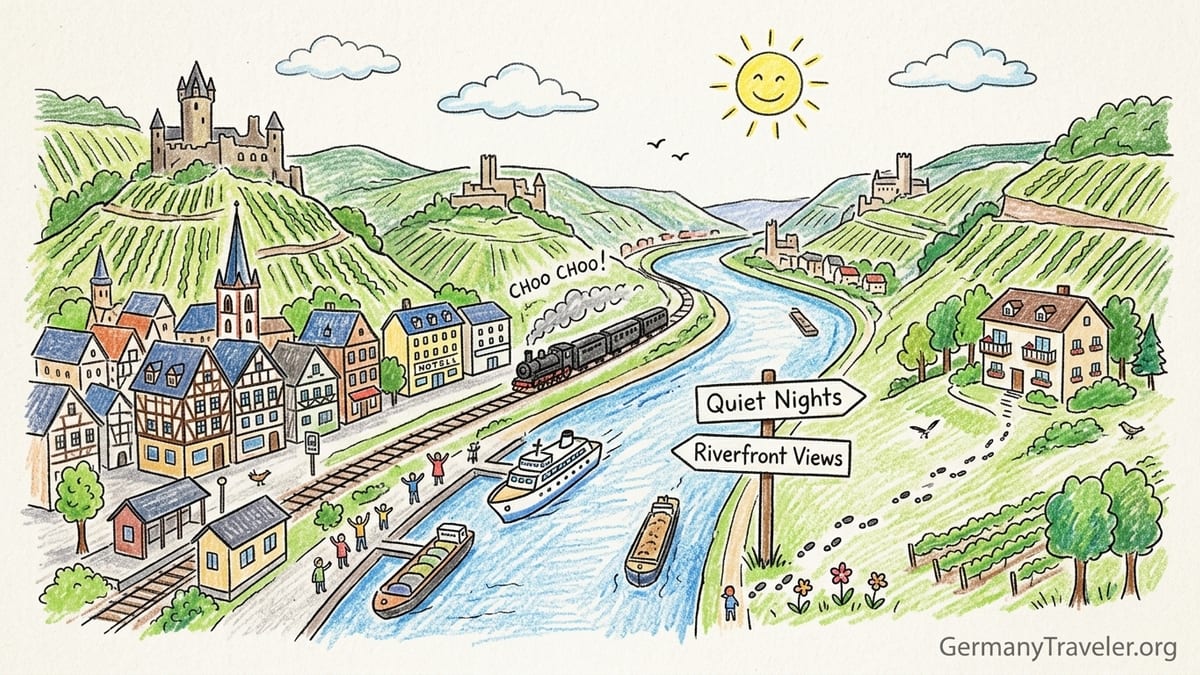
The central question in the Rhine Gorge is whether you prioritize silent nights or front-row river drama. The double-track main line between Mainz and Cologne runs along most of the west bank, and another busy line hugs much of the east bank. In many villages, those tracks sit between riverside hotels and the water, so a balcony facing the Rhine often also faces the railway. Even modern soundproofing can only do so much if you like to sleep with windows open in summer.
Before booking, decide what matters most: do you want to wake up to barges sliding past your balcony, or would you accept a 5 to 10 minute walk down from a quieter hillside guesthouse to get that sleep-friendly silence. Travelers relying on trains should also check the walking distance to stations and ferry piers. In St. Goar and Boppard, for example, you can step off the train and reach several waterfront hotels in under five minutes, while some vineyard or castle stays require taxis or steep walks with luggage.
Price-wise, a comfortable double room with breakfast in these towns usually starts around the low to mid three figures per night in high season, with premium river-view rooms and suites costing more. Rates vary by date and demand, so treat examples as indicative rather than fixed. What matters more for most visitors is understanding the practical trade-offs each town and hotel type offers so your expectations align with reality.
Rüdesheim: Buzz, Wine Taverns and Easy Transport
Rüdesheim is one of the busiest Rhine stops, a common start or finish point for cruises and day trips from Frankfurt. The waterfront and old town are packed with hotels, many traditional family-run houses above wine taverns. Staying right by the river or along the famously lively Drosselgasse means you are at the heart of things but should expect both crowd noise and trains across the water on the opposite bank, especially in the evenings when coaches unload and river ships tie up.
If you want a boutique feel and quick access to ferries and cruise piers, look for central hotels a short walk from the river but set slightly back from the tracks, usually a few streets into the old town. A number of mid-range properties in the historic core offer modernized rooms, courtyards or small gardens, and breakfast buffets built around local bread, cheeses and cold cuts. They give you a practical compromise: an easy five to eight minute walk to the main pier and cable car station, but less direct railway noise than the first row along the water.
Travelers arriving by train should note that Rüdesheim’s station sits just inland from the riverside strip, so most central hotels are reachable on foot in under ten minutes with wheeled luggage. Parking in peak season can be tight and often involves small hotel courtyards or nearby public lots for a daily fee, so if you are driving, it is worth checking in advance whether your chosen hotel reserves on-site spaces. Riverside rooms here rarely guarantee complete quiet, but for visitors who plan to be out late in wine taverns and only back in their rooms after the main freight traffic, the trade-off can feel acceptable.
Bacharach: Storybook Streets and the Sharpest Noise Trade-Offs
Bacharach is often described as the prettiest base on this stretch of river, with half-timbered houses, a ruined castle above town and vines tumbling down the slopes. It is also where the railway line runs extremely close to many waterfront buildings, so choosing the right property makes an outsized difference to your sleep. On the riverfront itself, small hotels in old towers and timbered houses offer captivating views straight across to the opposite bank, sometimes from compact balconies. In return, trains pass directly behind or beside the buildings, which you will notice if you like open windows.
One widely booked riverside boutique option offers recently renovated rooms, some with balconies and a direct view over the promenade and passing ships. Reviews highlight good soundproofing and air conditioning in many rooms, which allows you to keep windows closed at night to mute the trains while still staying comfortable. Guests often describe the experience as “gorgeous views with almost no noise once the windows are shut,” but note that if you leave the windows open or stay in rooms without modern glazing, you will hear both passenger and freight services on the tracks between hotel and river.
If quiet is non-negotiable, consider hillside or back-street accommodation behind the main line. Small pensions and guesthouses in streets that run up into the valley away from the river tend to be more insulated from train traffic, sometimes just a five or seven minute uphill walk from the station and cruise pier. Several vineyard-facing properties trade balcony river views for garden terraces, inner courtyards and a more residential feel. Breakfasts here are typically generous spreads in small dining rooms, and parking is often easier than directly by the promenade, where spaces are limited and streets are narrow.
For a completely different experience above the town, the castle hostel on Burg Stahleck sits high on the hill in former fortress buildings. It is primarily a youth hostel rather than a classic hotel, with simple rooms and shared facilities in many cases, but the outlook over the river and vineyards is spectacular and the distance from the tracks means nights are much quieter. The walk up is steep, so it is best suited to travelers with light luggage, but the reward is a unique stay that feels far removed from train noise and coach groups below.
St. Goar: Ferry Crossings, River Drama and Compact Convenience
St. Goar lies roughly in the middle of the gorge and is a favorite overnight stop for travelers who want easy ferry connections and classic castle views. The town’s small size means that almost anywhere you stay will be within 5 to 10 minutes on foot of the KD cruise pier and the local ferry that crosses to St. Goarshausen on the opposite bank. Trains on the western shore pass behind the line of waterfront hotels, so the familiar balance of river views versus rail noise applies again, though the compact street grid means even rooms a block or two inland can still glimpse the river between buildings.
Right on the main square near the river is a cluster of small hotels and guesthouses that appeal to travelers who prefer to be within a minute or two of the cruise pier and ferry landing. Expect straightforward rooms, some with small balconies or French windows overlooking the river. Reviews frequently mention friendly family owners and hearty breakfasts that set you up for a day hiking up to Rheinfels Castle or cruising through the Loreley section. In these central properties, the railway is close enough that you will hear passing trains if windows are open, especially at night, although newer windows and shutters help.
If you are sensitive to noise but still want to be near the water, look for hotels or apartments one or two streets inland, or consider staying slightly uphill on the way toward Rheinfels. These options still keep you within a reasonable walk of both station and pier, often under 10 minutes, but interpose other buildings between you and the tracks. Drivers will find that parking can be easier in these upper streets than along the riverfront strip, where spaces disappear quickly on sunny weekends. For travelers without a car, St. Goar’s station is small and only a short, essentially flat walk from most central accommodations.
Boppard: Riverside Promenade, Chairlift Views and Flexible Budget Options
Boppard offers perhaps the most balanced mix of atmosphere, transport and hotel choice on this section of the Rhine. The town curls around a wide bend in the river, giving many hotels sweeping views, and the waterfront promenade is an attractive place to stroll or sit at café terraces. Several long-established hotels line the river, from traditional houses to more upscale properties. Many of their front-facing rooms have balconies with chairs where guests sit in the evenings watching passing cruise ships and barges as the hills catch the last light.
One of the best-known riverfront hotels occupies a prime position in the middle of the promenade, with a long facade facing the Rhine and a reputation for professional service and a substantial breakfast buffet. Its river-view rooms and suites come at a premium but reward you with generous windows and sometimes French balconies or full sit-out balconies. Train lines here also run between promenade and river, so you will see and hear trains from your balcony if windows are open. However, modern glazing means many guests report that closing windows mostly solves the problem, and the overall feel is more resort-like than in some smaller villages.
More budget-friendly but still scenic riverfront stays in Boppard include smaller family-run hotels where a double room with balcony and river view can be relatively affordable outside peak holiday periods. Guest feedback often highlights very friendly hosts, clean rooms and simple but satisfying breakfasts. The trade-off is usually that furnishings can be basic and some bathrooms compact. Again, track noise is present, but many visitors feel it is a fair price to pay for stepping from the lobby straight onto the promenade and being less than five minutes’ walk from the KD pier and local cruise boats.
If you value quiet above view, Boppard also has pensions and apartments set back from the river, sometimes on streets that climb toward the chairlift station for the well-known Sesselbahn ride to the Vierseenblick viewpoint. These hillside options can offer partial river glimpses or vineyard views and tend to be calmer at night. The walk to the station or ferry is slightly longer, generally 8 to 12 minutes downhill, and you will want to consider this if you have heavy luggage. On the plus side, drivers usually find easier street parking or small on-site lots at these more residential addresses than in the packed waterfront zone.
Koblenz: City Comfort, Rail Hubs and River Confluence
Koblenz is a regional city at the confluence of the Rhine and Moselle and feels very different from the small wine villages upstream. For many travelers, it works well as a practical overnight base at the start or end of a Rhine Valley trip because it offers multiple train stations, bigger hotels and an urban spread of restaurants and shops. The old town and Deutsches Eck, where the two rivers meet, are a 15 to 20 minute walk from the main station, or a short ride on local buses or taxis. Here, the trade-off is less about vineyards versus riverfront and more about whether you want doorstep access to trains or to the picturesque river promenade.
Just beside the main station stands a long-established three-star-superior hotel that appeals to rail travelers catching early or late departures. Rooms are typically business-style rather than romantic, but you gain the advantage of rolling luggage straight from the platform to reception in a couple of minutes. Noise here comes mainly from city traffic and station activity rather than passing freight trains right below your window, and intensive modern glazing mitigates much of it. Breakfasts follow an international pattern with hot and cold options, and parking is usually in a nearby public garage or limited hotel spaces.
Along the Rhine and Moselle banks, mid-range chain hotels and independent properties offer river views from many rooms, especially on the upper floors. Expect to pay more for guaranteed river-facing rooms, particularly those with small balconies or French windows, though some city hotels stick simply to large windows. Walking distance to the old town squares and the cable car up to Ehrenbreitstein Fortress can be as little as 5 to 10 minutes from these riverside addresses. You are somewhat farther from the main rail hub, but Koblenz also has a city-centre station closer to the river that is served by regional trains, allowing for a compromise between scenic location and public transport convenience.
Travelers who prefer a quieter, more residential setting might consider neighborhoods slightly upstream or across the river, reached by local trains to smaller stations or by bus. Here, guesthouses and smaller hotels trade big-city convenience for more relaxed surroundings, sometimes with easier street parking. You will rely more on public transport or a longer walk to reach cruise piers and the old town, so this approach suits visitors who prize calm evenings after day trips along the gorge rather than those who want to step out directly into nightlife and riverfront bustle.
Balconies, Breakfasts, Parking and Pier Access: What Really Matters
When comparing hotels along the Rhine Valley, certain practical details can outweigh star ratings. A balcony is often top of the wish list, especially in places like Boppard and Bacharach where castle-topped hills glow in the evening light. However, if that balcony directly overlooks the railway, consider realistically whether you will actually sit outside during the busiest times or whether intermittent trains will send you back indoors. A river-view room with large, well-sealed windows but no balcony can sometimes give a calmer experience at a lower price, particularly in towns where trains run very close to the water.
Breakfast is another factor that shapes your stay. In this region, many family-run hotels pride themselves on a good spread of local rolls, spreads, cold cuts, cheeses, eggs and fruit, often included in the room rate. Chain hotels in Koblenz and larger riverfront properties may charge extra for breakfast, but in return offer wider buffets with hot items and fresh pastries. If you are catching early boats or trains, check breakfast times; in small villages these might not start extremely early in low season, though many hotels will prepare something to go if asked in advance.
Parking conditions vary sharply between villages pressed hard against the river and larger towns with more space inland. Riverside streets in Bacharach, Boppard and St. Goar can fill quickly, especially on sunny weekends and around public holidays. If you are driving, look for hotels that either include a courtyard or on-site lot or have clear agreements with nearby public garages. Be prepared for modest daily charges in popular places, which are usually offset by the convenience of leaving your car while you explore by boat or train. Train-focused travelers, by contrast, can prioritize hotels within a flat 5 to 8 minute walk of stations and piers, minimizing the need for taxis.
Ferry and cruise pier access is especially important if you plan to use the Rhine boats as hop-on, hop-off transport between villages. In Boppard and St. Goar, many hotels sit within two or three minutes’ walk of KD and local pier landings. In Rüdesheim, the layout is more spread out, but central hotels in or near the old town still put you within easy reach of both piers and the cable car station. Bacharach’s smaller pier is a short walk from the old town gate, so even a hillside guesthouse up the valley usually keeps you within a 10 to 15 minute amble of your boat departure, though you will want to factor in the uphill walk home at the end of the day.
Managing Railway Noise Without Losing the River Magic
No matter which of these five towns you choose, trains are a constant in the landscape. The good news is that you can manage the impact with some planning. First, study photos and descriptions: if you can see tracks directly between the hotel and the water, expect some noise with open windows. Properties that highlight modern soundproof windows and air conditioning in river-view rooms usually acknowledge the issue and have invested in ways to keep interiors quieter. If such amenities are not mentioned, ask directly by email how rooms handle train noise and whether quieter courtyard or rear rooms are available.
If you are an especially light sleeper, you might deliberately sacrifice a direct riverfront for a second-row or hillside stay. In Bacharach, this might mean choosing a guesthouse up the Steeger valley instead of a tower room on the promenade. In Boppard, it could mean opting for a pension near the chairlift or back streets rather than the first row on the promenade. The scenic rewards of balconies and immediate river views are real, but so is the cumulative effect of freight trains at night, especially in warm weather when air conditioning is limited and you may want fresh air.
Practical aids like foam earplugs or white-noise apps can help, particularly if you only stay one or two nights in a very scenic but potentially noisy room. Travelers often report that they quickly tune out the sound after the first night once jet lag eases and daytime activities leave them tired. Cruising the river, hiking to castles and sampling local Riesling can make sleep come easier, even with occasional trains in the background. The key is to choose with eyes open: understand that in a valley carved deeply between cliffs, with little flat land, the river, road and rail line all compete for the same strip of space.
The Takeaway
For most visitors, the best strategy in the Rhine Valley is to choose one or two bases that match your travel style and then use boats and trains for day trips. Rüdesheim offers bustle, wine taverns and easy onward connections; Bacharach delivers storybook lanes and sharp trade-offs between riverside romance and rail noise; St. Goar balances compact convenience with big scenery; Boppard gives a broad promenade, chairlift views and lots of hotel choice; and Koblenz supplies city comforts and rail connectivity at the confluence of Rhine and Moselle.
When you compare riverside hotels, vineyard stays, boutique properties and train-friendly city options, look beyond star ratings to the details that will shape your actual stay: whether your balcony overlooks water or tracks, how close you are to the pier or station, whether breakfast and parking are included, and how the hotel mitigates inevitable railway noise. With realistic expectations and a clear sense of your priorities, you can wake up in the Rhine Gorge to castle silhouettes and vineyard slopes, feeling that you made exactly the right booking choice for your own version of the river’s romance.
FAQ
Q1. Which Rhine Valley town is best for first-time visitors without a car?
Rüdesheim, Boppard and Bacharach all work well, but Boppard and Bacharach often feel more relaxed while still offering frequent trains, cruise boats and ferries within a short walk of central hotels.
Q2. How serious is railway noise if I book a river-view room?
In much of the gorge the tracks run very close to the river, so you should expect to hear trains with windows open, especially at night. Modern soundproof windows and air conditioning help a lot, but light sleepers should consider hillside or second-row hotels.
Q3. Are vineyard or hillside stays practical if I am traveling by train?
Yes, as long as you are comfortable walking uphill 10 to 15 minutes with luggage or arranging a short taxi ride from the station. Once checked in, you can still use trains and boats for day trips, but you gain quieter nights away from the tracks.
Q4. How far in advance should I book Rhine Valley hotels in peak season?
For late spring through early autumn and during wine festivals, it is wise to book popular riverside and boutique hotels several months ahead, especially if you want specific room types like balconies, castle views or family rooms.
Q5. Is it worth paying extra for a balcony on the Rhine?
If you enjoy sitting outside with a glass of wine watching ships and castles glide by, a balcony can be a highlight of your trip. Just remember that balcony rooms are often closer to the tracks, so the upgrade is best for travelers who are not extremely sensitive to noise.
Q6. Which towns have the easiest walking access from station to hotel and cruise pier?
In St. Goar and Boppard you can usually walk from the station to many riverfront hotels and KD piers in 5 to 10 minutes on mostly flat streets. Bacharach and Rüdesheim are also walkable, though some quieter guesthouses sit up the valley and require short uphill walks.
Q7. Do most Rhine Valley hotels include breakfast in the room rate?
Many family-run hotels and guesthouses do include breakfast, often featuring local breads, cheeses and cold cuts. Larger city hotels in Koblenz and some upscale riverfront properties may charge separately, so it is worth checking when you compare prices.
Q8. How is parking if I am driving along the Rhine?
Parking can be tight directly beside the river in small towns, particularly on sunny weekends. Look for hotels that offer courtyard or on-site spaces or have clear arrangements with nearby public lots, and factor in modest daily charges as part of the stay.
Q9. Can I stay in one town and still visit others easily by train or boat?
Yes, the valley is well served by regional trains and regular riverboats, so basing in one or two towns and taking day trips works very well. Many travelers, for example, stay several nights in Boppard or Bacharach and visit Rüdesheim, St. Goar and Koblenz from there.
Q10. What is the best time of year to stay in the Rhine Valley for quieter hotels?
Late spring and early autumn offer pleasant weather with slightly fewer crowds than midsummer. Weekdays outside major holidays are usually calmer, and trains and boats still run frequently enough for convenient day trips.