


Few decisions in Germany trip planning cause more second guessing than choosing between the Rhine Valley and the Moselle Valley. Both offer storybook castles, steep vineyards and atmospheric wine towns along winding rivers in western Germany. Yet on the ground, the experience in each valley feels distinctly different. One is busier, grander and easier to navigate by train and frequent boats. The other is gentler, slower and more focused on tiny wine villages and Riesling.
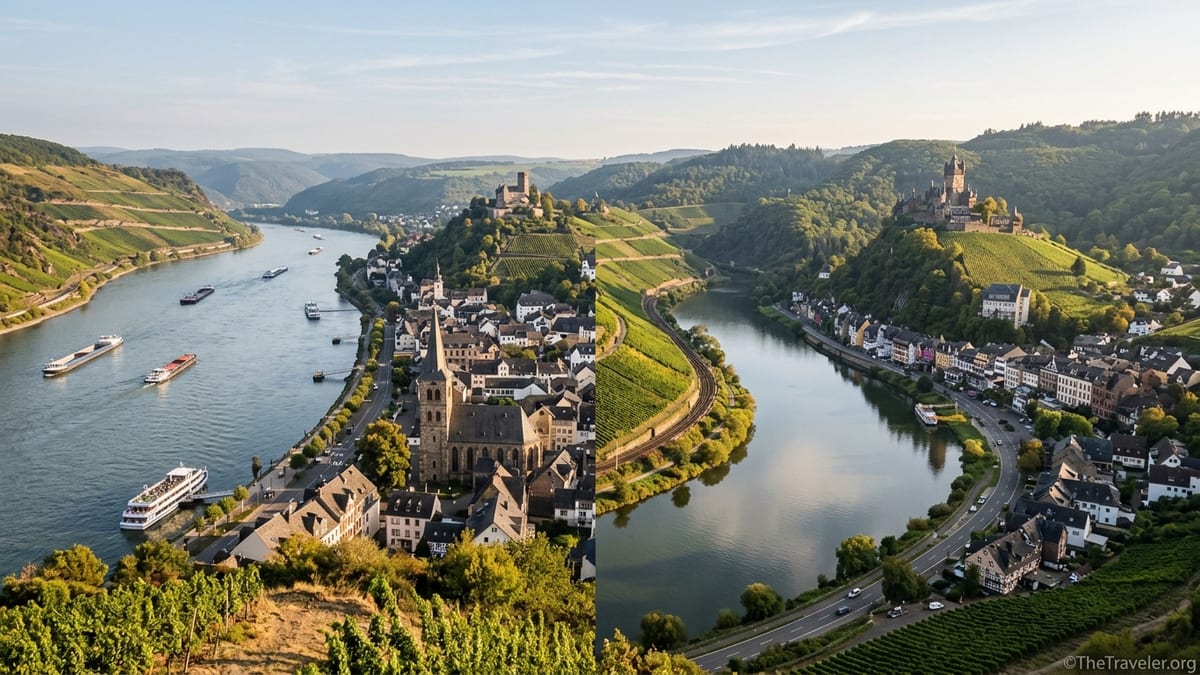
Rhine vs Moselle at a Glance
Think of the Middle Rhine between Bingen and Koblenz as the dramatic, big-stage river valley. Clifftop castles like Marksburg, Burg Katz and the vast ruins of Burg Rheinfels loom over the water, freight and cruise ships pass constantly, and the Loreley rock narrows the river into a famous S bend that feels almost canyon-like. Passenger boats run multiple times per day in season between towns such as Boppard, St. Goar, Oberwesel and Rüdesheim, which makes it very easy to hop on and off without a car.
The Moselle between Trier and Koblenz offers a different rhythm. Here the river twists in tighter bends, flanked by some of Germany’s steepest vineyards around Bremm’s Calmont and Cochem. Instead of larger towns and industrial ports, you pass compact wine villages like Beilstein, Ediger-Eller and Kröv, half-timbered old towns such as Bernkastel-Kues and the fairy-tale setting of Cochem under Reichsburg castle. Boats and buses are less frequent, which keeps traffic and noise down but also means more planning, especially outside summer.
Both valleys are heavily promoted by Germany’s national and regional tourism boards as classic castle-and-wine landscapes, and that reputation is deserved. The key difference is atmosphere. The Rhine feels like a grand transport corridor where villages sit between tracks, road and river, with Intercity trains and long-distance barges always in view. The Moselle feels more tucked away, with many stretches where the loudest sound is a tractor in the vineyards and the river cruise boat gliding past.
If you want convenience, iconic sights and easy car-free logistics, the Rhine usually wins. If you dream of lingering in wine taverns, wandering tiny lanes and easing along a slower road-trip route, the Moselle is often the better match.
Castles, Scenery and Signature Sights
On the Rhine, castles are almost constant. Between Bingen and Koblenz you can see dozens from the boat or riverbank, from the perfectly preserved Marksburg above Braubach to the hilltop Pfalzgrafenstein on a tiny island near Kaub. Many travelers pick one or two to actually visit inside. Marksburg is a strong choice because it is one of the few never destroyed, with guided tours through original kitchens, towers and armory rooms. Burg Rheinfels above St. Goar offers sprawling ruins and tunnels with wide views over a tight bend in the river.
The most famous natural feature is the Loreley rock between St. Goar and St. Goarshausen, where the Rhine narrows and currents become treacherous. Several boat companies run dedicated Loreley cruises from towns like Boppard and Rüdesheim in season, often with multiple daily departures from April to October. A typical round-trip cruise from Boppard to the Loreley and back takes about three to four hours and gives you a good overview of the Middle Rhine’s castles from the water.
The Moselle has fewer castles overall but the ones it has are highly atmospheric. Reichsburg Cochem, rebuilt in neo-Gothic style, presides over the town like an illustration in a children’s book. Burg Landshut above Bernkastel-Kues offers a short hillside walk from the old town, rewarded with panoramic views over one of the prettiest town and river combinations on the Moselle. The surrounding vineyards are more visually dominant here than on the Rhine, sometimes covering slopes at gradients so steep they require monorail tracks for workers.
For pure scenic drama, many travelers rate the stretch between Cochem and Beilstein among the most beautiful in Germany. The river makes a series of tight loops, villages huddle against the banks, and rows of vines climb almost vertically up to the forest line. It is less about one single landmark like the Loreley and more about a continuous sequence of romantic river curves.
Wine, Food and Village Atmosphere
Both valleys are wine regions, but the Moselle leans much harder into Riesling culture. The official Moselle tourism board highlights the area as one of Europe’s classic white wine landscapes, with hundreds of small family wineries offering tastings in cellars and rustic taverns. In villages between Trier and Bernkastel-Kues, you can drop into simple “Strausswirtschaften” or seasonal wine taverns where the winemaker pours a flight of dry and off-dry Rieslings alongside plates of sausage, cheese and local bread. Many tastings start around a modest per-person fee for several samples, with more structured experiences available at larger estates.
In Bernkastel-Kues, for example, visitors can taste wines at historic merchants’ houses around the market square, or join cellar tours that explain how steep-slope vineyards are worked by hand. Between Cochem and Traben-Trarbach, wineries often pair tastings with vineyard walks or short boat trips, particularly during harvest festivals in September and early October. It is relatively easy to build an entire Moselle itinerary around hopping from one wine village to the next by boat, bus or bike.
The Rhine produces wine as well, including Riesling in places like Bacharach and Oberwesel, but the atmosphere is a little less intimate. In many Rhine towns, the main riverfront is lined with hotels, beer gardens and group-oriented restaurants designed for bus tours and river cruise passengers. You will still find local wine taverns serving regional dishes such as flammkuchen and schnitzel with a glass of Riesling or Spätburgunder, but they are mixed in with more generic dining options and souvenir shops.
In terms of village feel, Cochem and Bernkastel-Kues on the Moselle come across as compact, walkable and heavily focused on half-timbered streets, medieval squares and riverside promenades. The Rhine’s Boppard and Rüdesheim are larger and busier, with more hotels and nightlife, but also more day-tripper crowds and a less “village” atmosphere. Travelers who enjoy staying somewhere that almost goes quiet after dinner often prefer Moselle small towns like Beilstein, which is sometimes described by German tourism outlets as a “Sleeping Beauty” village for its tiny size and preserved center.
Transport, Boats and Car-Free Travel
Logistics are where the Rhine has a decisive edge, especially if you want to travel without renting a car. The main left-bank Rhine railway line between Mainz and Koblenz is a major corridor with frequent regional trains and at least hourly long-distance services stopping in Koblenz. From Frankfurt Airport, you can usually reach Bingen, Boppard or Koblenz with one simple train change, and from Cologne there are regular direct trains down the Rhine to Koblenz and beyond. This makes short trips, one-way walks and flexible day plans easy.
River cruise boats between Bingen and Koblenz run on regular timetables in season, often from late March or April through October, with denser schedules in July and August. It is common to ride the boat one way and return by train, for example cruising from Boppard to St. Goar to see Burg Rheinfels, then taking a 15-minute regional train back. Schedules are more limited in shoulder months, but on the Rhine there is usually at least some daily boat service between the main towns throughout the main season.
The Moselle line between Koblenz and Trier also has regular regional trains, but towns are more spaced out and some small wine villages sit a bus or bike ride away from the nearest station. Boats between Trier, Bernkastel-Kues, Traben-Trarbach and Cochem generally run less frequently than on the Rhine and can be more seasonal, sometimes concentrating service on weekends or peak months. It is still very possible to explore the Moselle without a car, particularly if you base yourself in hubs like Cochem, Bernkastel-Kues or Trier, but you will need to pay closer attention to timetables and may find evening connections thin.
If you do have a car, both valleys are easy to drive. The main Moselle road often hugs the river closely, threading through small villages where you can stop at short notice for a coffee or tasting. The Rhine has more traffic and some busy sections where road, river, rail and villages all squeeze into a narrow corridor. Parking in smaller Moselle villages can be limited during harvest festivals and sunny weekends, so arriving earlier in the day is wise.
Hotels, Guesthouses and Where to Base Yourself
Accommodation styles track the different characters of each valley. On the Rhine, you will find more mid-range hotels with sizable room counts, especially in Boppard, Rüdesheim and Koblenz. Many riverfront hotels cater to coach tours and river cruise passengers, with buffet breakfasts, elevator access and larger dining rooms. Prices vary widely by season, but in summer it is common to see standard doubles in well-located Boppard or St. Goar hotels priced in a moderate to upper-moderate range per night, with cheaper pension rooms and apartments available one or two streets back from the river.
The Moselle offers more small guesthouses and family-run wine estates where rooms are tucked above the cellar or around a courtyard. In villages between Cochem and Bernkastel-Kues it is easy to find simple, clean double rooms in a “Weingut” with breakfast and often a complimentary tasting or discount on bottles. Rates can be attractive outside the peak harvest season, and even in September many travelers report good value compared with larger Rhine hotels, especially if you are comfortable staying in a quieter village rather than the main hubs.
For a first-time Rhine stay, Boppard makes a practical base. It has good train connections in both directions, frequent boats, a pleasant riverside promenade and a compact old town. St. Goar and Bacharach are smaller and more romantic, ideal for couples who want to walk or cycle during the day and have a quiet drink by the river at night. On the Moselle, Cochem is the busiest base with plenty of restaurants, boat departures and a hilltop castle, while Bernkastel-Kues offers perhaps the most picturesque streets and a strong concentration of wine-focused stays.
Travelers who want to blend both valleys often choose Koblenz. It sits at the confluence of Rhine and Moselle and functions as a significant train hub. From here you can take day trips by boat and train in either direction, ride the cable car up to Ehrenbreitstein Fortress for a broad view of both valleys, and return to a city with a range of hotels and restaurants.
Cycling, Hiking and Slower Ways to Explore
Both valleys are excellent for low-effort outdoor trips, but they emphasize slightly different experiences. The Rhine Cycle Route, part of a broader international cycling corridor, is predominantly flat along the river between Bingen and Koblenz. Many sections are segregated from traffic or routed on quiet roads, making it suitable even for casual cyclists. Travel reports often describe rides like Mainz to Koblenz as “pancake flat,” with the main challenges being distance rather than hills. This makes the Rhine ideal for day rides between villages, especially if you can take a train in one direction.
On the Moselle, the river cycle path is also generally flat and family friendly, running close to the water for long stretches. However, the surrounding landscape invites more vertical adventures. Well-marked trails climb into the vineyards and hills, such as routes near the Calmont, often described as one of Europe’s steepest vineyard sites. The long-distance Moselsteig trail links many sections between Trier and Koblenz, with multi-day hiking packages widely promoted by regional tourism offices. Even if you are not a serious hiker, short sections above villages like Bernkastel-Kues or Traben-Trarbach deliver big-view rewards in under two hours.
If you like truly slow travel, the Moselle arguably feels better suited. Many travelers happily spend an entire day moving only from one village to the next by bicycle, stopping for tastings, coffee and riverside benches. The Rhine can feel more in motion, with frequent trains and ships, which is fascinating to watch but less conducive to a completely tranquil atmosphere.
In either valley, e-bikes are widely available for rent in larger towns, making it easier to cover more distance or handle short climbs. Booking ahead in high season is sensible, especially on sunny weekends or during wine festivals.
Combining Rhine and Moselle in One Trip
The good news is that you do not actually have to choose between the Rhine and the Moselle if you have three or more days to play with. Koblenz, where the two rivers meet at the Deutsches Eck headland, functions as a natural switch point between them. Long-distance and regional trains from Cologne and Frankfurt Airport converge here, and from Koblenz you can hop on the Moselle railway toward Cochem and Trier or continue along the Rhine toward Bingen and Mainz.
A classic four or five day itinerary might look like this. Spend your first two nights in Boppard or St. Goar on the Rhine, using one day for a boat trip through the Loreley gorge and castle visits, and another for cycling or walking between river towns. Then travel by train to Cochem for two nights on the Moselle, taking a cruise to Beilstein or a day trip to Bernkastel-Kues, with a vineyard walk and Riesling tasting. Start or end the trip in Koblenz to experience the confluence and the fortress view.
For a longer journey, you can run the Moselle first from Trier through the wine villages to Koblenz, then swing south along the Rhine toward Mainz, combining two rivers into one continuous loop. Many bike tour companies already offer similar multi-day packages with luggage transfers between small hotels and guesthouses. If you prefer to self-organize, it is entirely feasible using regional trains and boats, as long as you watch seasonal schedules.
Because both valleys lie in western Germany, they fit easily into broader trips that include Cologne, Frankfurt, Luxembourg or even Paris. Just keep in mind that weekends during school holidays and major local festivals can make popular bases like Cochem, Boppard and Bernkastel-Kues quite full, so advance reservations are strongly recommended.
Which Valley Is Better for You?
Choosing between the Rhine and the Moselle mostly comes down to your travel style and priorities. If this is your first time in Germany and you want immediately recognizable scenery, easy logistics from major airports and the option to see a maximum of castles in minimal time, the Middle Rhine is the obvious pick. You can land in Frankfurt, reach a Rhine town in around one to two hours by train in many cases, ride a boat past the Loreley, walk through a castle and be back in your hotel by evening without renting a car.
If, on the other hand, your ideal day involves strolling through tiny lanes, sampling wines directly from the producer, and watching the sunset from a quiet riverbank with only a few boats passing, the Moselle will likely feel more rewarding. Its gentler, more village-focused character can be especially appealing to repeat visitors to Germany, food and wine enthusiasts, and travelers who prefer smaller, less hectic bases.
Families with younger children may appreciate the Rhine’s frequent boats and trains, which make short-notice plan changes easier. Couples on a romantic break might lean toward Moselle villages like Beilstein or Bernkastel-Kues, where evening strolls after dinner feel more intimate. Active travelers who want a mix of cycling and hiking can thrive in either valley, but those more focused on multi-day hiking may find the Moselsteig and its associated services particularly convenient.
If you still feel torn, there is a simple rule of thumb. For a quick, two-night side trip from Frankfurt or Cologne, choose the Rhine. For a dedicated four- to seven-night countryside holiday with a focus on wine and slow days, choose the Moselle or combine both using Koblenz as a hinge point.
The Takeaway
The Rhine and Moselle are not rivals so much as complementary chapters in the same story of western Germany’s rivers. The Rhine offers headline sights, busy river traffic and a strong rail spine that make it excellent for short, flexible trips and first-time visitors. The Moselle delivers a softer, more intimate landscape of tight river bends, steep vineyards and small towns where wine culture shapes daily life.
Germany’s tourism authorities market both as classic castle-and-wine landscapes, and that label holds true. Yet when you stand on a Moselle riverbank at dusk in a tiny village, listening to glasses clink in a courtyard tavern, it feels very different from watching the constant choreography of barges, trains and cruise ships on the Rhine. Neither is inherently better; the question is which mood you want for this particular trip.
With a bit of planning, especially around boat and train schedules, it is entirely possible to experience both worlds in a single journey, using Koblenz as your bridge between them. Whether you choose the Rhine, the Moselle or a combination of the two, you will be traveling through landscapes that have been shaped by wine, water and human imagination for centuries.
FAQ
Q1. Is the Rhine Valley or the Moselle Valley better for a first-time visitor to Germany?
For a short first trip, the Rhine Valley usually works better because it is easier to reach from Frankfurt or Cologne, has more frequent trains and boats, and offers many castles and classic views in a compact stretch. The Moselle is ideal if you have a bit more time and want a quieter, more village-focused experience.
Q2. Can I visit both the Rhine and Moselle valleys in one weekend?
It is possible but feels rushed. In two full days you could stay in Koblenz, take a half-day cruise on the Rhine toward Boppard or St. Goar on one day and ride a shorter Moselle boat or train trip to Cochem on the other. However, you will only get a taste of each valley rather than a deeper experience.
Q3. Do I need a car to explore the Moselle Valley properly?
You do not strictly need a car, but it helps if you want to reach smaller villages and wineries on your own schedule. Regional trains and buses connect main towns like Trier, Bernkastel-Kues, Traben-Trarbach and Cochem, and riverboats run in season. Without a car, basing yourself in one of these hubs and planning around timetables works well.
Q4. Which valley is better for wine tasting and vineyard visits?
The Moselle generally wins for wine-focused travel. It has a denser concentration of small wineries, especially for Riesling, and many villages are almost entirely geared toward wine tourism. The Rhine also has good wine, but tasting experiences are often more spread out and sometimes feel secondary to general sightseeing.
Q5. How easy is it to travel car-free in the Rhine Valley?
The Rhine Valley between Bingen and Koblenz is one of the easiest regions in Germany to explore without a car. A main railway line and frequent regional services link the towns, and seasonal boats allow you to cruise one way and return by train. You can comfortably rely on public transport for most itineraries.
Q6. Are boat cruises available year-round on the Rhine and Moselle?
Regular sightseeing cruises on both rivers are strongly seasonal, typically operating from spring through autumn, with peak frequency in summer. Some companies run limited services in early spring and late autumn, and there may be special event or holiday cruises in winter, but you should always check schedules for your exact travel dates.
Q7. Which towns make the best bases on the Moselle for a three- or four-night stay?
Cochem is a popular choice thanks to its castle, good transport connections and range of hotels and restaurants. Bernkastel-Kues appeals to travelers who prioritize a particularly pretty old town and wine culture. Trier is a larger city with Roman sights that works well if you want more museums and urban offerings alongside day trips on the river.
Q8. Is the Rhine Valley very noisy because of trains and ships?
Some stretches of the Rhine, especially near the main railway line, can be quite noisy, with freight trains and river traffic running from early morning into the night. If you are sensitive to sound, consider booking accommodation a little back from the tracks or choosing smaller, quieter towns. The Moselle generally feels less affected by heavy traffic, though main roads still follow the river in many places.
Q9. Which valley is better for cycling with children or less experienced riders?
Both valleys offer mostly flat riverside cycle paths that are suitable for families and casual cyclists. The Rhine route can feel busier and more developed, while the Moselle path often has a more relaxed countryside feel. For younger children, choosing shorter sections with good access to trains or boats for a bail-out option is wise in either valley.
Q10. When is the best time of year to visit the Rhine and Moselle valleys?
Late spring and early autumn are particularly attractive, with mild temperatures, green or golden vineyards and generally good boat and train schedules. Summer offers the fullest range of cruises and outdoor events but also higher prices and more crowds. Winter is much quieter, with limited cruises, but some towns host atmospheric Christmas markets and offer a very different, off-season mood.