


The image most travelers hold of the Rhine River is not the entire 1,200-kilometer waterway that runs from the Swiss Alps to the North Sea, but a compact, spectacular stretch where castles perch above steep vineyards and villages huddle by the water. That postcard view lives in Germany’s Upper Middle Rhine Valley, often called the Romantic Rhine, between Rüdesheim and Bingen in the south and Koblenz in the north. This guide explains how to visit that exact corridor for the first time, where to base yourself, and how to experience its boats, trains, trails and wines in a practical, time-efficient way.
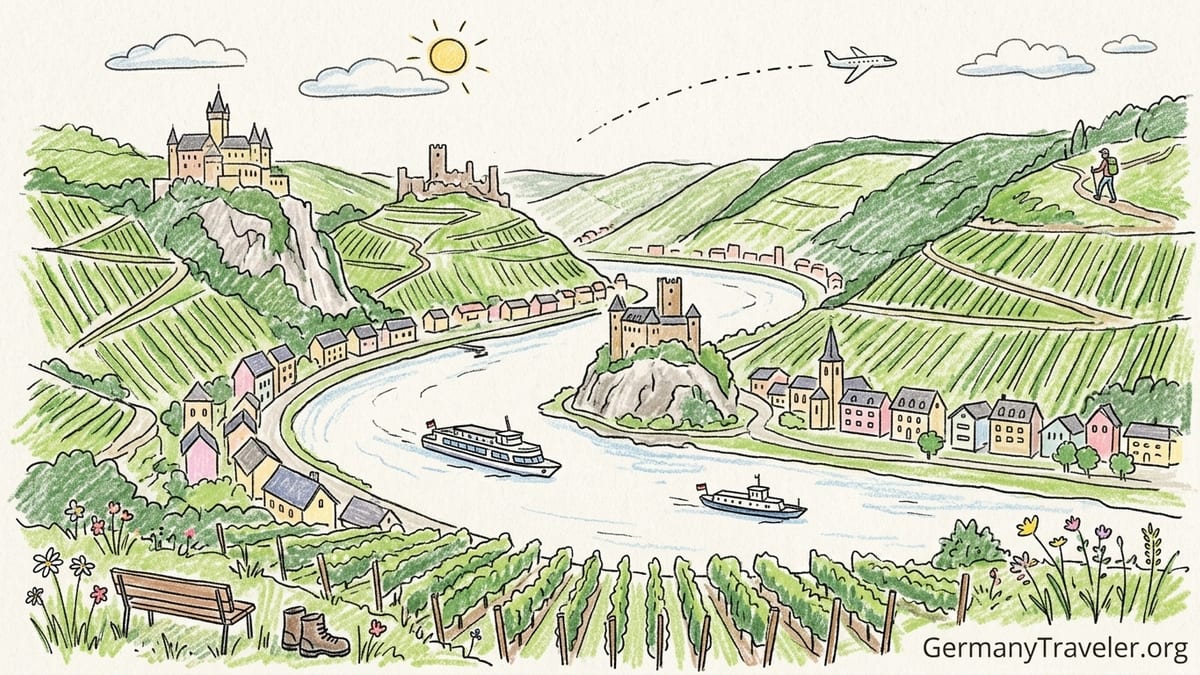
Understanding the Upper Middle Rhine: The Classic Castles-and-Vineyards Stretch
The Upper Middle Rhine Valley is a UNESCO World Heritage landscape roughly 65 kilometers long, running between Rüdesheim and Bingen in the south and Koblenz in the north. This is the section that produces the famous views of crag-top castles, terraced vineyards and pastel villages squeezed between cliffs and river. If you have seen a brochure of the “Romantic Rhine,” it was almost certainly taken somewhere between Bingen and Koblenz.
It is important to distinguish this region from the Rhine River as a whole. The Rhine flows hundreds of kilometers through Switzerland, France, Germany and the Netherlands, with long industrial and flat sections that look nothing like the Romantic paintings or cruise brochures. First-time visitors who simply book a “Rhine cruise” may find themselves on a ship that races through this scenic core in just a few hours, or bypasses it altogether overnight. To get the iconic scenery, you want the corridor from Rüdesheim and Bingen to Koblenz, especially the narrow gorge between Bingen and Boppard.
On maps you may see the terms “Upper Middle Rhine Valley,” “Rhine Gorge” or “Oberes Mittelrheintal.” They all describe roughly the same section. Key villages that anchor this area include Bacharach, Oberwesel, St. Goar, Kaub, Braubach and Boppard, plus the twin towns of Rüdesheim and Bingen at the southern gateway and the small city of Koblenz at the northern end. Trains run on both banks and ferries link opposite sides, so it is easy to move up and down the valley even without a car.
Because the gorge is compact, you can see headline sights in one long day from Frankfurt, Cologne or Mainz. However, most visitors who stay at least two nights in a riverside town say that sunrise on the water, quiet evenings and unhurried walks through the vineyards are what make the Upper Middle Rhine memorable. Think of it less as a single attraction and more as a chain of small, walkable villages, each with its own castle and personality.
Key Towns: From Rüdesheim and Bingen to Koblenz
Rüdesheim and Bingen form the southern gateway to the Romantic Rhine. Rüdesheim, on the east bank, is more overtly touristic, with its cobbled Drosselgasse lined by wine taverns and brass bands on summer evenings. Bingen, on the west bank, is quieter and more local in feel, with a pleasant riverside promenade and straightforward rail connections. Short cruises advertised locally often start here, such as 1.5 to 2-hour “castle cruises” towards Bacharach or the Loreley rock that cost roughly 20 to 30 euros per adult in 2026, depending on operator and duration.
A little further downstream, Bacharach is many travelers’ favorite base. It is a compact village of half-timbered houses, a riverside promenade and vine-covered hills that can be reached in about one hour by regional train from Mainz via Bingen. In practice, this means you can arrive from Frankfurt Airport in roughly two hours with a single change. Bacharach’s station is on the west-bank line, so you step off the train and are in the old town within minutes, a big advantage if you are carrying luggage.
Oberwesel, just upstream, feels quieter and more residential, but its well-preserved medieval walls stand out when you glide past on a boat. Many travelers choose to walk a gentle path between Oberwesel and Bacharach through vineyards, then return by train in less than 10 minutes. St. Goar, a few stops north, is the gateway to Burg Rheinfels, once the largest castle on the Rhine and still an imposing ruin with tunnels and views over a perfect S-bend of river. Just across on the east bank lies St. Goarshausen, where steep paths and bus connections climb towards the plateau of the Loreley rock.
Further north, Kaub is a workaday wine village distinguished by the mid-river fortress of Pfalzgrafenstein, a former toll castle reachable only by boat. Braubach, on the east bank near Koblenz, is the access point for Marksburg, the only hilltop castle on the Middle Rhine that was never destroyed, while Boppard, on the west bank, is a popular overnight base with a lively promenade, chairlift to a famous viewpoint above the largest river bend in the Middle Rhine, and frequent cruise departures. At the top of the corridor, Koblenz is the region’s main city, where the Rhine meets the Moselle under the equestrian statue at the Deutsches Eck and a cable car floats across to the Ehrenbreitstein fortress.
Castles and Loreley: Highlights of the Romantic Rhine
One reason this valley became a UNESCO World Heritage site is its exceptional density of castles. Between Bingen and Koblenz you can see dozens from the water or train, but a few stand out for first-time visitors. Burg Rheinfels above St. Goar is among the most atmospheric ruins, with long tunnels, ramparts and sweeping views over the town and river. Reaching the castle involves a steep but manageable 15 to 20 minute walk from the station or main square. Entry tickets are typically in the low double-digit euros for adults, with family and student discounts available, and allow you to explore at your own pace.
Marksburg Castle, above Braubach, offers a different experience. Unlike many Rhine castles that were destroyed and later reconstructed, Marksburg survived on its original hilltop. Guided tours, usually available multiple times per day in German and at set times in English, take you through furnished rooms and defensive works, giving a sense of how the medieval nobility actually lived. As of recent seasons, adult admission with tour has generally been in the 10 to 15 euro range, which makes it one of the best-value historic experiences in the region.
Kaub’s Pfalzgrafenstein Castle is uniquely photogenic. The small, white tower-fortress sits in the middle of the river on a rocky island, and was once used to collect tolls from passing ships. To visit, you typically take a short shuttle boat from Kaub’s riverside, paying a modest round-trip fare plus a separate entry ticket. Even if you remain on the shore or on a cruise boat, the sight of this solitary castle surrounded by water is one of the Romantic Rhine’s signature images.
No feature of the valley is more tied to legend than the Loreley rock, a steep slate cliff rising around 130 meters above a narrow, twisting section of river near St. Goarshausen. Historically, this was a treacherous part of the shipping route, amplified in folklore by stories of a siren whose song lured sailors to their doom. Today, barges still have to navigate the bend carefully, and passenger boats slow down so travelers can take photographs. You can experience the Loreley from several angles: by passing directly beneath on a cruise, from the viewing platform at the Loreley plateau reached by bus, car or hike, or from classic viewpoints on the opposite bank’s hiking trails that frame the rock against the river below.
Boats, Trains and Ferries: Getting Around the Valley
For many visitors, the ideal introduction to the Upper Middle Rhine is by boat. Several companies run scheduled services along the river, with the best-known operating regular cruises between Koblenz and Rüdesheim that stop at many towns including Boppard, St. Goar, Oberwesel, Bacharach, Kaub and Bingen. On a typical schedule in 2026, you can board a morning boat in Boppard or Bingen and spend two to three hours gliding through the core gorge, disembarking in St. Goar or Bacharach for lunch and sightseeing. One-way fares for mid-length segments such as Boppard to St. Goar or Bingen to St. Goar tend to fall in the roughly 20 to 30 euro range per adult, with special prices for children and day passes.
Round-trip “Loreley cruises” are also popular. For example, there are regular circular sailings from Boppard that cruise upriver to the Loreley and back, operating daily in the warmer months and marketed as two to three-hour sightseeing excursions. Similarly, Rüdesheim and Bingen-based operators sell half-day boat trips towards the Loreley with on-board commentary in multiple languages and optional wine tastings. In practice, this means you can choose how much time to spend on board: short 60 to 90 minute loops that showcase a cluster of castles, or longer stretches that link two overnight towns and save you a train ride.
Trains are the backbone of practical travel in the valley. The west-bank line from Mainz through Bingen, Bacharach, Oberwesel, St. Goar, Boppard and Coblenz is served by regional trains that run at least hourly during the day. One of the best-known services is the MittelrheinBahn, line RB26, which follows the left bank between Mainz and Cologne and passes directly through the heart of the gorge. Timetables show early-morning departures from Bingen towards Koblenz around dawn and then roughly hourly services through the day, making hop-on, hop-off sightseeing by train straightforward.
The east bank also has a rail line that links Rüdesheim, Lorch, Kaub, St. Goarshausen, Braubach and Koblenz-Ehrenbreitstein. Many travelers use a combination of both banks by riding a boat one way and a train back along the opposite shore. Local day passes, such as regional rail tickets valid throughout Rhineland-Palatinate and neighboring areas, often offer good value if you plan several train segments and local buses in a single day. While exact ticket names and prices change periodically, a ballpark figure is that day tickets for one adult on regional trains in the wider area tend to cost several tens of euros, but become very economical when shared by two to five people.
Short ferries tie the whole system together. Car and passenger ferries connect across the river at strategic points such as Bingen–Rüdesheim, St. Goar–St. Goarshausen and Boppard–Filsen. Crossing on foot usually costs only a few euros and takes under ten minutes, allowing you to stay in a west-bank town like St. Goar or Boppard yet quickly reach an east-bank trailhead or train station. In practice, many hikers and cyclists plan loops that cross the river once in the morning and once in the afternoon, using ferries almost like moving bridges.
Hiking and Cycling: Experiencing the Valley from Above and Along the Water
While boat decks and train windows deliver classic postcard views, the finest panoramas are often from the ridges and vineyard paths high above the river. The Upper Middle Rhine is crisscrossed by long-distance hiking routes that can be sampled in short, manageable stages. On the east bank, the Rheinsteig trail runs from Bonn to Wiesbaden, with particularly scenic segments between Rüdesheim, Kaub, Braubach and Koblenz-Ehrenbreitstein. Promoted stages in the Upper Middle Rhine area are typically 8 to 25 kilometers long, signed in both directions and accessible by train or bus at each end, which makes it easy to pick a half-day walk and return by public transport.
On the west bank, the Rheinburgenweg, or Rhine Castle Trail, connects Bingen with Remagen and parallels the river high on the slopes. Sections between Bingen, Bacharach, Oberwesel, St. Goar and Boppard combine forest, vineyard terraces and clifftop castle views with frequent descents to the villages. For example, a common itinerary for active travelers is to hike from Oberwesel to St. Goar in the morning, enjoy Burg Rheinfels after lunch, then ride the train back to their base town in the afternoon. Another favorite is the loop from Boppard up to the viewpoints at the Vierseenblick, near the top station of the local chairlift, which frames the great river bend in a series of overlapping curves.
Cycling in the gorge is more relaxed than the steep slopes might suggest, because dedicated bike routes follow the relatively flat riverside roads and paths. Touring cyclists often ride from Koblenz to Bingen in a full day, but first-time visitors frequently choose shorter segments, such as Koblenz to Boppard or Boppard to St. Goar, then hop on a train with their bicycles if they tire. Many hotels and guesthouses on both banks offer bike rentals or can point you to nearby shops; prices for a basic trekking bike rental often start in the mid double-digit euros per day, with e-bikes usually costing somewhat more.
In summer and early autumn, vineyards provide shade and variety on both hikes and rides. You might find yourself walking through rows of Riesling vines above Bacharach in the morning, watching barges inch along the water below, and then drop into the village in time for a wine tasting on a cobbled square. Even short strolls from town centers can be rewarding. In practice, this means you do not need to be an experienced hiker to enjoy the landscape: a 45-minute wander from Bacharach’s church up to the ruins of Stahleck Castle, or from Braubach’s old town up towards Marksburg, will already deliver big views.
Wine, Food and Seasonal Events
The Upper Middle Rhine Valley is one of Germany’s classic wine-growing areas, with steep slate slopes that produce mostly white wines, especially Riesling. The dominant style ranges from dry to off-dry, with lively acidity and mineral notes, but you will also see Müller-Thurgau, Pinot Blanc and some red varieties such as Spätburgunder. In practical terms, this means that almost every village has at least one family-run Weingut, or winery, where you can taste several wines side by side for a modest fee, often refunded if you buy a bottle. Expect to pay roughly high single-digit to mid double-digit euros for a decent bottle of local Riesling in a village wine shop or directly at the winery.
Wine taverns and Straußwirtschaften, seasonal wine pubs run by growers, serve simple, hearty dishes that pair well with the local vintages. Typical menus in places like Bacharach or Boppard include flammkuchen (thin, crisp flatbread with cream, onions and bacon), sausages with sauerkraut, schnitzel, potato salads and cheese plates featuring local specialties. A main course at a casual tavern generally falls in the roughly 12 to 20 euro range, with glasses of house wine starting in the low single-digit euros. Many taverns have outdoor terraces, so on a warm evening you might find yourself eating under vines with the sound of river traffic drifting up from below.
Throughout late summer and early autumn, wine festivals animate the towns along the gorge. Boppard, Oberwesel and Bacharach, among others, hold multi-day events where local wineries pour their products in small tasting stalls, marching bands pass through the streets and fireworks light up the castles. While exact dates change annually, these events typically fall between late August and early October. Accommodation in riverside towns can book up quickly for festival weekends, so first-time visitors who prefer quieter nights might aim for weekdays just before or after major celebrations.
Outside of festival periods, evenings in the Upper Middle Rhine are pleasantly low-key. After day-trippers leave, even popular towns like Rüdesheim calm down, and you may find only a handful of locals and overnight guests on the promenades. Many travelers structure their days with a morning boat or hike, a long lunch in a village inn, and a slower-paced afternoon visiting a castle or sitting at a café with cake and coffee. Because the valley is relatively compact, you can move between experiences without long transfers, giving you flexibility to adjust plans around the weather or your energy levels.
Planning Your Stay: Bases, Itineraries and Practical Tips
Choosing the right base depends on your priorities. Bacharach and Boppard are the most popular all-round options for first-timers. Bacharach is quieter and more intimate, with limited but charming accommodation in half-timbered houses and former merchant homes. Boppard is larger, with a broader choice of hotels ranging from simple guesthouses a few streets back to four-star properties facing the river. Both have frequent trains and regular cruise departures, making it easy to explore in either direction. St. Goar is smaller but perfectly located beneath Burg Rheinfels and opposite the Loreley bend, while Braubach appeals to travelers who prioritize visiting Marksburg.
For a two-night stay without a car, a practical itinerary might look like this. On arrival day, travel by train to Bacharach or Boppard, check into your hotel and take a short walk through the vineyards or old town, followed by a relaxed dinner in a local wine tavern. On your full day, ride a morning boat along the most scenic stretch, perhaps from Bingen or Boppard to St. Goar, visit Burg Rheinfels over lunch, then return to your base by train, stopping in Oberwesel or Kaub for a short stroll. On departure day, fit in a quick riverside walk or café stop before catching your train to Frankfurt, Cologne or your next destination.
Public transport tickets are straightforward once you know the basics. If you plan multiple train rides in one day, look up regional day passes that cover local trains and many buses within Rhineland-Palatinate and surrounding areas; these often allow up to five people to travel together for a flat fare, which can work out cheaper than buying individual tickets, especially for couples or small groups. When combining boat trips and trains, check whether cruise companies sell discounted “rail and sail” combinations or return fares that let you ride the boat one way and train back; offers vary by season but can noticeably reduce costs on longer routes.
Seasonality matters. The main boat schedules usually run from spring to autumn, with the most frequent services from roughly late April through early October. Outside this window, you will find fewer or no regular sightseeing cruises, and some hotels and restaurants may close or reduce hours, especially in smaller villages. However, trains operate year-round, so winter visits are still possible if you are prepared for colder weather and shorter days. Summer can bring hot afternoons and busy weekends, especially during festivals and school holidays. Many travelers therefore aim for May, June, September or early October, when temperatures are comfortable, boats run frequently and vineyards are green.
FAQ
Q1. What exactly is the Upper Middle Rhine Valley, and how is it different from the rest of the Rhine?
The Upper Middle Rhine Valley is a roughly 65-kilometer UNESCO-listed stretch of river between Rüdesheim and Bingen in the south and Koblenz in the north, famous for its dense concentration of castles, steep vineyards and medieval villages. It represents only a small part of the much longer Rhine River, which elsewhere includes industrial areas and flatter landscapes that do not have the same dramatic scenery.
Q2. How many days should a first-time visitor spend in the Romantic Rhine corridor?
If you are short on time, you can see highlights on a long day trip from Frankfurt, Mainz, Cologne or Koblenz, combining a short boat cruise and one or two villages. However, spending two or three nights in a riverside town such as Bacharach or Boppard allows you to enjoy quieter mornings and evenings, fit in a castle visit and a short hike, and travel at a more relaxed pace.
Q3. Which towns make the best base for exploring the Upper Middle Rhine?
Bacharach and Boppard are strong all-round bases, thanks to their rail connections, cruise departures and attractive old towns. St. Goar is ideal if you want to focus on Burg Rheinfels and the Loreley bend, while Braubach works well for those prioritizing Marksburg Castle. Rüdesheim and Bingen also make convenient gateways if you are arriving from Frankfurt or Mainz and want lively evening atmospheres or easy access to short cruises.
Q4. Do I need a car to explore the castles and villages?
No. The corridor from Rüdesheim and Bingen to Koblenz is particularly well served by regional trains on both riverbanks, frequent ferries across the water and regular boat services in season. Many visitors explore entirely by public transport, using trains for speed, boats for sightseeing and short ferries to cross between banks. A car can be useful for reaching hilltop viewpoints away from villages, but is not necessary for a satisfying first visit.
Q5. What is the best time of year to visit the Upper Middle Rhine Valley?
The most popular months are from late April to early October, when boat services operate regular schedules and vineyards are green. May, June, September and early October often provide a good balance of mild temperatures, active hiking and cycling conditions, and fewer peak-season crowds than midsummer. Winter visits can still be rewarding if you focus on towns and castles and rely on trains, but you will find fewer cruises and shorter daylight hours.
Q6. How much does a typical Rhine boat trip cost in this section?
Prices vary by operator, distance and season, but as a rough guide in recent years a one-way cruise between two towns such as Bingen and St. Goar or Boppard and St. Goar has generally cost in the region of 20 to 30 euros per adult. Shorter round-trip sightseeing loops, such as Loreley cruises from Boppard, may be a bit less, while full-day passes or long routes between Koblenz and Rüdesheim cost more. Children, groups and holders of certain regional rail tickets often receive discounted fares.
Q7. Are the hiking trails suitable for beginners?
Many sections of the Rheinsteig and Rheinburgenweg involve climbs and descents, but you can choose short, moderate stages that are suitable for reasonably fit beginners. For example, half-day walks between towns like Oberwesel and St. Goar or around Boppard combine good views with clear signposting and frequent opportunities to shorten the route by dropping down to a village and catching a train. Sturdy walking shoes and water are still important, especially in warm weather.
Q8. Can I visit multiple castles in one day without rushing?
Yes, if you focus on a compact area. A common combination is to base in or near Boppard and spend one day visiting Marksburg via Braubach in the morning and exploring Boppard’s river bend viewpoints in the afternoon. Alternatively, staying in St. Goar lets you visit Burg Rheinfels and then take a short boat or train ride to another nearby town such as Bacharach or Oberwesel for a second dose of castle scenery without long transfers.
Q9. Is the Upper Middle Rhine Valley family-friendly?
The region works well for families, especially with school-age children. Trains and boats are easy to use, castles like Burg Rheinfels and Marksburg fire imaginations, and short ferry rides, chairlifts and easy riverside bike paths add variety. Many hotels offer family rooms or apartments, and restaurants are generally relaxed and accommodating. As always, it helps to plan regular breaks, choose shorter hikes, and pack layers for changeable weather on the river.
Q10. How can I avoid crowds and still see the main sights?
To experience the valley more quietly, travel on weekdays outside major public holidays and wine festival weekends, start your boat trips early in the day, and consider staying in slightly less busy towns such as Oberwesel, Kaub or Braubach. Visiting headline sights like Burg Rheinfels or Marksburg soon after opening time, and timing your walks for late afternoon when day-trippers have left, can also make even popular spots feel more relaxed.