


The Middle Rhine between Bingen and Koblenz is one of Europe’s few regions where you can still sleep in real castles perched above a major river. For couples and castle fans, the question is no longer whether it is possible, but which fortress best fits your budget and style. From Burg Gutenfels above Kaub to turreted Schönburg at Oberwesel, the Romantic Rhine offers a dense cluster of historic strongholds that now welcome overnight guests.
What Counts as a Real Castle Hotel on the Romantic Rhine
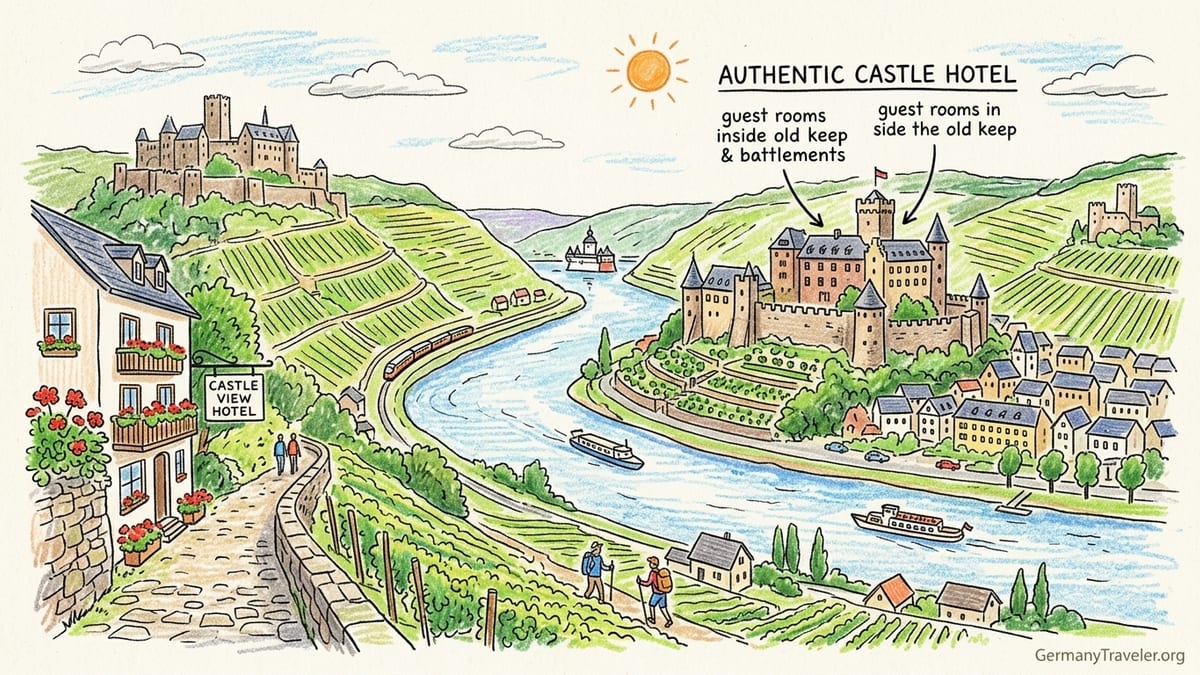
On the Romantic Rhine you will see “castle” in many hotel names, but not all of them put you inside medieval walls. The regional Romantic Rhine tourism board even maintains a dedicated category for castle accommodation, which makes a clear distinction between authentic fortress stays and ordinary hotels with scenic views of a ruin on the hill. When planning a trip, it is worth checking whether your bed is in the old keep, a later palace wing, or simply in a modern building down by the river.
A genuine castle hotel usually occupies the original curtain walls, towers, or inner bailey. Examples include Burghotel auf Schönburg in Oberwesel, where rooms are spread through the historic castle core and its outbuildings, and Burghotel Reichenstein above Trechtingshausen, which wraps a boutique hotel into the 19th century rebuild of a medieval fortress. By contrast, some “castle view” properties in riverfront villages like Boppard or St. Goar offer excellent panoramas of Marksburg or Rheinfels, but you are sleeping in a normal town hotel rather than a fortified site.
Another gray zone are hotels that stand beside a castle but outside the ramparts. Around St. Goar for instance, there are modern properties that market themselves with Rheinfels Castle yet sit below the hill, while the main Schloss Rheinfels hotel complex is integrated into the former fortress above. For travelers who specifically want to wake up to stone vaults, arrow slits and spiral staircases, reading the accommodation’s own description and photos carefully is essential.
Finally, some of the Rhine’s most atmospheric castles, such as Burg Stahleck above Bacharach, operate as youth hostels rather than full-service hotels. They belong firmly in the “real castle stay” category but offer communal bunks and simple facilities instead of couples’ suites. These properties are ideal for families, hikers and budget travelers, but less suited to a splurge anniversary weekend.
Burg Gutenfels: Classic Fortress Above Kaub
Burg Gutenfels, looming above the ferry town of Kaub, is one of the archetypal Romantic Rhine silhouettes. The castle dates back to the 13th century and long guarded river tolls together with the midstream Pfalzgrafenstein fortress below. After periods of ruin and restoration, Gutenfels has functioned at various times as a private residence and guesthouse. Today it remains a coveted, if more limited, place to sleep directly within a fortified shell, often featuring in specialist castle-hotel roundups and Rhine itineraries.
Accommodation here typically emphasizes thick stone walls, timber beams and views over the vineyards and river. Rooms tend to be fewer and more individual than in larger castle hotels such as Schönburg or Rheinfels, which helps keep the atmosphere quiet and residential. Rates, when available for the public, are usually in the mid to upper range for the valley, comparable to an upscale boutique hotel: guests can expect to pay roughly what they would for a good four-star property elsewhere in Germany, with seasonal variations and a premium on summer weekends.
Kaub itself is a tiny, walkable town with a riverside promenade and direct train access on the left bank line, but Gutenfels sits steeply above it. Reaching the castle involves a substantial uphill walk or a short transfer by taxi or private car. There is typically on-site parking for overnight guests, though spaces can be tight. Those arriving by rail or river cruise should be prepared for a climb, especially with luggage.
For couples, Burg Gutenfels offers deep quiet and a feeling of retreat. Nightlife is minimal and dining options in Kaub are simple, so most guests treat the stay as a chance to linger over dinner either in the castle’s own dining rooms when open or in one of the riverside restaurants before returning uphill. It suits travelers who care more about stone corridors and starry skies than about spa facilities or late bars.
Schönburg at Oberwesel: Romantic Classic With Full-Service Comfort
If Burg Gutenfels feels intimate and almost private, Burghotel auf Schönburg above Oberwesel delivers the full Romantic Rhine fantasy at four-star level. The castle crowns a steep hill behind the town and has been carefully restored as a hotel with around 30 rooms and suites. Guests sleep within the ramparts or adjoining castle buildings and have exclusive access to terraced gardens and a small tower museum when open.
Room rates at Schönburg generally fall in the upper mid to high range for the region. Visitors can often expect a package including breakfast, a welcome drink and access to the castle grounds, with prices roughly similar to a stylish design hotel in a major German city. Many rooms feature Rhine views, some with balconies or terraces hanging directly over the river valley. For special occasions such as honeymoons or milestone birthdays, suites with four-poster beds and fireplaces are especially sought after.
The restaurant at Schönburg is a major draw. It serves multi-course dinners in panelled dining rooms and on terraces overlooking the river, with menus reflecting regional game, freshwater fish and local wines. Breakfasts are generous by German standards, and the dining atmosphere in the evening can be very romantic, particularly at sunset. Advance reservations are strongly recommended, especially in peak season when day visitors also covet dinner tables.
Oberwesel has a station on the main Rhine rail line, and from there energetic guests can walk steeply up through vineyards to the castle in around 20 to 30 minutes. With luggage, however, a taxi or hotel-arranged transfer is much more pleasant. Drivers will find on-site parking at the top of a narrow access road. A car is useful for exploring nearby viewpoints and villages, but not strictly necessary; the Rhine boats and trains make it easy to visit Bacharach, St. Goar or Boppard from Oberwesel.
Reichenstein and Rheinfels: Castle Hotels With Historic Shells and Modern Wings
Further north, Burg Reichenstein near Trechtingshausen and Schloss Rheinfels above St. Goar illustrate a different model of castle hotel: part historic stronghold, part modern extension. At Reichenstein, a boutique hotel occupies restored wings within and around the romantic 19th century reconstruction of a medieval castle. The stone courtyards, towers and battlements are real, but many guest rooms feature contemporary interiors, clean white walls and modern bathrooms. Guests wake up within castle walls yet enjoy the comforts of a recent boutique renovation.
Room categories at Reichenstein typically range from compact doubles on the hillside to larger “Rheinblick” rooms with expansive river views. Prices tend to sit in the mid to upper-mid bracket, more accessible than the most exclusive Rhine castle hotels but above simple guesthouses along the riverfront. A high-quality breakfast and a refined on-site restaurant, often serving regional cuisine in vaulted rooms or on terraces, make it attractive for food-focused travelers.
Schloss Rheinfels at St. Goar takes things a step further. The hotel complex belongs to a larger fortress ruin that once dominated this section of the Rhine and today forms part of the Upper Middle Rhine Valley UNESCO site. Guests sleep in a substantial hotel incorporated into the former castle, with views across the river to Maus Castle and nearby vineyards. Some rooms occupy historical-looking wings, others sit in more modern sections that blend into the ramparts. The result is a hybrid: you are within the historic compound but not every corridor feels medieval.
Both Reichenstein and Rheinfels are practical for travelers with cars, offering parking at or near the castle itself. Access from local train stations in Trechtingshausen and St. Goar is possible by taxi, and the climbs on foot, while steep, are shorter than to some more isolated ruins. For couples, these hotels work particularly well when one partner dreams of romance and the other insists on good mattresses, elevators where possible and reliable heating.
Liebenstein and Sterrenberg: Twin Castles and Intimate Stays
Between Boppard and St. Goarshausen, the “Feindliche Brüder” or Hostile Brothers form one of the most striking castle pairs on the Rhine. Burg Liebenstein and Burg Sterrenberg sit side by side on a ridge above the village of Kamp-Bornhofen, separated by a famous wall. Today, both castles welcome guests: Liebenstein as a family-run castle hotel with a restaurant, and Sterrenberg as a partly modernized property with dining and accommodation integrated into the historic site.
Liebenstein is particularly atmospheric for overnight stays. The small hotel occupies the main residential tower and adjoining buildings, with a limited number of rooms, many of them retaining stone walls, wooden beams and views across the river. Prices are typically in the mid-range relative to the region, often more affordable than Schönburg or Reichenstein, especially outside summer and public holidays. Dinner in the castle restaurant, with windows looking onto vineyards and passing cruise ships far below, adds to the sense of seclusion.
Sterrenerg, slightly larger and more open to day visitors, also offers meals with sweeping Rhine panoramas and a handful of guest rooms within the fortress. The experience here can feel a little less intimate but more sociable, with hikers on the Rheinsteig trail stopping in for drinks and food. For many travelers, the appeal is staying in a living historic ensemble where two rival castles share one dramatic ridge.
Access to both castles is via a steep, narrow road from Kamp-Bornhofen, where there is a train station on the right bank. Guests without a car often take a taxi up the hill, as walking with luggage is demanding. Parking for hotel guests is usually available within or just below the castle precincts, though space is tight in high season. Once on the ridge, walking paths connect the two castles and continue along the hills for superb river views, which makes this pair a fine choice for hikers and romantically minded walkers.
Pricing, Dining and When to Book Your Castle Stay
Staying in or beside a castle on the Romantic Rhine is not automatically expensive, but prices are noticeably higher than for standard riverfront guesthouses or chain hotels in nearby Koblenz or Mainz. As a rough guide, mid-range castle hotels such as Liebenstein or some rooms at Reichenstein often start around what a good three- to four-star town hotel would cost in Germany, with rates rising for Rhine-view rooms and suites. Top-tier properties like Schönburg or the most desirable rooms at Rheinfels can reach high-end city hotel levels, particularly on summer weekends and during wine festivals.
Many castle hotels on the Rhine operate seasonally, with some or all facilities closing in the depths of winter. A few, including certain wings at Reichenstein or Rheinfels, may remain open year-round, but services such as terrace dining or gardens are more limited in cold months. Travelers dreaming of warm evenings on battlements should target stays from late April to October, while those seeking lower prices and fewer crowds might consider shoulder seasons like early spring or late autumn.
On the dining side, castle restaurants typically emphasize regional ingredients and wine. Multi-course set menus are common at Schönburg and Rheinfels, while Liebenstein and Sterrenberg often offer hearty dishes suited to hikers and river cruisers. Breakfasts are usually included or attract a modest surcharge, and dining “in house” is often the most convenient option, since walking or driving back down to village restaurants after dark can be cumbersome.
Booking well ahead is essential for summer weekends, public holidays and special events like the Rhine in Flames fireworks nights, when river villages and castles fill up months in advance. For a romantic stay, it is worth requesting specific room types, such as a turret room or balcony suite, and confirming whether the room is in the historic core of the castle or an adjoining modern wing. Travelers with mobility issues should ask in detail about stairs and elevator access, as many genuine castle rooms are reachable only via narrow, uneven steps.
Do You Need a Car, and How Accessible Are the Castles?
One of the advantages of the Middle Rhine is its superb public transport: frequent trains run along both banks between Koblenz and Bingen or Mainz, and many towns also have riverboat piers. Strictly speaking, you can visit almost all of the castle hotels without your own car, at least if you are comfortable combining trains, taxis and some walking. Properties such as Schönburg, Reichenstein, Rheinfels and the twin castles at Kamp-Bornhofen all sit within a few kilometers of a station.
That said, the castles were built to be defensible, not convenient. Expect steep access roads or footpaths from the valley floor. With light luggage, it is realistic to walk up to Schönburg from Oberwesel or to Rheinfels from St. Goar in 20 to 30 minutes, though the gradient is considerable. For Burg Gutenfels and the Hostile Brothers, most guests prefer to arrange a taxi from the station or ferry landing, especially on arrival and departure days.
Travelers with limited mobility should look particularly closely at hotel descriptions. Some castle hotels have made significant accessibility improvements, such as adding elevators to newer wings or creating barrier-reduced routes to certain rooms and restaurants. Others remain full of narrow spiral staircases, low doorways and uneven cobbles, which add charm but make life difficult for anyone with knee or balance problems. Before booking, it is wise to email the property directly and ask about steps, parking distance from reception and room locations.
A car is most useful if you plan to combine a castle stay with visits to outlying viewpoints, small vineyards and side valleys that are poorly served by trains. It also makes late-night returns easier if you eat in a different village. However, parking at some castles is restricted, with tight spaces inside courtyards and narrow access roads. Confident drivers in compact cars will have the easiest time. If you prefer to rely on rail and riverboats, focus on castles above towns with good train service, such as Oberwesel, St. Goar and Kamp-Bornhofen.
Choosing the Right Castle for Romance, Families or Hikers
Not every castle hotel on the Rhine suits every type of traveler. Couples seeking a private, cocooned atmosphere often gravitate toward smaller properties like Burg Gutenfels or Burg Liebenstein, where there are fewer rooms and the evenings are quiet. The lack of nightlife and limited nearby bars become advantages, as nights are spent on terraces watching the river or by fireplaces with a glass of local Riesling.
For honeymooners or milestone celebrations who want a blend of romance and full-service comfort, Schönburg and Reichenstein work particularly well. Both combine strong sense of place with high-quality bedding, polished service and memorable meals. At these hotels, it is easy to fill a short stay without ever leaving the castle hill, which can be helpful on a tight itinerary.
Families with children might prioritize castle properties that have more space to roam and less fragile furnishings. Schloss Rheinfels, with its extensive ruins, and Burg Stahleck, with hostel-style accommodation and communal areas, are good examples. Kids can explore towers and walls during daylight and sleep in simple but atmospheric rooms at night. Hikers on multi-day treks along the Rheinsteig trail often plan their stages to finish at castles like Sterrenberg, Reichenstein or Schönburg, where a hot shower, solid dinner and panoramic terrace await.
Finally, some travelers combine several styles in one trip. It is entirely feasible to spend a night or two at an intimate hilltop fortress, then move to a riverside hotel with castle views for variety and easier logistics. The key is being clear about priorities: do you want maximum historical immersion, the most comfortable room, the best restaurant or the easiest access from the train? On the Romantic Rhine, there is usually a castle to match each of those wishes.
FAQ
Q1. What is the difference between a real castle hotel and a hotel with castle views?
Real castle hotels place guest rooms inside the historic walls, towers or bailey of a former fortress or palace, whereas hotels with castle views sit outside the complex and simply overlook a nearby castle from the valley floor or opposite bank.
Q2. Is Burg Gutenfels open as a hotel to the general public?
Availability at Burg Gutenfels can change over time and may be limited or focused on special arrangements, so travelers should check current guest information and booking options directly with the property before planning an overnight stay there.
Q3. How expensive is it to stay in a Rhine castle hotel?
Prices vary widely, but many castle hotels on the Romantic Rhine are comparable to good three- to four-star city hotels, while the most exclusive properties and river-view suites can reach higher boutique or luxury levels, especially in peak season.
Q4. Do I need a car to stay at castles like Schönburg or Rheinfels?
No, you can reach Oberwesel, St. Goar and other hubs by train and then take a taxi or walk up to the castles, although a car makes it easier to explore smaller side valleys and viewpoints that are not well served by public transport.
Q5. Are Rhine castle hotels suitable for travelers with limited mobility?
Some castle hotels have elevators and partially step-free access in modern wings, but many rooms still require climbing narrow or uneven stairs, so guests with mobility concerns should contact the hotel in advance to discuss specific room options and access routes.
Q6. Which castle hotels are best for a romantic weekend?
Burghotel auf Schönburg in Oberwesel, Burg Liebenstein above Kamp-Bornhofen and carefully chosen rooms at Burg Reichenstein or Schloss Rheinfels are particularly popular with couples looking for views, good food and a historic setting.
Q7. Can families with children stay in Rhine castle hotels?
Yes, many castles welcome families, and some, such as Schloss Rheinfels and the youth hostel at Burg Stahleck, are especially child friendly thanks to spacious grounds and a relaxed atmosphere, though parents should always supervise kids around walls and steep drops.
Q8. When is the best time of year to book a Rhine castle stay?
Late spring to early autumn offers the most pleasant weather and open terraces, but these months are also busiest, so shoulder seasons like April, May and late September can provide a good balance between atmosphere, price and availability.
Q9. Do castle hotels on the Rhine include breakfast and dinner?
Breakfast is often included or available for a modest supplement, while dinner is usually served in the castle restaurant as either an à la carte menu or a multi-course set menu; advance table reservations are advisable in smaller properties.
Q10. How far in advance should I reserve a room in a popular Rhine castle hotel?
For summer weekends, holidays and special events, booking several months ahead is prudent, while midweek nights in shoulder seasons can sometimes be secured closer to the travel date, particularly in larger properties with more rooms.