


Before you compare individual hotels in the Rhine Valley, you need to pick the right town. Rüdesheim, Bacharach, St. Goar, Boppard and Koblenz each offer a very different experience in terms of wine, romance, river views, parking, trains, ferries and nightlife. This guide looks at how they really function on the ground so you can choose the base that fits your trip, then book the perfect room with confidence.
How to Choose Your Rhine Valley Base
On most accommodation search pages for the Upper Middle Rhine, you will see the same list of towns over and over: Rüdesheim, Bacharach, St. Goar, Boppard and Koblenz. The real decision is not just which hotel has the nicest photos, but which town’s layout, transport links and evening atmosphere match the kind of trip you want. Moving a few kilometres up or downriver can change how easy it is to park, how often boats and trains run, and whether you will still find an open restaurant at 9 pm in shoulder season.
Think first about your priorities. If you want a wine-focused stay with easy access from Frankfurt Airport, Rüdesheim is usually the most convenient choice, with frequent regional trains and vineyards walking distance from most hotels. If you are chasing a fairytale feel, Bacharach’s compact half-timbered core and hillside castle hostel are hard to beat. For big Rhine icons like the Loreley Rock and Rheinfels Castle, St. Goar sits center stage. Boppard gives you a larger riverside town with good rail links in both directions, while Koblenz functions as a small city, with the broadest range of hotels, restaurants and onward transport.
Also weigh the practicalities that rarely show up in glossy photos: which side of the river a town is on, how often ferries run if you need to cross, whether your hotel will face the river or the railway line, and how late the last cruise boat comes back in season. Choosing the right base can mean strolling five minutes from your hotel to a pier, or having to time your entire day around ferry schedules.
Rüdesheim: Wine Hub With Strong Transport Links
Rüdesheim am Rhein is one of Germany’s best-known wine towns and the eastern gateway to the UNESCO-listed Rhine Gorge. The town is served by the East Rhine Railway, with hourly regional trains on the RB 10 “RheingauLinie” connecting it to Frankfurt, Wiesbaden and Koblenz, which makes arrival from Frankfurt Airport straightforward with one or two changes. The compact station sits just behind the riverside road, so even with luggage you can walk to most central hotels in under 10 minutes.
For drivers, Rüdesheim offers several signed parking areas on the edge of the old town as well as a riverside car park that is convenient but can fill quickly in high season and on festival weekends. If you are staying in the pedestrian core around the Drosselgasse, you will likely park in a public lot and then walk or roll your suitcase through cobbled lanes. Prices for day parking are typical for the region and many hotels either have a few reserved spaces or offer discounted access to nearby garages, but you should always check this before booking if you are arriving by car.
Rüdesheim’s wine focus is clear in its hotel inventory. You will find many small and mid‑range family‑run hotels and guesthouses that double as wineries or wine taverns. A typical double room in a centrally located 3‑star hotel with partial river views in peak summer might cost in the mid to high three figures per night in euros, while simpler guesthouses on higher streets or in neighbouring Assmannshausen will be more affordable. Because the town attracts day trippers and river cruise passengers, it tends to feel busy in daytime but still has a reasonably lively restaurant and bar scene after dark compared with smaller villages.
Being on the right (east) bank, Rüdesheim sits opposite the rail line and road on the left bank, and is linked across the river by a frequent ferry to Bingen. This ferry is important if you want to combine east‑bank walking or cycling with west‑bank train rides, and some regional tickets to or from Rüdesheim are valid on the ferry. Cruise logistics are easy: major day‑cruise companies operate multiple departures in season from Rüdesheim to the Loreley stretch, often allowing one‑way boat and return by train. This combination of wine, transport frequency and cruise options makes Rüdesheim a strong base if you value convenience over peace and quiet.
Bacharach: Romantic Atmosphere and Riverfront Charm
Bacharach is the classic “storybook” Rhine town, with a tight cluster of half‑timbered houses, a ruined chapel on the hillside and vineyards rising behind. It lies on the left bank on the West Rhine Railway between Bingen and Boppard, with regional trains typically stopping at least once an hour. The station sits only a short walk from the riverfront and old town, but like many places on this side of the Rhine, the railway runs between the town and the water, so some riverfront hotels will have train noise along with their views.
The hotel stock in Bacharach is smaller than in Rüdesheim or Boppard, and rooms can book out quickly in late spring and early autumn. On the plus side, a high proportion of accommodation is atmospheric: think centuries‑old guesthouses with creaking staircases and breakfast rooms looking onto courtyards. There is also a well‑known youth hostel inside the hilltop castle, popular with budget travellers and families who like the idea of sleeping in a fortress above the vineyards. Because availability is tighter, it pays to choose your town first and then reserve early if you have your heart set on Bacharach.
Dining after dark is more limited here than in Rüdesheim or Koblenz. In peak season you will find several wine taverns and small restaurants open until late evening along the main lanes and riverfront, offering regional dishes and local Riesling. Outside of weekends or shoulder months, kitchens may close earlier and mid‑week choice can shrink to just a handful of places, so it is wise to check opening days and perhaps reserve a table if you are arriving late. The payoff is atmosphere: once the day‑trippers leave, the old town can feel very calm and romantic, ideal for slow evening walks along the floodwall with the castles lit on the hills.
Transport‑wise, Bacharach does not depend on a cross‑river ferry as heavily as some neighbouring towns. There is a ferry connection nearby across to Kaub, which is useful if you plan to visit Pfalzgrafenstein Castle or explore walking routes on the opposite bank, but most visitors arrive and leave by train. Day cruises are easy to access: some boats stop directly in Bacharach, especially in main season, though not as frequently as in larger hubs such as Boppard or Rüdesheim. If you care most about a romantic base with a handful of memorable inns rather than a long restaurant list or late‑night bars, Bacharach is a strong contender.
St. Goar: For Loreley Views and Rheinfels Castle
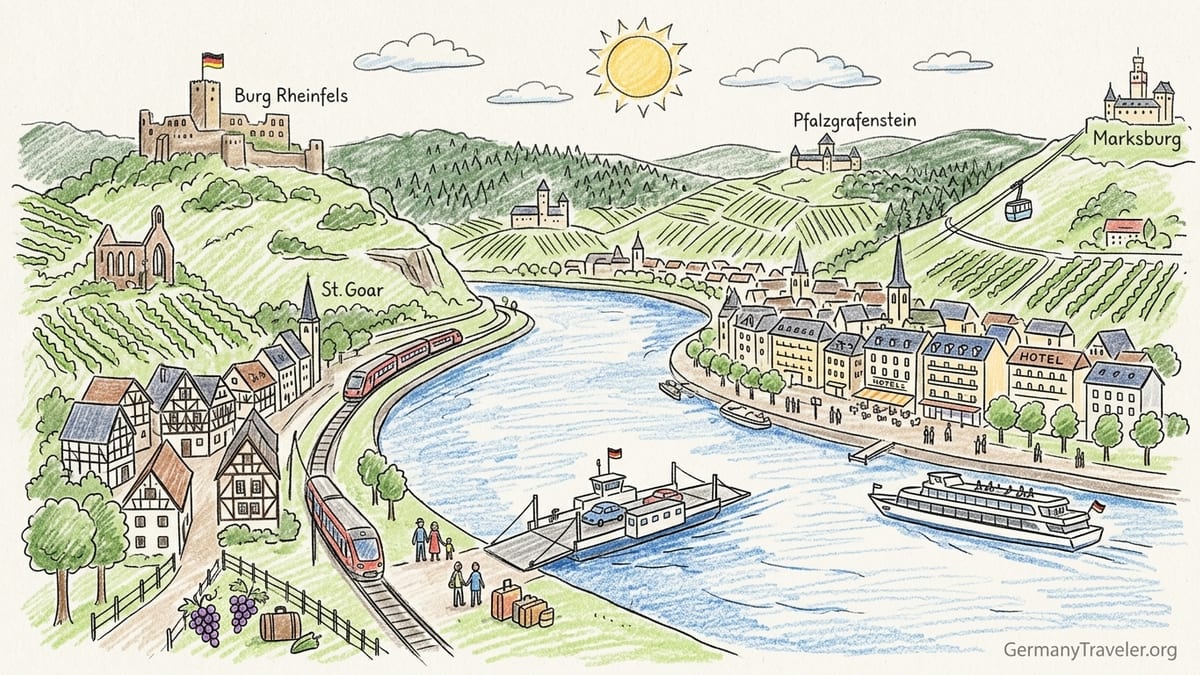
St. Goar sits roughly in the middle of the gorge, directly opposite St. Goarshausen and just upstream from the Loreley Rock. This location puts you within easy reach of two of the Rhine’s biggest icons: the Loreley viewpoint on the right bank and Burg Rheinfels, the sprawling castle ruins above St. Goar itself. A car ferry runs between St. Goar and St. Goarshausen, which makes it a practical base if you plan to cross the river several times to hike, visit viewpoints or catch trains on both banks.
The town is served by regional trains on the left‑bank line, handy for short hops to Boppard, Bacharach and Bingen. The railway again hugs the river, so many hotels sit either between the tracks and the hillside or between the tracks and the water. This means you should pay close attention to hotel descriptions and reviews about noise. Some riverside properties have added good soundproofing, allowing you to enjoy ship and castle views without being disturbed, while smaller, older pensions closer to the line may be more suitable for heavy sleepers.
St. Goar’s hotel inventory is mid‑sized for the valley. You will find a few riverfront hotels with balconies facing passing barges and cruise ships, some simple guesthouses set one or two streets back, and apartments on the slopes above town with wide views. Prices are often slightly lower than in Rüdesheim, reflecting a quieter evening scene. There are a number of restaurants and cafés around the ferry landing and main square, but nightlife is modest. In the evenings, you can expect a handful of places serving hearty German dishes and local wine until around 9 or 10 pm in high season, with reduced options outside of summer.
What St. Goar excels at is access to classic Rhine experiences. Burg Rheinfels is a short but steep walk or drive from the center, with a dedicated parking area near the castle for those arriving by car or taxi. From St. Goar you can take a quick ferry ride across to St. Goarshausen and then continue by bus or on foot up to Loreley viewpoints, or simply enjoy the spectacle of long freight trains and river traffic squeezing through the narrowest part of the gorge. Several day‑cruise boats include St. Goar on their schedules between Boppard and Rüdesheim, which makes it an efficient middle base if your priority is to see the Loreley and explore castle ruins.
Boppard: Larger Riverside Town With a Relaxed Feel
Boppard is a larger town on a broad bend of the Rhine, a little north of St. Goar, and is often recommended as a comfortable base for travellers who want more services but still a traditional riverside atmosphere. The town lies on the left bank, again on the main railway line, with hourly regional trains running between Koblenz and Mainz. The station is set just behind the riverside promenade, so you can easily arrive by train and be at most central hotels within a short walk.
Being bigger than Bacharach or St. Goar, Boppard offers a wider range of accommodation, from simple guesthouses in backstreets to modern riverfront hotels with terraces and on‑site restaurants. In season, you can often find good mid‑range double rooms with direct river views here that are more competitively priced than in the very busiest hubs. If you are travelling with a car, parking is generally manageable, with public lots and some hotel garages, although weekends and festival dates can still be busy. Boppard’s flat riverside layout makes it easier for travellers with mobility issues than hillier towns where steep streets separate hotels and the water.
The town supports a healthy restaurant and café scene that stays active into the evening, especially on or near the promenade. You will find pizzerias, wine taverns and more contemporary restaurants alongside traditional inns, giving more options for travellers who like to dine later or change cuisine types from night to night. After dark, the town feels livelier than Bacharach or St. Goar but still far from a big‑city nightlife spot, which suits many visitors who want atmosphere without noise until the early hours.
Boppard works particularly well as a base for day cruises and short excursions. Several cruise companies run round‑trip sailings from Boppard to the Loreley region in high season, and boats connecting Koblenz with Rüdesheim typically call here, giving you flexibility to cruise one way and return by train. There is also a well‑known chairlift up to viewpoints above the Rhine, which starts near the river and has parking close by. Because Boppard sits roughly between the gorge and Koblenz, it is also a practical choice if you want to combine classic Rhine scenery with a day trip along the Moselle or into Koblenz without changing hotels.
Koblenz: Best for Transport, Choice and City Comforts
Koblenz, at the confluence of the Rhine and Moselle, is the largest of the five bases discussed here and feels like a small city rather than a town. It has a busy main station with frequent intercity and regional trains in many directions, including direct services to major German cities. This makes Koblenz appealing if you are arriving from farther afield or continuing on a wider rail itinerary. From the station you can walk or take local buses to the Altstadt and riverfront, where many hotels and restaurants are concentrated.
The accommodation range in Koblenz is significantly broader than in other Rhine towns. Alongside classic family‑run hotels and guesthouses, you will find business hotels near the station, large chain properties on or near the river, and apartment rentals scattered through residential areas. River‑view rooms in modern hotels near the Deutsches Eck or along the Rhine promenade are popular, particularly during events and in summer. For drivers, city‑style parking rules apply: most larger hotels have underground or courtyard parking for a daily fee, and there are multiple public garages in and around the center.
In terms of evening life, Koblenz clearly outperforms the smaller river towns. Its old town and waterfront offer a long list of restaurants, from casual beer gardens and wine bars to more refined regional kitchens and international options. You will have little trouble finding dinner after 9 pm, even on weekdays, and there are enough cafés and bakeries to support relaxed mornings without setting an alarm. This makes Koblenz attractive for travellers who like the scenic daytime excursions but still want the dining and bar choices of a small city at night.
Koblenz is also a key hub for day cruises and river traffic. Cruise boats ply both the Rhine and the Moselle from its piers, and you can easily join shorter sightseeing trips or longer journeys up or downriver. The city’s cable car over the Rhine up to the Ehrenbreitstein Fortress provides another perspective on the river landscape without needing a car. As a base, Koblenz is ideal if you are using the Rhine Valley as one stop on a longer German itinerary, want strong transport links, and value restaurant and hotel choice over being directly in the narrowest, most romantic section of the gorge.
Practicalities: River Sides, Ferries, Parking and Cruises
One factor that strongly shapes your stay is which bank of the Rhine your base sits on. Rüdesheim lies on the right (east) bank, while Bacharach, St. Goar, Boppard and central Koblenz are on the left. The main railway lines follow both sides of the river through much of the gorge, but the pattern of services and how they interact with towns differs. On the left bank, the railway often runs directly between the town and the river, which is convenient for train users but means some river‑view hotels will also be train‑view hotels. On the right bank, as in Rüdesheim, the tracks tend to sit slightly back from the riverfront, resulting in a different balance of noise and views.
Ferries are crucial if you plan to hop between both sides of the river. From Rüdesheim there is a frequent passenger and car ferry to Bingen, which many travellers use to combine east‑bank vineyards with west‑bank rail connections. St. Goar’s car ferry to St. Goarshausen allows easy access to Loreley viewpoints and the right‑bank rail line without a long detour. Elsewhere, smaller ferries and seasonal boats link towns across the river, but schedules can thin out in the low season or later in the evening. If your hotel is on one bank and you book dinner or a late return train on the other, it is essential to check the last ferry times for your travel dates.
Parking conditions vary from town to town. Compact, historic centers like Bacharach and parts of Rüdesheim have limited on‑street parking and rely on public lots just outside the medieval core. St. Goar and Boppard offer a mix of riverside parking and central spaces, with some hotels reserving small private lots for guests. Koblenz, as a larger city, has structured car parks and underground garages but charges daily fees similar to other German cities. When comparing hotels, pay close attention to whether parking is included, available at extra cost, or off‑site, especially if you are visiting during popular festivals or school holidays when demand is high.
Day cruises are straightforward from all five bases, but not equally frequent. Rüdesheim and Boppard tend to see the highest number of departures in peak season, including round‑trip cruises to the Loreley region and longer runs that can be combined with train travel in the opposite direction. St. Goar and Bacharach are commonly included as intermediate stops on these routes, sometimes with only one or two calls per day, which may require you to time your sightseeing carefully. From Koblenz, you can join both Rhine and Moselle cruises, but you are a little further from the tightest cluster of gorge castles, so journeys to the Loreley stretch will be longer. If you want maximum flexibility to decide your cruise day at short notice, Rüdesheim, Boppard or Koblenz provide the most options.
Which Town Fits Which Traveler?
When you put all these factors together, each town emerges with a clear personality. Rüdesheim suits travellers who want an easy link from Frankfurt, a strong wine focus and plenty of boats. It can feel busy and a little commercial in high season, but if you like having a choice of wine taverns and late‑opening restaurants close to your hotel, it delivers. Bacharach is better for couples or solo travellers who value atmosphere over amenities: you trade some evening choice and hotel quantity for narrow lanes, historic façades and a quieter riverside promenade once the last train of day‑trippers leaves.
St. Goar is the obvious choice if Loreley and Burg Rheinfels are your main goals. You can wake up to castle views, stroll up to the ruins in the morning and catch a boat or train in either direction in the afternoon. The ferry to St. Goarshausen makes it simple to switch banks without planning your entire day around one crossing. Boppard is a strong all‑rounder for visitors who want good connections, a pleasant promenade and more dining than the smaller villages, without stepping up to big‑city scale. Its bend in the river and nearby viewpoints give fine scenic rewards with minimal effort.
Koblenz, finally, is ideal for travellers who see the Rhine Gorge as one part of a wider Germany or Europe journey. Here, you can base yourself in a modern hotel, enjoy reliable city‑level public transport and restaurant choice, and still reach the castles and cruise routes within an hour or less. It also works well for trips that combine the Rhine with the Moselle, thanks to frequent boats and trains on both rivers. Thinking through how you like to travel in the evenings, how often you want to move hotels, and whether you prefer village charm or urban convenience will usually make the right choice among these five clear.
FAQ
Q1. Which Rhine town is best if I am arriving from Frankfurt Airport by train?
Rüdesheim is often the most convenient, because hourly regional trains link it with Frankfurt and Wiesbaden and the station is a short walk from most hotels. Koblenz also has excellent rail connections if you prefer a larger city base.
Q2. Where should I stay for the most romantic atmosphere?
Bacharach is a strong choice for romance, thanks to its compact half‑timbered old town, riverside setting and limited through‑traffic. After day‑trippers leave, the streets become quiet and atmospheric, ideal for evening walks and relaxed dinners.
Q3. Which town is best for visiting the Loreley Rock and Rheinfels Castle?
St. Goar is the most convenient base for both. Burg Rheinfels stands directly above town, with road and walking access, and a short ferry crossing takes you to St. Goarshausen for buses or hikes up to Loreley viewpoints.
Q4. If I want a larger town with more restaurants and shops, where should I stay?
Boppard and Koblenz both offer more services than the smaller villages. Boppard has a lively promenade and several restaurants that stay open into the evening, while Koblenz functions as a small city with a wide range of dining, shopping and nightlife.
Q5. How important is it to think about which side of the river I stay on?
It matters for both noise and logistics. Left‑bank towns often have the railway between the town and the river, affecting hotel ambience, while right‑bank Rüdesheim requires a ferry crossing for some rail routes. If you plan to explore both sides, staying near a ferry crossing such as St. Goar or Rüdesheim is helpful.
Q6. Will I need to rely on ferries if I stay in one of these towns?
You can travel the valley entirely by train and boat on one side of the river, but ferries add flexibility. Rüdesheim to Bingen and St. Goar to St. Goarshausen are the most commonly used crossings for visitors who want to switch between east and west banks.
Q7. Which base is best if I plan to take several day cruises?
Rüdesheim and Boppard typically offer the most frequent cruise departures to the Loreley region in high season, with easy train connections back from other towns. Koblenz has many cruises too, including on the Moselle, but journeys into the narrowest gorge section are longer.
Q8. Where is parking easiest for travellers with a car?
Parking is manageable in all five towns but simplest in Boppard and Koblenz, which have more spaces and garages. In Rüdesheim and Bacharach you will often use public lots just outside the historic core, while St. Goar offers a mix of central and castle‑area parking.
Q9. Are there enough restaurants open after dark in these towns?
Rüdesheim, Boppard and Koblenz generally keep good evening hours, especially in main season. Bacharach and St. Goar can feel quieter, with fewer venues open late or on some weeknights, so it is wise to check opening days if visiting outside summer weekends.
Q10. If I only have two nights on the Rhine, which town should I choose?
For a first visit focused on scenery and castles, many travellers pick either Rüdesheim, Boppard or St. Goar. Rüdesheim is best for wine and easy access from Frankfurt, Boppard offers a balanced mix of services and scenery, and St. Goar gives you Loreley and Rheinfels right on your doorstep.