


Few road trips in Europe pack as much scenery into such a short distance as Germany’s Romantic Rhine. Between Mainz and Cologne the river squeezes through a steep gorge, flanked by vineyards, storybook villages and more than 60 castles. Germany Travel and the ADAC motoring club promote this corridor as the official Rhine-Romantic Route, a classic drive that threads together ferries, fortress towns and some of the best river viewpoints in the country.
Understanding the Official Rhine-Romantic Route
The Rhine-Romantic Route is an established holiday route that follows the Middle Rhine between Mainz and Cologne, roughly 190 kilometers if you continue all the way north. The heart of it lies in the Upper Middle Rhine Valley, the UNESCO-listed stretch between Bingen and Rüdesheim in the south and Koblenz in the north, where the river bends through a narrow gorge lined with terraced vineyards and hilltop castles. Drivers follow existing federal roads and village streets close to the water rather than an artificial scenic loop, which makes it easy to join or leave the route wherever your schedule allows.
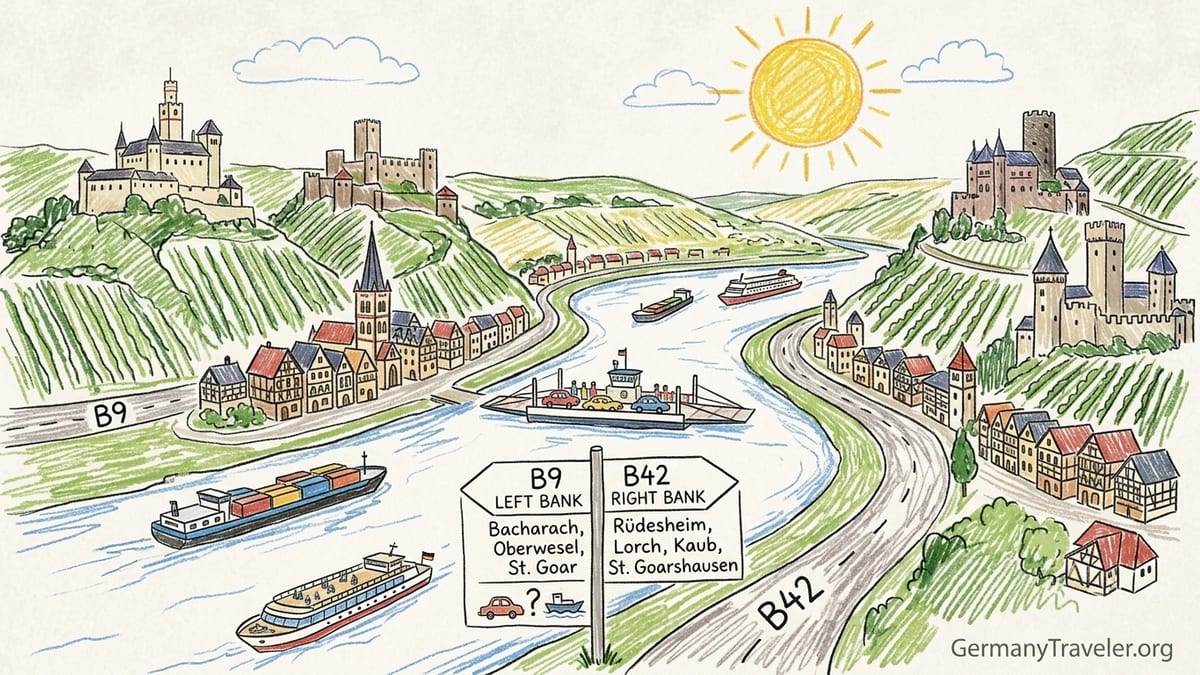
From a driver’s perspective, the two key roads are the B9 on the left bank and the B42 on the right bank. Between Mainz and Koblenz there are no bridges across the Rhine, only a series of car ferries, so choosing your starting bank shapes your day. The left bank B9 passes through towns like Bingen, Oberwesel, St. Goar and Boppard, while the right bank B42 threads through Rüdesheim, Lorch, Kaub, St. Goarshausen and Braubach. Both deliver classic river views, but they feel different at the wheel, and this guide will help you decide when to drive each side, when to cross by ferry and when to park the car and switch to boats or trains.
Most international travelers approach the route through Frankfurt Airport, about 30 to 40 minutes by road or rail from Mainz. Others arrive via Cologne or Düsseldorf in the north and work their way south. In practice many visitors concentrate on the core section between Mainz or Rüdesheim and Koblenz over two or three days, then either return the same way or extend toward Bonn and Cologne. That middle segment is where river traffic, castles and romantic legends are most intense, and where driving slowly along the valley still feels like stepping into a 19th century painting.
Mainz to Rüdesheim and Bingen: Choosing Your First Bank
If you are starting in Mainz, your first decision is which bank to follow into the gorge. Heading northwest out of the city, the B9 stays on the left bank, passing vineyards and small industrial towns like Ingelheim and Bingen. This side offers a slightly more relaxed start, with broad river views and several pull-offs where you can pause at informal riverfront parking areas to watch passing cargo barges and long-distance river cruise ships. Drivers often use Bingen as their final fuel and supermarket stop before the narrower gorge, since it has larger grocery stores and filling stations right off the main road.
On the right bank, the B42 leads from Wiesbaden and Eltville toward Rüdesheim. This side feels more compact, with the road often squeezed between hillside vineyards and railway tracks. Rüdesheim am Rhein is one of Germany’s classic wine towns, with a dense old core and a busy seasonal atmosphere. Here it makes sense to park the car early in the day in one of the signed parking lots at the edge of the center, where a full-day ticket for a passenger car is typically in the range of 10 to 15 euros depending on location and season. From there you walk into the lanes around the Drosselgasse, ride the cable car up to the Niederwald Monument for a first aerial view of the Rhine, or join a short cruise that loops through the Bingen Gate at the southern entrance to the gorge.
Travelers with only one or two days often choose to start on the right bank in Rüdesheim, ride the cable car above the vineyards in the morning, then cross to the left bank later in the day at the Bingen–Rüdesheim car ferry. The crossing itself takes only a few minutes and typically runs at intervals of around 10 to 20 minutes in season, with a small fee per car and per passenger paid directly on board. Making this early crossing lets you continue into the gorge on the quieter stretches of the B9 past Bingen and Bacharach, while still having enjoyed Rüdesheim’s views and wine taverns without fighting traffic through its very narrow main street.
Driving the Rhine Gorge: Bingen/Rüdesheim to Koblenz
Once you leave Bingen and Rüdesheim behind, the landscape tightens and the Rhine Gorge begins in earnest. Most drivers find the left bank B9 the more relaxed option between Bingen and Boppard, because it has a little more separation from the railway line and offers frequent direct river views. The road follows a string of villages like Bacharach, Oberwesel and St. Goar, where parking is usually found in signed lots at the entrance to town. In Bacharach, for example, there is a marked day-parking area set back from the station where you can leave a car for several hours to wander the timber-framed lanes or hike up to Burg Stahleck. Expect hourly or day rates that are moderate by German standards, often around a few euros per hour, displayed on blue parking signs and ticket machines.
On the right bank, the B42 tends to run even closer to the water and to the rail line, which makes it visually spectacular but occasionally more demanding if you are not used to driving in narrower river valleys. The road passes Assmannshausen, Lorch and Kaub, where Burg Pfalzgrafenstein sits on a rocky island in midstream. Short-stay parking here allows a quick detour on foot to the pier for boat shuttles that bring you out to the tiny fortress. Continuing north, the road threads through St. Goarshausen under the shadow of Burg Katz and the Loreley rock, and later through Braubach at the foot of Marksburg, the only hilltop castle in the region that has never been destroyed.
Because there are no bridges, car ferries become part of the driving experience. Besides the busy Bingen–Rüdesheim crossing, the St. Goar–St. Goarshausen car ferry near the Loreley is one of the most useful for road trippers. It runs frequently throughout the day, with crossings roughly every 20 to 30 minutes during regular hours, and allows you to switch banks without detouring far north or south. Many travelers, for example, drive up the left bank as far as St. Goar to visit Burg Rheinfels above the town, then take the ferry across to continue north on the right bank toward Braubach and Koblenz. The fare is paid on board, typically in cash or by card, and is reasonable given the time saved compared with a loop back to the nearest bridge outside the gorge.
Castles, Viewpoints and When to Leave the Car
The concentration of castles along the Rhine Gorge is one of its defining features, but not all fortresses are equally easy to reach by car. Burg Rheinstein and Burg Reichenstein, between Bingen and Trechtingshausen, are both on the left bank and well set up for drivers, with small parking areas beside the access roads and marked walking paths up to the castle gates. Entrance tickets are purchased at the castle, and it is worth allowing at least an hour for a visit to explore ramparts, small museums and river viewpoints. Slightly further north, Burg Rheinfels above St. Goar is accessible by a steep town road with limited parking near the entrance, so arriving earlier in the day increases your chance of finding a spot without having to circle through narrow streets.
On the right bank, Marksburg above Braubach is a highlight because it is one of the few castles that survived undamaged into the modern era. Drivers follow signs up a twisting local road to a hillside parking area just below the castle walls. Guided tours run throughout the day, and joining one is often the only way to see the interior rooms, which preserves the feel of a working medieval fortress. Nearby, Schloss Stolzenfels just south of Koblenz is another good stop, though here you park at the base of the hill and walk up a paved path through forest to reach the castle courtyard. The walk itself is part of the charm, with filtered river views back toward Boppard.
Because parking in small medieval towns can be tight, especially on sunny weekends and during wine festivals, it sometimes makes sense to leave the car at a base and switch to other modes. Boppard, Oberwesel and Bacharach on the left bank, and St. Goarshausen or Braubach on the right bank, all have rail stations on the busy Mainz–Koblenz or Koblenz–Cologne lines. This makes it practical, for example, to spend a night in Boppard, leave your car in the hotel’s courtyard or in a nearby long-stay lot, and use regional trains to hop between towns the next day while enjoying views out the window without worrying about traffic or parking.
Ferries, Boats and When to Swap the Wheel for the Water
A key pleasure of the Rhine-Romantic Route is that you are rarely limited to the car. Regular car ferries handle the essential river crossings, while passenger boats let you float past the steepest cliffs and castle clusters without navigating the twisty roads. Several regional operators and larger companies run scheduled cruises between Mainz, Rüdesheim, Bingen and Koblenz in the main season from roughly April to October. Typical offerings include short two or three hour loops from Rüdesheim to the Loreley and back, as well as one-way services that allow you to combine a downstream boat trip with an upstream train ride.
For a balanced day, many travelers park in a central town such as Boppard or St. Goar, then take a morning boat downstream through the narrowest part of the gorge and return by train in the afternoon. Because river boats travel slower than cars or trains, this rhythm gives you time to photograph the Loreley rock, Burg Katz, Maus Castle and the river’s tightest S-curves from open decks. Ticket prices depend on distance and operator, but simple point-to-point fares between neighboring towns are usually within reach of most mid-range budgets, comparable to a restaurant meal rather than a luxury excursion.
Car ferries are simpler but crucial for flexible itinerary planning. Each key crossing, such as Bingen–Rüdesheim, Kaub–Engers or St. Goar–St. Goarshausen, posts a timetable and approximate fares at the ramp. In practice, in good weather you can usually just drive up, wait for the next boat and pay on board. Schedules can be reduced outside of summer or in poor conditions, so if you are traveling in late autumn or winter it is wise to check the latest information locally through tourist offices or your hotel before committing to a cross-bank loop that depends on a specific ferry late in the day.
Parking, Overnight Bases and Using Trains Along the Route
The Rhine-Romantic Route works especially well if you choose one or two bases and day-trip from there. Boppard, Bingen, Rüdesheim, Koblenz and Linz am Rhein all offer a range of hotels and guesthouses with on-site or nearby parking. Many family-run inns along the river include a few free spaces in front of the building for guests, allocated on a first-come basis, while larger modern hotels often charge a nightly fee for secure parking garages. When comparing prices, remember that a central location that lets you walk to dinner and evening riverfront promenades may save time and fuel compared with staying up on the heights.
Public parking in the medieval cores tends to be time-limited along the riverfront promenades and more flexible in marked car parks on the outskirts. In Bacharach, Oberwesel or St. Goar, for example, you might find short-stay bays near the water limited to one or two hours, while all-day lots sit a five to ten minute walk from the center. Machines usually accept coins and increasingly card payment. It is important to display your ticket correctly behind the windscreen and to respect marked resident-only zones in narrow side streets, where enforcement is active.
Rail transport runs in parallel to the driving route on both banks, and it can be very efficient to combine car and train. Regional trains connect Mainz to Koblenz along the left bank and Koblenz to Cologne along both banks, with frequent stops in intermediate towns such as Bingen, Bacharach, Oberwesel, Boppard and Andernach. This means you can, for example, park your car in Koblenz for the day, buy a day ticket, ride south by train to Oberwesel, spend the morning exploring there, then return north on a late afternoon boat or train without moving your vehicle. For visitors based in Frankfurt or Cologne, this rail network can also make it practical to visit parts of the Rhine-Romantic Route as day trips without renting a car at all.
Extending North to Bonn and Cologne
While the most dramatic scenery lies between Bingen and Koblenz, the official Rhine-Romantic Route concept continues toward Bonn and Cologne, where the valley widens but the river remains the backbone of local life. North of Koblenz, the left bank B9 continues through towns like Andernach and Remagen, while the right bank B42 leads via Neuwied and Bad Honnef toward Bonn. The first section out of Koblenz is less steep than the gorge but still rewarding, with highlights such as the volcanic cold-water geyser near Andernach and the Rolandsbogen viewpoint above Remagen, which looks back across the river to the hills of the Siebengebirge.
Approaching Bonn and Cologne, traffic density rises and the route feels more urban, especially during commuter hours. It can be worth leaving the car in a park-and-ride lot or hotel garage on the edge of the center and switching to trams, metro lines or walking once you reach these larger cities. In Bonn, for example, many drivers choose accommodations near the riverfront south of the old town, where it is easier to park and from which you can still stroll along the promenade with views toward the Drachenfels. In Cologne, staying on the right bank in neighborhoods like Deutz or on the left bank near the river bridges gives you quick access to the historic core and cathedral without needing to cross the city by car multiple times.
From a route-planning standpoint, it makes sense to treat the Bingen–Koblenz gorge and the Bonn–Cologne stretch as two different moods in one journey. The gorge offers slow village-to-village driving, frequent ferries and constant castle silhouettes, while the northern section balances stretches of riverside countryside with access to cultural sights like the Beethoven House in Bonn or the cathedral and museum quarter in Cologne. Travelers with limited time might focus their driving on the gorge and use fast motorways or trains to connect to the big cities, while those with a full week can afford to string everything together at a gentler pace along the river roads themselves.
The Takeaway
The Rhine-Romantic Route is not a contrived scenic loop but a living corridor that has carried trade, legends and travelers for centuries. By building your road trip around the established left and right bank roads between Mainz, Bingen, Rüdesheim and Koblenz, and then optionally onward to Bonn and Cologne, you experience the valley the way locals do, simply at a more relaxed pace and with more frequent stops at castles and viewpoints.
To make the most of the journey, decide early which bank to favor in each section, use car ferries to switch sides at natural sightseeing hubs like Bingen and St. Goar, and aim to park on the outskirts of the medieval cores rather than wrestling your vehicle into their tightest alleys. Balance time behind the wheel with hours on foot in riverfront promenades, on hilltop hiking trails and on open boat decks gliding past the Loreley. When parking grows scarce, take advantage of the dense rail network that shadows the route on both banks and gives you the freedom to leave the car at the hotel for a day.
In the end, the Rhine-Romantic Route rewards those who travel slowly and flexibly. Whether you are tracing the gorge for a single extra day after business in Frankfurt, or devoting a full week to meandering from Mainz to Cologne, this stretch of river offers a layered mix of landscapes, historic architecture and everyday German life. Plan the structure of your drive, but leave room for spontaneous stops where a side road climbs to a vineyard terrace or a small sign points down to a riverside café. Those unscripted pauses, framed by water, rock and castle towers, are where the Rhine’s romantic reputation still feels fully deserved.
FAQ
Q1. How many days do I need for a Rhine-Romantic Route road trip?
Most travelers find two to three days enough for the core Mainz or Rüdesheim to Koblenz section, with four to six days if you also want to continue toward Bonn and Cologne at a relaxed pace.
Q2. Which bank of the Rhine is better to drive, left or right?
The left bank B9 between Bingen and Boppard is slightly more relaxed for driving, while the right bank B42 often feels more dramatic and close to the water. Many itineraries combine both by using car ferries to switch sides.
Q3. Do I need to book Rhine car ferries in advance?
On the main Middle Rhine crossings you generally do not need reservations. Ferries like Bingen–Rüdesheim or St. Goar–St. Goarshausen run frequently and you typically pay on board when you drive on.
Q4. Is parking difficult in Rhine Valley towns?
Parking can be tight in small medieval centers during weekends and festivals, but most towns provide signed public lots on the edge of the core. Arriving earlier in the day and using these edge-of-town car parks usually avoids problems.
Q5. Should I leave my car at the hotel and use trains or boats?
It often makes sense to base yourself in a town like Boppard, Bacharach or Koblenz, park at your hotel and use regional trains or river boats for at least one day to avoid repeated parking and enjoy the scenery more fully.
Q6. When is the best time of year to drive the Rhine-Romantic Route?
Late spring through early autumn offers the best combination of weather, open boat services and green vineyards. High summer is busier but has the longest daylight; shoulder seasons are quieter but can have cooler or more changeable weather.
Q7. Can I do the Rhine-Romantic Route without renting a car?
Yes. Regular regional trains and river boats connect most towns between Mainz, Bingen, Rüdesheim and Koblenz, so you can experience much of the route using public transport and walking, especially if you are comfortable carrying luggage short distances.
Q8. Are there tolls on the scenic Rhine roads?
The B9 and B42 themselves do not have tolls for private cars. Standard fuel, parking fees and occasional motorway segments outside the valley are usually your main driving-related costs.
Q9. Is the route suitable for nervous drivers?
The Rhine roads are generally well maintained and not technically difficult, but they can be narrow with frequent curves and nearby rail lines. Nervous drivers may prefer to limit daily distances, avoid peak commuter hours and use trains or boats for some sections.
Q10. How child-friendly is a Rhine Valley road trip?
The route works well for families, with short distances between towns, castles that appeal to children, river promenades with playgrounds in many places and frequent opportunities for short boat rides that break up time in the car.