


The Rhine Valley is one of Europe’s classic cycling holiday destinations, and it is more accessible than ever. Well-signposted riverside paths, gentle gradients and a mature network of tour operators mean you can ride from hotel to hotel while your luggage travels separately, with a comfortable room and breakfast waiting each night. This guide explains how modern Rhine Cycle Route holidays work in practice, from daily distances and route sections to e-bike rental, luggage transfer and train support.
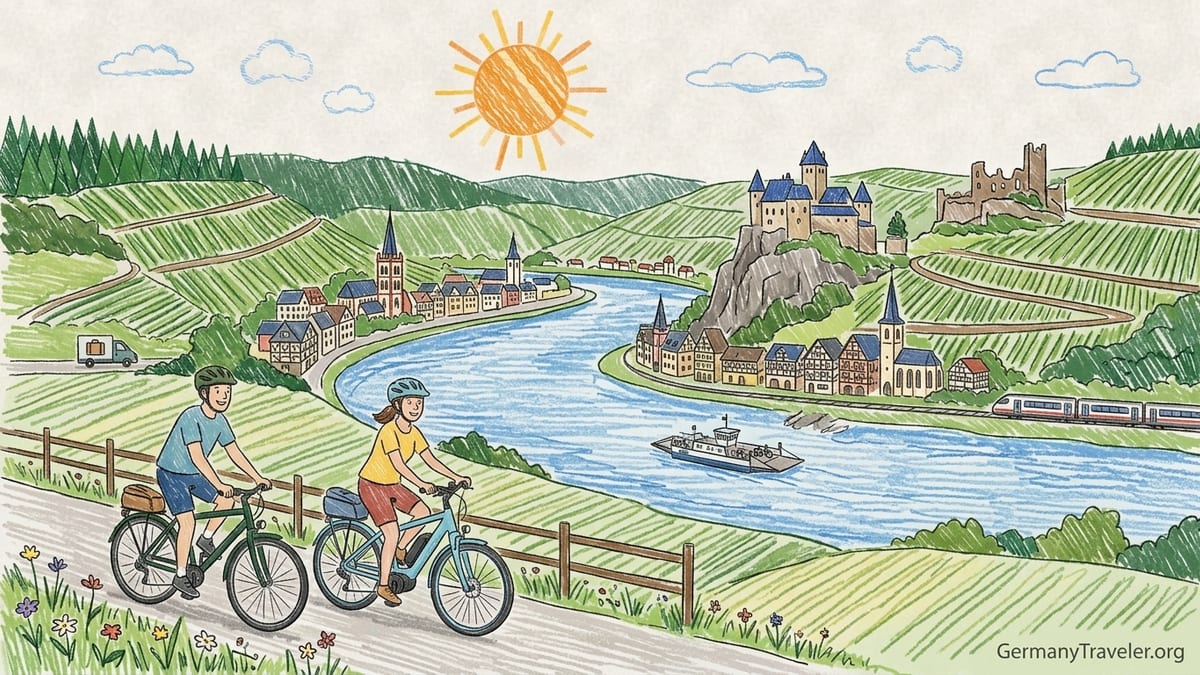
Why Choose a Rhine Valley Cycling Holiday
The Rhine Cycle Route, also known as EuroVelo 15, follows the river for more than 1,200 kilometres from the Swiss Alps to the North Sea. In the heart of the Rhine Valley, particularly between Basel and Cologne, the path usually runs close to the water on dedicated cycleways or quiet river roads. That means minimal climbing compared with the steep vineyard slopes above, making the route attractive to travellers who enjoy being active but do not consider themselves serious cyclists.
Unlike remote touring routes that require camping gear and advanced navigation, the Rhine Valley has dense infrastructure. Riverside towns such as Bingen, Bacharach, St. Goar, Koblenz, Boppard, Bonn and Cologne are frequent, trains track the river on both banks through much of Germany, and bike services are well established. This combination allows tour operators to package cycling holidays that feel adventurous and scenic but are logistically straightforward, even for a first European cycling trip.
For many travellers, the main appeal is comfort and convenience. Current operators commonly bundle pre-booked hotels, daily breakfast, luggage transfer and bike or e-bike rental into one price. You ride with just a day bag, follow clear route notes or GPS tracks, and check in each afternoon to an already-reserved room. It is closer to a walking holiday on the Camino or an inn-to-inn hike in the Alps than to old-style bicycle touring with heavy panniers.
How Self-Guided Hotel-to-Hotel Packages Work
Most Rhine Valley cycling holidays sold for 2026 are self-guided: you cycle independently, but the itinerary, hotels and logistics are organized in advance. A typical seven-night package between Mainz and Cologne might include six cycling days, luggage transport between hotels, breakfast each morning and rental of a trekking bike or e-bike. Prices vary by operator and hotel standard, but many mid-range packages fall in the region of a low to mid four-figure sum per person in high season, with reductions for shoulder seasons.
On arrival day, you check into your first hotel, collect or are fitted to your bike and receive a briefing. Operators commonly provide printed day-by-day route descriptions plus GPX files for use on a phone or GPS device. Some still hand out overview maps of EuroVelo 15, particularly in regions like the Upper Middle Rhine between Bingen and Koblenz, so you can see how the river meanders and where ferries or viewpoint detours lie.
Each morning you leave your main luggage at reception with a label provided by the operator. A local logistics partner collects bags and delivers them to your next hotel, usually by mid-afternoon. While your suitcase travels in the van, you ride with water, snacks, an extra layer and valuables in small panniers or a handlebar bag. At the end of the day, you simply pick up your bag from reception in the next town. This structure frees you to enjoy cafe stops, castle visits and river views without worrying about the weight on your bike.
Because the Rhine corridor has frequent trains and ferries, self-guided packages are usually flexible. If you wake to heavy rain between Boppard and Bonn, for example, you can often take a regional train with your bike to shorten the ride. Many operators mention these options in their route notes and can advise which stations and ferries are most bike friendly when you book.
Daily Distances and Who the Rhine Route Suits
One of the reasons the Rhine Cycle Route has become a mainstream holiday choice is that daily distances are calibrated for comfort rather than performance. Classic hotel-to-hotel trips often plan 35 to 60 kilometres of cycling per day, depending on the section. On the dense and scenic stretch through the UNESCO-listed Upper Middle Rhine Valley, it is common to see itineraries with around 40 kilometres per day from Mainz to Boppard, Boppard to Koblenz, and on towards Bonn. At a relaxed pace with photo stops and a long lunch, many leisure riders cover that in three to five hours.
Because the route is generally flat along the riverbanks, time in the saddle is more important than climbing ability. The biggest elevation changes on the core valley sections are usually when you cross bridges, roll up from the towpath into a town centre, or choose to ride up into the vineyards for a viewpoint. Some days are effectively “pancake flat,” particularly on the lower Rhine into the Netherlands, which appeals to first-timers or families with school-age children who want an achievable adventure.
Operators design specific versions of their Rhine tours for different audiences. There are shorter “comfort” itineraries with only 25 to 35 kilometres per day between villages like Rüdesheim, Lorch, Oberwesel and St. Goar, ideal for travellers who want plenty of time for castle visits and wine tasting. At the other end, there are sportier options stringing together longer legs, such as Mainz to Koblenz in one day, or riding from Cologne deep into the Ruhr region with daily distances closer to 70 kilometres. In all cases, the same basic services apply: hotel bookings, breakfast, luggage transfer and bike rental.
Rhine Cycle Route Sections and Best Bases
The full Rhine Cycle Route runs from Andermatt in Switzerland to the river’s mouth in the Netherlands, but most holiday packages focus on the most accessible and scenic sections. One popular region is the Upper Middle Rhine Valley between Bingen and Koblenz, often marketed as the “Romantic Rhine.” Here the river squeezes between steep slopes dotted with castles and terraced vineyards, and small towns such as Bacharach, Oberwesel and St. Goar sit on the banks, linked by ferries and trains. You can base yourself in one town for several nights and ride out-and-back, or move every day with a hotel-to-hotel itinerary.
Further south, the stretch between Basel and Karlsruhe passes through the Rhine plain and the wine regions of Alsace and Baden. Towns like Breisach, Neuf-Brisach, Freiburg (a short detour from the river) and Strasbourg feature heavily in tour brochures, with routes that swap between the German and French sides of the Rhine using bridges and ferries. This area suits cyclists who enjoy combining gentle miles with city sightseeing, wine villages and local gastronomy.
North of Koblenz, the cycle route skirts Bonn and Cologne and then follows the broadening river towards Düsseldorf, Duisburg and the Dutch border. Some self-guided holidays end at Cologne or Düsseldorf, allowing travellers to fly in and out of large airports while still enjoying a largely riverside route. Others continue into the Netherlands, where the Rhine splits into several branches and the route runs on excellent Dutch cycleways to coastal towns near Rotterdam or Hoek van Holland. These lower sections are especially flat and straightforward, attractive to families and groups of mixed ability.
For travellers who want a short taste of the Rhine rather than a full multi-country journey, three to five night breaks are common. A typical example might be a four-night holiday based in Boppard or Bacharach with day rides up and down the valley, boat excursions and a day trip by train to Koblenz. Because the Rhine corridor is threaded with rail lines, it is easy to scale a trip to the time you have without losing the essence of the route.
Luggage Transfers, Bike Hire and E-Bikes
Luggage transfer is central to the modern Rhine cycling holiday. Even operators that target budget-conscious travellers recognize that riding pannier-free is one of the key selling points. Bags are usually limited to one suitcase or large holdall per person within a set weight, with surcharges for additional items. Pick-up times are typically late morning, allowing for a leisurely breakfast before you set off. Delivery is often guaranteed by mid-afternoon so that late riders still find their luggage waiting when they check in.
Bike rental is normally included in the base price of a package, with the option to upgrade. Standard bikes along the Rhine are often 21- to 24-speed trekking or touring models with pannier racks, mudguards and lights, suitable for the paved cycle paths and occasional compact gravel sections. Most companies offer step-through frames as well as crossbar models, which can be more comfortable for occasional riders. Helmets may or may not be included, so travellers from abroad often choose to bring their own to ensure fit.
E-bike rental has grown significantly along the Rhine, reflecting wider trends in European cycling tourism. Many 2026 packages explicitly list e-bikes as an option at a per-day or per-tour supplement. Having electric assistance opens the route to a wider audience, including less fit riders, older travellers and couples where one partner cycles more than the other. Although the river sections are not especially hilly, e-bikes can make longer days, headwinds or optional vineyard climbs more enjoyable. Operators typically provide chargers and explain how to manage battery range based on the day’s distance.
Real-world examples illustrate how integrated these services have become. It is common to see a small delivery van dropping off suitcases in towns like Rüdesheim or St. Goar around midday, while groups of cyclists roll in later with only handlebar bags. Rental fleets parked outside hotels in Mainz, Koblenz or Strasbourg often include a mix of traditional touring bikes and modern e-bikes with mid-drive motors and upright positions. For travellers who do not want to worry about mechanics, some operators also include emergency breakdown hotlines and simple on-the-road assistance within their packages.
Trains, Ferries and Other Route Support
One of the biggest safety nets on a Rhine cycling holiday is the parallel train network. Through much of Germany, regional trains run along both banks of the river, with frequent stops in small towns. Many of these services have bike spaces that can be reserved or boarded with a modest bike ticket, allowing you to shorten a day, skip bad weather or adjust your itinerary on the fly. On the Upper Middle Rhine, it is perfectly normal for riders to cycle from Bacharach to St. Goar in the morning, then take a train to Koblenz for afternoon sightseeing and return by bike or rail.
Ferries are another useful tool. The river twists and bends, and cycle paths run on both banks, so small car and passenger ferries link the two sides. Towns such as St. Goar and St. Goarshausen, Boppard and Filsen, or Bacharach and Kaub have regular crossings that carry bikes. Operators often design itineraries that incorporate these ferries, both for variety and to balance distances. Travellers might, for example, ride on the quieter left bank in the morning, cross the river after lunch, and then follow the opposite bank to the next hotel.
Because the Rhine valley is densely populated, access to services is rarely a problem. Cafes, bakeries and beer gardens are frequent along the route, particularly in the German wine regions and Dutch towns. Locksmiths, bike shops and general mechanics are present in most larger centres such as Mainz, Koblenz, Bonn and Cologne, so mechanical issues can usually be fixed without derailing the entire trip. Many organized packages include a list of recommended repair shops and emergency numbers as part of the travel documents.
For travellers who like extra structure, some operators combine cycling with river cruising. In these bike-and-boat holidays, you sleep on a small river ship that moves along the Rhine each day while you ride sections of the route. Luggage remains on board, the ship provides meals, and you can stay on the boat if you prefer to skip a cycling day. While this format is different from hotel-to-hotel touring, it is built on the same infrastructure of riverside paths, e-bike availability and train-connected towns.
Accessibility Beyond Serious Cyclists
What distinguishes the Rhine from more demanding cycling destinations is how forgiving the terrain and logistics are. Along the core valley stretches, gradients are low, surfaces are mostly paved and navigation is straightforward, often just following Rhine Cycle Route signs with the EuroVelo 15 logo. You see a wide mix of riders: couples on rented trekking bikes, groups of friends on e-bikes, families towing trailers, and local commuters on city bikes, all sharing the same riverside paths.
Because much of the route remains close to water level, you are not committing to remote mountain passes or long, exposed climbs. The steep, postcard-perfect vineyards you see rising above towns like Boppard, Oberwesel or Rüdesheim are optional detours rather than obstacles on the main route. If you choose to climb into the hills, you can, but the standard holiday itineraries typically keep to the riverbanks so that distance, not altitude, is the main challenge.
This accessibility makes the Rhine an appealing destination for mixed-ability groups. A family might book a seven-night package between Strasbourg and Mainz, with parents on e-bikes and teenagers on regular bikes. A couple in their sixties might ride from Bingen to Cologne with short daily stages and an extra rest day in Koblenz. A group of friends could combine cycling with wine tastings and castle visits, confident that they can always hop on a regional train if they get tired.
Travelers used to city bike-share schemes often find the Rhine holiday format familiar but elevated. The bikes are sturdier, routes are continuous and car traffic is usually kept at a distance. Yet you still roll straight into town squares, riverside promenades and station forecourts. This blend of ease, safety and cultural richness explains why tour operators consistently list the Rhine among their most popular European cycling products.
The Takeaway
A Rhine Valley cycling holiday is not just about covering kilometres along a famous European river. It is about combining achievable daily rides with the comfort of luggage-free cycling, pre-booked hotels and the option of e-bike assistance. The riverside route keeps climbing modest, while trains and ferries provide an ever-present safety net. Towns, castles, vineyards and cities unfold at a human pace, with frequent opportunities to stop, explore and taste along the way.
For travellers comparing destinations, the Rhine stands out as a highly organized, low-stress option. Current cycling operators in 2026 package the essentials into one booking: accommodation, breakfast, luggage transfer and bike rental, with route notes and practical support layered on top. Whether you choose a long journey from Basel to the Dutch coast or a short break between Bingen and Koblenz, the experience is designed to be accessible far beyond seasoned cyclists.
If you are planning your first self-guided cycling holiday, the Rhine Cycle Route is an intuitive place to start. You can select stages that match your fitness, rely on transport links if plans change, and enjoy some of Europe’s classic river scenery without the burden of heavy bags. With thoughtful preparation and the right package, riding the Rhine becomes less a physical challenge and more a relaxed way to travel through the heart of Central Europe.
FAQ
Q1. Do I need to be an experienced cyclist to book a Rhine Valley cycling holiday?
Most organized Rhine Valley cycling holidays are designed for leisure riders rather than competitive cyclists. The riverside sections of the Rhine Cycle Route are generally flat or gently rolling, surfaces are good, and daily distances on standard packages are typically in the 35 to 60 kilometre range. If you can comfortably ride a bike for a couple of hours at home, you can usually manage a self-guided Rhine itinerary, especially if you opt for an e-bike.
Q2. How many days should I plan for a Rhine cycling trip?
Many travellers choose a week-long holiday, with seven nights yielding five or six cycling days plus arrival and departure days. That is enough time, for example, to ride a classic section such as Mainz to Cologne or Basel to Karlsruhe at a relaxed pace. Shorter three- to five-night trips based around one or two river towns are also common, while long-distance riders sometimes link two weeks or more to follow the Rhine from the upper valley into the Netherlands.
Q3. What is typically included in a self-guided Rhine cycling package?
Most 2026 operators include hotel accommodation, daily breakfast, luggage transfer between hotels and bike rental in the base price. Many also provide e-bikes for a supplement, detailed route notes, GPX files, a briefing on arrival and a helpline for emergencies. Evening meals, drinks and entry fees for castles or museums are usually extra unless you specifically book a half-board package.
Q4. When is the best time of year to cycle the Rhine?
The main cycling season on the Rhine runs from late April to early October. May and June often bring mild temperatures and fresh greenery, while September can be particularly attractive in wine regions as vineyards are active and days are still long enough for comfortable rides. July and August are also popular but can be hotter and busier, especially in tourist hotspots like the Upper Middle Rhine Valley.
Q5. Can I rent an e-bike for my Rhine Valley cycling holiday?
Yes, many current operators explicitly offer e-bike rental on Rhine packages. You usually pay a daily or per-tour supplement to upgrade from a standard trekking bike to an e-bike. This can be worthwhile if you are less confident about fitness, want to extend daily distances or hope to include optional detours into hillier vineyard terrain without worrying about steep climbs.
Q6. How does luggage transfer work on the Rhine Cycle Route?
On hotel-to-hotel packages, you leave your main luggage at the hotel reception each morning with labels provided by your operator. A designated driver collects the bags and transports them to your next hotel, typically delivering them by mid-afternoon. You ride with only a small day bag for essentials. Operators usually specify a maximum size or weight per bag and may charge a fee for additional items.
Q7. What kind of bike will I get, and can I bring my own?
Standard rental bikes on Rhine holidays are usually comfortable trekking or touring bikes with multiple gears, mudguards, lights and a rear rack. Step-through frames are widely available. E-bikes are offered by many companies as an upgrade. If you prefer to bring your own bike, most operators allow this and may reduce the price slightly, but you are then responsible for transporting and maintaining it during the trip.
Q8. How do trains and ferries fit into a Rhine cycling itinerary?
Regional trains run along much of the Rhine and can carry bikes, subject to local rules and tickets. They are useful if you want to shorten a stage, avoid poor weather or explore a city without riding both ways. Ferries cross the river at numerous points, allowing you to switch between banks or follow circular routes. Many self-guided itineraries mention recommended train stations and ferry crossings in their route notes.
Q9. Are Rhine Valley cycling holidays suitable for families?
The gentle gradients, good surfaces and frequent towns make parts of the Rhine Cycle Route suitable for families, especially with older children. Some operators offer family-focused packages with shorter daily distances, child bikes, trailers or tag-along attachments, and suggestions for child-friendly stops. Parents should still consider traffic levels around larger cities and choose sections where the route stays on dedicated paths away from busy roads.
Q10. How far in advance should I book a Rhine cycling package?
Availability varies, but for high season dates between May and September it is sensible to book several months in advance, particularly if you want specific hotel standards or e-bikes, which can sell out. Shoulder-season trips in spring and early autumn are sometimes available closer to departure, but booking early still helps secure preferred dates and routes, especially on the most popular stretches such as the Upper Middle Rhine Valley.