


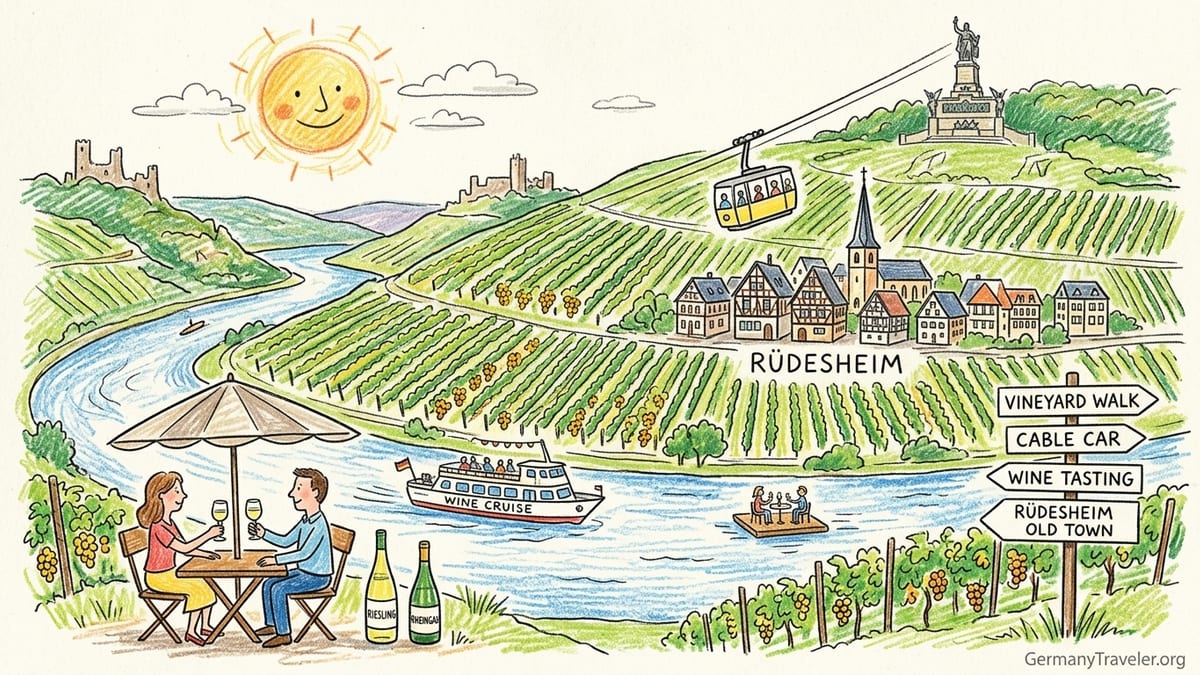
The steep vineyards above Rüdesheim and the Rhine’s broad, shimmering curve below are what many travelers picture when they imagine German wine country. This is the heart of the Rheingau and the Upper Middle Rhine Valley, where Riesling clings to slate and quartzite slopes, castles watch from crags, and wine has shaped daily life for centuries. Today, Rüdesheim’s compact old town is also one of the easiest places in Germany to build a wine-focused trip, with everything from casual tastings and cable-car rides to serious vineyard hikes and curated private tours.
Understanding the Rheingau, Rüdesheim and Riesling
The Rheingau is one of Germany’s most historic wine regions, stretching along a wide east-west bend of the Rhine between Wiesbaden and Lorch. Rüdesheim sits near the western end of this arc, where the river narrows and the UNESCO-listed Upper Middle Rhine Valley begins. The town itself is small and walkable, but it is surrounded by steep slopes like the Rüdesheimer Berg, planted mostly with Riesling vines that have made the area world-famous.
Riesling is the dominant white grape here and defines most wine experiences in and around Rüdesheim. Expect dry and off-dry styles to be the norm in the Rheingau. Labels often highlight specific vineyard names such as Berg Roseneck, Berg Rottland or Berg Schlossberg, signaling wines from steep, sun-catching terraces above the river. These sites typically produce concentrated wines with high acidity, citrus and stone-fruit notes, and a distinct mineral edge linked to the slate, quartzite and loess soils.
Travelers sometimes arrive assuming all German Riesling is sweet. In Rüdesheim and the wider Rheingau, “trocken” on the label signals dry, while “feinherb” or “halbtrocken” indicates off-dry with a gentle hint of residual sugar. Many winery tastings will pour a mix of styles so you can compare how sweetness, acidity and ripeness interact. Even at beginner-friendly tastings, staff are usually happy to translate label terms and explain the local classification system in simple language.
Red wine does appear, especially Spätburgunder (Pinot Noir) from nearby Assmannshausen, but most core wine experiences around Rüdesheim remain Riesling-focused. For many visitors, this makes the town an ideal base to learn how Riesling can shift from crisp and linear to ripe and textured depending on slope exposure, soil and harvest decisions, all within a short radius.
Wine Tastings in and around Rüdesheim
Rüdesheim offers an unusually dense mix of tasting options, from simple bar tastings to curated flights at historic estates. In the old town, you will find wine taverns and tasting rooms pouring local producers by the glass. A structured tasting of three to five wines typically starts around 12 to 20 euros per person, with more extensive flights or premium single-vineyard selections costing more.
At classic Rheingau estates just beyond the town center, tastings with a guided cellar tour remain excellent value. A typical example in the wider region is a cellar and winery tour including one sparkling wine and three to seven still wines, often priced roughly between 15 and 25 euros per person, depending on length and number of wines. These experiences usually last one to two hours and walk you through production areas, barrel or stainless-steel cellars, and sometimes a brief vineyard stroll before you sit down for the main tasting.
Some wineries in Rüdesheim and neighboring villages run tastings that double as short educational workshops. Expect staff to line up several Rieslings from different vineyards or vintages side by side. They might pour, for instance, a village-level dry Riesling, followed by a single-vineyard wine from the Rüdesheimer Berg, and finish with a slightly sweeter late-harvest bottle. This style of tasting is ideal for travelers who want to leave understanding why elevation, soil and harvest date matter rather than simply sampling “house white” and “house red.”
Wine bars and hotel restaurants in town often stock a broader cross-section of Rheingau producers by the glass, which can be helpful if you want to taste more without committing to long tours. Glass pours commonly start in the 6 to 9 euro range for solid dry Riesling and climb for reserve or single-vineyard wines. If your time is short, one efficient strategy is to schedule a single structured winery tasting mid-day and then use a local wine bar in the evening to fill in styles or producers you missed.
Guided Vineyard Walks, Cable Cars and Floating Tastings
Guided vineyard walks are one of Rüdesheim’s signature experiences and a good way to connect the wine in your glass with the slope it came from. The town’s official tourism office currently promotes several guided wine hikes and “walking and tasting” tours that lead through surrounding vineyards, often combining panoramic viewpoints with tastings poured directly in the vines. These walks typically last about two to three hours, include several wines, and are scheduled on specific dates through the main season.
Rüdesheim’s cable car, which glides over the vineyards to the Niederwald Monument high above town, has become a backbone for wine-and-scenery packages. Some guided tours use a “float above the vines” concept, starting with a cable-car ride up to the monument, then descending on foot along vineyard paths while stopping for tastings. A typical small-group experience of this kind runs roughly three hours, includes three to four wines, and is often priced around 60 to 80 US dollars per person when booked through international platforms.
Wine-focused boat experiences give another perspective on the valley. From Rüdesheim’s riverside piers, regular passenger boats head through the castle-studded stretch of the Middle Rhine toward Bingen, Bacharach or as far as the Loreley rock. Some departures are packaged as wine cruises with onboard tastings led by local wineries. Current programs marketed by the Rüdesheim tourism office include themed cruises where a Rheingau estate pours several wines as you pass terraced slopes and ruined castles. Prices vary by length and wine selection, but many travelers can expect a half-day boat trip with tasting elements to land in the 40 to 70 euro per person bracket.
For travelers seeking something more immersive, a few regional estates and tour operators offer “strolling tastings” that weave together gentle walks through historic estates or along vineyard tracks with tastings at multiple stops. These might include, for example, a welcome sparkling wine in a courtyard, followed by small pours at scenic points overlooking the Rhine. While you will not cover huge distances, there is often some uphill walking and unpaved tracks, so closed shoes and readiness for uneven ground are important.
Independent Visits vs Guided Tours: How to Choose
Rüdesheim and the Rheingau can absolutely be explored independently, especially if you are comfortable reading basic German signage and planning your logistics around local trains, boats and the cable car. An independent day might look like this: morning stroll through Rüdesheim’s old town, a cable-car ride up to the Niederwald Monument, a self-guided walk through vineyards back toward town, and an afternoon tasting at a pre-booked winery. For many experienced travelers, that level of independence offers the best balance of flexibility and cost control.
Guided tours, however, remove guesswork and can unlock experiences that are harder to arrange on your own. The official tourism office in Rüdesheim markets multiple guided wine walks, tastings and boat trips that bundle tickets, tastings and timing into one package. Regional platforms also sell small-group experiences such as “Rüdesheim guided wine hikes with cable car” or “Rüdesheim walk, drink, repeat” tours, usually three-hour experiences that combine vineyard walking, old-town commentary and multiple tastings. These can be particularly attractive if you are visiting on a weekend or during a festival when individual wineries might be busy or closed for private events.
Consider booking a guided tour instead of going fully independent if you fall into at least one of these categories: you have only one full day in the region and want to maximize what you see; you are traveling with friends who prefer to relax rather than navigate; or you are anxious about language barriers or reservations. Guided tours are also smart when traveling in high season, roughly May through September, when popular wineries may fill their tasting appointments well in advance and boats or cable cars can be crowded.
Independent travel works best for visitors who can commit a bit of time before arrival to check winery opening hours, send reservation emails and understand train and boat timetables. If you want to build in both serious tasting time and flexible wandering, a hybrid approach often works well: book one structured group or private tour for orientation on your first day, then use what you learn about Riesling styles and local geography to shape more spontaneous winery visits on following days.
Transportation, Terrain and Walking Difficulty
Most visitors reach Rüdesheim from Frankfurt or Mainz. From Frankfurt, expect roughly an hour by regional train with a change in Wiesbaden or via the Rhine route from Frankfurt airport. From Mainz, a regional train follows the north bank of the Rhine west toward Assmannshausen and Rüdesheim, with vineyard views almost the entire way. Many travelers treat this train ride itself as a scenic introduction to the valley, especially on the stretch between Mainz and Koblenz where castles and steep vineyards crowd the riverbanks.
Within Rüdesheim, you can walk to most central tasting rooms and the cable car in less than 15 minutes from the station. The lower town is mostly flat and paved, though some lanes are cobbled. Once you head uphill toward the vineyards, paths quickly become steeper and can involve compacted dirt, gravel or grass. Official vineyard walks promoted by regional tourism bodies often mention whether they include steep sections or steps, but it is safe to assume that any route climbing to viewpoints above town will involve moderate elevation gain.
Guided vineyard hikes usually rate as moderate in difficulty: you should be able to walk steadily for two to three hours, sometimes on narrow or uneven tracks, and handle some sustained uphill sections. In summer, the combination of heat, reflection from light-colored soils and lack of shade can make even modest slopes feel more demanding. Good walking shoes, sun protection and a refillable water bottle are essential, even for relatively short tours.
Transportation between towns along the Rhine is straightforward, which encourages travelers to base in Rüdesheim yet explore further. Regular boats connect Rüdesheim with Bingen and upstream Middle Rhine towns such as Bacharach and St. Goar, while the regional train network on both riverbanks allows easy hops between wine villages. For wine-focused days, many visitors combine a morning train ride to a famous Rheingau estate or monastery, an afternoon tasting and a late-afternoon boat or train back to Rüdesheim for dinner and an evening stroll.
Comparing Key Wine Experiences and What They Cost
For planning, it helps to think in categories: short in-town tastings, half-day vineyard walks, full-day regional excursions, and private custom tours. In-town tastings are the most flexible and affordable option. Walk-in tastings of three to five wines in Rüdesheim and nearby Rheingau villages often start around the mid-teens in euros per person, rising for premium lineups or extensive cellar tours. Adding a simple snack plate increases the price but can transform a quick tasting into a relaxed light meal.
Guided vineyard walks, especially those marketed via local tourism sites, tend to cost a bit more but deliver context and scenery. Many two- to three-hour group walks with three or four wines land roughly in the 40 to 80 euro per person range, depending on what is included. If there is a cable-car ride, that ticket is commonly bundled into the price. These tours are ideal for travelers who want to keep moving, take photos among the vines and hear stories about local winemaking history rather than sit indoors.
Wine-and-boat experiences introduce more moving parts, so prices are more variable. A simple scenic boat ride without tastings is usually affordable, and some travelers choose to pair it with independent tastings before or after. By contrast, curated wine cruises that include multiple wines poured onboard, commentary, and sometimes snacks can push the cost closer to a full-day excursion. They work best if your group values scenic cruising as much as detailed wine education, since onboard tastings are often more relaxed and social than technical.
Private wine tours, whether booked through regional tourism offices, hotel concierges or specialized operators, sit at the top of the cost spectrum but offer maximum control. A private half-day tour by car, visiting two to three wineries in the broader Rheingau, often starts in the low hundreds of euros for the vehicle and guide, with tasting fees sometimes added per winery. These tours are most worthwhile if you have specific producers in mind, are traveling in a small group that can split the cost, or have mobility or timing needs that do not fit standard group schedules.
When to Visit and How to Book
The main wine-touring season in the Rhine Valley runs from late April through October, with the busiest months typically May, June, September and early October. During this window, Rüdesheim’s official tourism calendar fills with guided wine walks, open tastings and themed cruises. Some programs, like the town’s multi-stop WINEAROUND tasting in the historic center, run on many dates throughout late summer and autumn, while others such as specific vineyard hikes or harvest-season events appear only on selected weekends.
If your trip falls between May and October and you want a structured wine experience, it is wise to book core activities in advance, especially on Fridays and Saturdays. Popular guided wine hikes that combine cable-car rides, vineyard tastings and old-town commentary often operate with fixed capacities. Booking ahead through official tourism channels or reputable tour platforms helps avoid disappointment, particularly if you are a small group hoping to join a specific departure.
Outside the main season, typically November through March, Rüdesheim is quieter. Some wineries reduce opening days or switch to appointment-only tastings. Boat schedules are more limited and certain vineyard walks or open-air events pause until spring. Winter visits can still be rewarding, especially around Christmas when Rüdesheim hosts seasonal markets, but you should expect fewer group wine-tour options and plan to contact wineries and tourism offices directly to confirm availability.
A practical approach is to anchor your trip around one or two pre-booked experiences, then leave extra space for spontaneous tastings and strolls. For example, you might reserve a guided vineyard walk with tastings for your first morning in Rüdesheim and a wine-focused boat trip for another afternoon. Between those anchors, you can wander into wine taverns, explore side streets, or hop a short train to a neighboring Rheingau village without feeling overscheduled.
The Takeaway
Rüdesheim and the surrounding Rheingau and Middle Rhine offer wine travelers an unusually compact mix of experiences. You can taste Riesling from steep, historic vineyards in the morning, float past castle-topped cliffs with a glass in hand in the afternoon, and wander cobbled lanes back to your hotel in the evening, all without needing a car. The town’s role as a major tourist hub means that its tourism office and local operators have developed a wide range of guided wine walks, tastings and cruises that are easy to book and understandable even for first-time visitors to German wine country.
Whether you choose independent tastings, structured vineyard hikes, wine-and-cable-car experiences, floating tastings on the Rhine or custom private tours ultimately comes down to how you like to travel. Independent explorers who enjoy planning can string together trains, boats and winery reservations to build flexible days at relatively modest cost. Travelers who prefer to focus on the experience rather than logistics can lean on guided tours that bundle transport, tastings and storytelling.
What unites all these options is the region’s core character: Riesling vines clinging to slopes above one of Europe’s great rivers, shaped by centuries of monastic and civic winemaking. With a bit of advance thought about walking difficulty, transportation and when to rely on guides, you can tailor a Rhine Valley wine trip that matches your pace, your budget and your curiosity about the wines in your glass.
FAQ
Q1. Do I need to book winery tastings in Rüdesheim in advance?
Many central wine bars and simple tastings can be done as walk-ins, especially on weekdays, but structured cellar tours and tastings at well-known estates usually require reservations, particularly from May to October and on weekends.
Q2. How much should I budget for a basic wine tasting in the Rheingau?
A straightforward tasting of three to five wines at a winery or dedicated tasting room typically costs from the low to mid-teens in euros per person, with more elaborate flights or premium single-vineyard lineups priced higher.
Q3. Are guided vineyard walks suitable for beginners or non-hikers?
Most vineyard walks around Rüdesheim are designed for reasonably fit visitors and involve moderate hills, unpaved paths and some steps, so comfortable shoes and basic fitness are helpful, but you do not need technical hiking experience.
Q4. Can I visit both the Rheingau and Middle Rhine wine areas from Rüdesheim without a car?
Yes, regular regional trains and boats run along the Rhine, so you can base in Rüdesheim and use public transport to reach nearby Rheingau villages and Middle Rhine towns for tastings and sightseeing.
Q5. When is the best time of year for wine tours around Rüdesheim?
The most active period for tours and tastings is generally late April through October, with peak activity in May, June, September and early October when weather is mild and vineyards are green.
Q6. Are most Rieslings in Rüdesheim dry or sweet?
In the Rheingau and around Rüdesheim, many Rieslings are made in a dry style labeled “trocken,” though you will also find off-dry and sweeter wines, so it helps to mention your preference during tastings.
Q7. Is a guided tour worth it if I only have one day in the region?
If you have just a single day, a guided vineyard walk or combined cable-car and tasting tour can efficiently bundle scenery, education and logistics, though independent travelers comfortable with planning can still see a lot on their own.
Q8. What should I wear for wine-and-cable-car or vineyard walk experiences?
Wear closed, comfortable walking shoes with good grip, weather-appropriate layers, sun protection in warmer months and bring a small bag for water, since vineyard paths can be steep, uneven and exposed.
Q9. Are wine-and-boat experiences very formal?
Most wine-focused cruises on the Rhine are relaxed and casual, with tastings geared toward enjoyment and scenery rather than technical analysis, so smart-casual clothing and a laid-back attitude are usually perfect.
Q10. How do tasting fees work if I am on a private wine tour?
Some private tours include tasting fees in a single package price, while others charge for transport and guiding separately and pay tasting fees at each winery; you should clarify what is included when booking so you can budget accurately.