


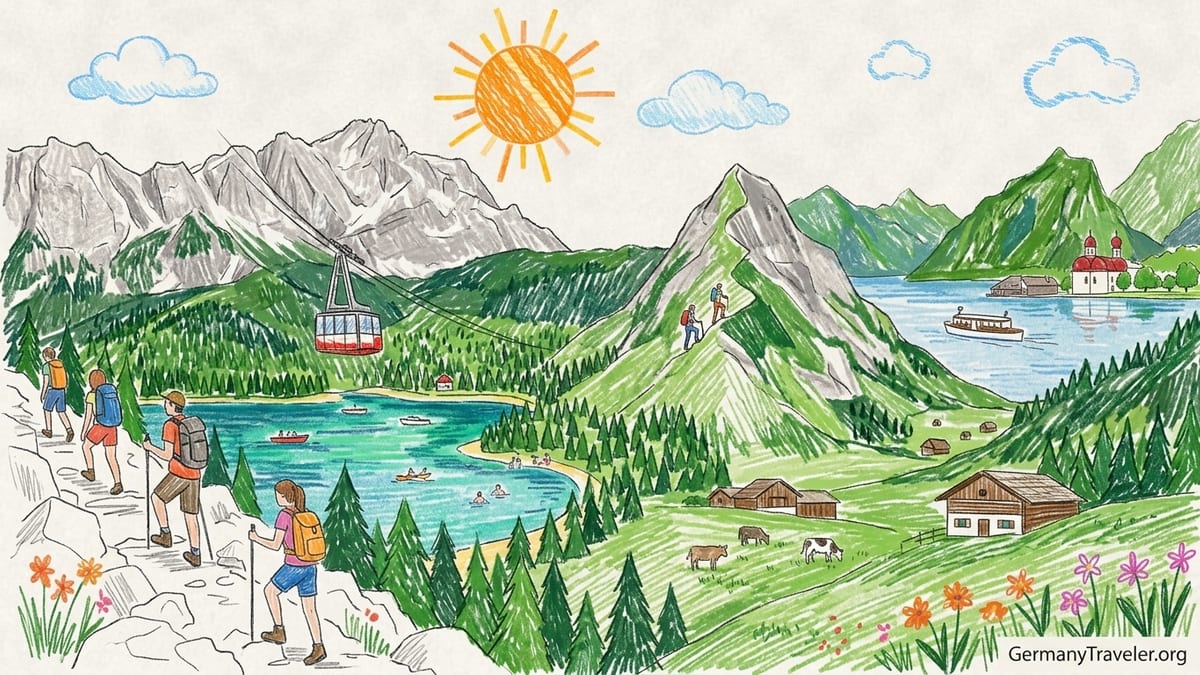
The German Alps in summer are a different world from their snowbound winter image. Meadows turn green, turquoise lakes warm enough for a bracing swim, and cable cars that once ferried skiers now whisk hikers and sightseers up to panoramic ridgelines. From the Zugspitze and Eibsee near Garmisch-Partenkirchen to the fjord-like Königssee, the quiet valleys of Oberstdorf and Mittenwald, and the lake country around Tegernsee and Chiemsee, this is Germany at its most dramatic outdoors. This guide focuses on warm-season experiences: hiking, mountain lakes, cable cars, swimming, cycling and scenic drives, with practical details woven in so you can plan a real trip, not just dream about one.
Summer Weather, Seasons and How the Alps Feel in Warm Months
Summer in the German Alps typically runs from late May to early October, with the most reliable warm, green conditions in July and August. At valley level around towns like Garmisch-Partenkirchen, Berchtesgaden or Oberstdorf, daytime highs often sit between the low 20s and high 20s Celsius, while nights cool down enough that you may still want a light jacket. Higher up at 2,000 meters and above, such as on the Nebelhorn, Fellhorn or Zugspitze plateau, temperatures can be 10 degrees cooler. You can leave Munich in T-shirt weather and arrive at an upper cable car station stepping into a stiff, chilly breeze.
Thunderstorms are part of the summer rhythm. Warm, humid afternoons, especially in July and August, can build into short but intense storms with lightning, heavy rain and strong gusts. Local weather services and mountain railways usually update their apps and station boards through the day, and hut wardens will often warn about incoming storm cells over dinner. Plan your main hikes and summit visits for the morning, aiming to be back below treeline by mid to late afternoon, and never ignore a darkening sky in the high mountains.
Even on clear days, the sun is stronger than many visitors expect. UV levels rise quickly with altitude, so long hikes above tree line on ridges like the Wank, Hochfelln or across the open slopes above Tegernsee feel more intense than similar distances in the lowlands. Pack high-factor sunscreen, sunglasses with good coverage and a light cap. Weather can still flip fast: it is not unusual in June or September to start a hike in sunshine and end it in light sleet on the same trail near 2,000 meters, so a compact waterproof jacket and a warm layer belong in every daypack.
Warm-season operations for mountain lifts generally run from late May to early November, though precise dates vary each year. For example, in recent years the Nebelhorn and Fellhorn lifts near Oberstdorf have typically operated from the end of May until early November, while many smaller chairlifts in ski areas close in late September. Outside the core July–August period, be prepared for occasional closure days if the weather is very poor or maintenance is scheduled. Always check the specific lift’s current timetable the evening before you plan to go.
Understanding Cable Cars and Choosing the Right Ride
Cable cars and gondolas are the backbone of summer mountain travel in the German Alps. They turn what would be an all-day, 1,500-meter climb into an easy 10-minute ascent, opening spectacular terrain to casual hikers and families. A typical example is the Cable Car Zugspitze from Eibsee, which takes only around 10 minutes to climb almost 2,000 vertical meters to Germany’s highest peak, with cabins timed at least every half hour and additional runs during busy periods. Other classic summer lifts include the Karwendelbahn above Mittenwald, the Nebelhornbahn and Fellhornbahn at Oberstdorf, and the local peaks around Garmisch in the Garmisch-Classic area.
Most major lifts sell one-way and return tickets, as well as combined products that integrate local trains or multiple mountains. Prices vary but a return ticket for a flagship summit like the Zugspitze can be in the high double digits per adult, while mid-range peaks such as Fellhorn or Nebelhorn usually sit somewhat lower. If you plan several lift rides in a week, many guest cards in towns such as Oberstdorf offer discounts, and some accommodations participate in “mountain railways included” programs that give you free daily trips on local lifts during your stay.
Operationally, summer cable cars are highly weather dependent. Strong winds, thunderstorms or persistent low cloud can halt services even on dates listed as “open.” Morning is generally the safest window, both for visibility and stability. On popular days in August, it is worth arriving at base stations early to avoid queues. Germany’s tourism promotion actively encourages visitors to use lifts as gateways to hiking, cycling and climbing, and trail maps at most upper stations show a clear grading system: easy panoramic paths, moderate routes with some steep sections, and challenging alpine trails that may include fixed ropes or exposed traverses.
If you are new to alpine travel, start with a return ticket and gentle circuit hikes from upper stations. A classic beginner-friendly option is the loop at the top of the Karwendelbahn near Mittenwald, combining wide gravel paths, viewing platforms and a stop at the mountain restaurant. As your confidence grows, you can plan more ambitious one-way ideas, such as riding the Nebelhornbahn up, hiking via the Seealpsee mountain lake to a hut, then descending on foot to the valley. Always build in a time buffer for the last downhill cabin: missing it can turn a comfortable day into an unplanned and possibly risky night walk.
Eibsee and Zugspitze: High Peaks and Emerald Water
Eibsee, about an hour and a half from Munich by train and bus via Garmisch-Partenkirchen, is one of Germany’s most photogenic lakes. Fed by mountain springs, it glows in shades of emerald and turquoise on sunny days, fringed by forest and overlooked by the rock wall of the Zugspitze massif. A mostly level walking path encircles the lake in around two to three hours, suitable for most visitors with sturdy shoes. Along the way you pass gravel beaches, wooden jetties and a small boat rental where you can hire rowing boats, stand up paddleboards or pedalos in summer.
Swimming in Eibsee is wild and unsupervised, with no entry fee for the water itself. Even in high summer, temperatures remain cool, so expect a refreshing plunge rather than bath-like warmth. On calm mornings, local swimmers often take long laps close to shore, while day-trippers prefer quick dips from the shore near the main parking area and hotel. Because the lake is fed from underground springs, its shallower bays warm up more quickly than the deeper central basin, making them more comfortable for families with children.
The Zugspitze summit is accessible from Eibsee by the modern cable car and from the valley by the historic cogwheel railway that climbs through tunnels to the glacier plateau, where another short cable car completes the journey to the top. On clear days, views stretch across Germany, Austria and, on the horizon, the higher Alps to the south. Summer visitors come for panoramic viewing platforms, short glacier walks, easy via ferrata routes and terrace restaurants rather than for skiing, which typically finishes in early spring. Serious mountaineers still climb the peak on long routes, but casual travelers overwhelmingly rely on the cable cars.
For hikers, the Zugspitze area offers more than just the summit. In the Garmisch-Classic region below, lifts like the Alpspitzbahn and Kreuzeckbahn open up a web of panoramic trails with views down into the Loisach valley and across to the Wetterstein range. Typical day routes include taking the Alpspitzbahn up, following a well-marked ridge path past viewpoints, then descending via the Kreuzeckbahn station. Each leg can run a few hours at moderate difficulty, with a mix of gravel tracks and rocky footpaths. Always check with the tourist office or lift operator about remaining snowfield sections in early summer, which can significantly increase difficulty for inexperienced hikers.
Königssee, Obersee and Berchtesgaden National Park
At the southeastern edge of Bavaria, Berchtesgaden National Park protects some of Germany’s most dramatic scenery: jagged peaks, deep forested valleys and high lakes. At its heart lies Königssee, a long, narrow lake often compared to a fjord, with steep cliffs plunging straight into clear green water. Motorboat traffic is tightly controlled, and the only regular boats are the quiet electric vessels operated by Bayerische Seenschifffahrt, which run a frequent service in the summer season from Schönau across the lake to St. Bartholomä and onward to the far eastern shore at Salet.
From the Salet landing, a short level hike leads to Obersee, an almost perfectly still lake framed by the vertical wall of the Röthbachfall and surrounding peaks. The path along its northern shore continues on narrow, sometimes rocky ground, including a short exposed section with a handrail that may not be ideal for very young children or anyone with severe vertigo. At the far end lies the Fischunkelalm, a traditional alpine pasture serving simple dishes like cheese bread, sausages and buttermilk in summer. Many visitors plan their day around the boat timetable, taking an early crossing to beat crowds, hiking to Obersee and Fischunkelalm, then allowing time to return to Salet for a mid-afternoon boat back down-lake.
Elsewhere in Berchtesgaden National Park, hiking options range from easy valley walks to demanding alpine ascents. The Jennerbahn cable car from the lakeshore rises to the Jenner area, where broad gravel paths lead to viewpoints over Königssee and more strenuous routes branch off toward higher summits. Weather in this region can shift quickly due to complex mountain wind systems, so even on short walks, good footwear and a rain jacket are essential. Park information points in Berchtesgaden and at Königssee provide updated trail conditions, particularly important in early season when higher routes can still be snow-covered.
Swimming in Königssee itself is limited by steep shores and cool water, but nearby smaller lakes and river pools offer more comfortable spots. South of Berchtesgaden, the Hintersee near Ramsau provides a gentle alternative, with a forest loop path, small beaches and rowboat rentals. Tourism authorities highlight this entire corner of Bavaria as a prime area for hiking, cycling in the valleys, climbing in the surrounding massifs and non-motorized water sports on appropriate lakes, making it suitable for travelers who want several activity options in a single base.
Oberstdorf: High Trails, Alpine Lakes and Summer Ski Resorts Without Snow
Oberstdorf in the Allgäu Alps is one of Germany’s best all-round mountain bases, especially outside ski season. The town is ringed by accessible peaks served by lifts, yet retains a traditional village feel with wooden balconies, church spires and cows grazing in nearby meadows. In summer, its ski infrastructure transforms into a network for hikers, cyclists and paragliders. The Nebelhornbahn climbs in three sections to over 2,200 meters, where a short loop path and viewing terraces give sweeping views over the surrounding ranges, and on clear days you can trace ridgelines deep into neighboring Austria.
Below the Nebelhorn, a series of trails connects alpine lakes like the Seealpsee, popular with photographers for its mirror-like reflections of surrounding cliffs. The route from the mid-station of the Nebelhornbahn down to Oberstdorf via this lake is a classic moderate-grade walk, combining gravel track, rocky stepped sections and forest paths. In summer heat, the lakes and streams here offer chances to cool your feet, though water tends to remain cold. Families who prefer less vertical gain can ride the cable car up, enjoy the high views and a mountain restaurant lunch, then descend by gondola rather than on foot.
On the opposite side of the valley, the Fellhornbahn leads toward the German-Austrian border ridge. In recent years, this lift has focused heavily on summer use, with upgraded cabins that maximize panoramic glass and a series of signed hiking loops at the top. Wildflower meadows, grazing cattle and occasional marmot sightings make these routes feel particularly alpine. Trails vary from short one-hour circuits suitable for most visitors to longer ridge traverses that demand surefootedness and some tolerance for exposure.
Oberstdorf’s winter sports areas remain highly worthwhile in the warm months because of this lift network and complementary infrastructure. Mountain huts and restaurants that serve skiers in January open their terraces to hikers and mountain bikers in July. Many guesthouses in town participate in programs that include daily lift rides in the room rate during summer, encouraging visitors to explore a different mountain each day. Cycling options range from paved valley cycleways along the Stillachtal and Trettachtal to gravel roads that climb toward passes, suitable for e-mountain bikes that can be rented in town.
Mittenwald, Karwendel and the Lakes of Tegernsee and Chiemsee
Mittenwald sits close to the Austrian border beneath the rugged Karwendel range, and in summer it feels like a postcard come to life. Painted facades line the old center, and the Karwendelbahn soars from the edge of town to over 2,200 meters. At the upper station, signed panoramic paths, viewing balconies and a visitor center make it easy to spend a half-day with only modest walking. Stronger hikers can follow ridge paths, while less experienced visitors stick to broad gravel walks and family-friendly viewpoints. Even in high summer, the weather here can be cool and windy, so a fleece and windproof layer are advisable.
To the north and west lie the gentler lake districts of Tegernsee and Chiemsee, where the Alps fall away into rolling foothills. Tegernsee has a distinctly upmarket feel, with lakeside promenades, spa hotels and yacht clubs mixed with public lidos and family bathing beaches. Summer activity here revolves around hiking the surrounding hills on well-marked paths, riding e-bikes along the lakeshore and nearby valleys, and swimming from grassy banks and piers. Water temperatures in July and August often become comfortable enough for long swims, and local bathing areas usually provide changing cabins, toilets and sometimes simple snack kiosks.
Chiemsee, by contrast, is broader and more open, with views of peaks like the Hochfelln and Kampenwand rising to the south. Ferries criss-cross between mainland landing points and islands such as Herrenchiemsee and Frauenchiemsee, operating more intensively in summer when visitor numbers are highest. Many cyclists use the boats to shorten circuits around the lake, combining a few hours of pedaling on mostly level paths with relaxed crossings on deck. Bicycles are generally allowed on board for a fee, but space at busy times in July and August is finite, so arriving earlier in the day helps.
The lakes around Tegernsee and Chiemsee highlight another side of the German Alpine corridor that national tourism campaigns emphasize: soft adventure. Here the focus is as much on accessible outdoor time as on serious mountaineering. Stand up paddleboards, rowing boats and small sailing dinghies dotted across the water sit against a backdrop of forested slopes and distant rocky summits. Many visitors build itineraries that mix a high mountain day on a cable car peak with a recovery day cycling around a lake or relaxing at a lido.
Hiking Difficulty, Mountain Huts and Staying Safe
Hiking in the German Alps spans everything from lakeside strolls to exposed via ferrata climbs. Trail information boards and printed maps typically use a clear grading system. Blue or “easy” hikes follow wide forest or meadow paths with limited steepness, such as the loop around Eibsee, the walk from Salet to Obersee, or valley trails near Oberstdorf. Red or “moderate” routes include steeper gradients, uneven surfaces and occasionally short, secured sections, for example the circuit from Nebelhorn mid-station via Seealpsee or ridgeline paths in the Garmisch-Classic area. Black or “difficult” trails demand sure-footedness, a head for heights and sometimes basic scrambling skills, and are only for experienced alpine hikers.
Mountain huts are central to how Germans and Austrians use the Alps in summer. Operated by alpine clubs or private owners, huts range from large lodges with dormitories and hot meals to small alm pastures open only in fine weather. Around Berchtesgaden, Oberstdorf and Garmisch, it is common to plan day hikes that break at a hut for lunch on a terrace with views over the valley. Classic dishes include Kaiserschmarrn, potato pancakes and local cheeses, and many huts provide tap water refills if you are refilling bottles. For overnight stays you normally reserve in advance, particularly on popular routes in high season, and bring a lightweight sleeping bag liner if staying in shared bunks.
Safety considerations start with footwear and weather awareness. Sturdy hiking shoes or boots with good tread are strongly recommended for anything beyond lakeshore paths. Flip-flops and fashion sneakers are a frequent cause of minor injuries on rocky or rooty sections. Before starting out, check the latest forecast from local services or at lift stations, paying special attention to thunderstorm risk. If a storm builds while you are on an exposed ridge, the safest choice is almost always to descend quickly toward lower ground, avoiding isolated trees or metal structures.
Families and less experienced walkers should plan conservatively. A three-hour red-graded hike at 1,800 meters can feel significantly more tiring than a similar distance on flat ground, especially under strong sun. Build in generous time for breaks, carry enough water and snacks, and remember that cable cars have last descent times that may be earlier than you expect outside of July and August. If you are unsure whether a route suits your ability, local tourist offices in places like Garmisch-Partenkirchen, Berchtesgaden and Oberstdorf are used to advising visitors and can suggest appropriate loops with clear signage.
Scenic Drives, Cycling Routes and Villages Worth a Stop
One of the joys of the German Alps in summer is how easily you can combine mountain experiences with relaxed drives through valleys and passes. Classic scenic roads include the route from Garmisch-Partenkirchen to Mittenwald and on into the Leutasch valley, where the landscape opens into broad meadows backed by the Karwendel range, and the winding road from Berchtesgaden into Ramsau and toward Hintersee, lined with farms and traditional wooden houses. Drivers should be prepared for narrow lanes, occasional cattle on the road in high pastures and slow-moving agricultural traffic.
Cyclists find plenty of choices from gentle to demanding. Around Chiemsee and Tegernsee, mostly flat cycle paths follow the lakeshore, linking villages, bathing spots and beer gardens. In Oberstdorf and Garmisch-Partenkirchen, gravel valley tracks climb gradually toward side valleys like the Stillachtal or Reintal, suitable for trekking bikes and e-bikes. Enthusiastic road cyclists often tackle longer loops that link several valleys and low passes in a day, while mountain bikers use forest roads to reach high huts and then sometimes descend on designated singletrack. Rental shops in major bases stock e-mountain bikes, which make sustained climbs to huts more accessible to intermediate riders.
Villages themselves often reward slow exploration. Mittenwald’s painted houses and violin-making heritage, Oberstdorf’s pedestrianized center of cafes and sports shops, and the spa town ambiance of Tegernsee and Bad Wiessee show the softer, cultural side of the Alps. Chiemsee’s lakeside towns mix everyday life with summer visitors heading for ferries and bathing spots. In all of these places, summer evenings on outdoor terraces are as much part of the experience as daytime hikes: local breweries supply crisp lagers, and menus lean on regional dishes such as schnitzel, trout, cheese dumplings and seasonal salads.
Germany’s tourism authorities actively brand this whole corridor as a four-season outdoor region, but in summer their messaging leans particularly heavily on hiking, cycling, climbing and watersports. In practice that means well-maintained trail networks, signposted bike routes, supervised bathing areas on popular lakes and a dense web of tourist information centers. For travelers, it adds up to a destination where you can arrive with only a broad idea of “mountains and lakes” and still find clear, on-the-ground support to shape day plans once you are there.
The Takeaway
The German Alps in summer are not just a winter ski region without snow; they are a fully-fledged warm-season destination, built around green valleys, clear lakes and accessible peaks. Cable cars lift you quickly into high terrain, but it is the web of trails, lakeshore paths and cycling routes that fill your days. From the emerald waters of Eibsee and the glassy surfaces of Königssee and Obersee to the ridges of Oberstdorf and Mittenwald and the gentler landscapes around Tegernsee and Chiemsee, each area offers a slightly different flavor of the same core promise: big mountain views and fresh air, wrapped in German efficiency.
Whether you are an experienced hiker planning multi-day hut-to-hut routes or a family looking for short walks, boat rides and the occasional cable car thrill, the infrastructure is in place to make things straightforward. Summer thunderstorms and rapidly changing mountain weather demand respect and preparation, but good information is easy to access and trails are generally well marked. Build flexibility into your itinerary, mix high days with lake days, and you will discover why Germany’s own marketing now champions this Alpine corridor as one of Europe’s premier summer playgrounds.
FAQ
Q1. When is the best time to visit the German Alps in summer?
The most reliable period for warm-weather hiking and lake activities is from late June to early September, with July and August offering the longest days and warmest temperatures. Early June and late September can be quieter and beautiful but may still see snow on higher trails and more variable weather.
Q2. Do I need a car to explore places like Eibsee, Königssee and Oberstdorf?
No, but it can be convenient. Major spots such as Eibsee, Zugspitze, Königssee, Berchtesgaden, Garmisch-Partenkirchen and Oberstdorf are all reachable by train and bus connections from Munich and other German cities. A car gives more flexibility for scenic drives and smaller lakes, while public transport works well if you base yourself in one or two hubs and do day trips.
Q3. How difficult are the hikes around Eibsee and Königssee?
Both areas offer a range of difficulty. The loop path around Eibsee and the walk from Salet to Obersee are generally classed as easy, mostly level hikes on good paths. More challenging routes in the surrounding mountains, such as ridge walks above Eibsee or steep ascents from Königssee toward high alpine huts, require fitness, sturdy footwear and comfort with steeper, sometimes exposed ground.
Q4. Can I swim safely in mountain lakes like Eibsee, Tegernsee and Chiemsee?
Yes, swimming is common and welcomed in many lakes, but water temperatures vary. Tegernsee and Chiemsee usually reach comfortable swimming temperatures in high summer and have designated bathing areas with facilities. Eibsee and smaller alpine lakes remain cooler, so swims are refreshing rather than warm. Always check for local rules and be cautious of sudden depth changes and cold water shock.
Q5. Are cable cars and gondolas suitable for families with children?
Generally yes. Major lifts such as the Zugspitze cable car, Nebelhornbahn, Fellhornbahn and Karwendelbahn are designed for all visitors, including families. Cabins are enclosed, boarding platforms are staffed, and upper stations usually have easy viewpoints, restaurants and short walking options. It is still important to supervise children closely near edges and on any trails with drops or rough ground.
Q6. What should I pack for day hikes in the German Alps in summer?
At a minimum, sturdy shoes with good grip, a light waterproof jacket, a warm layer such as a fleece, sun protection (hat, sunglasses, high-factor sunscreen), water, snacks and a small first-aid kit. Even on sunny mornings, conditions can turn cool and wet at altitude, so packing for changeable weather is more important than packing light.
Q7. Do I need to book mountain huts in advance?
For popular huts and weekends in July and August, advance reservations are strongly recommended, especially if you want a specific room type. Many huts accept online or phone bookings and will confirm whether they provide half-board meals. For simple alm pastures that only offer daytime food and drink, reservations are usually not necessary, but opening times can depend on weather and pasture season.
Q8. Are there good options for cycling if I am not very experienced?
Yes. Around lakes like Tegernsee and Chiemsee and in valleys near Garmisch-Partenkirchen and Oberstdorf, you will find mostly flat or gently rolling cycle paths suitable for casual riders. E-bikes greatly expand your range, allowing you to tackle moderate climbs to viewpoints and huts without needing advanced fitness. Local rental shops can suggest routes matched to your experience and the bike you hire.
Q9. Which winter ski resorts are still worth visiting in summer?
Resorts such as Garmisch-Partenkirchen, Oberstdorf, Berchtesgaden and Mittenwald are excellent summer bases. Their ski lifts convert to hiking and sightseeing lifts, mountain restaurants and huts focus on walkers and cyclists, and the surrounding trail networks are extensive. Many visitors who know these towns only from winter are surprised by how lively and attractive they remain in the green season.
Q10. How worried should I be about thunderstorms in the mountains?
Thunderstorms are common in summer afternoons but manageable with planning. Check the forecast daily, aim to finish higher, exposed sections of hikes by mid-afternoon and avoid ridges and open summits if storms are predicted. If thunder is audible or you see lightning nearby, descend toward lower ground as quickly and safely as possible. Using cable cars in the morning and focusing on valley walks on days with higher storm risk is a sensible strategy.