


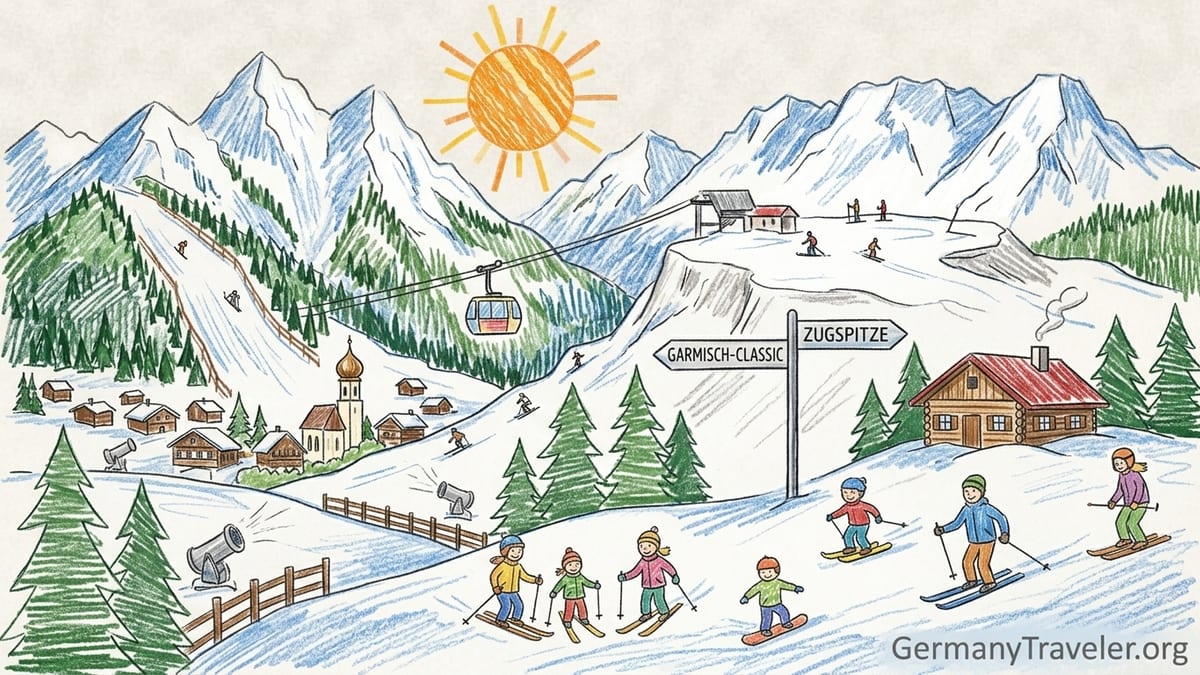
Germany’s Bavarian Alps will not compete with the mega-resorts of France or Austria on size, but they offer something different: compact, characterful ski areas within easy reach of Munich, a strong family focus and prices that often undercut big-name Alpine destinations. For many skiers, that trade-off is ideal. This guide compares the main German ski resorts that matter for visitors flying into or starting from Munich, with a focus on Garmisch-Classic, Zugspitze, the Oberstdorf area, Sudelfeld and Winklmoosalm/Reit im Winkl.
German Ski Resorts in Context: Smaller but Appealing
Compared with Austrian neighbors like SkiWelt or France’s Three Valleys, German resorts are modest in scale. Garmisch-Classic offers around 40 kilometers of pistes, Fellhorn/Kanzelwand about 37 kilometers, and Sudelfeld roughly 31 kilometers. These numbers are a fraction of the 250 to 600 kilometers of linked slopes in the largest Alpine domains. Terrain here is typically concentrated on one or two mountains, with a single main base area rather than a sprawling network of interconnected valleys.
That smaller size changes who these mountains suit. Strong expert skiers who want to clock up huge daily mileage will likely be happier in Austria or Switzerland. But for long weekends from Munich, mixed-ability groups, families, or travelers who value atmosphere and affordability over endless statistics, Bavarian ski areas make a lot of sense. You can park or arrive by train, pick up rentals and passes within a few minutes’ walk, and be on the slopes quickly, without deciphering a huge lift map.
The other major distinction is altitude and snow reliability. With the exception of Zugspitze, which sits on Germany’s highest mountain and has glacier-like conditions with natural snow well into spring, many Bavarian resorts top out below 2,000 meters. That means snowmaking plays a significant role and lower slopes can be thin in warm spells, especially early or late in the season. Planning around typical conditions and choosing the right resort for your dates is crucial.
Price is another point in Germany’s favor. A day pass at a mid-sized Bavarian resort can often cost noticeably less than in high-profile Austrian or Swiss areas. For example, in a recent season an adult day ticket at Sudelfeld or Winklmoosalm/Reit im Winkl was typically below the cost of a day at major Austrian destinations just over the border. Accommodation and dining also tend to be moderately priced in the villages, especially if you book guesthouses or apartments rather than full-service hotels.
Garmisch-Classic and Zugspitze: Germany’s Flagship Ski Duo
The twin areas of Garmisch-Classic and Zugspitze form Germany’s most famous ski destination and the country’s best-known winter sports brand. Garmisch-Classic sits directly above the town of Garmisch-Partenkirchen and offers around 40 kilometers of runs, including the legendary Kandahar World Cup downhill. The vertical drop from the top at roughly 2,050 meters down to around 700 meters is substantial by German standards, with a mix of long intermediate pistes and several genuinely challenging black sections.
Garmisch-Classic’s lift system includes cable cars, gondolas and chairlifts, with modern installations serving the main Hausberg and Kreuzeck/Osterfelderkopf sectors. Snowmaking covers a large part of the area, which is important because most slopes are below 2,000 meters. For intermediates, the long red runs such as the Olympia and the more forgiving Hausberg slopes are the main draw. Confident skiers will gravitate to the Kandahar and other steeper variations, which can feel as demanding as many Austrian black pistes when conditions are firm.
Just up the valley, Zugspitze offers a very different experience. The ski area here occupies a high plateau on the Zugspitzplatt, between roughly 2,000 and 2,700 meters. With about 20 kilometers of slopes, it is not large, but it is reliably snowy thanks to the altitude. The season commonly runs from early December into early May, and the snow quality is often excellent midwinter, with dry natural snow rather than heavy spring slush. Beginners and intermediates find forgiving blue and red runs, while the views from the top station over four countries are a highlight in their own right.
One practical advantage is the combination ticket that allows one day in Garmisch-Classic and one day on Zugspitze, often marketed together for short stays. Many visitors use Garmisch-Classic on days with good lower-mountain snow and choose Zugspitze after fresh storms or in late spring. Getting here from Munich is straightforward by direct train to Garmisch-Partenkirchen in around 80 to 90 minutes, with local buses and the cog railway continuing to the lifts. For a long winter weekend without a car, this is arguably the simplest option in the German Alps.
Oberstdorf: Fellhorn/Kanzelwand, Söllereck, Ofterschwang and Oberjoch
Oberstdorf in the Allgäu region feels more like a small ski network than a single resort. The standout is Fellhorn/Kanzelwand, a two-country ski area straddling Germany and Austria with around 37 kilometers of pistes. It offers a strong mix of blue and red runs and a few short black sections, plus long top-to-base descents that can easily take ten minutes or more when traffic is light. This is where confident intermediates will spend most of their time, making wide carving turns on rolling red pistes that drop towards Oberstdorf on the German side or Riezlern in Austria.
Just up the valley is Söllereck, a smaller area known for its gentle, wooded runs and strong family focus. Terrain here is limited compared with Fellhorn/Kanzelwand, but that is part of the appeal for parents with young children. Kids’ ski schools, conveyor-belt lifts and wide beginner slopes are the specialty. For example, a first-timer family from Munich might book a weekend apartment near the Söllereck base, enrol children in group lessons, and still have time for tobogganing or easy winter walks in the afternoon.
Nearby Ofterschwang and the Oberjoch area, reachable by car or ski bus from Oberstdorf, expand the options. Ofterschwang has a reputation for well-groomed, sun-exposed slopes and has hosted World Cup races in the past, which speaks to its suitability for confident intermediates and advanced skiers. Oberjoch, slightly farther east, offers a compact network of mostly red runs that are ideal for skiers who enjoy repeated laps rather than exploring a giant map. On a typical three-day stay, many visitors buy a regional pass and spend one day at Fellhorn/Kanzelwand, one at Söllereck for relaxed skiing, and another at either Ofterschwang or Oberjoch depending on snow and weather.
Access to Oberstdorf from Munich typically takes around 2.5 to 3 hours by train with a connection, or by car via the A7 and B19. The village itself has a more traditional small-town feel than Garmisch-Partenkirchen, with a compact center of guesthouses, bakeries and sports shops. For travelers combining skiing with winter walking, cross-country skiing or a visit to the famous ski jumping hill, Oberstdorf can be more varied than single-focus ski towns.
Sudelfeld and Winklmoosalm/Reit im Winkl: Mid-Sized Bavarian Favorites
Sudelfeld, near the village of Bayrischzell south of Munich, is one of Bavaria’s largest individual ski areas, with around 31 kilometers of pistes spread across the Wendelstein region. Terrain here ranges from easy meadows near the base to longer red and some black runs higher up, including a FIS-standard slalom course. The layout suits intermediates and confident beginners who have progressed beyond the nursery slopes, and there is a modern mix of chairlifts and surface lifts. An area branded as an “Actionwelt” adds snowpark features and a freeride cross track to appeal to snowboarders and younger skiers.
Sudelfeld’s strengths are convenience and atmosphere rather than altitude. The top lifts reach below the big Alpine peaks, so snow reliability can vary more than at Zugspitze. However, extensive snowmaking helps maintain the main pistes in a typical winter. Many Munich locals treat Sudelfeld as a classic day-trip mountain: drive the roughly 80 to 90 minutes via the A8 and local roads, park near the lifts, ski from mid-morning to late afternoon, then head back to the city the same evening. Huts scattered around the slopes offer hearty Bavarian dishes like Käsespätzle or Germknödel at prices that remain comparatively reasonable for Alpine resorts.
Farther southeast, Winklmoosalm/Reit im Winkl forms a cross-border ski area with Steinplatte in Austria. On the German side, the slopes around Winklmoosalm are mainly gentle blues and easy reds, ideal for cautious intermediates and improving beginners. The full connected area, including the Austrian side, offers more varied red runs and broader views, but travelers should check current ticketing arrangements if they plan to ski both sides extensively. Reit im Winkl itself is a charming village known as much for its cross-country skiing and winter hiking as for alpine skiing.
Getting to Reit im Winkl from Munich by car usually takes around two hours depending on traffic, following the motorway towards Salzburg and then regional roads. Because the village sits at a moderate altitude, snow reliability in the valley can fluctuate, though the higher Winklmoosalm plateau usually holds snow better. Many visitors hedge their bets by planning a flexible itinerary: booking accommodation in Reit im Winkl, but reserving the option to drive to nearby Austrian areas like Steinplatte or even to larger Tyrolean resorts if conditions are significantly better across the border.
Terrain, Snow Reliability and Who Each Area Suits
The German resorts discussed here differ more in character than in raw size, which makes matching your expectations to the right destination crucial. For skiers who prioritize snow reliability above all, Zugspitze sits clearly at the top of the list. Its high elevation and focus on natural snow give it one of the longest and most dependable seasons in Germany, making it a smart choice for early December or late April trips. The trade-off is modest terrain mileage and an exposed setting that can feel bleak in bad weather.
Garmisch-Classic and Fellhorn/Kanzelwand provide the most satisfying terrain for ambitious intermediates and advanced skiers. Both offer vertical drops large enough to deliver proper top-to-bottom runs, a mix of piste difficulties, and a sense of skiing on “real” Alpine mountains rather than just hills. Garmisch-Classic stands out for its World Cup heritage and challenging sections like the Kandahar, while Fellhorn/Kanzelwand balances cross-border novelty with a broad selection of scenic red runs. Sudelfeld, Ofterschwang and Oberjoch fall into the mid-sized category, ideal for those who enjoy repeating favorite runs, exploring variations and relaxing at huts rather than trying to tick off dozens of lifts per day.
For beginners and families, Söllereck and Winklmoosalm/Reit im Winkl are particularly appealing. Their terrain is forgiving, lift systems are less intimidating, and ski schools are accustomed to introducing first-timers to the sport. A realistic example: a couple from Hamburg bringing children to the Alps for the first time may feel overwhelmed by the idea of a huge Austrian ski circus. Instead, they might book a week in Reit im Winkl, sign up for morning group lessons at Winklmoosalm, and spend afternoons building snowmen, sledding or walking through the forest, all without pressure to “make use” of hundreds of kilometers of pistes.
Snow reliability at the mid-altitude Bavarian resorts is increasingly dependent on cold spells and artificial snowmaking. Garmisch-Classic, Sudelfeld and the Oberstdorf mountains generally operate robust snowmaking systems on core runs, but lower valley runs can close during warm periods. If you are planning a trip in November, very early December, late March or April (outside of Easter weeks in cold years), it is wise to check live webcams and snow reports shortly before travel and keep your plans flexible. Booking accommodation with free cancellation, or choosing bases with easy access to higher Austrian resorts, can provide useful back-up options.
Lift Infrastructure, Ski Schools, Après-Ski and Accommodation
German Alpine resorts have steadily upgraded their lift infrastructure in recent years, but visitors used to the newest detachable chairlifts and gondolas in Austria or Switzerland will still notice the difference. Garmisch-Classic and Zugspitze have modern cable cars and gondolas on the core access routes, but some secondary areas continue to rely on older chairlifts or drag lifts. Fellhorn/Kanzelwand is comparatively well equipped, with comfortable gondolas and chairs servicing the main pistes. Sudelfeld has invested in a high-capacity 8-seater and 6-seater chairlifts, yet surface lifts remain important in beginner zones.
The upside of this mix is that queues outside peak holiday weeks are often manageable. On a typical mid-January weekday, skiers at Sudelfeld or Oberjoch may find they can ski straight onto most lifts, and even in Garmisch-Classic waiting times can be short outside weekends and school holidays. Peak crowds do occur, particularly on sunny Saturdays when Munich residents drive south in large numbers, so early starts and strategic coffee breaks at mid-morning can help you avoid the worst of the lineups.
Ski schools are a strength across all these areas. In Garmisch-Partenkirchen and Oberstdorf you will find multiple schools offering group and private lessons in German and English, plus rental outlets where a full ski or snowboard setup can be hired for a day or week. At family-focused areas like Söllereck or Winklmoosalm, instructors are used to working with complete beginners and young children, often including lunchtime supervision and play-based teaching. It is common, for example, for parents to drop their children at 9:30 in the morning, ski their own laps until 14:30, then meet for a final few gentle runs together.
Après-ski in the German Alps is generally more low-key than in Austria. Garmisch-Partenkirchen has several busy bars and a few venues where things can become lively on weekends, but even here the mood tends to focus on conversation and drinks rather than table-dancing and loud party music all afternoon. In Oberstdorf, Bayrischzell or Reit im Winkl, après-ski often means a beer and schnitzel in a wood-paneled Gasthof, perhaps followed by a stroll through lantern-lit streets back to your guesthouse. Travelers who want classic Austrian-style après-ski may prefer to day-trip into Tyrol.
Accommodation choices range from simple guesthouses and self-catering apartments to four-star spa hotels. In Garmisch-Partenkirchen and Oberstdorf, expect familiar mid-range hotel brands alongside family-run lodgings. Prices vary by season, but a reasonable example might be a three-star guesthouse offering double rooms with breakfast for a nightly rate that is meaningfully lower than in many Swiss or French resorts of comparable stature. In smaller villages like Bayrischzell or Reit im Winkl, apartments are common and can be cost-effective for families who are happy to cook some meals at home.
Getting There from Munich and Planning an Itinerary
Munich is the most practical gateway for almost all German Alps resorts. Garmisch-Partenkirchen stands out for its direct rail link: regional trains connect Munich’s main station with Garmisch in roughly 80 to 90 minutes, and special ski trains sometimes operate on winter weekends. From the station you can walk or take a short bus ride to the Hausbergbahn or other base lifts. This makes a car-free ski weekend straightforward, especially when combined with ski rental shops located close to the lifts.
Reaching Oberstdorf by public transport is slightly more involved, with at least one change of train, and door-to-door travel times from Munich often approaching three hours. Sudelfeld and Reit im Winkl are more convenient by car, with driving times of roughly 1.5 to 2 hours in normal traffic. In winter, it is wise to factor in potential delays on busy Saturdays and ensure your rental car is equipped with winter tires and, where required, snow chains. Parking at the lifts is typically paid but moderately priced compared with larger international resorts.
For visitors on a week-long trip, a sample itinerary might start with two days in Garmisch, using a combined ticket to ski both Garmisch-Classic and Zugspitze, followed by a transfer to Oberstdorf for three days at Fellhorn/Kanzelwand, Söllereck and a smaller Allgäu hill. The final two days could be spent at Sudelfeld or Reit im Winkl on the way back towards Munich, especially if you are keen to sample different regional cuisines and landscapes. Alternatively, city-focused travelers might book accommodation in Munich itself and treat the mountains as a series of day trips, though this works best if you are comfortable with early starts and evening returns.
Whichever pattern you choose, the key is aligning resort choice with your group’s profile. Beginners and young families are better off in the gentler environments of Söllereck, Winklmoosalm or the easier slopes of Garmisch’s Hausberg. Keen intermediates who want to log satisfying vertical will be happiest at Garmisch-Classic, Fellhorn/Kanzelwand and possibly Ofterschwang. Powder seekers and late-season skiers should prioritize Zugspitze and remain ready to cross into higher Austrian areas on short notice if a strong storm cycle favors Tyrol or Salzburg.
The Takeaway
The best ski resorts in the German Alps offer a different proposition from the giant domains of the wider Alps. They are smaller, closer-knit, often more affordable and more relaxed, with terrain that is perfectly suited to beginners, families and competent intermediates who are content to focus on a handful of quality runs rather than an endless network of lifts. For travelers based in or flying through Munich, resorts like Garmisch-Classic, Zugspitze, Oberstdorf’s Fellhorn/Kanzelwand, Sudelfeld and Winklmoosalm/Reit im Winkl provide realistic, enjoyable ways to spend a few winter days in the mountains without complex logistics.
Choosing between them depends on your priorities. If snow reliability and high Alpine views are paramount, include Zugspitze in your plans. If you want challenging pistes and World Cup history, Garmisch-Classic is essential. For variety and a mix of family-friendly and more demanding slopes, Oberstdorf’s network stands out, while Sudelfeld and Reit im Winkl deliver classic Bavarian charm and mid-sized terrain within convenient reach of the city. With realistic expectations about size and snow, the German Alps can deliver a richly rewarding ski holiday that feels distinct from, rather than second-best to, their better-known neighbors.
FAQ
Q1: Are German ski resorts big enough for a full week’s holiday?
For many intermediate skiers they are, especially if you combine several areas. A week split between Garmisch-Classic, Zugspitze and Oberstdorf or Sudelfeld can provide plenty of variety, though mileage-focused experts might prefer to add a day trip to a larger Austrian resort.
Q2: Which German resort is best for complete beginners?
Resorts with gentle terrain and strong ski schools, such as Söllereck near Oberstdorf and Winklmoosalm/Reit im Winkl, are particularly well suited to first-timers. The beginner zones around the Hausberg area in Garmisch-Classic are also popular for initial lessons.
Q3: How reliable is snow in the German Alps compared with Austria or Switzerland?
Aside from Zugspitze, which is very snow-sure due to its high elevation, most German resorts sit at moderate altitudes, so snow can be more variable. Snowmaking helps maintain core runs, but lower slopes may suffer in warm spells, especially at the start and end of the season.
Q4: Can I reach the main German ski resorts without a car?
Yes. Garmisch-Partenkirchen is easily accessed by direct train from Munich, and Oberstdorf is reachable with a simple connection. Buses and local trains link some smaller areas, but Sudelfeld and Reit im Winkl are generally more convenient with a car, especially for families with equipment.
Q5: How do lift ticket prices compare to other Alpine countries?
Day passes at German resorts are often somewhat cheaper than at major Austrian, Swiss or French mega-resorts. Prices still vary by season and area, but many travelers find that accommodation and food can also be more affordable in Bavarian villages than in famous international ski towns.
Q6: Is there lively après-ski in German resorts?
Après-ski exists but is generally more low-key than in Austria. You will find busy bars and some live music in Garmisch-Partenkirchen and Oberstdorf, while smaller resorts lean towards cozy hut evenings and relaxed village pubs rather than big party scenes.
Q7: Which German ski area is best for advanced skiers?
Garmisch-Classic, with its World Cup pistes, and Fellhorn/Kanzelwand near Oberstdorf offer the most satisfying challenges for strong skiers. Steeper sections, occasional moguls and longer descents provide variety, though the overall scale is still smaller than top Austrian or Swiss resorts.
Q8: When is the best time to ski in the German Alps?
Late January to early March usually offers the most reliable conditions at mid-altitude resorts. Zugspitze often has a longer season that can stretch from early December into early May, making it a good choice for early or late trips when other areas may have limited snow.
Q9: Are German ski resorts good for families with young children?
Yes. Many Bavarian areas focus strongly on families, with dedicated children’s zones, gentle slopes, affordable ski schools and plenty of non-ski activities like sledding and winter walks. Söllereck, Winklmoosalm and Sudelfeld are common choices for family-friendly holidays.
Q10: Can I combine skiing in Germany with visits to Austrian resorts?
Very easily. Several German bases, such as Reit im Winkl and Oberstdorf, sit close to the Austrian border. Many visitors ski a few days in Germany, then drive or bus over to larger Austrian areas for a day or two, making use of the short distances between valleys.