


The German Alps stretch across the southern edge of Bavaria, a compact region of snow peaks, emerald lakes and storybook villages that is surprisingly easy to explore on a first trip. From Allgäu’s rolling pastures and Oberstdorf’s deep valleys to the turquoise waters of Königssee and the limestone cliffs above Garmisch-Partenkirchen, this is where Germany concentrates its classic Alpine scenery into a week or two of travel. This guide focuses on the main year-round areas for visitors and explains, with concrete examples, how to hike, ski, ride mountain lifts, visit castles like Neuschwanstein, use trains and buses, drive the German Alpine Road and choose the right season for your plans.
Understanding Germany’s Alpine Region
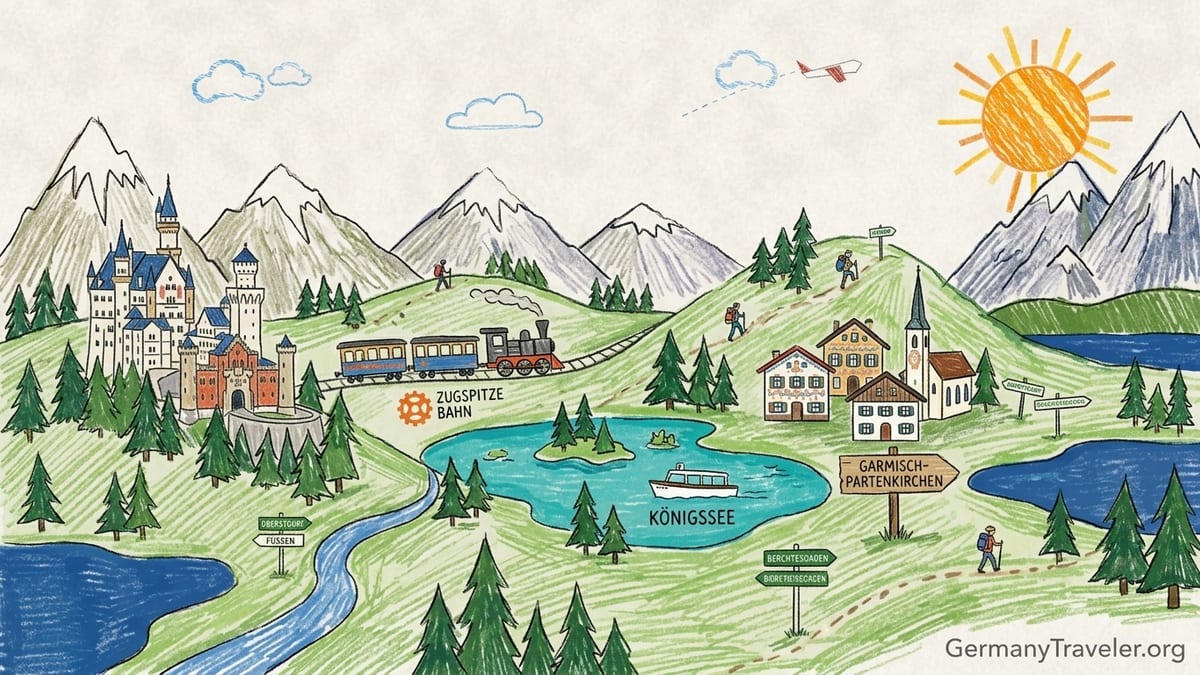
The German Alps lie entirely in Bavaria, running in a narrow east to west band along the Austrian border. On a map, they start in the Allgäu around Oberstdorf in the west, then sweep past Füssen and the Ammergau Alps, Garmisch-Partenkirchen and Zugspitze, Mittenwald and the Karwendel range, the Tegernsee and Chiemgau lakes, before finishing in the Berchtesgadener Land around Königssee and Berchtesgaden National Park. Distances are shorter than many first-time visitors expect: by car, Garmisch-Partenkirchen to Berchtesgaden is roughly four hours in normal traffic, and Munich to most Alpine bases takes between one and three hours.
For trip planning, it helps to divide the region into a few hubs. Allgäu and Oberstdorf are ideal if you want classic hiking and a quieter, rural feel. Füssen and the Ammergau Alps combine lakes and castles, including Neuschwanstein. Garmisch-Partenkirchen and Zugspitze are the most famous high-mountain destination and a logical first stop for many, thanks to frequent train connections from Munich. Mittenwald and the Karwendel offer wild-feeling limestone peaks. Tegernsee and the Chiemgau area mix lake life with gentler mountains. Finally, Berchtesgadener Land, anchored by Königssee and Berchtesgaden National Park, feels dramatically Alpine yet is still well set up for visitors.
Most foreign travelers arrive via Munich and then continue by Deutsche Bahn regional trains and buses or by rental car. A typical one-week loop in summer might start with two nights around Füssen, continue with three nights in Garmisch-Partenkirchen for Zugspitze and Eibsee, then end with two or three nights in Berchtesgaden. In winter, visitors often base longer in a single resort such as Oberstdorf, Garmisch-Classic or Berchtesgaden’s ski areas to reduce daily logistics.
Allgäu and Oberstdorf: Meadows, Peaks and Quiet Valleys
The Allgäu region, in the far southwest of Bavaria, blends soft foothills and high peaks. Oberstdorf sits at about 800 meters, surrounded on three sides by the Allgäu Alps, and has spent more than a century as a center for hiking and mountain sports. Local tourist information advertises over 200 kilometers of marked hiking trails, from easy valley walks to demanding high routes, and several cable cars and chairlifts start right from the village edge. In summer, a common first-day outing is to ride the Nebelhorn cable car to over 2,000 meters and follow short ridge paths for panorama views, then descend by lift and stroll back along the valley floor.
Lakes around Oberstdorf and wider Allgäu provide accessible half-day trips. Freibergsee, for example, is a small mountain lake set above the Stillach valley and reachable only on foot, which keeps it quieter than drive-up lakes. Families often combine a visit with the nearby ski jump stadium. Elsewhere in Allgäu, travellers base in villages like Oberstaufen, Bad Hindelang or Immenstadt, which offer mountain lifts, toboggan runs in winter and well-signposted hiking routes in summer. Prices are generally a little lower than in the more famous Bavarian resorts; in 2026 it is still realistic to find double rooms in simple guesthouses from roughly 80 to 120 euros per night if you book outside peak school-holiday periods.
Winter in Allgäu focuses on mid-sized ski areas. Resorts such as Oberstdorf’s Fellhorn/Kanzelwand and Nebelhorn or Hindelang-Oberjoch offer groomed pistes that are particularly attractive to intermediate skiers rather than extreme experts. Many villages also maintain cross-country skiing loops, often lit at night, which can be a good option if you are new to snow sports and do not want to commit to full downhill gear rental. In shoulder seasons like late October or April, some cable cars still run for hikers, but many higher trails can be muddy or snow-covered, so plan more valley-based activities.
Füssen and the Ammergau Alps: Castles, Lakes and Pilgrimage Churches
Füssen, close to the Austrian border, is the classic base for visiting Neuschwanstein Castle and is also a gateway to the Ammergau Alps. The town itself sits on the Lech River and is surrounded by lakes such as Forggensee and Alpsee. In summer, boat tours on Forggensee cruise past views of Neuschwanstein’s towers and the Ammergau and Tannheim Alps on clear days. Cyclists follow the Lech cycle route and quiet backroads between small alpine dairies and village churches. Prices in Füssen are competitive because the town has a broad mix of hotels, pensions and vacation apartments aimed at both German and international visitors.
Neuschwanstein Castle remains one of the most popular palaces in Europe, commissioned in the 19th century by King Ludwig II and dramatically perched on a ridge above Hohenschwangau. The Bavarian castle authority notes that visits are only possible on a guided tour and that tickets must be purchased via the official system before you walk or ride up from the valley. In high season, timed-entry slots for mid-morning and early afternoon can sell out weeks in advance, so many independent travellers either book an early morning tour or choose the last slots of the day to avoid the most intense crowds.
From Füssen and the nearby Ammergau Alps, it is easy to blend culture and nature. One realistic day plan in summer is to take an early Neuschwanstein tour, then walk around Alpsee and up to Marienbrücke for the classic castle viewpoint. Later, you could drive or take a regional bus to the Wieskirche, a UNESCO-listed pilgrimage church set in open meadows, and end the day in the painted houses and woodcarving workshops of Oberammergau. In winter, the same area offers low-elevation snowshoe walks and small ski slopes, though serious alpine skiers often day-trip to Garmisch or the Allgäu from here.
Garmisch-Partenkirchen, Zugspitze and Eibsee
Garmisch-Partenkirchen is the best-known ski and mountain town in Germany and the main gateway to Zugspitze, the country’s highest peak at nearly 3,000 meters. From Munich, a regional express or Werdenfelsbahn train usually takes around one hour and twenty minutes to reach Garmisch station. From there, you can join the classic Zugspitze round trip operated by the local lift company: a cogwheel train runs from Garmisch through Grainau and a tunnel to the Zugspitze plateau, then cable cars link the glacier area with the summit and down to Lake Eibsee before another cogwheel train returns along the lake and back to town.
Official summer price lists for 2025 show that a combined ticket covering Zugspitze and the nearby Garmisch-Classic area costs close to 90 euros per adult, with discounts for children. Cheaper options include taking the cogwheel train only as far as Eibsee, paying a modest local bus fare from Garmisch instead, or hiking up from valley stations if you are fit and want to avoid multiple cable car legs. Many budget travellers decide to enjoy Eibsee’s shore path and views up to Zugspitze without paying for a summit ticket, especially on days with uncertain weather when summit views might be clouded in.
Eibsee itself lies roughly 13 kilometers southwest of Garmisch-Partenkirchen under the north face of Zugspitze. The lake’s clear turquoise water and forested islands attract day-trippers year-round, and a well-built path circumnavigates the shore in about two hours at a relaxed pace. In summer, expect to pay for parking in a private lot near the lakeshore and to share the path with many others, especially from late morning onwards. Deeper into the valley, the Garmisch-Classic ski area and local trails such as the Partnachklamm gorge provide further walking and skiing options.
Winter in Garmisch is centered on downhill skiing, snowboarding and winter hiking. The Garmisch-Classic area offers a spread of pistes served by gondolas and chairlifts above the town. On Zugspitze itself, a glacier plateau provides high-altitude snow that typically lasts into late spring; skiers access this via the cogwheel train and a glacier cable car. For non-skiers, Garmisch maintains prepared winter walking trails and sledging hills, and it is common to see visitors combining a half-day walk around Eibsee with an afternoon in town cafés.
Mittenwald, the Karwendel, Tegernsee and Chiemgau
Northeast of Garmisch-Partenkirchen, the villages of Mittenwald and Krün sit below the sheer limestone walls of the Karwendel mountains. The Karwendel range is one of the wildest-feeling parts of the German Alps, despite being close to Munich. From Mittenwald, a cable car rises to a high ridge where summer trails lead to viewpoints across both Germany and Austria. Below, the Isar valley has bike paths and easy river walks. Mittenwald is also known for violin making, and the painted facades of the old town add a cultural layer to a largely outdoor-focused destination.
Further west, Tegernsee is a deep blue lake framed by rounded mountains and elegant villas. Just over an hour by Bayerische Regiobahn train from Munich, it has become a weekend escape for city residents. In practical terms, that means well-maintained lakeside promenades, a network of signed hiking routes up peaks like Wallberg and Hirschberg, and a range of accommodation from simple guesthouses to spa hotels where rooms can easily exceed 250 euros per night in summer. The combination of lake swimming, moderate day hikes and good public transport makes Tegernsee a convenient Alpine taster for first-time visitors who do not want to rent a car.
Chiemgau lies east of Tegernsee around Lake Chiemsee and the Chiemgau Alps. The region offers a softer, family-friendly introduction to the mountains, with cable cars such as the Kampenwandbahn above Aschau taking visitors quickly to panoramic walking routes. On the lakeshore, boat trips visit islands with palaces and monasteries, and in summer the shallower bays of Chiemsee warm up enough for swimming and stand-up paddling. Many travellers on a longer itinerary thread Tegernsee and Chiemgau together, spending two or three nights in one before continuing by train or car to Berchtesgaden.
Berchtesgadener Land, Königssee and Berchtesgaden National Park
At the eastern end of the German Alps, Berchtesgadener Land feels like a natural finale. The town of Berchtesgaden is surrounded by steep peaks, and just beyond lies Berchtesgaden National Park, a protected area famous for its fjord-like lake, Königssee. Long-distance scenic routes describe Berchtesgaden as the majestic final act of the German Alpine Road, the holiday route that links Lake Constance to this corner of Bavaria. In practice, the area is compact enough that you can base in Berchtesgaden or the village of Schönau am Königssee and reach most major sights in 20 to 30 minutes by bus or car.
The classic outing here is the boat trip on Königssee. Electric boats depart from the main pier and glide between near-vertical cliffs to the famous pilgrimage church at St. Bartholomä and, on longer trips, further to the southern end of the lake at Salet. From Salet, walking paths reach smaller Obersee and alpine pastures dotted with huts selling simple cheese boards and drinks in summer. Hikers with a full day and good fitness combine the boat trip with longer routes on marked trails, such as climbing toward viewpoints high above the lake or crossing alpine meadows in the upper valleys of the national park.
Berchtesgadener Land also offers varied hiking away from Königssee. Trails like the Jenner panorama path, reachable by cable car, or valley hikes along the Ramsauer Ache river give you mountain scenery with less crowding than the lake’s main piers. In winter, smaller ski areas such as Jenner and Götschen serve local skiers and visiting families, while cross-country skiing tracks and winter walking trails run through the valleys. Accommodation ranges from simple guesthouses to four-star spa hotels, and prices are similar to or slightly below those in Garmisch, depending on season and proximity to Königssee.
The German Alpine Road and Driving vs Public Transport
The German Alpine Road, or Deutsche Alpenstrasse, is a signposted holiday route that links Lake Constance in the west to Berchtesgaden in the east, largely following the northern fringe of the Alps. It passes through or near many of the places mentioned in this guide, including Oberstdorf’s wider region, Füssen and the Ammergau Alps, the area around Garmisch-Partenkirchen, the Isar and Tegernsee valleys, parts of Chiemgau and finally Berchtesgadener Land. Rather than a high mountain pass road, it is a sequence of scenic regional roads, with viewpoints over lakes, access to cable cars and frequent village cafés where you can stop for a coffee and slice of apple strudel.
For first-time visitors, driving the German Alpine Road offers more flexibility than relying only on buses and trains, especially if you want to link several smaller valleys. Rental cars from Munich Airport and the city’s major stations are straightforward to arrange, but you should plan for parking charges in busy resort towns, particularly around Eibsee, Neuschwanstein and Königssee, where private lots and municipal car parks charge daily fees. Traffic during Bavarian school holidays in August can be heavy on popular segments like the approach to Garmisch or the stretch between Füssen and Oberammergau.
Public transport remains a realistic option if you prefer not to drive. Regional trains connect Munich with Garmisch-Partenkirchen, Füssen, Tegernsee, Chiemsee towns and Berchtesgaden (usually via a change in Freilassing). Once in the mountains, local buses tie together village centers, lake shores and lift stations. For example, visitors commonly take the train from Munich to Garmisch, then transfer to the private cogwheel Zugspitzbahn or a regional bus to reach Eibsee. Similarly, in Berchtesgadener Land, a network of RVO buses links Berchtesgaden station with Königssee, Ramsau and the Jennerbahn gondola. Travel passes such as Bayern-Ticket day tickets reduce costs for couples or small groups making longer regional journeys.
Hiking, Skiing, Lakes and Castles: Choosing Activities and Seasons
Hiking is the backbone of most German Alpine trips. In summer, all of the regions covered here signpost paths by difficulty and duration, and tourist offices sell inexpensive maps and publish recommended routes online. A typical day in June might see you take a morning gondola from Mittenwald or Tegernsee, walk a three to four hour loop across alpine meadows with simple huts selling cheese and buttermilk, and descend by lift in time for an afternoon swim in a lake. In shoulder seasons like late May or October, lower routes around lakes such as Chiemsee, Tegernsee or Forggensee are more reliable than higher passes, which may still carry snow or be temporarily closed.
Winter sports concentrate in several ski areas, including Garmisch-Classic, Zugspitze, the Oberstdorf region, and smaller fields in Berchtesgadener Land and Chiemgau. Lift passes and rentals are typically a little less expensive than in neighboring Austria or Switzerland, but you should still budget for at least several dozen euros per day for equipment and tickets. First-time skiers often choose resorts with English-speaking ski schools, which are widely available in Garmisch and Oberstdorf. If you prefer gentler activity, many valleys maintain groomed winter walking circuits and cross-country loops that you can access with basic hiking boots or rental cross-country skis.
Lakes are a constant presence across the German Alps and shape many itineraries. Eibsee below Zugspitze, Königssee in Berchtesgaden National Park, Forggensee and Alpsee near Füssen, Tegernsee and Chiemsee further north all support boat trips, swimming areas in summer and photo stops year-round. Because some, like Königssee, sit within protected areas, motor traffic on the water is strictly limited and boats are electric. In practice, that means very calm, quiet journeys even on busy days. In peak months, consider catching the first or last departures to find more space on board and less congestion at jetties.
Castles and monasteries punctuate the region. Neuschwanstein is the headline sight, but nearby Hohenschwangau, the island palace on Chiemsee and monasteries such as Ettal in the Ammergau Alps provide additional architectural highlights. Guided tours in these sites usually last between 30 and 60 minutes and often require specific time slots. Combining a morning castle tour with an afternoon hike or lake walk is a practical way to balance indoor and outdoor experiences, whether you are staying in Füssen, around Chiemsee or in Berchtesgadener Land.
The Takeaway
For a first-time visitor, the German Alps are approachable, compact and surprisingly varied. Within a week or ten days, you can experience the high summit of Zugspitze, quiet meadows in Allgäu, boat rides on Königssee, the fairy-tale silhouette of Neuschwanstein and the softer lake landscapes of Tegernsee and Chiemsee, all without long travel days. Munich serves as a convenient gateway, with rental cars and regional trains fanning out to each valley.
The key decisions are where to base yourself and when to come. Summer from June to September is ideal for hiking and lake activities, with long days and operating mountain lifts. Winter from late December to March suits skiers and those who want snow-covered roofs and Christmas markets in nearby cities. Spring and autumn bring quieter paths and lower prices but require more flexibility for weather. By combining one or two main bases such as Garmisch-Partenkirchen, Füssen or Berchtesgaden with day trips to outlying valleys, you can build an itinerary that samples the full range of Germany’s Alpine landscapes with manageable logistics and a realistic budget.
FAQ
Q1. How many days do I need for a first trip to the German Alps?
Most first-time visitors spend 5 to 10 days, which allows at least two bases, for example 3 nights in Garmisch-Partenkirchen or Füssen and 3 to 4 nights in Berchtesgaden or Allgäu, plus travel time to and from Munich.
Q2. What is the best season to visit if I want both hiking and some snow views?
Late May to mid June and late September to early October are good compromises. Higher peaks may still hold snow while most mid-level hiking trails and valley walks are open, and crowds are lighter than in peak summer.
Q3. Do I need a car to explore the German Alps properly?
No, but a car adds flexibility. Trains and buses link major bases like Garmisch-Partenkirchen, Füssen, Tegernsee, Chiemsee towns and Berchtesgaden. If you want to drive the German Alpine Road end to end or stay in small side valleys, renting a car is more convenient.
Q4. How far in advance should I book Neuschwanstein Castle tickets?
In summer and during holidays, it is sensible to book several weeks ahead, especially for mid-morning times. Outside peak periods, a few days can be enough, but you should still reserve as soon as your dates are firm.
Q5. Is Zugspitze worth the high ticket price?
For many visitors, standing on Germany’s highest peak and seeing the surrounding Alps is a memorable highlight. If your budget is tight or the forecast is cloudy, consider just visiting Eibsee or taking a mid-mountain lift elsewhere for views at a lower cost.
Q6. Can beginners ski in the German Alps or should they go to Austria instead?
Beginners can absolutely learn in the German Alps. Areas like Garmisch-Classic, Oberstdorf’s Fellhorn and Nebelhorn and smaller Chiemgau and Berchtesgaden resorts have ski schools and gentle slopes suitable for first-timers.
Q7. Are the German Alps suitable for families with young children?
Yes. Many lifts offer stroller-friendly gondolas, lake paths are often easy and villages commonly have playgrounds and family rooms. Family-friendly destinations include Tegernsee, Chiemsee, Allgäu villages and the lower trails around Berchtesgaden.
Q8. How expensive is accommodation compared with Austria or Switzerland?
On average, Bavaria’s Alpine resorts are somewhat cheaper than well-known Swiss destinations and broadly comparable to many Austrian areas. Simple double rooms in pensions often start around 80 to 120 euros per night outside major holidays, while full-service hotels cost more.
Q9. Can I visit Königssee, Eibsee and Neuschwanstein in a single trip?
Yes, but you should allow at least a week. A realistic route would be to base first in Füssen for Neuschwanstein, then in Garmisch-Partenkirchen for Eibsee and Zugspitze, and finally in Berchtesgaden for Königssee and the national park.
Q10. Do I need special equipment for hiking in the German Alps?
For most day hikes, sturdy walking shoes with good grip, weather-appropriate layers, sun protection and a small backpack are enough. For higher or more exposed routes, consider trekking poles and always check local advice about conditions before setting out.