

The German Alps stretch in a chain of lakes, peaks and storybook villages south of Munich, but not every resort suits every traveler. Some places are built around ski lifts and mountain adventure, others around castles or quiet lakeside promenades. Choosing the right base can save you hours of transit time and turn a busy checklist into a relaxed Alpine holiday. This guide compares the main bases most Munich-bound visitors consider and helps you match Garmisch-Partenkirchen, Grainau and Eibsee, Mittenwald, Füssen, Oberstdorf, Tegernsee, Reit im Winkl, Berchtesgaden and Schönau am Königssee to the kind of trip you actually want.
Munich as Your Alpine Gateway, Not Your Destination
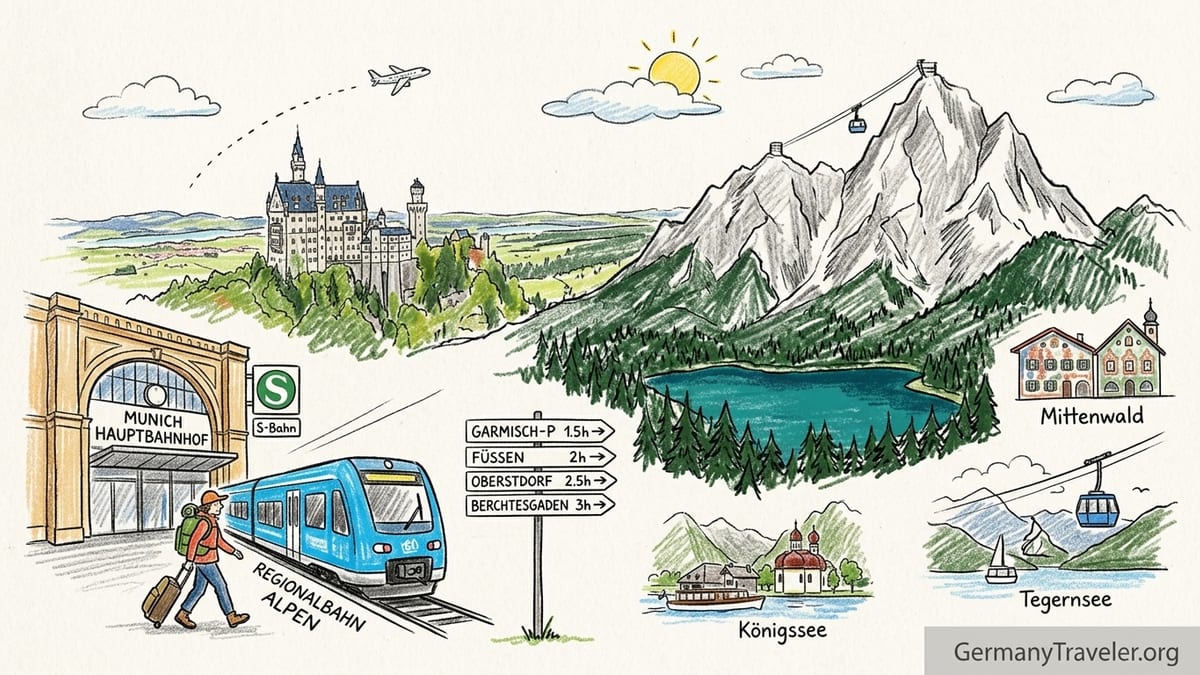
Munich is the natural starting point for exploring the Bavarian Alps, but it is better used as a transport hub than an Alpine base. Munich’s main station has direct regional trains to Garmisch-Partenkirchen, Grainau and Eibsee via the rack railway, Füssen for Neuschwanstein Castle, Tegernsee, Oberstdorf and Berchtesgaden, generally in 1.5 to 3 hours depending on the route. This means you can land at Munich Airport in the morning, take the S-Bahn into the city, and be checking into a mountain guesthouse in time for an afternoon stroll along a lakefront promenade.
For most visitors, a practical approach is to spend one or two nights in Munich at the beginning or end of a trip, then move into the Alps for three to six nights split across one or two bases. For example, you might pair three nights in Garmisch-Partenkirchen for classic mountain scenery and easy Zugspitze access with three nights in Berchtesgaden or Schönau am Königssee for the deep-blue fjord lake and national park. Trains and regional passes such as Bavaria-wide day tickets typically make these hops straightforward and cost effective for couples and families traveling without a car.
The key is to resist the temptation to do the Alps as day trips from Munich. While day tours to Neuschwanstein or Tegernsee are heavily promoted, you will spend much of the day on trains or coaches. Staying in the mountains allows you to walk out of your guesthouse and be on a hiking trail within minutes, watch weather roll over the peaks at sunrise or sunset, and enjoy quieter evenings once bus groups have departed.
Garmisch-Partenkirchen & Grainau/Eibsee: Big Peaks, Big Infrastructure
Garmisch-Partenkirchen is the most all-round base in the German Alps if you want serious mountains paired with a full-service town. It sits at the foot of Germany’s highest mountain, the Zugspitze, and offers two main ski and hiking areas: Garmisch-Classic and the Zugspitze glacier. In winter the area is a national center for skiing and snowboarding, with family zones, ski schools and a range of rental shops packed into the town center. Official tourism information highlights children’s areas in Garmisch-Classic and winter hiking routes like the Garmisch to Lake Pflegersee path that families can manage in under three hours.
Grainau and nearby Eibsee, a short ride up the valley, feel more like a mountain village than a town. A rack railway from Garmisch-Partenkirchen runs via Grainau to Eibsee and then on to the Zugspitzplatt glacier, with trains timed to connect to the Zugspitze cable car for summit visits. Seasonal timetables show this rail link running regularly in winter and summer, which makes Grainau and Eibsee excellent for car-free travelers who still want that turquoise-lake-meets-glacier panorama. At Eibsee itself, you can walk a popular 7 to 8 kilometer loop around the shore with constant views of the Wetterstein range, rent rowboats in summer and have lunch on the hotel terrace directly above the water.
For families, Garmisch-Partenkirchen has enough infrastructure to make life easy: supermarkets on both sides of town, a pedestrian zone lined with cafes, and frequent buses connecting Garmisch, Partenkirchen and the cable car stations. For hikers, routes range from stroller-friendly path sections near Pflegersee to full-day climbs on peaks like the Kramer. For skiers and snowboarders, the relatively high elevation of the Zugspitze glacier offers reliable snow when lower resorts are patchy. The trade-off is that Garmisch feels more like a small city than a quiet village, especially on winter weekends and during major events.
Mittenwald & Füssen: Painted Villages and Storybook Castles
Mittenwald sits east of Garmisch near the Austrian border and is one of the most picturesque villages in the German Alps. Its center is compact and flat, with frescoed houses, violin-making heritage and a church steeple that serves as a clear landmark as you wander. Cable cars like the Karwendelbahn rise directly above town, delivering hikers to panoramic ridge routes in summer and ski tours in winter. Compared with Garmisch, Mittenwald feels smaller and more traditional, ideal if your image of Bavaria includes narrow streets, painted facades and evenings in wood-paneled stuben rather than bar-hopping.
Füssen, by contrast, is primarily about castles and lakes. The town lies in the Allgäu region, set among rolling pre-Alpine hills with wide views rather than sheer peaks. It is the gateway to Neuschwanstein Castle and Hohenschwangau Castle, which stand on rocky outcrops above the village of Hohenschwangau. Official information confirms that Neuschwanstein can only be visited on a timed guided tour, and that you must pick up tickets from the central ticket office in Hohenschwangau before walking, taking a shuttle bus or riding a horse-drawn carriage up to the castle courtyard. In practice this means planning half a day for the castle alone during busy months.
As a base, Füssen works extremely well for travelers whose top priority is Neuschwanstein. You can arrive by train from Munich in roughly two hours, check into a guesthouse in the old town, and use local buses to reach Hohenschwangau at no extra cost if your accommodation provides the regional visitor card, as many do. It is less ideal if you want dramatic high-mountain hiking or ski-in ski-out lodging; the surrounding peaks are lower and ski areas are smaller compared with Garmisch or Oberstdorf. Think of Füssen as a fairy-tale castle hub with pleasant lakeside walks around Forggensee and Alpsee, rather than a hardcore Alpine base.
Oberstdorf & Reit im Winkl: Hiking & Skiing for Active Travelers
Oberstdorf, at the southern tip of Germany, is one of the country’s highest towns and a major center for Nordic and Alpine skiing. It regularly hosts Nordic world championships and has a dense network of lifts and trails. The town center is partly traffic-calmed with a tall church spire that makes navigation easy. Pedestrian streets are lined with sports shops selling everything from cross-country skis to trail-running shoes, and the railway station sits right by the village core, which makes it a strong choice for car-free travelers looking for an active base.
In winter, skiers can spread out across several areas including Nebelhorn, Fellhorn and Kanzelwand, linked to Austria. In summer, cable cars and chairlifts bring hikers to high alpine meadows and ridge walks; one popular pattern is to ride a lift up in the morning, traverse across several peaks and descend on foot or via another lift in the afternoon. Because Oberstdorf’s valley is long and flanked by steep mountains, you get a true “deep in the Alps” feeling that is more intense than at lower, more open locations like Füssen or Tegernsee.
Reit im Winkl, in the Chiemgau Alps closer to Salzburg, is smaller but designed around outdoor activities. The village is known for well-maintained winter walking routes and cross-country skiing loops as well as alpine ski slopes in nearby Winklmoosalm and Steinplatte. Many guesthouses cater specifically to families, offering playrooms and child-friendly meal times, and you will see sledges parked outside hotels in winter much like bicycles in summer. For hikers, Reit im Winkl offers access to rolling pastures and karst plateaus with views over both Bavarian and Austrian peaks, without the more intense vertical relief of the high Alps.
Tegernsee: Lake Life with Easy City Access
Tegernsee and the surrounding lakeside villages offer one of the easiest lake-and-mountain combinations to reach from Munich. Regional trains operated by the Bavarian Oberland line run from Munich’s central station to Tegernsee in roughly one hour, with services usually at least twice per hour. The train pulls in right next to the lake, so within minutes of stepping onto the platform you can be walking the waterfront or sitting in a lakeside beer garden with views of forested slopes and boathouses. This convenience makes Tegernsee ideal for short Alpine breaks or as a soft landing for travelers who are unsure about driving in the mountains.
The lake itself is ringed by villages such as Tegernsee town, Rottach-Egern and Bad Wiessee. You can take boats in season to hop between them, or use lakeside buses if you prefer to stay on land. Hills rise immediately behind the shore, offering hiking routes that start from village streets and lead to panoramic huts within a few hours. The Wallberg area above Rottach-Egern, for example, is cited in regional guides as one of the best viewpoints, with cable car access, a mountain restaurant and sweeping views north to the Bavarian foothills and south to higher ranges. In summer, lake temperatures are often warm enough for locals to swim from public bathing lawns, and it is common to see stand-up paddleboards and rowing boats for hire.
Compared with Garmisch or Berchtesgaden, Tegernsee feels more like a refined lakeside resort than a mountain sports hub. You will find wellness hotels with spa facilities, boutique shops on the main streets and a historic monastery complex that now houses a popular brewery restaurant. If your priority is combining leisurely lakeside walks, moderate hikes and good dining with minimal travel stress, Tegernsee is one of the most comfortable bases in the region, particularly for first-time visitors to Bavaria or short weekend escapes from Munich.
Berchtesgaden & Schönau am Königssee: Deep Fjord Lake & National Park
Berchtesgaden and neighboring Schönau am Königssee, near the Austrian border, anchor the most dramatic corner of the German Alps. The Königssee is a long, narrow lake hemmed in by almost sheer limestone cliffs, often compared to a fjord. The village of Schönau sits at the north end of the lake, where a car park, visitor services and boat pier cluster together. Electric boats operate on the lake year-round except on Christmas Eve, stopping partway to demonstrate the famous echo from the surrounding rock walls. At St. Bartholomä, the onion-domed chapel and lakeside beer garden sit on a narrow strip of land between turquoise water and the Watzmann massif.
Berchtesgaden itself lies a few kilometers up the valley and functions as the transport hub. The regional bus station near the center shows schedules for routes running between Berchtesgaden, Schönau am Königssee, Jennerbahn cable car and surrounding villages. A timetable valid into 2026, for example, details frequent services on the line linking Berchtesgaden’s main bus hub to Königssee and the Jennerbahn base station, which makes it easy to stay in either Berchtesgaden town or Schönau and move around without a car. The Jennerbahn gondola brings hikers to high viewpoints over the lake and into Berchtesgaden National Park, where rangers occasionally lead guided walks about the region’s flora and fauna.
For hikers, this area offers some of the most demanding routes in the German Alps as well as leisurely lakeside strolls. You might, for instance, ride the boat to Salet at the far end of the Königssee and walk an hour to the Obersee, a smaller upper lake with crystal-clear reflections of surrounding cliffs. Families often combine a short walk there with lunch at the lakeside hut, then ride back in the afternoon. For more serious hikers, multi-hour ascents into side valleys and high alpine pastures start from trailheads above Berchtesgaden and Schönau. The trade-off is that the narrow valley and national park regulations limit road access, so accommodation can feel more spread out and booking ahead in summer is wise.
Matching Destinations to Travel Styles
When choosing a base, think in terms of your priorities rather than an abstract list of “must-see” spots. If your main goal is high alpine scenery, cable cars and serious hiking, then Garmisch-Partenkirchen, Grainau and Eibsee, Oberstdorf and the Berchtesgaden and Königssee area rank highest. All offer quick lift access to peaks and ridges, and all have well-marked trail networks from valley walks to strenuous summit routes. For example, from Garmisch you can be on the Zugspitze glacier within a couple of hours via the rack railway and cable car, while from Berchtesgaden you can reach Jenner’s summit area by gondola and step straight onto high-level trails.
For lakeside relaxation and gentler landscapes, Tegernsee and Füssen stand out. In Tegernsee you can combine easy lakeside promenades, moderate hill walks, and spa time, with rail connections back to Munich in around an hour. In Füssen, Forggensee and Alpsee provide beaches and rental boats in summer, and lakeside cycling paths wind through the pre-Alpine countryside. Neither area has the massive vertical drop of the central high Alps, but that can be a benefit if you prefer long, rolling walks over steep climbs.
If you want a really traditional Bavarian village feel, look toward Mittenwald and Reit im Winkl, along with smaller parts of Grainau and Schönau. In Mittenwald, house fronts are covered with detailed frescoes, and the central streets are built on a scale suited to foot traffic and bicycles rather than cars. Reit im Winkl’s center is compact and full of chalet-style guesthouses with flower boxes in summer and heavy snow roofs in winter. These are the kinds of places where evenings are more about lingering over a plate of käsespätzle in a family-run inn than about nightlife.
For car-free travelers, Garmisch-Partenkirchen, Tegernsee, Füssen, Oberstdorf and Berchtesgaden are the strongest hubs. All have direct trains from Munich and good local bus networks, and some, like Garmisch and Füssen, offer regional guest cards that include free or discounted local transport. Grainau and Eibsee are easy bolt-ons via the rack railway from Garmisch, and Schönau am Königssee is linked by frequent buses from Berchtesgaden. If you plan not to drive, favor these locations over more dispersed villages where you might depend on infrequent bus services or long walks from the station.
Families, Seasons and Practical Trade-Offs
Families generally do best in larger bases with clear infrastructure and plenty of simple walking options. Garmisch-Partenkirchen is particularly strong here, with dedicated family hiking routes that tourism offices describe as suitable for strollers, plus winter walking paths like the Pflegersee circuit that offer manageable distances and amenities such as lakeside cafes. Oberstdorf and Reit im Winkl are also good options thanks to a mix of well-waymarked trails, playgrounds and guesthouses that actively cater to children. In summer, lakeside bases such as Tegernsee and Füssen add the bonus of easy-access swimming and paddleboat rentals, which can fill relaxed afternoons without complex logistics.
For dedicated skiers and snowboarders, Oberstdorf and Garmisch-Partenkirchen are still the main German choices due to their extensive lift networks and higher-altitude terrain. Garmisch’s connection to the Zugspitze glacier typically offers reliable snow cover even in milder winters, and the town has rental shops carrying modern gear from major brands, alongside ski schools with English-speaking instructors. Oberstdorf’s multi-area pass and links to Austrian slopes create a broader ski domain than you will find at smaller resorts like Reit im Winkl or the family-oriented areas near Füssen.
Seasonal timing matters. July and August bring the most reliable hiking weather but also the biggest crowds at Neuschwanstein, Königssee and the Zugspitze. Late May, June, September and early October can offer a sweet spot of milder temperatures and somewhat fewer visitors, though higher trails may still hold snow in late spring. In winter, December through March generally define the ski season, with February often the busiest month for lifts and family holidays. Shoulder-season travelers in April or November may find some cable cars closed for maintenance and mountain huts shut, so if your trip falls then, favor larger towns like Garmisch, Berchtesgaden or Tegernsee where there is still activity in the valley.
Budget is another consideration. Lake and castle hotspots with international reputations, such as Füssen near Neuschwanstein and Schönau am Königssee, tend to command higher prices in peak season and book out early. In contrast, slightly less famous yet still scenic villages or staying a short bus ride away from the prime viewpoint can bring room rates down. Regional guest cards, often included in the accommodation price in areas like Füssen or Berchtesgaden, can offset some costs by covering local buses to major sights and sometimes offering discounted entry to pools or museums.
The Takeaway
There is no single “best” place to stay in the German Alps. Instead, each base excels for specific travel styles. Garmisch-Partenkirchen and Grainau around Eibsee give you the country’s highest peak, strong skiing heritage and plenty of family-friendly infrastructure, at the cost of some crowds and a more urban feel. Mittenwald and Reit im Winkl deliver the painted-house, small-village atmosphere many people picture when they think of Bavaria, ideal for slower-paced stays focused on walking, local food and traditional guesthouses.
Füssen works beautifully if Neuschwanstein is non-negotiable and you want lakes and gentle hills rather than big-mountain drama. Tegernsee is the easy, elegant lakeside choice for travelers who value short train rides, wellness hotels and accessible hill walks. Oberstdorf and the Berchtesgaden and Königssee area, finally, are for those who prioritize hiking and skiing in more rugged surroundings, with extensive trail networks and national park access.
Using Munich as a gateway instead of a base, and limiting yourself to one or two Alpine hubs rather than trying to sample everything, lets you spend more time on trails and lakefront terraces and less time on trains and buses. With clear priorities and realistic travel times, the German Alps become a region of deeply satisfying, beautifully varied stays rather than a frantic dash between postcard views.
FAQ
Q1. Which German Alps base is best if I am traveling without a car?
Garmisch-Partenkirchen, Tegernsee, Füssen, Oberstdorf and Berchtesgaden are the most convenient for car-free travelers because all have direct trains from Munich and well-developed local bus networks. Grainau and Eibsee can be reached easily from Garmisch on the rack railway, and Schönau am Königssee is linked to Berchtesgaden by frequent buses, so you can access lakes, cable cars and most trailheads using public transport alone.
Q2. Where should I stay if my top priority is visiting Neuschwanstein Castle?
Füssen is the most practical base for Neuschwanstein Castle, because regular buses run from Füssen station to the ticket center in Hohenschwangau in around 10 to 15 minutes, and many local accommodations include visitor cards that cover this bus ride. You can schedule a morning or afternoon castle tour, then spend the rest of your time exploring Füssen’s old town and nearby lakes without needing to rush back to Munich the same day.
Q3. Which area is best for serious hiking in high mountain terrain?
If you want demanding hikes and big alpine scenery, focus on Garmisch-Partenkirchen and Grainau near the Zugspitze, Oberstdorf with its multiple lift systems, and the Berchtesgaden and Königssee region with access to Berchtesgaden National Park. All three have cable cars and gondolas that take you above the tree line, plus extensive networks of well-marked trails ranging from ridge walks to full-day summit routes.
Q4. What is the best base for a lakeside, low-stress holiday?
Tegernsee is ideal for a relaxed lakeside break because you can reach it by direct train from Munich in about an hour, walk straight from the station to the waterfront, and choose from gentle promenades, boat rides and moderate hill walks. Füssen and Schönau am Königssee also work well if you like combining lake views with short hikes, but Tegernsee is generally the easiest for short, car-free trips.
Q5. Which destinations are most suitable for families with younger children?
Garmisch-Partenkirchen, Tegernsee, Oberstdorf and Reit im Winkl stand out for families. They combine stroller-friendly paths, playgrounds and family-oriented guesthouses with easy access to cable cars, lakes or beginner ski areas. In Garmisch, for example, you will find designated family hiking routes and winter walking paths, while in Tegernsee and Füssen shallow lake shores and boat rentals provide simple, low-planning activities.
Q6. Where should I stay if skiing or snowboarding is my main goal?
For downhill skiing and snowboarding, Garmisch-Partenkirchen and Oberstdorf are the strongest bases. Garmisch offers the Garmisch-Classic area and the higher-elevation Zugspitze glacier, which often has reliable snow when lower slopes are marginal. Oberstdorf’s Nebelhorn, Fellhorn and Kanzelwand areas, plus cross-border links into Austria, create a relatively large ski domain by German standards, along with extensive cross-country networks.
Q7. Which villages feel the most traditionally Bavarian?
Mittenwald and Reit im Winkl offer some of the most traditional village atmospheres, with frescoed houses, chalet-style guesthouses and compact, walkable centers focused on local inns rather than large hotels. Grainau and parts of Schönau am Königssee also retain a strong village feel, especially once you step away from main parking areas and tourist hubs toward residential streets lined with flower-decked balconies and small farms.
Q8. Is it realistic to base in Munich and visit the Alps on day trips?
While day trips from Munich to places like Neuschwanstein or Tegernsee are possible, they involve several hours of train or coach travel and leave limited time for relaxed walks or multiple activities. For most travelers, it is more enjoyable to use Munich as a gateway for one or two nights and then stay three or more nights in an Alpine base like Garmisch-Partenkirchen, Berchtesgaden, Tegernsee or Füssen, reducing daily travel and allowing early starts on trails or cable cars.
Q9. How far in advance should I book accommodation in these regions?
In peak periods such as July, August and the main winter holiday weeks, it is wise to book accommodation in popular bases like Garmisch-Partenkirchen, Füssen, Tegernsee and Schönau am Königssee several months in advance, especially for weekends and school holidays. Outside those times, you often find more flexibility, though booking at least a few weeks ahead still helps secure better located guesthouses and a wider choice of room types.
Q10. If I only have three or four nights, which two bases combine best?
With three or four nights, a practical combination is Garmisch-Partenkirchen plus either Füssen or Berchtesgaden, depending on whether you care more about castles or fjord-style lake scenery. Another efficient pairing is Tegernsee and Garmisch, giving you one base focused on lakeside relaxation and one on high-mountain adventure, all within manageable train journeys from Munich and between the two destinations.