


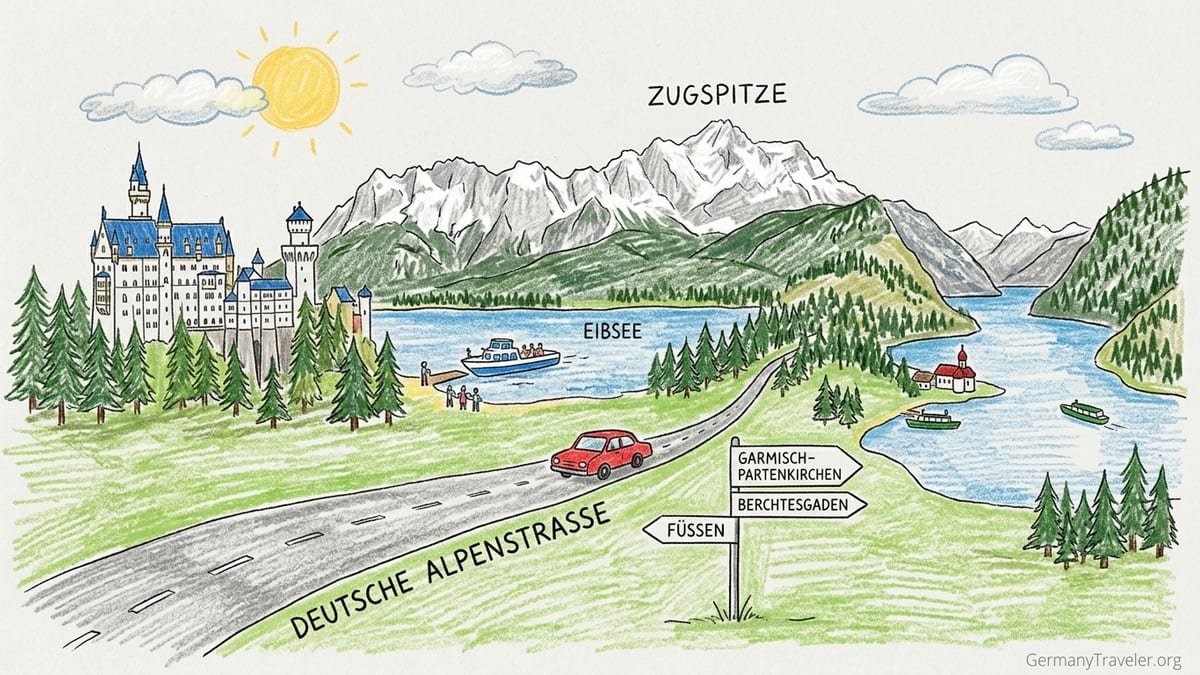
The German Alpine Road offers one of Europe’s most scenic drives, threading 484 kilometers along Bavaria’s mountain fringe from Lake Constance to Königssee. For many travelers, the highlight section lies between the royal castles around Füssen, the high alpine drama of Zugspitze near Garmisch-Partenkirchen, the lake country of Chiemgau and the emerald waters of Königssee near Berchtesgaden. This guide shows how to build a realistic road trip using the official German Alpine Road as your backbone, with concrete advice on mountain driving, parking, overnight bases and when to swap the steering wheel for a train or cable car.
Understanding the German Alpine Road Backbone
The German Alpine Road, or Deutsche Alpenstraße, is Germany’s oldest dedicated scenic route, running about 484 kilometers from Lindau on Lake Constance to Schönau am Königssee. Official planning material suggests allowing at least a week for the full trip and breaking it into multiple stages to avoid simply racing from viewpoint to viewpoint. In practice, many international visitors focus on the eastern half, weaving between Füssen, Garmisch-Partenkirchen, the Chiemsee and Chiemgau region, and Berchtesgaden and Königssee.
The road is toll free and stays entirely within Germany, threading along the northern side of the Alps without requiring mandatory border crossings into Austria. You will still see Austrian peaks on the horizon, and in some areas the quickest fast-road alternative dips briefly into Austria, but the official German Alpine Road route itself can be driven with only standard German road rules in mind. The surface is paved end to end, and while there are steep grades and hairpins, it is accessible for standard rental cars, compact campervans and touring motorcycles.
For this guide, the backbone route begins in Füssen, then follows the German Alpine Road east through Garmisch-Partenkirchen and the Zugspitze region, continues via Bad Tölz or Tegernsee toward the Chiemgau lake district, and finishes in Berchtesgaden and Königssee. Drivers with more time can add a western Allgäu loop toward Lindau either at the beginning or end. Treat the official seven and nine day sample itineraries from tourist boards as pacing models: they show that covering roughly 60 to 100 kilometers of scenic road on a given day leaves time to actually walk lakeside promenades and ride cable cars.
Füssen and Neuschwanstein: Royal Castles at the Western Gateway
Füssen works as both a starting point and a soft landing into alpine driving. The town itself sits just off the German Alpine Road and is tied to the famous royal castles of Neuschwanstein and Hohenschwangau a few minutes away. Many travelers arrive by train from Munich, pick up a rental car in town, and spend two nights to adjust to local driving and explore the lakeside paths around Forggensee or Hopfensee before heading east.
Neuschwanstein is one of Germany’s busiest sights, and the logistics matter. Tickets must be purchased in advance through the official system, with timed entry and a small booking fee, and same-day tickets frequently sell out in high season. Parking is not available directly at the castle but in several village lots in Hohenschwangau. Cars and small campers are typically directed to numbered lots near the ticket center, and parking is charged per day with higher fees for oversized vehicles; signs at the entrance show the current rates, which visitors in 2026 report as noticeably higher than generic town parking. From the parking area you either walk uphill for about 30 to 40 minutes, take the shuttle bus when it operates, or hire a horse-drawn carriage for the steepest section.
As an overnight base, Füssen offers a spread of options from pensions in the old town to lake-view hotels in nearby Hopfen am See. Choosing a base with on-site parking simplifies an early-morning castle visit: you can check in the previous afternoon, leave luggage in the room, then drive to Hohenschwangau for an early time slot when crowds and queues for the shuttle bus are shorter. After your castle visit, you can rejoin the German Alpine Road by following the local signage for the Deutsche Alpenstraße toward Schwangau and Trauchgau, which immediately immerses you in rolling Allgäu meadows and the first foothills of the Alps.
Driving From Füssen to Garmisch-Partenkirchen and Zugspitze
The stretch from Füssen to Garmisch-Partenkirchen introduces more serious mountain driving without being technically difficult. The German Alpine Road here undulates through villages such as Steingaden and Oberammergau, with occasional short but steep segments and a mix of forested curves and open valley views. Expect posted speed limits to drop frequently when entering villages; enforcement is active, so maintaining a relaxed pace is both safer and smarter. In summer, farm tractors and cyclists share the route, which can slow progress but also reinforce that this is a local living landscape rather than a dedicated tourist highway.
Garmisch-Partenkirchen is a natural base for visiting Zugspitze, Germany’s highest peak at just under 3,000 meters. The town has two main access points to the mountain: the cogwheel railway that departs from Garmisch-Partenkirchen station and climbs via Grainau and Eibsee to the Zugspitzplatt, and the modern cable car that glides from the lakeshore at Eibsee directly to the summit. As of the 2026 summer season, a standard round-trip ticket for adults typically costs in the high 60 to low 70 euro range depending on whether you choose a mixed cog railway and cable car option or stick to one mode. Many visitors combine the two, riding the cogwheel train up and floating down by cable car to enjoy the lake views.
Parking strategy around Zugspitze can influence your day. One popular approach is to drive from Garmisch-Partenkirchen along the valley road to the Eibsee car park early in the morning and park there for a lakeside stroll before taking the cable car to the summit. The Eibsee lot uses day rates that climb through the summer, and it can fill by mid-morning on blue-sky weekends, so arriving before 9:00 is wise. Alternatively, you can leave the car at your hotel and use a regional ticket such as the 2026 MVV Garmisch Summer ticket from Munich’s transport association, which bundles regional train travel from the Munich area with local buses toward Eibsee or Hausberg. Using the train or bus instead of a car cuts out parking hassles and can be cheaper than urban car rental and fuel for small groups.
Alpine Lakes and Optional Western Allgäu Detours
While the eastern half of the German Alpine Road is the focus of most classic itineraries, travelers with a few extra days can push west from Füssen into the Allgäu to capture a sense of the route’s full sweep. The official road runs all the way to Lindau on Lake Constance, passing smaller resorts and farm country around Nesselwang and Oberstaufen, which tend to see fewer international buses but plenty of German and Swiss road trippers. Lakes such as Großer Alpsee near Immenstadt and Hopfensee near Füssen themselves are quieter alternatives to the marquee attractions further east.
Driving these western sections introduces longer, more flowing curves rather than tight alpine passes. It can be particularly rewarding for those in classic cars or motorcycles, but it adds distance: a full round-trip loop from Füssen out to Lindau and back before continuing to Garmisch-Partenkirchen can push your total driving by several hundred kilometers. Travelers who only have seven days and want ample time in Garmisch-Partenkirchen and Berchtesgaden often choose to skip the far west and instead sample a single Allgäu lake as a side trip on their arrival or departure day.
Throughout both Allgäu and the lake sections further east, fuel and services are straightforward. You will pass regular petrol stations on the outskirts of towns and along major connecting roads. Prices in 2026 remain higher than in many non-European countries, but the distances involved are modest; the entire 484 kilometer route can be driven on a single tank in a typical mid-sized rental car, though in practice you will refuel every few days. Payment is commonly by card or contactless, and some smaller independent stations may be unstaffed at night, using automated pumps that require chip-and-pin cards.
Through Chiemgau to Berchtesgaden and Königssee
East of Garmisch-Partenkirchen, the German Alpine Road crosses gentle passes and rolling farmland into Upper Bavaria’s lake district. Drivers can choose between a more northerly route via Bad Tölz and the Isar valley or a more southeasterly path that dips past Tegernsee and Schliersee before turning toward Chiemsee. The official scenic road uses a combination of local and regional roads that are signposted; navigation apps recognize “Deutsche Alpenstraße” in many segments, but keeping a printed overview map or downloaded brochure helps when roadworks temporarily divert traffic.
The Chiemgau region introduces a string of lakes framed by low but dramatic peaks. Chiemsee, often marketed as the Bavarian Sea, is the largest and offers boat rides to palace-topped islands, but the true “Alpine Road” feel sharpens again as you continue east past smaller lakes such as Thiersee and, near Ruhpolding and Inzell, the chain of Weitsee, Mittersee and Lödensee. Here the road narrows at times and approaches nature reserves, with frequent lay-bys where you can pull off for a ten-minute walk to turquoise shoreline. Parking at these smaller lakes is usually managed via pay-and-display machines that accept coins or cards, and charges are modest compared with castle or cable car car parks.
Berchtesgaden and Königssee form a natural finale for an eastbound itinerary. The town sits in a deep valley wrapped by steep walls, and the last stretches of the German Alpine Road approach through forested gorges and tight bends. Once in Schönau am Königssee, parking is concentrated in large central lots a short walk from the boat pier. Expect full-day parking fees that echo those at other German tourist hotspots, especially on sunny days in July and August when queues for boats snake across the plaza. Many visitors schedule two nights in Berchtesgaden to combine a mellow lake day with a second day on higher ground, whether that means the Jennerbahn cable car, a hike to a smaller lake such as Hintersee, or a visit to documentation centers that examine the area’s complex twentieth-century history.
Mountain Driving, Parking and Border Considerations
Mountain driving on the German Alpine Road is accessible even for those without prior alpine experience, but it does require a different mindset from freeway cruising. Hairpin bends appear after short straights, and gradients can be steep enough that staying in a lower gear is necessary both uphill and downhill. Rental cars in Germany are increasingly automatic, which simplifies gear selection, but you still need to modulate speed with engine braking to avoid overheating brakes on long descents. In practice, this means letting faster local drivers pass in designated pullouts and taking your time, especially in wet or foggy conditions that are common in shoulder seasons.
Parking is one of the most concrete stress points on this route. At marquee stops such as Neuschwanstein, Eibsee for Zugspitze, and Königssee, large lots serve a mix of cars, buses and motorhomes, with clear separation lines and electronic signs indicating when a lot is full. Fees are typically charged per day or per half-day and can be significant compared with urban street parking. In Hohenschwangau, for example, motorhome owners report camper-specific tariffs at certain lots in the mid-double-digit euro range in summer, while standard cars pay a lower flat rate. Where possible, overnight guests should look for hotels or guesthouses that include a dedicated space; this can quietly offset parking charges by tens of euros across a week-long trip.
The official German Alpine Road does not require border crossings, but the route runs close to Austria, and navigation apps sometimes suggest short detours via Austrian motorways or main roads to save time. Crossing the border in a rental car is usually permitted but may require you to purchase a vignette, a toll sticker, for Austrian motorways if your route uses them. For a purist German Alpine Road trip, you can avoid these entirely by sticking to the signposted route and German federal and state roads, accepting that this might add an extra 20 or 30 minutes compared with the fastest option. If you do plan to hop into Austria for a side trip to places such as Innsbruck or the Achensee, budget the cost of a vignette on top of fuel and factor in potential checks at busy crossings during holiday periods.
Choosing Overnight Bases and When Trains Work Better
One of the key strategic decisions on a German Alpine Road trip is whether to change accommodation every night or to use a few strong bases. Given that the official route can be comfortably broken into seven to nine days, many experienced travelers choose three or four main stops. A common pattern is two nights in Füssen, three in Garmisch-Partenkirchen or Grainau, two in the Chiemgau or Chiemsee area and three in Berchtesgaden. This arrangement reduces the daily packing and unpacking routine while still keeping drive lengths between 90 and 150 minutes on most days.
Staying in slightly smaller satellite towns can also bring practical benefits. For Zugspitze, for instance, basing yourself in Grainau rather than central Garmisch-Partenkirchen means shorter morning trips to the cogwheel train stop or to Eibsee, and many guesthouses include parking. Around Chiemsee, staying in Prien or Bernau balances lake access with quick re-entry onto the German Alpine Road. In Berchtesgaden, some visitors split their stay between the main town and quieter spots such as Ramsau bei Berchtesgaden, trading nightlife and restaurant choice for alpine silence.
There are also segments where using trains and buses rather than driving makes sense. The Munich to Garmisch-Partenkirchen line is frequent and scenic, and in 2026 new seasonal offers such as the MVV Garmisch Summer tickets bundle regional rail and local transport at attractive prices. One realistic strategy is to rent a car for the Füssen and Allgäu section, drop it in Garmisch-Partenkirchen, and continue by rail to Munich and beyond, using day trips by train for Zugspitze or hiking in the region. Likewise, travelers who are uncomfortable with alpine hairpins may prefer to arrive in Berchtesgaden by train via Salzburg and only rent a small car locally for short excursions to Königssee and nearby trailheads.
Balancing Scenic Detours With Time and Budget
The German Alpine Road is rich in side roads and viewpoints that tempt spontaneous detours. For example, between Garmisch-Partenkirchen and the Chiemgau region you can divert to the Walchensee and Kochelsee lakes, which involve a steeper, more technical pass road with rewarding blue-green water views at the top. Around Ruhpolding and Inzell, narrow lanes lead into side valleys and trailheads that do not appear prominently in guidebooks but are popular with local hikers. Each detour typically adds 30 to 90 minutes, including photo stops, and the cumulative effect across a week can easily turn planned two-hour driving days into four-hour slogs.
Balancing these impulses means choosing a few themes. A family might prioritize lake swims and easy boat trips, focusing on Chiemsee and Königssee plus a half-day at Eibsee, while an outdoor-oriented couple might devote more time to cable cars and ridge hikes, scheduling full days for Zugspitze, Jenner and perhaps a smaller local mountain accessible from the Chiemgau. In budget terms, big-ticket items like castle entries, Zugspitze cable cars and major boat trips together can match or exceed fuel costs, especially for larger groups. Spreading them out across the itinerary and mixing in low-cost pleasures such as village walks, free lakeside lidos and farm shop visits keeps the trip financially sustainable.
Time of year also shapes trade-offs. In high summer, long daylight hours make early starts and late scenic drives possible, but congestion around marquee sights peaks and afternoon thunderstorms can roll in. In shoulder seasons such as May, June, September and early October, traffic is lighter and room rates often drop, though some cable cars and boat lines may operate reduced schedules. Winter driving along the German Alpine Road introduces its own charm with snow-covered peaks and Christmas markets in towns like Füssen and Berchtesgaden, but requires winter tires, careful attention to weather reports and acceptance that certain lakeside walks and minor roads may be snowbound.
The Takeaway
Using the German Alpine Road as a backbone lets you discover Bavaria’s Alps with structure and flexibility. Anchoring your route on the official 484 kilometer scenic road ensures a steady stream of mountain panoramas, lakes and historic towns, while linking together marquee stops such as Neuschwanstein, Zugspitze, Chiemgau’s lakes and Königssee. With thoughtful planning around overnight bases, parking, fuel and occasional border considerations, driving becomes part of the pleasure rather than a chore.
For many travelers, a week to ten days is the sweet spot. That allows two or three nights in each key region, time for a summit day on Zugspitze, at least one unhurried lake day in Chiemgau or at Königssee, and space for a few spontaneous detours when the morning light on a side valley looks irresistible. Knowing when to leave the car behind, whether that means riding the cogwheel railway to the Zugspitzplatt or taking a regional train from Munich to Garmisch-Partenkirchen, reduces stress without sacrificing experience. In the end, the German Alpine Road works best not as a checklist of viewpoints but as a connecting thread for memorable days spent between castles, peaks and quiet lakeshores.
FAQ
Q1. How many days do I need for the German Alpine Road between Füssen and Königssee?
Most travelers are comfortable with seven to nine days for this section, which allows two or three nights in Füssen, Garmisch-Partenkirchen, the Chiemgau or Chiemsee area and Berchtesgaden without rushing.
Q2. Is mountain driving on the German Alpine Road suitable for first-time visitors?
Yes, the road is paved and well maintained, and gradients are moderate compared with high alpine passes. First-time visitors should drive defensively, use lower gears on descents and avoid tight schedules that encourage rushing.
Q3. Do I need to cross into Austria while following the German Alpine Road?
No, the official German Alpine Road route stays entirely in Germany and does not require border crossings. Some navigation apps may suggest quicker routes through Austria, but you can ignore these if you prefer to remain on the German side.
Q4. When is the best time of year to drive this route?
Late spring, summer and early autumn are most popular. May, June, September and early October balance milder weather and open attractions with slightly lower visitor numbers and room rates than the peak school holiday weeks.
Q5. Is it better to stay in many different hotels or a few bases?
Using three or four main bases, such as Füssen, Garmisch-Partenkirchen or Grainau, a Chiemsee or Chiemgau village and Berchtesgaden, keeps packing simple while keeping drives between them to manageable lengths.
Q6. How expensive are parking and tickets for major sights like Neuschwanstein and Zugspitze?
Parking at major sights can cost a noticeable amount per day, and big-ticket admissions such as Neuschwanstein and Zugspitze cable car or cog railway tickets can each run to several dozen euros per adult, so budgeting for them in advance is sensible.
Q7. Can I do this trip without renting a car?
Yes, but it requires more planning. You can link main hubs such as Füssen, Garmisch-Partenkirchen, Chiemsee and Berchtesgaden by regional trains and buses, then use local buses and cable cars for side trips, accepting that some smaller lakes and villages will remain hard to reach.
Q8. Are there fuel or charging stations along the German Alpine Road?
There are regular fuel stations along the route, mostly on town edges and main connectors. Electric vehicle charging points are increasingly common around tourist hubs and motorway junctions, but planning ahead is still wise for pure electric cars.
Q9. Do I need special equipment for winter driving on the German Alpine Road?
In winter, cars should be equipped with winter tires as required by German regulations in wintry conditions, and carrying snow chains can be advisable in higher sections, especially if you plan to drive shortly after heavy snowfall.
Q10. Is advance booking necessary for accommodation in summer?
Yes, in July and August it is prudent to reserve rooms in popular hubs such as Füssen, Garmisch-Partenkirchen, Chiemsee and Berchtesgaden several weeks ahead, particularly if you need family rooms or on-site parking.