


The German Alps are one of Europe’s great road-trip regions, yet many visitors land in Munich wondering whether they really need a car. For some itineraries, Bavaria’s efficient trains are all you need. For others, especially if you dream of hopping between lakes, tiny villages and panoramic passes, a rental car turns a good trip into a great one. This guide explains when a car makes sense, how to rent at Munich Airport and in the city, and what to know about winter equipment, parking and quick hops across the Austrian border.
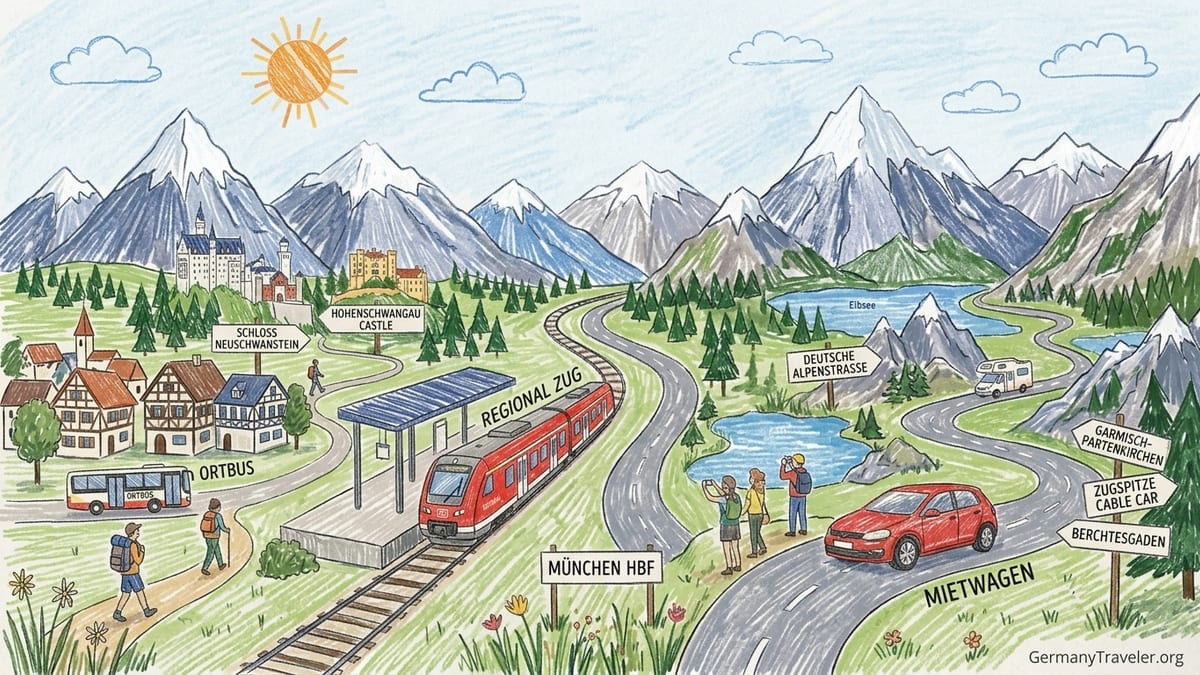
Do you really need a car in the German Alps?
If your main goals are headline sights such as Neuschwanstein Castle near Füssen or the Olympic ski town of Garmisch-Partenkirchen, you can manage comfortably without a car. Direct regional trains from Munich Hauptbahnhof reach both hubs in roughly 1.5 to 2 hours, and local buses connect from the stations to landmarks like Hohenschwangau, Eibsee and the Zugspitze cable car. For a long weekend focused on one base, rail is usually cheaper, less stressful and better for the climate.
The equation changes if you want to string together multiple small lakeside villages, remote trailheads or the full sweep of the German Alpine Road from Lake Constance toward Berchtesgaden. Official route material for the Deutsche Alpenstrasse explicitly presents it as a touring road for cars and campervans, with suggested stages that assume you have your own wheels. In practice, public transport along the route exists but often runs only every one or two hours, and some panoramas are all but inaccessible without a vehicle.
Think about how you like to travel day to day. If you are happy choosing one or two bases like Füssen and Berchtesgaden and exploring on foot, by bus and with the occasional taxi, you can still see a great deal. But if you picture sunrise at quiet lakes, pulling over at improvisational viewpoints and detouring to village festivals you spot from the road, a car gives you that spontaneous freedom that timetabled transport simply cannot match.
For many visitors, a hybrid strategy works best. You can travel by train from Munich to your first Alpine town, settle in without driving after an overnight flight, then pick up a rental car locally a day or two later just for the road-trip portion. Increasingly, regional tourism boards and even the German Alpine Road organization highlight this mix of rail and rental car as a low-stress, lower-impact way to tour the Bavarian Alps.
Picking up a rental car at Munich Airport and in the city
Munich Airport is the most convenient starting point for a German Alps road trip. Major companies such as Sixt, Hertz, Avis, Budget, Enterprise and Europcar operate side by side in the Munich Airport Center, the covered plaza between Terminals 1 and 2. Desks and parking for rental cars are located around level 3 of the airport center, signposted simply as “Car Rental Center,” so you can walk from baggage claim to the counters without leaving the building.
Once you have your keys, driving from the airport to the edge of the Alps is straightforward. It is around a 45-minute drive into central Munich in normal traffic, and about 1.5 hours to Garmisch-Partenkirchen if you follow the A95 autobahn south. Many travelers skip the city entirely, collecting the car at the airport and heading straight toward the mountains, which avoids urban traffic and parking. If you prefer to rest after an overnight flight, you can overnight at an airport hotel, then pick up the car early the next morning for a fresh start.
If your first days are dedicated to Munich itself, it often makes more sense to delay your rental and collect the car at a city office. Most major brands maintain branches near Munich Hauptbahnhof and around the Altstadt ring. A typical pattern is to stay two or three nights in a central hotel reachable by S-Bahn from the airport, then walk or take a short tram ride to a rental depot on the morning you depart for the Alps, returning the car to the airport at the end of your trip.
When comparing airport and city pickups, look carefully at one-way fees and opening hours. Some downtown offices close at lunchtime or early on Saturdays, while the airport locations usually keep longer hours. Pickup at Munich Airport may carry a modest surcharge, but when you factor in not paying for city-center parking, and the ease of immediately joining the motorway network, it often still provides the best value for a dedicated Alpine road trip.
Automatic vs manual cars, insurance and deposits
In Germany, manual transmissions are still common, and that is reflected in rental fleets. If you are not completely confident driving a stick, reserve an automatic in advance and do not assume you can simply request one at the counter. In peak summer and over key winter weekends, automatic compact SUVs and wagons are among the first categories to sell out. Prices for automatics are usually higher than for equivalent manual models, but for many visitors the peace of mind on unfamiliar mountain roads is worth the premium.
For Alpine itineraries, you do not need a large car. A compact hatchback such as a Volkswagen Golf or similar is perfectly capable of tackling steep grades and narrow village lanes. Slightly taller compact SUVs like a VW T-Roc or Skoda Karoq can offer a bit more ground clearance and luggage room, but remember that larger vehicles may be harder to squeeze into tight hotel garages or old-town parking structures. Whatever category you pick, check that luggage for all passengers will fit under the trunk cover so valuables are not visible when you are parked at trailheads or viewpoints.
Insurance terminology can be confusing if you are used to North American rental norms. Most German rentals include basic collision damage waiver with a relatively high excess, often in the range of several hundred to a couple of thousand euros. At the desk you will be offered upsells to reduce that excess, plus add-ons such as glass and tire coverage. Some travelers rely on a credit card’s collision benefit instead, but you should confirm in advance that your card covers rentals in Germany and neighboring Austria and that you are comfortable handling a potential damage claim directly with your card provider.
Expect the rental company to place a deposit or hold on your credit card at pickup. For a mid-size automatic, a typical preauthorization might run to several hundred euros on top of the estimated rental charge. Make sure the card you plan to use has sufficient available limit, and that it is in the driver’s name, as most agencies will not accept a card belonging to a non-driving spouse or friend. Before driving off, walk slowly around the car, taking clear photos of any existing scratches or wheel scuffs and ensuring they are noted on the paperwork.
Winter tires, snow chains and seasonal rules
Germany follows a “situational” winter tire rule rather than fixed calendar dates. The law requires appropriate winter equipment, meaning winter or certified all-season tires, when conditions such as ice, packed snow or slush are present. In practice, rental companies in Bavaria typically fit their fleets with winter-capable tires for the colder months, and many offer a clearly priced “winter package” on bookings during late autumn, winter and early spring. It is worth checking the rental quote to see whether winter tires are included or listed as an extra charge.
Snow chains are less commonly needed on main Bavarian and Austrian roads, which are generally cleared quickly, but they can be required on steep minor routes or in heavy storms. In the Alps you may encounter temporary roadside signs instructing drivers to mount chains for a particular stretch. If you are traveling into more remote valleys or staying at higher-altitude guesthouses, asking the accommodation in advance whether chains are ever necessary on their access road can help you decide whether to request chains from the rental agency.
Even with good winter tires, Alpine driving demands smooth, defensive technique. Maintain longer following distances, remember that stopping distances grow dramatically on snow and ice, and use lower gears on long descents to minimize heavy braking. Before setting out each day, clear all snow and ice from the windows, mirrors and roof so debris does not slide forward under braking. Rental cars usually come with an ice scraper and basic safety kit, but it is sensible to pick up a small snow brush and a bottle of de-icer from a supermarket or service station if you are traveling deep into winter.
If your trip runs from late November through March, consider structuring the first couple of days around rail-accessible bases such as Garmisch-Partenkirchen or Berchtesgaden, where streets are well maintained and buses reach key trailheads. You can then decide on a short-term rental for a specific window of stable weather, which reduces the time you are responsible for a vehicle in potentially challenging conditions.
Parking, fuel and driving etiquette in Alpine towns
Parking norms in Bavarian mountain towns are generally well organized but tightly controlled. In places like Garmisch-Partenkirchen, Mittenwald or Berchtesgaden, you will find signed municipal lots near the center, usually with ticket machines that accept coins and, increasingly, cards. Daily caps are common near cable car bases such as Eibsee for the Zugspitze or the Jennerbahn above Lake Königssee, and during busy holiday periods these lots can fill soon after opening, making an early start advisable.
Hotels and guesthouses offer a wide mix of parking arrangements. Some have underground garages with assigned spaces, while others rely on small surface lots or street parking permits. When you book accommodation, read the description carefully to see whether parking is on-site, reserved or first-come-first-served, and whether a nightly fee applies. A centrally located hotel in Füssen that appears slightly more expensive may work out cheaper if the room rate includes parking and you can walk to dinner instead of paying for short-stay lots.
Fueling is straightforward. Petrol stations are frequent on motorways and in larger towns; in more remote valleys they may cluster at the entrance village rather than deep in the mountains. Self-service pumps typically offer at least standard unleaded and diesel; high-octane options are labeled differently than in North America, so always match the fuel type indicated on the inside of the fuel flap or on your rental agreement. Most stations accept credit cards, though very small rural outlets may be more comfortable with debit cards or cash during staffed hours.
On the road, expect a mix of German autobahns, federal highways and local roads. In the mountains, even main roads can narrow and twist, passing directly through village centers with pedestrians, cyclists and buses. Speed limits drop accordingly, and enforcement with static cameras is common. Using turnouts to let faster local drivers pass, resisting the temptation to brake aggressively on every bend, and showing patience around farm vehicles all contribute to a less stressful Alpine drive.
Austrian border crossings, vignettes and the German Alpine Road
The Bavarian Alps rub shoulders with Austria along much of their length, and many of the most scenic day trips from German bases hop briefly across the border. From Berchtesgaden, for example, Salzburg is a popular day excursion. If you stick to regular roads, crossing with a German rental car is simple and usually permitted by major agencies, but you are responsible for complying with Austria’s motorway rules. Austrian motorways and expressways require a toll vignette, which can be a physical windshield sticker or a digital registration, valid for periods such as one day, 10 days, two months or a year.
If your plans include Austrian motorways even for a short stretch, such as the A12 near Kufstein or the A10 south of Salzburg, a vignette is obligatory. Some rental cars picked up in Austria come with an annual sticker already, but vehicles rented in Germany typically do not. Before your trip, read your rental conditions to confirm cross-border permissions and ask at the desk whether your car already has a vignette. If not, you can budget a modest extra sum for the shortest digital vignette that covers your days in Austria, purchasable online or at fuel stations near the border before joining the motorway network.
Crucially, you do not need to use Austrian motorways at all to enjoy the German Alpine region. The classic German Alpine Road stays entirely within Germany and is toll-free for regular passenger cars. Official itineraries present it as a scenic touring route accessible 365 days a year, with suggested overnight stops in places like Oberammergau, Garmisch-Partenkirchen and Berchtesgaden. Because the route weaves along the foothills rather than racing along high-speed motorways, it favors unhurried exploration by car, with plenty of scope to detour to smaller lakes and villages.
When planning, look for combinations such as taking the train from Munich to Füssen, spending a couple of nights enjoying Neuschwanstein and lakeside walks without a vehicle, then renting a car locally for three or four days to follow a portion of the German Alpine Road eastward. You could drop the car in Berchtesgaden and return to Munich by rail, minimizing driving while still experiencing the core scenic road-trip section.
Mixing trains and rental cars for a flexible itinerary
One of the most practical strategies for the German Alps is to separate your city and mountain days. Start with two or three nights in Munich itself, moving around by U-Bahn, tram and on foot. When you are ready for the Alps, take a fast regional train to a hub like Garmisch-Partenkirchen, Füssen or Berchtesgaden, all of which are directly connected to Munich. This leg is easy even with luggage, and it spares you from navigating Munich’s ring roads or paying for parking while you are simply sightseeing in town.
From your first Alpine base, you can assess how much you want or need a car. Many visitors find that Garmisch-Partenkirchen, with its dense bus network to Eibsee, the Zugspitze lifts and nearby villages like Grainau, works well entirely by public transport. Füssen offers frequent buses out to the royal castles and to lakes such as Forggensee. If after a day or two you crave more flexibility, you can then rent a car for a shorter block, perhaps three to five days, targeting stretches of the German Alpine Road or cross-border loops into Tyrol and back.
This rail-plus-rental approach has other advantages. In winter, it lets you wait for a favorable weather window rather than committing to a full week of driving on potentially snowy roads. It can also lower your costs, since you pay for fewer rental days and avoid parking fees in the city. Some travelers even arrange their route so that they pick up the car in one town and return it in another, then use the train to return to Munich Airport, though one-way fees and opening hours vary, so those details need to be checked at the quoting stage.
However you split your time, build some margin into your schedule. Alpine roads can be affected by temporary construction, minor rockfalls or weekend traffic, and parking lots at headline sights can sell out. Allow more time than the bare driving distance suggests, especially on days when you also plan to hike or take mountain lifts, and aim to refuel and park for the night before darkness if you are unfamiliar with the area.
The Takeaway
Whether you need a car in the German Alps depends above all on the style of trip you want. For a focused visit to one or two popular bases like Garmisch-Partenkirchen or Füssen, trains and local buses serve you well, with the added benefit that you can admire the scenery instead of concentrating on curves and traffic. This approach pairs neatly with a car-free stay in Munich before or after your time in the mountains.
If, on the other hand, your dream trip includes linking together quieter lakes, tiny villages and the full sweep of the German Alpine Road, a rental car gives you invaluable freedom. Picking up at Munich Airport or a convenient city branch, understanding the basics of insurance, deposits and winter equipment, and planning around parking and fuel turns Alpine driving from a worry into a highlight. For many visitors, combining rail and road, and renting only for the scenic section, strikes the best balance between flexibility, cost and ease.
FAQ
Q1. Do I really need a car to visit the German Alps from Munich?
For trips focused on major towns like Garmisch-Partenkirchen or Füssen, you can rely on trains and buses. A car becomes most useful if you want to explore multiple smaller villages, lakes and the full length of the German Alpine Road on a flexible schedule.
Q2. Is it better to pick up a rental car at Munich Airport or in the city?
Munich Airport is ideal if you plan to drive straight to the Alps, since rental desks are in the airport center and you avoid city traffic. If you will spend several days in Munich first, it often makes sense to use public transport in the city and collect a car from a downtown branch only when you are ready to leave.
Q3. Will I get an automatic car by default in Germany?
No. Manual transmissions are still common in German rental fleets, so you must specifically book an automatic and do so early, especially for peak summer or ski weeks. Expect to pay a bit more for an automatic than for a comparable manual.
Q4. What insurance should I choose for a German Alps road trip?
Most rentals include basic collision damage cover with a deductible, and you can pay extra to reduce that excess. Some travelers rely on credit card coverage instead. Whichever route you choose, confirm that you are covered in both Germany and neighboring Austria if you plan cross-border drives.
Q5. Are winter tires automatically included with Munich rentals?
In the colder months, Bavarian rental fleets are usually equipped with winter-capable tires, but this may be itemized as a “winter package” on your booking. Check your quote or ask the provider so you know whether winter tires are included in the price.
Q6. Do I need snow chains for driving in the German Alps?
On main Bavarian and Austrian roads, snowploughs keep surfaces mostly clear and chains are rarely required. They can be necessary on steep side roads in heavy snow, so if you are staying at remote higher-altitude lodgings, ask your host whether chains are ever needed on their access road.
Q7. Can I drive my German rental car into Austria?
Most major companies allow travel into neighboring Austria, but you must obey local rules. If you use Austrian motorways or expressways, you need a toll vignette, which is not usually included with cars rented in Germany and must be purchased separately.
Q8. How difficult is parking in Alpine towns like Garmisch and Füssen?
Parking is generally well organized, with signed municipal lots and hotel spaces, but central areas and cable car lots can fill quickly in peak seasons. Booking accommodation with guaranteed parking and starting popular excursions early in the day reduces stress.
Q9. Is it practical to combine trains and a rental car in one itinerary?
Yes. Many travelers take the train from Munich to a base such as Garmisch-Partenkirchen or Füssen, enjoy a few days car-free, then rent a car locally for a shorter road-trip section along the German Alpine Road before returning to Munich by rail.
Q10. What kind of car is best for the German Alpine Road?
A compact hatchback or small SUV with a reliable engine and winter-capable tires in colder months is usually ideal. It offers enough power and luggage space while still being easy to maneuver and park in narrow village streets and compact garages.