


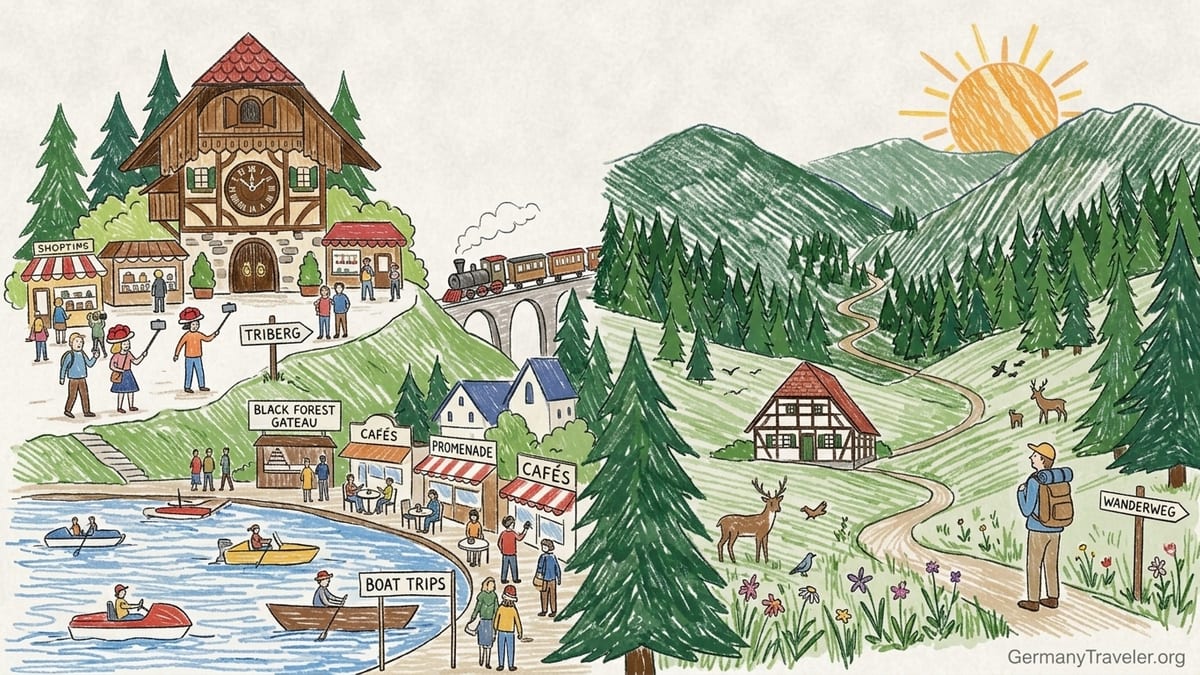
I arrived in Germany’s Black Forest with a head full of postcards. I pictured steep, dark pines leaning over misty valleys, farmhouses so heavy with timber roofs they seemed to grow out of the hillside, and tiny workshops where cuckoo clocks still ticked to the rhythm of a single valley. I imagined Black Forest cake in a village café, not a highway service station, and mountain roads where the only sound was the wind in the trees. What I found was more complicated: part fairytale, part shopping street, and part real forest that only emerged once I stopped chasing every cliché.
The Myth I Came Looking For
The modern image of the Black Forest is no accident. Baden-Württemberg’s own tourism materials cheerfully acknowledge that most visitors arrive thinking of cuckoo clocks, Bollenhut hats, and Black Forest gateau, even as they urge people to look beyond these symbols. Regional brochures show the familiar red-pompom Bollenhut, slices of cream-and-cherry cake, and oversized clocks alongside hiking trails and spa towns, as if to say: the stereotypes exist, but they are only the entrance gate.
Those traditional icons were exactly what pulled me in. Before my trip, I had read about clockmaking towns like Triberg and the Black Forest Open Air Museum near Gutach, where historic farmhouses show how isolated and self-sufficient valley life once was. I wanted to see if the romance of that history still clung to the hills, or if it had been polished into something more convenient and consumable.
I also arrived with a mental soundtrack of German “Heimatfilm” nostalgia and travel articles that lingered on mossy walking paths and deep ravines. When you are primed that way, it is easy to treat the whole region as one enormous set piece. What surprised me most was how sharply the Black Forest divided into two worlds: the crowded stage where those clichés perform on cue, and the quieter side valleys and ridges where they drop away and you finally hear the forest.
Over a week of driving, walking and taking regional trains, I moved back and forth between the two. The contrast did not ruin the trip. It sharpened it. The Black Forest that felt authentic did not always look like the photos that persuaded me to come.
Where the Clichés Felt Most Manufactured
My first deep breath of “classic” Black Forest came in Triberg, one of the region’s best known towns and a regular fixture in guidebooks and coach itineraries. It is famous for two things that fit perfectly on a tour brochure: the Triberg Waterfalls and the concentration of cuckoo clock shops that line the main street. You do not need a map; you follow the stream of people from the parking areas up toward the ticket booth for the falls.
The falls themselves are objectively impressive, a series of cascades where the Gutach River drops through a steep, rocky valley above town. Yet the infrastructure around them shifts the mood. There is an entrance fee, turnstiles, signposted paths with fencing and frequent photo stops. Visitor reviews often mention how busy the paths can become on summer afternoons and weekends, and when I arrived in the middle of the day I found the same: families queuing at railings for the best angles, selfie sticks held high, the constant rustle of jackets and multilingual chatter.
Lower down, Triberg’s central street doubles as a souvenir corridor. Several large clock retailers display entire walls of mechanical cuckoo clocks, many lit like theater sets. Alongside the classic chalet-style clocks with carved birds and leaves, there are novelty designs with moving beer drinkers and LED-lit scenes clearly tailored to bus groups who have one shot at bringing the Black Forest back in carry-on luggage. Another shop advertised the “world’s biggest cuckoo clock” a short drive away, a superlative that felt more like roadside Americana than a quiet German valley.
None of this is inherently wrong. Clockmaking is genuinely rooted in the region, and many shops also sell high quality mechanical clocks with documented origins. The problem, at least for my expectations, was less about authenticity and more about scale. Triberg felt optimized for volume: parking areas that fill and empty with coaches, multilingual menus by the waterfall entrance, and price tags on clocks calibrated for impulse buys in multiple currencies. Standing in the doorway of a shop that played overlapping cuckoo calls every few minutes for demonstration, I realised this was the Black Forest as a themed experience, neatly packaged for a half-day stop.
Overcrowded Nature: When Waterfalls and Lakes Feel Urban
If Triberg was my introduction to choreographed Black Forest branding, Lake Titisee showed me how even natural landscapes can start to feel like extensions of a shopping street. The lake itself, set between wooded hills in the Hochschwarzwald, is beautiful from almost any angle. On a weekday morning, the water was calm and scattered with a few pedal boats. But as the day progressed, the lakeside promenade in Titisee-Neustadt filled quickly with day-trippers from Freiburg and further afield, many arriving on regional trains or tour buses that stop a short walk from the shore.
Tourism information for the area describes several paid car parks in and around the town, often charging day rates that encourage people to make a full outing of their visit rather than a brief stop. By midday, those lots were near capacity, with lines of vehicles waiting for spaces. The lakefront path near the main pier became a slow-moving corridor of people drifting between gelato stands, boat ticket kiosks and rows of cafés advertising “original Black Forest cake” on glossy boards. It felt less like a mountain lake at 800 meters elevation and more like a seafront promenade on a busy holiday weekend.
Farther along the shore, things loosened a little, but even then the sense of infrastructure was never far away: regular excursion boats sounding their horns as they departed, signs coordinating swimming zones in the summer, and kiosks hiring out SUP boards and rowing boats. Guide articles often recommend Titisee as the most accessible Black Forest lake for visitors without cars, and that accessibility comes with a trade-off. It is easy to reach from Freiburg by train, the path along the water is flat and stroller friendly, and everything you might want is concentrated within a few hundred meters. The wilder atmosphere I had associated with the Black Forest receded behind a scene that could have been almost any central European resort lake.
The waterfalls and ravines are not immune to this dynamic either. In peak season, popular spots such as the Ravenna Gorge Christmas market or well-known gorge trails see large numbers of visitors, especially when regional tourist offices actively promote them as “must see” experiences. Some travelers genuinely enjoy the liveliness. For me, the constant presence of kiosks, ticket booths and bus bays at these focal points raised the same question: was I chasing famous names at the expense of the quieter forest experience I came for.
The Souvenir Trap vs. Living Tradition
The most revealing moment of my trip came at a combined attraction and souvenir stop along a regional road, not far from the highland area around Feldberg. The building advertised a restaurant, large gift shop and “traditional products from the Black Forest.” The parking lot could hold several coaches, and on the day I arrived, it was almost full. Inside, long counters displayed rows of pre-sliced Black Forest gateau, pre-packaged ham, schnapps in bottles shaped like pine trees, and mass-produced felt Bollenhut hats in children’s sizes.
It would have been easy to dismiss the whole place as a trap. Yet the cake, when I tried it, tasted decent. The ingredients matched what food writers describe as typical for Black Forest gateau from this region: layers of chocolate sponge, whipped cream, cherries and a hint of kirsch. The problem was not that it was fake, but that it felt disconnected from any particular community. This could have been an anonymous highway stop anywhere in Germany, dressed in regional colours for effect.
Contrast that with the Black Forest Open Air Museum at Vogtsbauernhof, set in the Gutach valley. Regional travel sites describe it as one of the classic attractions, and it certainly receives its share of visitors, but the emphasis there is different. Historic farmhouses have been relocated and reconstructed to show how families lived with the rhythm of the seasons, including smoke-blackened kitchens, barns and on-site demonstrations of traditional crafts. Descriptions from cultural agencies and museum material frame the familiar symbols differently: the Bollenhut headpiece, for example, is explained as a specific tradition from a few nearby villages rather than a hat everyone in the Black Forest once wore.
Spending a morning at Vogtsbauernhof helped re-anchor those clichés in real history. Local interpreters talked about the evolution of clockmaking as a way to earn income in long winters and how recipes like Black Forest cake became associated with the region over time, partly through marketing. After that, a rack of miniature clocks and shot glasses felt easier to ignore. The more context I gained, the clearer it became that the “souvenir trap” was usually not about whether an object was real, but whether it was presented as a shortcut to understanding a place rather than part of a broader story.
Finding the Forest Behind the Postcards
The turning point in my relationship with the Black Forest came when I left the largest names behind and followed the smaller roads into side valleys. One such detour led me to Schiltach, a town in the Kinzig valley area that regional descriptions and hiking blogs often praise for its half-timbered houses and quieter atmosphere compared with better-known bases. Arriving in late afternoon, I found a compact old town clustered around the river, with steep streets rising toward the forested slopes above.
From the center, a marked trail followed the Kinzig for a short stretch before curving into a side valley. Local tourism information for the area describes exactly this kind of route: paths that leave the main traffic corridors and lead into “ruhige Seitentäler,” quiet lateral valleys where the roads are smaller and the forest closes in. Within twenty minutes, the town noise had fallen away. The path narrowed to a dirt track between mossy stone walls, and the only sounds were runoff in the ditch and the tapping of a distant woodpecker.
There were still waymarks and the occasional bench, but no ticket booths, no interpretive panels in four languages and no kiosks selling cake. In places like this, the Black Forest finally matched the image that had lived in my head. The forest felt genuinely dark where spruce and fir closed over the ravine, the ground soft with needles and the air cooler than the town below. This was not a wilderness in the alpine sense. It was a cultivated landscape, with occasional clearings and side tracks leading toward farms. Yet the human presence here felt woven into the land over generations rather than designed around day-trip consumption.
Other side valleys and small lakes offered similar experiences. Local hikers and some recent trip reports point to spots like the Mathisleweiher near Hinterzarten or the paths between Titisee and the smaller Feldsee as places where you can step away from the densest visitor flows and still reach trailheads by train or bus. On one such walk, a simple kneipp pool stood by a cold stream, the only obvious “facility.” A hand-painted board invited walkers to cool their legs. It was the kind of gentle, lived-in tourism that feels supplemental to local life rather than a replacement for it.
Staying Overnight vs. Arriving With the Crowds
If there was one choice that consistently shifted my experience from commercial to authentic, it was staying overnight instead of visiting as a day-tripper. Many Black Forest towns and villages belong to schemes where overnight guests receive a regional card that allows free or discounted use of buses and trains. That practical detail changes your rhythm. Instead of racing to squeeze in Triberg before the afternoon crowds or Titisee between two long drives, I could let the peak hours belong to tour groups while I disappeared into the woods.
In Titisee-Neustadt, for example, day-trippers tend to cluster around the waterfront between late morning and late afternoon, when tour buses and regional trains arrive most frequently. Early in the morning, when I walked down from a guesthouse on the hillside, the promenade felt almost like a different place. Delivery vans were still unloading bakery trays, the excursion boats were docked and quiet, and only a few joggers shared the path. In the evening, after the last coaches left, the town settled again. Staying overnight did not turn Titisee into a hidden gem, but it did reveal calmer pockets of time that are largely invisible if you only arrive in the boom hours.
The same pattern held in smaller places such as Schiltach or Gengenbach. During the day, parking areas near the old town filled up, especially on sunny weekends and during events. Overnight, the streets emptied except for locals and a handful of visitors lingering over late dinners under timber gables. Public transport also feels different when you are not using it to “conquer” the region in a single sprint. A slow train ride along the Kinzig valley in early evening, after most hikers and shoppers have dispersed, aligns more closely with the unhurried Black Forest of regional marketing than a morning connection packed with commuters and excursionists.
Overnight stays also change how you use your car if you have one. Instead of hunting for parking at the absolute closest lot to each named attraction, you can leave the vehicle at your accommodation and approach places on foot or by bus. The congestion around big-name sights such as Triberg’s waterfalls or the busiest Titisee car parks is a reminder that when hundreds of people converge on the same “must see” spot at the same time, even a large forest can begin to feel oddly urban.
Getting Around: Parking, Buses and the Price of Convenience
Logistics in the Black Forest mirror its split personality. The main transport arteries are designed to funnel you straight to the highlights, often at a cost. Near heavily visited spots, car parks are plentiful but rarely free. In and around Titisee-Neustadt, for instance, several lots close to the lake charge flat day rates during the main season, with the exact tariff displayed at machines. In Triberg, much of the convenient parking lies either in municipal lots or on metered streets within walking distance of the waterfall entrance. Arrive late on a sunny day and you may find yourself looping through town several times, watching for brake lights and reverse lights as indicators that a spot is opening.
Buses and regional trains, on the other hand, reward patience and planning. From hubs such as Freiburg or Offenburg, hourly or better services run into the valleys, connecting towns like Titisee-Neustadt, Triberg and the smaller villages of the Kinzig area. Many guest cards include these journeys, which softens the cost of exploration and lets you avoid the stress of mountain parking. The trade-off is time. Reaching a side valley trailhead or a smaller lake by public transport may involve a connection at a regional center and a walk of several kilometers from the final stop.
Prices on the ground reflect the Black Forest’s status as a mature tourist region rather than a bargain frontier. Coffee and a slice of cake at a lakeside café in Titisee or a restaurant on Triberg’s main street can easily add up to the equivalent of what you might pay in mid-range German cities. Souvenirs, especially high quality mechanical cuckoo clocks, are significant purchases that reputable shops price accordingly. At the same time, many of the most satisfying experiences in the Black Forest remain either low cost or free: a local bakery breakfast in a small town, a bus ride up a valley covered by your guest card, or a full afternoon on a marked hiking trail where no one is trying to sell you anything.
The key is to recognize when you are paying for convenience and when you are paying for content. A paid parking space ten meters from a famous waterfall saves your legs but does not change the view. A small investment of time on a bus or on foot can often transport you from a hyper-concentrated tourist zone into a nearby valley that feels radically more in tune with the forest’s reputation.
What Actually Felt Authentic in the Black Forest
Looking back, the moments that felt most authentic were rarely the ones that matched the posters most closely. They were usually smaller in scale and slower in tempo. A farmer on the edge of Schiltach pausing to chat about weather while his dog circled curiously. An unassuming guesthouse in a side valley where the evening menu listed whatever the kitchen could make from local suppliers that day, including a version of Black Forest cake that arrived without fanfare on a plain white plate.
Hiking routes that did not appear on the short “highlights” lists but were described in local brochures or small-town tourist office maps turned out to be the most rewarding. Paths along the Kinzig and Elz watersheds or between less known lakes offered that mixture of forest gloom and occasional open pastures I had been searching for. The signage was sometimes less polished than around flagship attractions, but that lack of theatricality was part of the appeal. It signaled a landscape managed for residents first and visitors second.
Even some very recognizable elements felt genuine when met at the right scale. A single, well-made cuckoo clock in a family-run workshop on a side street has a different presence than a wall of clocks competing for attention under bright lights. A Bollenhut displayed in a small local museum, accompanied by information about which parishes still use it and on what occasions, carries more weight than racks of foam imitations. The symbols that drew me here did not need to disappear. They needed context, proportion and a bit of quiet around them.
Most of all, the forest itself felt truest in the in-between places. Not at the exact viewing platform where everyone stops to take the same waterfall photo, but on the connector trails between villages, where the light filters through fir branches and you have to watch your footing on exposed roots. Those sections delivered the sense of depth and mystery I had expected from the name “Black Forest” long before I saw my first souvenir hat.
The Takeaway
By the end of my trip, I realised that my disappointment was never with the Black Forest as a place, but with the narrow version of it that glossy brochures encourage us to chase. The region is large and varied, with spa towns, remote farmsteads, industrial valleys and quiet ridges. Treating it as a checklist of waterfalls, famous lakes and clock shops flattens it into a theme park. Yet once I stopped pursuing every postcard scene and allowed myself to skip some classics, the Black Forest opened up into something far more interesting and grounded.
If I returned, here is exactly how I would recalibrate. I would keep a few headline experiences that genuinely helped me understand the region, such as a visit to a well interpreted open-air museum and one or two carefully chosen traditional cafés where the cake is made with care rather than purely for volume. I would keep an early morning circuit of Lake Titisee, before the promenade turns into a slow shuffle of day-trippers, and a single, focused stop in a clockmaking town where I could talk to a craftsperson rather than browse under pressure.
I would remove the urge to see every famous waterfall and every lake that appears on top-ten lists. One or two crowded sites like Triberg’s falls taught me what I needed to know about how infrastructure shapes nature here. I would also remove the obligation to buy symbols of the region in souvenir form. The Black Forest does not live more authentically in my home if I return with a miniature hat or an imported clock. Conversation with local people, and time in the forest itself, left a much deeper imprint.
Most importantly, I would replace a chunk of my original itinerary with longer stays in smaller places. I would base myself for several nights in a town like Schiltach or another Kinzig valley village, use regional buses and trains to reach trailheads, and leave entire days unstructured for wandering into side valleys. The Black Forest becomes itself not when you photograph every icon, but when you stop chasing them and let the forest, in all its managed but still moody reality, close around you.
FAQ
Q1. Is Triberg worth visiting if it is so touristy
Yes, Triberg can still be worthwhile if you know what to expect. The waterfalls are impressive and the clock shops show a real craft tradition, but the town is busy, optimized for tour groups and heavy on souvenirs. Go early or late in the day and pair it with a quieter hike nearby instead of treating it as your only Black Forest stop.
Q2. How crowded does Lake Titisee actually get
On sunny weekends and during school holidays, the lakeside promenade can feel extremely busy from late morning through late afternoon, with full car parks, frequent excursion boats and dense crowds around the cafés. Early morning and evening are much calmer, and walking away from the central pier quickly reduces the sense of congestion.
Q3. Where can I find a more authentic Black Forest town atmosphere
Towns in the Kinzig valley area, such as Schiltach and Gengenbach, often feel more lived-in and less dominated by day-tripper infrastructure than the biggest names. They still have visitors, but you are more likely to see everyday life alongside tourism, especially if you stay overnight and explore side valleys on foot.
Q4. Do I need a car to escape the touristy parts of the Black Forest
A car makes it easier to reach trailheads and smaller valleys, but it is not essential. Regional trains and buses connect many towns, and overnight guests in several areas receive cards that include local public transport. With some planning and extra time, you can reach quieter trails and lakes without driving or worrying about parking.
Q5. How can I experience traditional Black Forest culture without falling into souvenir traps
Focus on places that explain traditions rather than simply selling them. Open-air museums, small local museums and family-run workshops often provide context about Bollenhut hats, farmhouse architecture and clockmaking. When you do buy something, choose a single, well-made item with a clear origin instead of armfuls of mass-produced souvenirs.
Q6. Are the famous waterfalls the best nature experiences in the Black Forest
The big waterfalls are striking but often crowded and heavily managed. Many travelers find more atmospheric forest experiences on lesser-known ravine walks, lakeside paths away from main promenades and marked trails between villages. If time is short, visiting one headline waterfall and then seeking quieter routes can give a better overall balance.
Q7. Is Black Forest cake better in small villages than at highway-style stops
Quality varies everywhere, but you are more likely to find memorable Black Forest cake in cafés or guesthouses that bake on site and serve a local clientele, often away from the biggest bus parking areas. Asking at your accommodation or trying a place where most other customers are speaking German can be a reliable guide.
Q8. What is the advantage of staying overnight instead of doing a day trip from a city
Staying overnight lets you experience popular spots in their quieter hours and frees you from the pressure to rush through a checklist. Early mornings and evenings in towns like Titisee or Triberg feel very different from midday, and an overnight base in a smaller town gives you easier access to side valleys and less visited trails.
Q9. How expensive is the Black Forest compared to major German cities
In heavily visited areas, café prices and some restaurant menus are comparable to mid-range city levels, and high quality cuckoo clocks are significant purchases. However, many of the most authentic experiences, such as hiking, exploring villages and using guest-included public transport, can be done at modest cost once you are in the region.
Q10. What should I prioritize if I only have two or three days in the Black Forest
Choose one well located base town, one or two classic sights such as a waterfall or open-air museum, and at least one full day for a quieter hike from your doorstep. Skipping a few famous names in favor of deeper time in a single valley will likely bring you closer to the Black Forest atmosphere that first captured your imagination.