


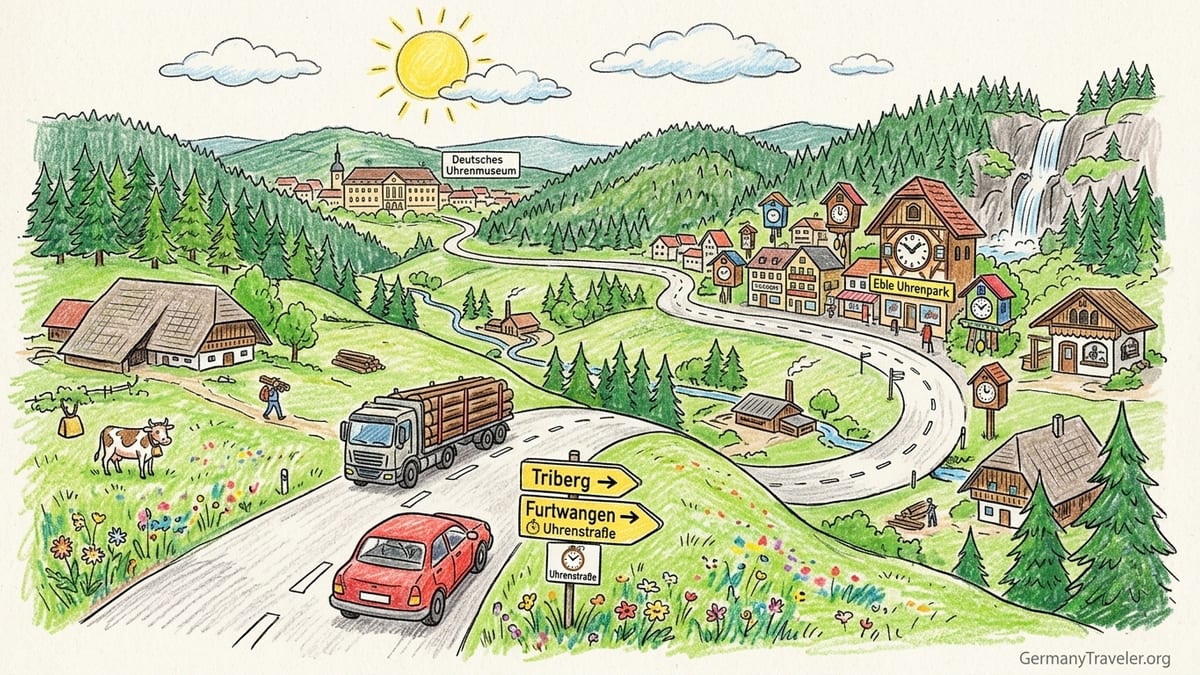
Somewhere between a carved cuckoo bird popping from a chalet facade and a silent, weight-driven regulator in a museum case, the German Clock Road stops feeling like a tourist slogan and becomes a real landscape again. I learned that the hard way, by actually driving a full day through the Black Forest’s historic clockmaking corridor, following the signed Deutsche Uhrenstraße between Villingen-Schwenningen, Furtwangen, Triberg and Titisee. On paper it is roughly 267 kilometers. On the ground it is curves, farmyards, sawmills, and conversations with people who still shape wood and brass into time.
Plotting a Real Route, Not Just a Line on the Map
I started and finished in Villingen-Schwenningen, which official tourism treats as a natural gateway to the German Clock Road. The loop on brochures looks almost casual: Villingen-Schwenningen to Triberg, over to Furtwangen, on toward St. Peter and Titisee, then back across the Baar plateau. In reality, if you care about museums and workshops, you need to cut this loop into digestible pieces rather than treat it as a single sprint.
My driving day focused on the historic core between Villingen-Schwenningen, Triberg, Furtwangen and Titisee, roughly 150 to 170 kilometers depending on small detours. I left Villingen-Schwenningen mid-morning, picked up the regional road toward Triberg, followed signposts for the Deutsche Uhrenstraße, and immediately discovered the first truth of this route. It is not a high-speed holiday road. It is two-lane, often narrow, shared with delivery vans, local buses and patient locals who know every curve.
The first leg to Triberg took a little over an hour, including getting stuck behind a timber truck and detouring into Hornberg to refuel both the car and myself with coffee. This is the sort of delay that never shows up on official mileage figures. When you are creeping through a village at 40 km/h past a bakery and a church, the idea of covering the full 267 kilometer loop in a single day suddenly feels aggressive rather than ambitious.
From Triberg, the road climbs and dips toward Furtwangen, the stretch that historians point to as the heart of Black Forest clock production between the 18th and 20th centuries. The distance is barely 25 kilometers, but between photo stops and slow trucks it still took close to 45 minutes. I planned one long stop at the German Clock Museum in Furtwangen, then a late-afternoon run across the wooded ridges toward Titisee before circling back toward Villingen-Schwenningen in the evening.
Triberg: When Cuckoo Clocks Feel Like a Stage Set
Triberg is the name most visitors recognize. It has one of Germany’s best-known waterfall walks and its main street is an almost uninterrupted run of clock shops. Stepping out of the car in one of the paid parking lots near the waterfall entrance, I was greeted by a familiar chorus: recorded cuckoo calls, music from chalet clocks, and the soft murmur of tour groups deciding which shop looked most authentic.
The Black Forest Museum near the waterfall entrance does a compelling job of explaining how clocks fit into a wider local culture, from old craft workshops to barrel organs and carved carnival masks. Inside, there are Black Forest clocks spanning several centuries, from shield clocks painted with floral motifs to heavy carved pieces that bear almost no resemblance to the kitschy chalet clocks sold in many shop windows today. It is a useful antidote to the idea that this region has only ever made one kind of clock.
On the commercial strip, things feel different. Eble Uhrenpark, a short drive outside the center, promotes the “world’s largest cuckoo clock” built into a house-size facade, with a giant pendulum swinging beneath the gable and tour buses idling in the parking lot. Even in town, a few shops display handwritten signs emphasizing “Made in Black Forest” or “certified workshops,” but these sit next to shelves of mass-produced quartz cuckoo clocks powered by batteries and assembled far from any valley farm.
This was the first moment when the Clock Road theme felt uncomfortably close to a gimmick. I could stand in a shop doorway and see several near-identical scenes: wooden facades, racks of ornate souvenirs, groups deciding how much wall space they had at home. Triberg remained worth a stop for the museum and the short but steep waterfall walk, but by midday I was ready to get back in the car and chase something quieter and more rooted in the working life of the craft.
Climbing to Furtwangen and the German Clock Museum
The drive from Triberg to Furtwangen restores the sense of geography that the shopfronts obscure. The road climbs through forests of spruce and fir, past farmhouses with broad, sloping roofs designed to shed snow, and small sawmills where the smell of cut wood drifts across the road. These are the landscapes where winter-bound farmers once carved clock cases to supplement their income, sending peddlers over the passes with boxes full of timepieces.
Furtwangen itself feels more like a working town than a resort. It is home to a university of applied sciences and light industry, and at its center sits the German Clock Museum. The museum holds one of the most comprehensive collections of German clocks, ranging from early wooden-gear Black Forest models to precision regulators and wristwatches. The building is directly on the Clock Road, with paid parking nearby that was easy to access even in mid-season.
Inside, the museum makes a point of telling clock history as social history. One room explores the famous shield clocks, with their painted wooden dials and simple movements. Another focuses on industrialization, when factories such as Junghans in nearby Schramberg began competing on a global scale. A reconstructed clockmaker’s workshop shows the tools and benches used when almost everything from the plates to the gears was cut and filed by hand. It is possible to visit in under an hour, but giving it two hours allowed time to read, watch demonstrations, and simply listen to the overlapping ticks and chimes from dozens of mechanisms.
This was where my skepticism about the Clock Road theme began to ease. Faced with row upon row of clocks that were never meant for tourists, it becomes clear that the Black Forest’s clock industry once existed for people who needed reliable time in farmhouses, schools and factories around the world. The carved birds and miniature beer drinkers came later. The core of the craft was precision in wood and metal, not novelty.
Meeting a Working Clockmaker in Schonach
Leaving Furtwangen, I detoured slightly off the most direct route to visit a working clock workshop near Schonach, one of the small towns that still support genuine hand carving and assembly. Several workshops in the area offer guided visits by appointment, often in plain industrial buildings or traditional farmhouses set back from the main road. I parked on a gravel pull-out in front of a modest workshop building, far from the tour buses of Triberg.
Inside, the air smelled of wood shavings and oil. On one bench lay rough-cut cases in pale linden wood, chosen because it carves cleanly without splitting. Another held brass plates drilled for arbors, waiting to be assembled into pendulum movements. A clockmaker in a worn apron explained that high-quality cuckoo clocks still use solid wood cases, often from spruce or linden, and mechanical movements made from brass and steel. The carvings, whether leaves, birds or hunting motifs, are usually done by hand with chisels and gouges, not by CNC machine.
He pointed out the differences between these workshop pieces and the mass-market clocks sold elsewhere. On a handmade clock, the wood grain runs consistently along carved elements, and the leaves have undercut edges and depth. The weights are cast metal rather than hollow shells, and the movement plates carry identifiable marks from a respected maker rather than anonymous stamped numbers. Many of these clocks include traditional rack-and-snail striking mechanisms, which can be serviced and repaired for decades, rather than sealed quartz modules designed to be replaced.
Watching him adjust a bellows and test the timing of a cuckoo call with a pendulum ruler felt less like shopping and more like visiting a small factory museum that never stopped operating. When he mentioned that a simple, entry-level mechanical cuckoo clock from a workshop like his commonly costs several hundred euros, with more intricate, deeply carved pieces reaching into the low thousands, it reframed the racks of cheaper clocks I had seen earlier in the day. Those were souvenirs. These were pieces of furniture and folk art meant to outlast their first owners.
Road Conditions, Parking and How Long the Day Really Took
From Schonach, I rejoined the signed Clock Road and drove toward Titisee, crossing wooded ridges and open meadows. The surface on these connecting roads was generally good, fully paved and well maintained, but not fast. Curves are frequent, overtaking lanes are rare, and speed limits drop sharply as you enter villages, often enforced by visible speed cameras and roadside boxes.
Including all stops, the day ran from about 9:30 in the morning, when I left Villingen-Schwenningen, to about 19:30, when I rolled back into town as the last light faded. Actual moving time shown on the GPS log was a little over four hours. The rest was swallowed by walking to waterfalls, museum visits, workshop conversations, coffee stops and a brief grocery run in Furtwangen. A route that might look like a half-day drive on a map became a full, satisfying travel day once I factored in everything I wanted to see.
Parking was rarely a problem but often paid. In Triberg, there are several signed lots near the waterfall entrance and museum, usually paid by machine with coins or card, with clear time limits. The German Clock Museum in Furtwangen sits near central parking areas, and I had no trouble finding a spot on a weekday. At the small workshop near Schonach, parking was informal. The owner simply waved me into an open space near the barn.
If I had tried to combine a deep visit to Furtwangen’s museum, a workshop tour, a full walk to the top of the Triberg waterfalls and extended browsing for a clock purchase, all within a single day, something would have felt rushed. As it was, skipping serious shopping and keeping the waterfall visit to an hour allowed the day to feel full but not frantic. The main constraint on the Clock Road is not distance. It is the density of things that reward lingering.
Beyond Cuckoos: Valleys, Farmhouses and Quiet Stops
One of the best surprises along the Clock Road was how easily the theme receded once I left the most commercial stretches. Between triberg, Furtwangen, Schonach and Titisee, the route slips through small valleys where the most interesting sights have nothing to do with clocks at all. In one hamlet, I pulled into a lay-by to photograph a traditional Black Forest farmhouse with a roof that almost brushed the ground, its timbered upper story stacked over a stone base. In another, a small roadside chapel stood in a clearing, its interior lit by real candles rather than LED imitations.
These unscripted stops did as much to explain the origin of the clock industry as any plaque. It is easy to imagine winters when fields disappeared under snow and farmers turned to carving and assembling wooden clock parts by lamplight. The same forests that provided timber for beams and shingles supplied linden and spruce for clockcases. Small streams that now power tourist mills once turned wheels and saws that cut boards and gears.
Driving with the windows half-open, I also gained a new respect for how quiet much of the Black Forest remains away from the busiest corridors. The famous B500 ridge road lies to the northwest, carrying a steady stream of sports cars and touring motorcycles. The Clock Road, in contrast, often feels like a regional back way. Twenty or thirty minutes would pass without another car appearing in either direction, leaving only the sound of the engine, cowbells and the distant bark of a chainsaw from a woodlot.
In the late afternoon near Titisee, I pulled into a lakeside parking area and walked down to the water. Here, rubber pedal boats and lakeside cafés brought me back to the tourist map, but even this scene felt less contrived than the choreographed clock calls of Triberg’s commercial strip. People were swimming, eating ice cream and watching the light fade on the water. Clocks, for a moment, had nothing to do with it.
When the Theme Feels Thin, and How History Restores It
Sometime in the middle of the day, crawling past yet another sign advertising the “largest,” “original” or “authentic” cuckoo clock, I caught myself wondering whether the entire Clock Road concept was just a clever way to string together places that would rather not be known only for timber and long winters. It is a tidy narrative for brochures: follow the route, buy a clock, tick that box. Ask no further questions.
What pulled me back from that cynicism were the quieter historical threads. In the German Clock Museum, exhibits on the global trade networks of Black Forest clock peddlers showed how this remote region once exported its products across Europe and as far as America and Asia. Old shipping records, advertising posters and examples of clocks made for specific foreign markets documented a surprisingly cosmopolitan story for such rural valleys.
The working workshop in Schonach reinforced that this story is not over. The clockmaker’s order book contained commissions from abroad as well as from German families marking anniversaries and new homes. Some orders specified traditional hunting motifs, others more restrained designs with simple mouldings instead of heavy carving. The point was not to chase a nostalgic idea of the Black Forest, but to build objects that would keep real, mechanical time in real houses.
Even the more commercial stops look different once you have that context. It becomes easier to distinguish displays that showcase local makers and explain how to recognize quality from those that simply treat clocks as interchangeable souvenirs. I left the region without buying a clock, but if I had, I would have driven straight back to a workshop or to a shop that clearly listed its makers and movements rather than one that focused on volume and discount signs.
Should the Clock Road Be a Dedicated Day or a Framework?
By the time I returned to Villingen-Schwenningen in the evening, it was clear that the German Clock Road works less as a stand-alone “attraction” and more as a lens through which to see one slice of the Black Forest. It gave my day structure, but the most memorable moments involved scenery and encounters that would have been worthwhile even if I had not been thinking about clocks at all.
If you are staying several days in the Black Forest, the historic core between Triberg, Furtwangen, Schonach and Titisee makes an excellent dedicated day, especially if you are genuinely curious about mechanical objects, folk art and industrial history. Planning for a full day allows you to spend two to three hours at the German Clock Museum, an hour or more at a workshop visit, and shorter stops for waterfalls and lakes without feeling rushed.
If your interests are broader, it may be better to treat the Clock Road as one thread woven into a larger road trip that also takes in routes like the B500 ridge road, vineyard landscapes on the western edge of the forest, or nearby university cities such as Freiburg. In that case, you might spend a half-day on clocks and another half hiking or exploring a historic town, using the Clock Road signs more as gentle suggestions than strict marching orders.
What the route does very well is highlight how a specific craft can shape an entire region over centuries. The valleys between Triberg and Furtwangen are dotted with physical reminders of that history, from modest farm workshops to museum collections that would be at home in much larger cities. Driving the Clock Road turned out not to be about hunting down the biggest cuckoo. It was about understanding why timekeeping, in all its ticking, chiming forms, ever took root so deeply among these dark trees.
FAQ
Q1. Can you really drive the entire 267 kilometer German Clock Road in one day?
It is physically possible to drive the full loop in a long day, but if you stop for museums, workshops and short walks it quickly becomes rushed. Most travelers will enjoy the route more by focusing on a core section such as Villingen-Schwenningen, Triberg, Furtwangen and Titisee over a full day rather than trying to cover every kilometer.
Q2. Where is the best place along the route to learn about clock history, not just buy souvenirs?
The German Clock Museum in Furtwangen offers the most in-depth look at Black Forest timekeeping, with historic workshops, early wooden clocks, industrial-era pieces and educational displays. Combining this with a visit to a small working clock workshop in towns like Schonach or Schönwald provides a strong sense of both history and living craft.
Q3. How different are handmade Black Forest cuckoo clocks from the cheaper mass-market versions?
Handmade clocks from regional workshops usually have solid wood cases, deep hand carving, mechanical brass movements and cast metal weights, and they can be serviced for decades. Mass-market clocks often rely on shallow, machine-assisted carving, battery-powered quartz movements and lighter materials, which keeps prices lower but also reduces longevity and repairability.
Q4. Is Triberg worth visiting if you are not planning to buy a clock?
Yes. Triberg has a compact waterfall walk, the Black Forest Museum with historic clocks and folk art, and a main street that is interesting as a cultural experience even if you do not shop. However, the most insightful clock-related experiences lie in the museum and the surrounding clockmaking towns rather than in the most touristy shops.
Q5. Do you need to book clock workshop visits in advance?
Many genuine workshops in the Schonach and Furtwangen area welcome visitors but prefer or require advance contact, especially outside peak summer months. Because they are active workplaces rather than staged attractions, calling or emailing ahead increases the chance of seeing real carving, assembly or repairs in progress instead of just a showroom.
Q6. What are road conditions like along the German Clock Road?
The route uses paved regional and federal roads with generally good surfaces, but it is mostly two-lane, winding and shared with local traffic. Expect frequent curves, sharp speed limit changes near villages and limited chances to overtake, which means driving times will be longer than simple distance calculations might suggest.
Q7. Is it realistic to combine the Triberg waterfalls, clock shopping and the German Clock Museum in one day?
It can be done, but it makes for a very full schedule. Visiting the waterfalls and a few shops in Triberg, then driving to Furtwangen for a thorough museum visit and possibly a workshop stop, will easily fill a day from morning to early evening without much slack for long meals or additional hikes.
Q8. Are there good places to park near the main clock-related sights?
Triberg offers several paid parking lots close to the waterfall entrance and museum, and Furtwangen has central parking areas within walking distance of the German Clock Museum. Smaller workshops often have informal parking on-site or in nearby lay-bys, but it is wise to arrive with some extra time in case you need to walk a short distance.
Q9. Does the German Clock Road still feel authentic, or is it mostly a marketing route?
In the busiest sections, especially around large souvenir shops, the route can feel heavily marketed. However, once you visit the museum in Furtwangen, smaller workshops and quieter valleys, the depth of the region’s clockmaking heritage becomes clear, and the route works well as a framework for exploring that history.
Q10. Is the German Clock Road suitable for families or better for enthusiasts?
The Clock Road can work for both. Families often enjoy the waterfalls at Triberg, the interactive elements at museums and the novelty of seeing giant cuckoo clocks, while enthusiasts will appreciate the technical displays and workshop visits. Planning a balanced day with outdoor time and limited driving segments helps keep everyone interested.