


On my first evening in Württemberg wine country, I walked straight past the Besen twice. I had flown in with romantic images of half-timbered wine taverns and candlelit vineyard views. What I found instead was a low house on a residential street near Stuttgart, a plastic tent in the courtyard, and a green wooden board with a small broom nailed to it. It was not the polished tasting room I expected. It was better.
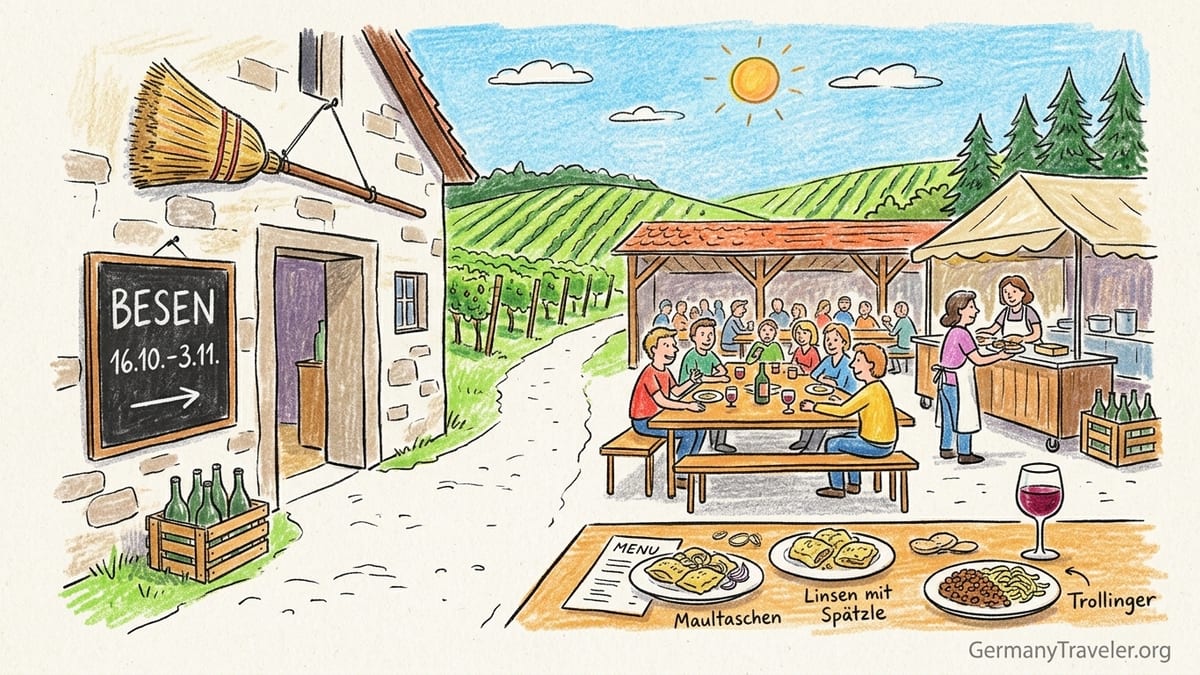
Finding the Besen: Following the Broom, Not the Brochure
I had read about Besenwirtschaften, usually shortened to Besen, in the Württemberg tourism material on the plane. They were described as seasonal wine taverns run by growers, informal places where you drink the estate’s own Trollinger or Lemberger among locals. What those glossy descriptions did not explain was how you actually find one that is open on a random Thursday in October.
My guesthouse host in Stuttgart-Bad Cannstatt shrugged when I asked for a recommendation and pointed me to the local newspaper’s events page and a printed Besenkalender pinned to the noticeboard in the hallway. Each line listed a grower’s name, a village like Uhlbach or Obertürkheim, and dates such as “16.10.–3.11., täglich ab 16 Uhr.” There was no website and no booking link, just a phone number. This already felt different from booking a winery tasting or a restaurant table in the city.
I chose a family winery in Stuttgart-Uhlbach because it was reachable on the U‑Bahn and then a short walk through terraced vineyards. When I called in the afternoon to ask about reservations in clumsy German, the woman on the phone laughed gently and said, “Kommen Sie einfach, ab halb sechs. Reservieren brauchen Sie nicht, nur wenn Sie viele Leute sind.” Come from 5:30 pm, no reservation needed unless you are a big group. For someone used to reserving weeks ahead for wine bars in major cities, this casual approach already hinted at the Besen’s more domestic rhythm.
The Besen itself hid in plain sight. On a narrow residential lane, there was no neon sign, just a doorway framed by stacked wine crates and a small broom hanging above a green wooden board with the handwritten word “Besen” and the opening dates. When the broom hangs out, locals know the tavern is operating. Without my host’s explanation, I would have taken it for a private party.
Stepping Inside: Seating, Shared Tables and First Impressions
As soon as I stepped into the courtyard, I understood why the city requires special registration for Besen taverns as a separate category of temporary hospitality business. These are not full-time restaurants but improvised extensions of farm life. The winery had stretched a clear plastic tent over the yard, with long wooden tables and simple benches. In one corner, stacked crates of empty one-liter bottles, in another, a portable bar and a chalkboard listing the wines and dishes. The air smelled of grilled sausages and onion fat.
A woman in her sixties, clearly part of the family, waved me in and asked, “Allein?” When I nodded, she steered me not to a separate table but to a half-occupied bench where an older couple and two younger men already sat elbow to elbow. The Besen is built on communal seating; it has more in common with a church hall supper or a harvest canteen than a restaurant. There were no tablecloths, no individual place settings, and nobody seemed to mind brushing shoulders with strangers.
I felt awkward for the first ten minutes. The conversations around me were rapid-fire Swabian German, full of rounded vowels and clipped consonants that even fluent German speakers sometimes struggle to follow. I could catch words like “Maultaschen” and “Viertele,” but most jokes were lost on me. Yet that initial discomfort was part of the cultural immersion. Within a few minutes, the couple across from me smiled, introduced themselves in standard German and translated key bits of the menu scrawled on the paper placemat.
The noise level was closer to a neighborhood pub than a tasting room: clinking glasses, children weaving between benches, the squeak of the kitchen door. A football match murmured from a small TV mounted above a barrel, the commentary occasionally drowned out by a burst of laughter from the next table. It was not quiet, and it was not trying to be.
Ordering in a Besen: Menus, Money and Mild Confusion
The menu looked nothing like the multi-page wine lists of city wine bars. In this Besen, each guest had a thin sheet of paper that doubled as a place mat, printed with a list of wines on one side and simple Swabian dishes on the other. Some items had been crossed out by hand as they sold out. There was no QR code, no English translation and no glossy photos. When I hesitated, my table neighbors pointed to their favorites and helped me decode the abbreviations.
For wine, everything was listed by the Viertele, the classic quarter-liter pour that is as much a Swabian identity marker as the pretzel. Options included Trollinger, the light red that still defines Württemberg for many locals, a Trollinger with Lemberger blend, a fruity Riesling, and a slightly more structured Lemberger. Prices ranged between about 4.20 and 5.80 euros for a Viertel, with a full liter jug for the table costing a bit under 16 euros. That put the Besen somewhere between a supermarket and a serious city wine bar, with the difference that every wine on the list came directly from the barrels in the cellar beneath our feet.
Food ordering worked on a hybrid system. Drinks were ordered and paid through the family member roaming the tables with a notepad, while hot dishes were prepared from a tiny kitchen accessible through a side door. When she reached our table, I ordered in German but fell back to English to make sure I understood the portion sizes. She did not blink, switching languages mid-sentence and confirming that I wanted “Maultaschen mit geschmelzten Zwiebeln und Kartoffelsalat” rather than the soup version.
One practical difference from restaurants surprised me: there was no card reader. On the paper menu, in small print at the bottom, it said “Nur Barzahlung.” Cash only. Regulars at the table nodded when I pointed it out. “Immer dabei haben hier,” one of them said. Always have it with you here. At the end of the evening, the same woman who took my order did the mental arithmetic for our shared table in seconds, splitting individual bills from a crisscross of tallies in her notebook. There was no printed receipt and no itemized breakdown, only a final number that felt modest compared with big-city dining.
What I Ate and Drank: A Real Besen Meal
I started with a Trollinger as my first Besen wine. In a region increasingly known among wine professionals for serious Lemberger and Pinot, ordering Trollinger can feel like choosing the unfashionable option. In Württemberg Besen culture, though, it remains the default red. Mine arrived in a thick-stemmed quarter-liter glass marked with a measurement line. It was translucent ruby, lightly chilled, more about sour cherry and freshness than depth. With the bustle around me and the grill smoke from the open kitchen, it made sense in a way that no tasting-room flight could have.
For food, I followed the couple’s recommendation and ordered Maultaschen with browned onions and potato salad, one of the iconic Swabian dishes widely associated with Württemberg cuisine. The plate that arrived carried two plump pasta pockets, sliced to show a filling of minced meat, spinach and herbs, covered in a tangle of sweet, slowly cooked onions. Next to them sat a mound of vinegary potato salad with translucent slices of cucumber. The Besen’s menu priced this at just under 10 euros, noticeably lower than similar Maultaschen plates in central Stuttgart restaurants, where they often range from around 14 to more than 17 euros.
Curious to try another classic, I shared a portion of Linsen mit Spätzle und Saitenwurst with my neighbors. This was a deep bowl of lentils in a lightly sour broth poured over soft egg noodles, topped with a smoked sausage. It was pure, filling peasant food, the kind that reflects the historically modest, Protestant roots of Swabian cooking rather than fine-dining ambition. For that dish, the Besen charged roughly 11 euros. While I ate, my neighbors talked about how many families in Württemberg still cook this at home every Monday.
For a second glass, I ordered the Trollinger-Lemberger blend. The server described it as “a bit more serious” than the straight Trollinger. It came slightly darker in the glass, with more spice and grip, a good match for a slice of cold Bauernbraten, farmhouse pork roast, that another guest passed down the table for me to taste. Without a formal tasting sheet, I simply wrote the name on my paper place mat to remember it later. That is part of the Besen experience too: tasting wine as you would drink it in daily life, not as an exercise in note taking.
Locals, Languages and the Social Side of Besen Culture
The most distinctive part of the evening was not the food or the wine, but the way the Besen collapsed the distance between visitor and local. At my table alone sat two pensioners who had been coming to this family's Besen for more than twenty years, a pair of colleagues from a nearby automotive supplier still in work shirts, and a young couple with a toddler and a stroller folded under the bench. This was not a tourist-only space; it was an extension of neighborhood life during the weeks the broom was out.
As a foreign visitor, language was the one real barrier. The staff and several guests were comfortable switching to standard German and, when I stumbled, to simple English. But much of the humor and warmth flowed in the Swabian dialect. People teased each other about how many Viertel they had had or which Besen in the valley served the best Schlachtplatte, a hearty plate of sausages and sauerkraut. I caught only fragments, but the rhythm and volume of the talk communicated the mood even when words slipped by.
Once it became clear I was genuinely interested in local wine rather than just a cheap meal, the older man next to me took on the role of informal guide. He explained that by law, these Besen can only operate for a limited number of days per year and must serve the grower’s own wine. He complained, half-jokingly, that some places had become “zu fein,” too fancy, almost like year-round restaurants. This, he insisted, pointing at our plastic tent roof and the faint smell of fermenting must from the cellar, was the real thing.
That informality extended to the service style. Plates arrived when ready, not necessarily in a strict order. The toddler received her sausage early, my lentils came a bit after everyone else’s. Nobody minded. Between courses, people got up to greet friends at other tables, glasses in hand. The lines between staff and guests blurred; a college-aged son alternated between running the bar and sitting for a quick chat with friends. In a formal restaurant, this might read as disorganized. Here it simply reflected that you are, quite literally, in someone’s extended living room.
How a Besen Differs from Restaurants, Wine Bars and Tasting Rooms
By the middle of the evening, the differences between the Besen and more familiar food and wine venues felt stark. Compared with a normal restaurant in Stuttgart, the menu was shorter, the seating tighter and the payment more old-fashioned. There was no children’s menu, no vegetarian page (beyond cheese bread and maybe Käsespätzle) and certainly no gluten-free symbol next to each dish. You accept what the kitchen can reasonably produce in a small domestic setup for a few intense weeks per year.
Relative to a wine bar, the Besen is less about showcasing famous estates from across Germany or the world and more about expressing one specific patch of hillside. The wines poured that night likely never travel far beyond the surrounding communities. Labels were simple, sometimes just the family name, grape variety and vineyard. There was no pressure to order a bottle; in fact, most tables stuck to the traditional Viertel glasses or shared liter jugs.
The contrast with a modern winery tasting room was perhaps the sharpest. There were no guided flights, no pre-booked time slots, no tasting fees redeemable on purchase. Nobody walked me through the soil types or fermentation regimes. Instead, I learned by watching who drank which wine with which dish, by tasting the Trollinger-Lemberger blend with a slice of cold roast, by hearing how the older man grumbled that the Riesling had become “zu fein” for his taste. It was messy, subjective and powerful.
Even the physical space made a statement. Where tasting rooms often feature polished wood, large windows and considered lighting, this Besen had fluorescent tubes, plastic-covered benches and mismatched plates. The charm lay less in visual design than in the sense of being allowed briefly into the back-stage world of Württemberg wine, where growers and neighbors meet on equal footing.
Practical Realities: Seasons, Transport and What I Would Do Differently
One key detail that can easily trip up first-time visitors is seasonality. Besenwirtschaften in Württemberg typically operate for a limited number of weeks each year, often split between a spring and an autumn opening. The exact dates vary by grower and are usually announced through local newspapers, village noticeboards, regional Besenkalender brochures and the wineries’ own announcement channels. As a traveler, you cannot assume that a place which existed last year will be open on your dates. You have to check current listings and, ideally, call ahead on the day to confirm that the broom is indeed out.
Opening hours can be equally specific. The Besen I visited opened at 5 pm on weekdays and earlier on Sunday, serving hot food until around 8:30 or 9 pm and keeping cold plates and drinks going a little longer. There was no late-night service; neighbors expect quiet by around 11 pm. Arriving too late can mean finding the kitchen sold out of certain dishes. Next time, I would aim to be there within the first hour of opening, both for a better choice of food and a calmer start before the tent filled.
Transport is another practical consideration that tourism brochures sometimes gloss over. Württemberg’s wine-growing suburbs and villages, such as Uhlbach, Untertürkheim, Fellbach or Besigheim, are often well connected by S‑Bahn, U‑Bahn or regional trains, but services thin out later in the evening. For my visit, I checked the return schedule in advance and set a quiet phone alarm as a reminder to leave in time for the last realistic train back to central Stuttgart. For groups staying in rural guesthouses, many locals recommend leaving the car and arranging a taxi or, where available, booking a local shuttle in advance. Driving after a few generous Viertel is not part of responsible Besen culture.
Looking back, there are small adjustments I would make. I would bring more cash in small denominations to make splitting the bill easier. I would also study a few key Swabian food words beforehand, such as “Linsen,” “Saitenwurst,” “Schlachtplatte,” and “Käsespätzle,” to navigate the menu more confidently. But I would keep the essential spontaneity: picking a Besen based on a hand-painted sign, walking up to a communal table and accepting a bit of social and linguistic uncertainty as part of the experience.
The Takeaway
My first Besen evening in Württemberg did not match the sleek, curated image of wine tourism that dominates social media. There were no shimmering vineyard sunset shots, no guided flights or tasting notes printed on heavy cardstock. Instead, there was the clatter of plates on wooden tables, the sweetness of slowly browned onions, the sour-cherry bite of Trollinger in a thick-stemmed Viertel glass and the hum of neighbors catching up under a plastic tent roof.
For travelers used to polished winery experiences, Besen can take a bit of decoding. They are seasonal by law and custom, usually open only a limited number of days per year. They tend to announce their existence through broom signs, local calendars and word of mouth rather than glossy advertising. Reservations are often unnecessary or even impossible for small groups, and cash is still the norm. Menus are short, firmly rooted in Swabian home cooking and not always translated.
Yet these very quirks are what make a Besen visit such a valuable window into Württemberg wine culture. You see how people actually drink the region’s wines with everyday meals, how families deploy their small kitchens to feed a village, how social networks knot and re-knot over shared benches. The wines you taste may not be the most prestigious in the region, but they are often the most embedded in local life.
If you are planning your own first Besen experience, start by checking the current Besenkalender for the area you are visiting and confirming dates directly with a winery. Expect basic, communal seating and bring enough cash for an evening of simple food and a few generous Viertel. Learn a handful of German phrases, especially for ordering and paying, but do not worry if your language skills are limited; goodwill and curiosity go a long way. Most importantly, plan your route home by public transport or taxi before your first glass arrives. In a landscape increasingly full of curated winery architecture and brand stories, a night in a Besen still feels like stepping into the unvarnished, working heart of Württemberg’s wine world.
FAQ
Q1. What exactly is a Besen in Württemberg?
A Besen is a seasonal wine tavern run by a winegrowing family, usually in their home or courtyard, where they serve their own wines and a small menu of regional Swabian dishes for a limited number of weeks per year.
Q2. How can I find a Besen that is currently open?
Look for regional Besenkalender listings, check local tourism offices and winery announcements, and watch for the broom sign and handwritten boards outside growers’ homes indicating dates and opening times.
Q3. Do I need a reservation for a Besen visit?
Small groups of one to four people usually do not need reservations and are seated at communal tables, while larger groups are often asked to call ahead, especially at popular Besen or on weekends.
Q4. What kind of food is typically served in a Besen?
Besen menus focus on hearty Swabian dishes such as Maultaschen with onions and potato salad, Linsen mit Spätzle und Saitenwurst, cold meat and cheese plates, and sometimes Käsespätzle or Schlachtplatte, depending on the family’s kitchen and season.
Q5. What wines should I try at a Württemberg Besen?
Typical choices include local Trollinger, Trollinger-Lemberger blends, Lemberger on its own and regional white wines such as Riesling, usually served by the quarter-liter in thick-stemmed glasses.
Q6. How much does a Besen meal and wine usually cost?
In many Besen, hearty main dishes often fall roughly in the 9 to 13 euro range, while a quarter-liter glass of estate wine tends to cost between about 4 and 6 euros, though prices vary by producer and location.
Q7. Is English spoken in Besen taverns?
Staff and some guests often manage basic English, but most conversation happens in German and local Swabian dialect, so knowing key food and ordering phrases in German is helpful but not strictly necessary.
Q8. How do I pay in a Besen?
Many Besen still operate on a cash-only basis, with the bill tallied by hand at the table at the end of the evening, so it is wise to bring enough cash in small denominations.
Q9. How can I get back safely after drinking at a Besen?
Plan your transport in advance by checking evening train or tram schedules, arranging a taxi or local shuttle where available, and leaving your car at your accommodation so you do not need to drive after drinking.
Q10. Why does a Besen visit feel different from a regular winery tasting?
A Besen is less formal and more communal, with simple surroundings, shared benches and home-style cooking, so you experience local wine as part of everyday social life rather than as a structured, curated tasting flight.