


Baden-Württemberg likes to call itself Germany’s number one spa state, and with more than 50 officially recognized spas and health resorts, it has the credentials to back that up. From grand Belle Époque bath temples to modern glass-and-steel wellness centers surrounded by vineyards, the region’s thermal culture is one of its most distinctive travel experiences. This guide looks beyond generic sightseeing to focus on what really matters for spa travelers: the different kinds of bathing on offer, how the rules and atmosphere change from town to town, and which spa destination actually fits your style, budget and itinerary.
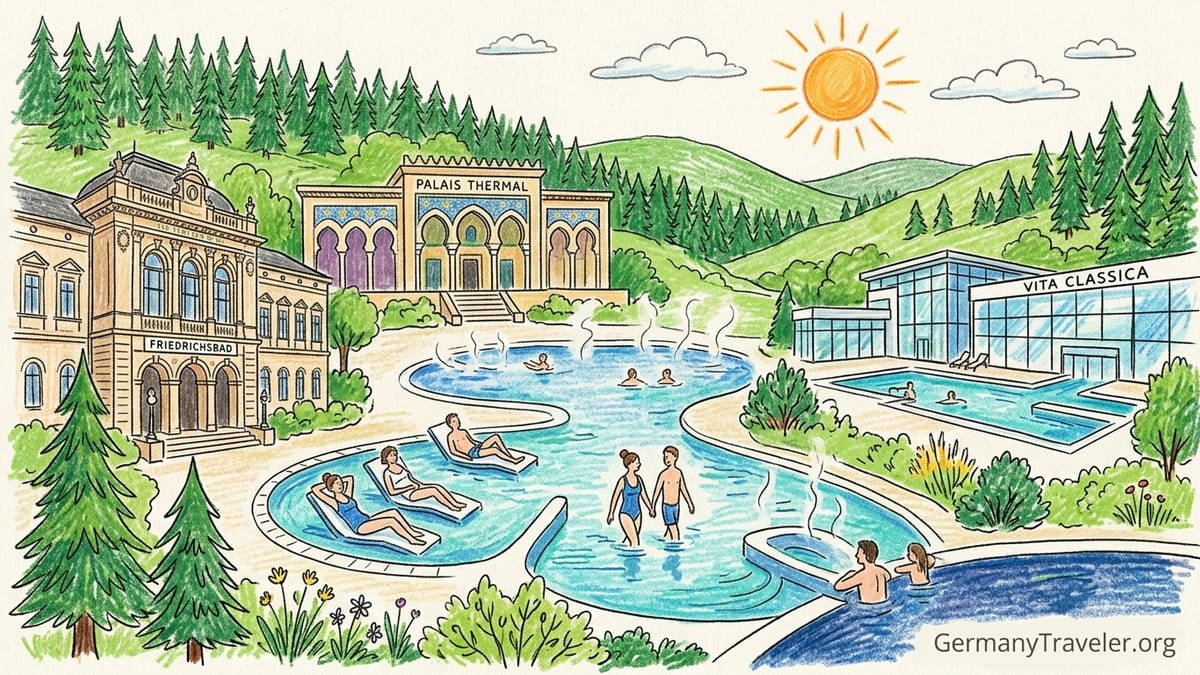
Thermal Waters and Spa Culture in Germany’s Leading Spa State
Across Baden-Württemberg, thermal and mineral waters rise from deep underground at temperatures above 20 degrees Celsius and with varying mineral compositions. The state tourism authorities describe Baden-Württemberg as the country’s number one spa region, highlighting 50-plus officially recognized spas and health resorts where natural remedies like mineral water, brine and therapeutic climate form the basis of both medical cures and leisure wellness stays. In practice, that ranges from classical Roman-style bathing in Baden-Baden to mountain-view saunas in the Black Forest and brine pools near the Rhine.
For travelers, understanding this spa culture is essential because the experience is more structured than a simple hotel pool. Facilities are usually divided into thermal pool areas and sauna or steam zones, with different ticket types, clothing rules and sometimes age limits. While day visitors can drop in for a few hours, many German guests book medical or wellness packages that combine several bathing days with massages, Kneipp hydrotherapy or physiotherapy. Even if you are only passing through for a road-trip stop, you are stepping into a tradition of health tourism that has evolved here over centuries.
This article focuses on three of the most interesting spa destinations in Baden-Württemberg today: Baden-Baden, with its UNESCO-recognized spa heritage and international luxury flair; Bad Wildbad in the northern Black Forest, home to the ornately tiled Palais Thermal; and Bad Krozingen near Freiburg, known for the contemporary Vita Classica complex. Together, they show how different a day in the water can feel, even within the same state.
Before you go, always check each spa’s official website or information line for the latest prices, opening hours and any renovation closures. Spa operators in Baden-Württemberg regularly adjust tariffs at the start of a year, and many schedule one or two weeks of annual maintenance when pools are drained and cleaned, which can fall in shoulder seasons that are otherwise attractive for travel.
Classical Historic Bathing: Baden-Baden’s Friedrichsbad
If you are curious about historic European spa culture, Baden-Baden’s Friedrichsbad offers perhaps the purest introduction anywhere in the region. Opened in 1877, this Roman-Irish bath palace leads guests through a fixed sequence of warm-air rooms, hot steam chambers and thermal pools. The experience is structured rather than free-form: you follow a numbered circuit of stations, each with its own temperature, from dry warm rooms around 54 degrees Celsius through hotter steam and then progressively cooler immersion pools. Staff are on hand to explain the order when you enter, and printed leaflets outline each step.
The Friedrichsbad is also where many international visitors first encounter Central European nude bathing traditions. The entire circuit is textile-free, with strict separation from the outside changing area but no swimwear allowed inside the baths themselves. On most days, men and women share the bathing spaces, though there are some single-sex days or partial separations depending on the current schedule. The atmosphere is quiet and ritualized rather than social. Photography is, of course, forbidden and mobile phones must stay in lockers.
Admission is priced as a flat experience ticket rather than by the hour. As of autumn 2026, published price lists show that a classic circuit at Friedrichsbad costs in the region of several tens of euros per person, with optional add-ons such as soap-and-brush massages charged on top. The bath usually opens from late morning into the evening, though hours can shorten on certain days. Because the visit follows a set path, you should allow around three hours from arrival to departure, including showering and changing. Children are not admitted; this is a quiet adult experience suited to spa enthusiasts, couples and solo wellness travelers who are comfortable with a traditional, textile-free environment.
Many visitors combine Friedrichsbad with a stay in one of Baden-Baden’s historic hotels and an evening at the famous casino, making it part of an elegant long weekend. Others stop for the bathing ritual as a cultural experience on a south-to-north drive through Germany. If your priority is understanding where European spa traditions began, rather than lounging outdoors with a cocktail, Friedrichsbad is the most instructive place in Baden-Württemberg to start.
Modern Thermal Pools and Sauna Worlds: Caracalla Therme and Beyond
For a more flexible, contemporary spa day, Baden-Baden’s Caracalla Therme sits just across the square from Friedrichsbad and focuses on free bathing in expansive pools and saunas. Unlike the fixed route at Friedrichsbad, Caracalla lets you move as you like between indoor and outdoor thermal basins, whirlpools, a lazy current channel and a sizeable sauna complex with multiple cabins at different temperatures. It is the kind of place where you might spend an afternoon drifting between water loungers and reading zones, then head upstairs to sweat in a Finnish sauna followed by a plunge pool.
Current price information from autumn 2026 lists a three-hour thermal bath ticket at Caracalla at approximately 25 euros per adult, with surcharges for four-hour and full-day stays, as well as a separate tariff if you want access to the sauna area. Evening tickets after a certain hour are often slightly cheaper and appeal to travelers who arrive in town late. The spa typically opens every day from morning into late evening, though exact opening times can vary between weekdays and weekends. Special maintenance periods, often in January, can see short closures or individual pools out of service.
Within Baden-Württemberg, this combination of indoor and outdoor thermal pools, whirlpools and saunas is the most common modern spa model. You will find variations on it at Bad Wildbad’s Vital Therme and at Bad Krozingen’s Vita Classica, among many others. The details differ: some complexes are attached to rehabilitation clinics, while others focus on leisure guests with design hotels and in-house restaurants; some emphasize silent relaxation zones, others a family-friendly approach with dedicated children’s pools.
If you simply want to relax for a few hours without committing to a long ritual, Caracalla and similar modern spas are the easiest entry point. They work well for mixed groups because some people can stay mostly in the water while others cycle through the sauna cabins. Facilities like rentable loungers or quiet rooms make these venues a comfortable place to recover after long-haul flights or multi-day road trips, especially if your hotel is within walking distance and offers discounted entry packages.
Oriental Atmosphere and Mountain Views: Bad Wildbad’s Palais Thermal
While Baden-Baden exudes grand international resort energy, Bad Wildbad in the northern Black Forest feels more intimate and slightly bohemian. The star attraction here is Palais Thermal, a richly decorated historic spa with Moorish arches, colorful mosaics and a warren of small thermal pools. Rather than one big main pool, you move between multiple basins embedded in tiled halls: whirlpools, bubble pools, massage pools and small cold plunge basins. The building has been extensively modernized behind its historical façade, but visually it still feels like stepping into a 19th century fantasy of the Orient.
According to visitor information from the town of Bad Wildbad in October 2026, Palais Thermal admits guests from age twelve upward and operates as a wellness facility rather than a family pool. Standard opening hours run from 1 pm to 10 pm on weekdays and from 10 am to 10 pm on Saturdays, Sundays and public holidays, with last bathing and sauna access ending around thirty minutes before closing. A day ticket including sauna costs around 31 euros on weekdays and 35 euros on weekends and holidays, while a three-hour visit comes in slightly cheaper. Choosing access without the sauna area reduces the price by around six and a half euros. There is also a discounted evening rate on certain weekdays after 6 pm. A scheduled maintenance closure is already announced for late June to early July 2026, underlining why it is wise to confirm dates before you plan a special journey.
Textile rules at Palais Thermal are more nuanced than in many German saunas, which makes it particularly important to read signage on arrival. The upper floors and most saunas operate as textile-free zones, in line with typical Central European sauna etiquette. However, Tuesdays are designated as a textile bathing day. On that day, all indoor thermal pools and the dedicated swimwear sauna must be used with swimsuits, while the outdoor thermal pool remains optional and traditional saunas and the Roman steam bath stay textile-free. This compromise allows guests who prefer to wear swimwear to enjoy much of the complex once a week, while still preserving classic nude sauna culture on other days.
Bad Wildbad suits travelers who want a sensuous, aesthetically distinctive spa experience without the more formal, urban feel of Baden-Baden. The atmosphere in Palais Thermal tends to appeal to couples and design-conscious visitors, and the minimum age of twelve keeps things quiet. Outside the spa, forest trails and suspension bridges above the treetops make Bad Wildbad an attractive base for hikers who appreciate a deep-heat soak after long days on the trail. Parking garages P3 Palais Thermal and P4 Kurzentrum offer several hours of free parking for spa guests, and the town is also reachable on the S-Bahn line from Karlsruhe and Pforzheim, which stops near the Kurpark.
Vineyard Wellness and Brine Baths: Bad Krozingen’s Vita Classica
Southwest of Freiburg, near the Rhine plain and within easy reach of the Black Forest and Alsace, Bad Krozingen offers yet another take on Baden-Württemberg wellness. The Vita Classica complex combines clear-lined modern architecture with Mediterranean touches: bright indoor pools with large windows, outdoor basins, and a sauna village that incorporates natural wood and garden views. The town is officially recognized for its mineral-rich waters, and the ambience is more open and light-filled than the ornate Palais Thermal.
Recent ticket information for Vita Classica, as reported through regional tourism publications and discount card brochures for 2026, indicates that a full-day admission to the thermal baths plus sauna costs just under 36 euros per adult outside of peak summer months. Straight thermal-only tickets are cheaper, and many guests also access the spa as part of medical rehabilitation stays or through health insurance programs. The complex offers multiple zones: classic thermal pools for floating and gentle exercise, hotter whirlpools for targeted heat, as well as Kneipp-style foot baths and experience showers. A separate area of themed private spas and treatment rooms caters to guests booking massages, body wraps or specialty packages.
Bad Krozingen stands out for its emphasis on brine-style and carbonic mineral baths, often recommended locally for circulation and joint complaints. In practice, that means some pools have noticeably salty or tingling water that increases buoyancy. For visitors used to fresh water pools, the floating sensation can be a pleasant surprise. Staff are accustomed to first-time guests asking questions and are generally happy to explain how long to stay in each type of pool and when to rest.
Vita Classica tends to attract a mixed audience: regional day trippers from Freiburg and Basel, older guests on longer cures, and younger couples using Bad Krozingen as a base for wine touring who treat the spa as a relaxing evening stop. It works particularly well for travelers who would like to combine thermal bathing with vineyard walks, cycling routes along the Rhine or excursions into the southern Black Forest but who prefer a contemporary spa building over an ornate Belle Époque monument.
Kneipp Traditions, Wellness Hotels and Who Each Town Suits
Beyond soaking and sweating, Baden-Württemberg is also strong in Kneipp hydrotherapy, a 19th century system that uses alternating warm and cold water applications, such as ankle-deep cold-water wading pools, arm baths and contrast showers, to stimulate circulation. State tourism information cites a dozen certified Kneipp health resorts, and even in towns that are not dedicated Kneipp centers, you will often find at least one public cold-water treading pool in a park or a Kneipp corner inside a spa. In Bad Krozingen’s Vita Classica and other modern complexes, that might be a shallow pebble-bottom basin where you walk a few circles, then step out to rest on a lounger.
Wellness hotels play a major supporting role. In Baden-Baden, several four and five-star properties either have their own small spa wings or offer packages that include day tickets to Caracalla or Friedrichsbad, sometimes with private transfer and priority check-in at the baths. These packages are tailored to luxury and international guests who prefer to have everything arranged in advance and appreciate English-speaking front-desk staff who can explain bathing rules. Room rates reflect that positioning especially in peak seasons tied to events and festivals.
Bad Wildbad’s accommodation is typically smaller scale and often locally owned. A highlight is the cluster of hotels directly connected to or within a few minutes’ walk of Palais Thermal, some of which form part of a combined spa-hotel complex. These properties frequently sell "short wellness" weekend offers, bundling one or two nights’ stay with extended bathing hours, a partial massage and maybe a candlelit dinner. Because prices in Bad Wildbad are generally lower than in Baden-Baden, this town appeals to couples and solo travelers looking for a more affordable but still atmospheric escape, and to hikers who want to sandwich a demanding Black Forest trek between sessions in the pools.
In Bad Krozingen, wellness hotels and guesthouses serve a mixed clientele of medical-therapeutic guests on longer cures and leisure visitors. Packages here might combine vineyard tours or wine tastings with spa access. The location on major rail lines between Freiburg and Basel makes the town especially practical for travelers who want a car-free spa break or who are using rail passes. For road trippers, Bad Krozingen works well as a restorative overnight stop between Switzerland or France and central Germany, with a few hours of floating to break up the drive.
Practicalities: Tickets, Clothing Rules, Lockers and Getting There
The most important practical decision for spa-goers in Baden-Württemberg is whether to buy a short stay ticket or a full-day pass. In Baden-Baden’s Caracalla, for example, a three-hour ticket is priced noticeably lower than an all-day stay, and for many travelers that is enough time to experience several pools and a sauna session. Day passes become good value if you plan to arrive soon after opening and stay through the afternoon, perhaps taking breaks in the restaurant or reading rooms. At Palais Thermal, the difference between a three-hour visit and an entire day is only a few euros, which tempts many guests to opt for the day ticket so they do not feel rushed between the many small pools and levels.
Overnight packages sold by hotels can sometimes undercut the price of buying separate day tickets, especially once you factor in extras like reserved loungers, bathrobe rentals or included massages. For example, a mid-range hotel in Bad Wildbad might bundle two nights’ accommodation, two days of Palais Thermal access and a 25-minute massage for less than the sum of individual list prices, particularly outside school holiday periods. In Baden-Baden, luxury hotels sometimes arrange late check-out aligned with spa visits, allowing you to bathe in the morning, return to your room to dress and then continue your journey in the afternoon.
Sauna and clothing rules are another area where advance awareness saves awkwardness. In almost all German saunas, including the sauna zones at Caracalla, Palais Thermal and Vita Classica, nudity is the norm and swimwear is not allowed, both for hygiene and to ensure even heat on the skin. You sit or lie on a towel so your skin does not touch the wood. In thermal pool areas, by contrast, swimsuits are standard except in explicitly textile-free pools or on special nude days. Palais Thermal’s textile Tuesday twists this by requiring swimwear in the indoor pools on that day while keeping most sauna cabins textile-free, so always read current notices when you arrive.
Most larger spas operate with electronic wristbands or cards that serve as your locker key and track any extra spending at restaurants or treatment desks. Lockers are included in the entry price; you bring your own towel or rent one for a fee, and many guests also rent a bathrobe if they plan to use relaxation lounges extensively. Parking arrangements vary but are usually convenient: Baden-Baden offers discounted or partially free parking in garages linked to the baths when you validate your ticket, while Bad Wildbad explicitly grants several hours of free parking in garages P3 and P4 for Palais Thermal visitors. Public transport access is good too, with Baden-Baden and Bad Krozingen both on mainline rail routes and Bad Wildbad on a regional S-Bahn line, so it is entirely possible to plan a car-free spa itinerary.
Which Spa Town Is Best for You?
Among the dozens of spa towns in Baden-Württemberg, the trio of Baden-Baden, Bad Wildbad and Bad Krozingen illustrate three distinct personalities. Baden-Baden is the natural choice if you are looking for an international, high-end city resort where bathing is one part of a broader cultural stay that might include the casino, concerts and gourmet dining. The combination of Friedrichsbad’s historic ritual and Caracalla’s modern pools gives you two very different water experiences in a compact center, and the town’s UNESCO-listed Great Spa Towns of Europe designation speaks to its global appeal. It best suits luxury travelers, first-time spa visitors who want clear information in multiple languages, and anyone who enjoys combining wellness with urban sophistication.
Bad Wildbad, by contrast, is ideal for travelers who want the spa itself to be the destination. Palais Thermal’s ornate interiors create an intimate, almost theatrical world that many guests are reluctant to leave once they have settled into its warm pools and dimly lit relaxation areas. The town around it is quieter and more rural, with the Black Forest rising immediately above the rooftops. This makes Bad Wildbad a smart base for active vacations built around hiking, cycling or treetop adventure trails, offset by long evenings in the water. Prices are generally lower than in Baden-Baden, and the minimum age of twelve helps maintain a calm, adult-oriented atmosphere that appeals to couples and solo wellness fans.
Bad Krozingen, finally, is the best fit for travelers who value functional modern design, medical-grade mineral water and easy access to both vineyards and mountains. Vita Classica’s clean lines and brine-rich pools are less about theatrical architecture and more about straightforward relaxation with a touch of indulgence in the sauna village and private spa suites. Its location near Freiburg and the French and Swiss borders makes it a convenient hub for regional exploration, and the visitor mix reflects that: cross-border day trippers, longer-stay health guests and road trippers who route their journey specifically to include a night of floating in mineral water.
If you are planning a multi-stop road trip through southwestern Germany, you could easily combine all three in a single itinerary: start in Baden-Baden for a deep dive into spa history at Friedrichsbad, retreat to the Black Forest charm of Bad Wildbad for an ornate palace-like experience at Palais Thermal, then head south to Bad Krozingen for daylight-filled pools and brine bathing before crossing into Switzerland or France. For a single-stop experience, choose Baden-Baden if you prioritize atmosphere and culture around the baths, Bad Wildbad if you want the most distinctive interior design at an accessible price, and Bad Krozingen if you are most interested in therapeutic mineral water and convenient transport connections.
The Takeaway
Baden-Württemberg’s identity as Germany’s leading spa state is more than a marketing slogan. It is visible in the sheer variety of bathing experiences woven through its towns and landscapes, from the ritualized, nude-only sequence at Baden-Baden’s 19th century Friedrichsbad to the sensuous Moorish halls of Bad Wildbad’s Palais Thermal and the light-filled brine pools of Bad Krozingen’s Vita Classica. These are not interchangeable facilities but reflections of different historical periods, approaches to health and target audiences.
For travelers, the key is to match your expectations to the right place. If you want classical grandeur and are comfortable with traditional nude bathing, Friedrichsbad and the wider Baden-Baden spa quarter are unmatched. If you dream of soaking under starry ceilings in a building that feels like a fantasy palace, with the option of mountain hikes just outside the door, Bad Wildbad is hard to beat. And if you crave modern comfort, clear signage and mineral water that actively shapes how your body feels in the pool, then Bad Krozingen offers a compelling southern base.
Regardless of which town you choose, approach the spa experience as Germans do: unhurried, with plenty of time to rest between heat sessions, hydrate and simply do nothing. Take a towel and flip-flops, read the house rules without rushing and be open to customs like textile-free saunas or Kneipp walking pools. In return, Baden-Württemberg’s thermal waters repay you with warm muscles, quieter thoughts and the pleasant sense that you have tapped into one of Europe’s most enduring travel traditions.
FAQ
Q1. Do I need to book Baden-Württemberg spas like Caracalla, Friedrichsbad or Palais Thermal in advance?
Advance booking is not always mandatory for day tickets, but it is increasingly recommended on weekends, holidays and during peak seasons when visitor numbers can be high. Online reservations or time-slot bookings, where available, help you avoid queues and guarantee entry, especially at smaller facilities like Palais Thermal. For treatments and massages in any spa town, prior booking is essential.
Q2. Are German saunas in places like Baden-Baden and Bad Wildbad always nude?
In most cases, yes. Sauna areas in Caracalla, Palais Thermal and Vita Classica are traditionally textile-free, meaning you do not wear swimwear inside the cabins and instead sit or lie on a towel. Some spas offer limited textile-friendly saunas or special days, such as Palais Thermal’s swimwear-friendly pools on Tuesdays, but you should expect nude sauna etiquette as the norm.
Q3. Can children visit these thermal baths, or are they adults only?
Policies vary by facility. Friedrichsbad is an adults-only environment and generally does not admit children. Palais Thermal allows guests from age twelve upwards, reflecting its quiet, wellness focus. Larger complexes like Caracalla and Vita Classica may be more family-friendly in the pool areas, sometimes with specific age limits for saunas or certain pools. Always check the current age rules before you arrive.
Q4. How much should I budget for a day at a Baden-Württemberg spa?
As of late 2026, a three-hour visit to a major thermal bath such as Caracalla costs around 25 euros per adult for the pool area, with day tickets and sauna access increasing the price. At Palais Thermal and Vita Classica, full-day combined bath and sauna tickets are generally in the low to mid-30 euro range. Add extra funds if you plan to rent towels or robes, book treatments or eat in the on-site restaurant.
Q5. What should I bring with me to the spa?
Bring a swimsuit for pool areas, at least one large towel for drying and sitting in saunas, flip-flops or spa sandals, and a waterproof bag for your wet items afterwards. Many guests also bring a bathrobe for comfort in relaxation rooms, although these can usually be rented for a fee. Toiletries are provided in varying degrees, but you may prefer your own shampoo and conditioner.
Q6. Are there any strict rules I should know before visiting?
Common rules include showering thoroughly before entering pools or saunas, keeping noise to a minimum, and not using mobile phones or cameras in bathing areas. In sauna zones, you must always use a towel so that no bare skin touches the wooden benches. Food and glassware are typically restricted to designated restaurant or lounge areas. Staff members are used to helping first-time visitors understand local etiquette, so do not hesitate to ask discreetly at reception if you are unsure.
Q7. Is it possible to visit a spa town like Baden-Baden on a day trip without staying overnight?
Yes. Baden-Baden and Bad Krozingen both lie on main train lines and are easily reachable from cities such as Frankfurt, Stuttgart, Freiburg or Basel for a day trip. You can arrive late morning, spend three to four hours in the baths and still catch an evening train back. However, staying at least one night allows you to enjoy quieter early-morning or late-evening sessions and combine the spa with local dining or cultural visits.
Q8. How do renovation closures and maintenance periods affect my plans?
Most spas in Baden-Württemberg schedule regular maintenance, often one or two weeks per year when entire complexes or specific areas are closed. For instance, Palais Thermal has already announced a revision period in late June and early July 2026. Smaller repairs can also temporarily close single pools or saunas. Checking the latest notices on the spa’s official channels before fixing your travel dates is the best way to avoid disappointment.
Q9. Which spa town should I choose if I am nervous about nude bathing?
If you are uncomfortable with textile-free saunas, focus on the thermal pool areas, where swimwear is standard, and look for special textile days. Palais Thermal’s Tuesday rules make most indoor pools swimwear-only, and many modern facilities like Vita Classica emphasize pool zones where swimsuits are required. Baden-Baden’s Caracalla is also easy for beginners, as you can simply skip the sauna level and stay in the pools.
Q10. Are the spa towns suitable for travelers without a car?
Yes. Baden-Baden and Bad Krozingen are both on major rail routes, and their main thermal baths are a short bus or taxi ride from the stations, with clear local wayfinding. Bad Wildbad is connected by regional S-Bahn to Karlsruhe and Pforzheim, with stops close to the Kurpark and spa quarter. Once you are in town, the spa facilities are typically within walking distance of central hotels and guesthouses, making car-free wellness trips straightforward.