


On the map, Baden and Württemberg are simply two halves of the federal state of Baden-Württemberg. In the glass, they are almost opposites. Baden stretches in a sunny band along the Rhine and the slopes of the Black Forest, a Pinot playground of sleek Spätburgunder and nutty Grauburgunder. Württemberg tightens around the Neckar and its side valleys, a red-wine stronghold of Trollinger and Lemberger climbing improbably steep stone terraces. Official tourism treats them not as one but as Germany’s third- and fourth-largest wine regions, and among its warmest. For travelers, that means something rare in Europe: two genuinely different wine trips within one set of state borders.
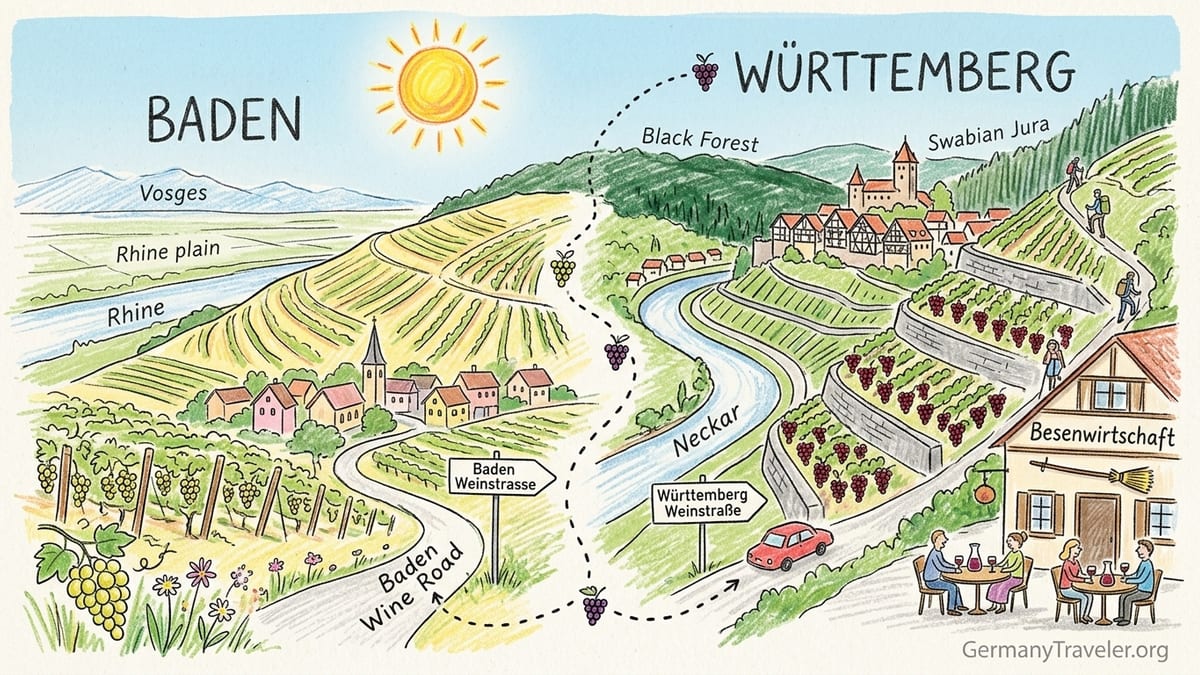
Baden vs Württemberg: Two Wine Regions, Not One
Stand in a vineyard above Freiburg in southern Baden, then a day later above Besigheim on the Neckar, and it is hard to believe you are in the same German state. Baden’s vines generally follow the Rhine for almost 400 kilometers from the Tauber Valley down to Lake Constance, with vineyard zones like Kaiserstuhl and Markgräflerland known for their sunshine and relatively mild climate. Germany’s national and state tourism boards point out that Baden is the only German wine region classified in the European Union’s warmer “Zone B” for winegrowing, which aligns it more closely with parts of Burgundy than with the cooler Mosel.
Württemberg, officially recognized as a separate wine region, is almost the mirror image. Here the vineyards are clustered inland around the Neckar River and its tributaries such as the Rems, Kocher, Jagst and Zaber, often on steep, terraced slopes that give a dramatic backdrop to towns like Stuttgart, Esslingen or Lauffen. Tourism information highlights Württemberg’s dominance in red wine and its special connection to grapes that are rare elsewhere in Germany, especially Trollinger and Lemberger, alongside Pinot Noir and Pinot Meunier.
Size alone justifies treating them separately. Baden and Württemberg rank as Germany’s third- and fourth-largest wine regions by planted area, sitting just behind Rheinhessen and the Palatinate. Both are among the country’s warmest, yet the way that warmth is expressed in the vineyard is different enough that travelers experience distinct landscapes, grapes and even social rituals. The key to planning is to think in pairs: two regions, two routes, and two complementary styles of trip.
Official scenic routes underline this dual identity. The Baden Wine Road runs for roughly 500 kilometers along the western edge of the Black Forest and the Upper Rhine Valley, while the Württemberg Wine Route covers a similar distance, around 500 to 511 kilometers, tracing the Neckar and its side valleys from Weikersheim in the north down toward Metzingen. State tourism promotes both as separate road trips, yet they can be joined in a single loop if you have the time.
Landscapes: Sun-Soaked Rhine vs Steep Neckar Slopes
If Baden has a signature image, it is the gentle rise of vine-covered hills above pastel villages in front of the Black Forest. Driving the Baden Wine Road from Heidelberg down through Ortenau, over the volcanic hill country of the Kaiserstuhl and on to Markgräflerland near the Swiss border is largely about curves and contours rather than cliffs. In Kaiserstuhl, the landscape is shaped by old volcanic cones and loess soils, which create rounded, terraced slopes planted tightly with Pinot varieties. Around Ihringen or Vogtsburg you find broad, open views west toward France, with the Rhine plain stretching wide and the Vosges mountains in the distance.
Markgräflerland, further south between Freiburg and Basel, trades drama for softness. Here, small spa towns like Badenweiler and Badenweiler’s neighbors are surrounded by low, sunny hills, orchards and mixed agriculture, with vineyards woven into an almost Mediterranean-feeling countryside. On an October afternoon, it is not unusual to see people hiking in light jackets, stopping at a Strauße or seasonal wine tavern for a glass of Gutedel, the local Chasselas-style white, while the higher Black Forest ridges already wear mist.
Württemberg’s core landscape is more vertical. Around Stuttgart, Esslingen and Besigheim, tourism offices emphasize the steep Neckar-side terraces that rise directly from the river, stacked with sandstone walls. Take the train into Stuttgart and you notice immediately how the city is cupped by vineyards that climb amphitheater-like from the suburbs up toward forested hills. The Stuttgart tourist board likes to point to these slopes, such as those in Uhlbach or around the Grabkapelle on the Württemberg hill, as almost unique among German cities.
Beyond the capital, the Württemberg Wine Route enters quieter wine landscapes that feel quite different from Baden. In Hohenlohe and the Tauber valley, the vineyards are interspersed with castles and half-timbered towns such as Weikersheim and Öhringen. The Zabergäu and Stromberg-Heuchelberg areas, which local tourism promotes as Germany’s largest contiguous red wine landscape, show long, gentle ridges with dense plantings of Trollinger and Lemberger. In the Rems Valley, east of Stuttgart, the river cuts through a succession of villages like Weinstadt and Schorndorf, with walking and cycling trails signed specifically for wine tourism.
Grapes in the Glass: Pinot Country vs Red-Wine Heartland
The easiest way to feel the difference between Baden and Württemberg is to order a tasting flight. In Baden, tourism campaigns foreground Pinot varieties. Spätburgunder (Pinot Noir) is the red flagship, particularly in Kaiserstuhl and the Ortenau, while Grauburgunder (Pinot Gris) and Weißburgunder (Pinot Blanc) make up a large share of quality white wines beside Riesling. In the small Markgräflerland subregion, Gutedel is a signature white, often served in a light, low-alcohol style that locals enjoy as an everyday wine with simple dishes.
Baden’s Pinots are shaped by warmth and sun. In villages like Achkarren or Ihringen in the Kaiserstuhl, which are frequently cited among Germany’s warmest vineyard sites, Spätburgunder comes across as fairly full-bodied, with ripe red fruit and often a touch of oak when you visit higher-end estates. At a well-known cooperative in Oberbergen, for example, a basic estate Spätburgunder might start somewhere around 9 to 11 euros a bottle at cellar door, with single-vineyard wines priced higher. White Pinots like Grauburgunder from Kaiserstuhl or Ortenau often show a creamy texture, suited to richer regional dishes.
In Württemberg, the picture flips. Statistics from regional and national wine bodies highlight Trollinger, an easy-drinking red, as historically the most planted grape, followed by substantial areas of Lemberger (also known as Blaufränkisch), Schwarzriesling (Pinot Meunier) and Spätburgunder, with key whites like Riesling and Kerner. Many Württemberg growers produce cuvées of Trollinger and Lemberger, labeled locally as “TL,” which you will see by the glass in village taverns for a moderate price.
The style tends to be lighter in color but can be surprisingly complex. A simple Trollinger from a cooperative in the Neckar Valley might be offered at 4 to 5 euros per glass in a Besen tavern, served cool in a quarter-liter pour. Lemberger, especially from high-quality producers in areas like Stromberg or the slopes around the Württemberg hill, can be dark, spicy and age-worthy. Regional and national wine guides increasingly praise these wines, and cellar-door prices often begin in the low teens for serious single-vineyard examples, with everyday bottlings in the 7 to 10 euro range.
For travelers who know German wine primarily as Riesling and sparkling Sekt, the contrast between a flight of Baden Pinots and a line-up of Württemberg red cuvées can feel like tasting two countries. It is very possible, over a four or five day trip, to start with a structured Spätburgunder in Kaiserstuhl, then taste a bright, herbal Trollinger in a Neckar-side Besen and understand why locals are so attached to their own home styles.
Tasting Culture, Besen Taverns and Wine Events
Both regions share the German tradition of informal wine drinking, yet the textures of tasting culture differ. In Baden, you are more likely to find modern vinotheques attached to estates, especially along the Baden Wine Road in Ortenau and Kaiserstuhl. Many wineries display the regional “Weinsüden” quality seals promoted by state tourism, indicating that they meet certain standards for visitor experience. Typical tasting fees, when charged, might be around 10 to 15 euros for several wines, often waived if you make a purchase. Scheduled cellar tours in larger estates are commonly offered on weekends and may need advance reservation, particularly in English.
Württemberg’s identity, by contrast, is closely bound to the Besen or Besenwirtschaft tradition. These are seasonal taverns run directly by winegrowers, allowed to operate for limited weeks each year under special licenses. Outside the door you see an actual broom or branch hanging as a sign that the Besen is open. Menus are short and homey: plates of Maultaschen (Swabian filled pasta), cold cuts, onion tart and potato salad, plus the grower’s own wines sold generously in quarter-liter glass measures.
The timing of Besen seasons is regulated but varies by grower. State and regional tourism authorities emphasize August through October as the months with the densest concentration of wine events and open taverns across Baden-Württemberg, when harvest is either approaching or underway. In practice, that means a traveler visiting in mid-September can structure days around walking or cycling and evenings at Besen taverns or wine festivals in small towns. In the Rems Valley, for example, the local tourism board publishes annual Besen calendars listing which courtyard is open on which dates, and a glass of everyday Trollinger might cost in the mid-single digits.
Wine festivals are a major part of the calendar in both regions. In Baden, villages along the Baden Wine Road organize autumn festivals where you can sample new-season Federweißer, a semi-fermented young wine, with onion tart for a modest combined price. In Württemberg, large events around Stuttgart, Heilbronn and in Neckar-side towns attract both locals and visitors. While exact entry fees and tasting prices depend on the event and change regularly, it is common to find reusable glasses sold with a small deposit and individual pours priced clearly per centiliter, which makes it easy for travelers to monitor their spending.
On the Road: Baden Wine Road vs Württemberg Wine Route
For planning, the two major routes are your backbone. The Baden Wine Road, celebrated in state tourism material as Germany’s longest wine trail, covers around 500 kilometers from the area near Heidelberg in the north, through Ortenau, across the volcanic Kaiserstuhl and Tuniberg hills, through Markgräflerland and down to Weil am Rhein near the Swiss border. You can drive the whole length in several days, but many visitors focus on one or two segments, such as the stretch between Baden-Baden and Offenburg in Ortenau, or the loop around Kaiserstuhl between Freiburg and Breisach.
Driving is straightforward. The route piggybacks on a mix of federal and local roads, passing through dozens of wine villages. Public signage with grape symbols helps with navigation. For those who prefer not to drive, the line of the Baden Wine Road roughly parallels the Rhine Valley rail corridor between Karlsruhe, Offenburg, Freiburg and Basel, making it realistic to base in a town like Bühl, Offenburg or Freiburg and reach nearby villages by train and bus. Regional day tickets for local public transport offer good value for couples or small groups when bought on official transport channels.
The Württemberg Wine Route runs for a similar distance, around 500 to 511 kilometers according to regional route descriptions. It begins in Weikersheim on the Tauber in the north, then threads through areas like Hohenlohe, Heilbronn, the Zabergäu-Stromberg region, the Neckar Valley around Stuttgart and the Rems Valley, ending near Metzingen. Many stretches run through quiet country roads and valley floors, then climb into vineyards or pass under castle hills. Distinct from, but often close to, the road route is the Württemberg Wine Hiking Trail, a long-distance path of roughly 313 kilometers that can be extended with extra loops to almost 470 kilometers, which local hiking clubs market as Germany’s longest dedicated wine hiking trail.
For drivers, the Württemberg route feels more intricate than Baden’s because it follows river bends and side valleys. It rewards slow travel. A typical day might run from Weinsberg to Besigheim, with morning stops at viewpoints, a lunch break at a cooperative winery restaurant in Heilbronn, and a late-afternoon stroll through the steep “Felsengärten” cliffs above the Neckar before checking into a guesthouse. In contrast to Baden, where you can often see wide open horizons, Württemberg’s roads frequently dip in and out of tight valleys, so allow time for unexpected viewpoints and village detours.
Walking, Cycling and Car-Free Wine Travel
Baden and Württemberg both invest heavily in wine-focused walking and cycling infrastructure, which makes them attractive for visitors who prefer to leave the car parked. In Baden, the Badischer Weinradweg or Baden Wine Cycle Route runs for more than 460 kilometers, roughly paralleling the wine road but sticking more closely to vineyard edges and quiet rural paths. Official route information describes it as divided into several stages, with a total elevation gain of around 3,300 meters, which serious cyclists can cover over a week while casual riders pick individual 30 to 60 kilometer day sections.
Typical day segments in Baden might include a 40 kilometer ride from Baden-Baden through the Ortenau villages of Bühl, Kappelrodeck and Oberkirch, stopping at village wine museums and cooperative cellars. Bike rentals, including e-bikes, are widely available in larger towns such as Baden-Baden, Offenburg and Freiburg, often in the mid-double-digit euro range per day for an e-bike. Some hotels along the Baden Wine Road market themselves as bike-friendly, offering secure storage and drying rooms.
Württemberg leans more into hiking, although it also has cycling routes like the Remstal-Radweg, a 106 kilometer signed bike path through the Rems Valley. The long Württemberg Wine Hiking Trail connects many of the core wine landscapes in stages that are often between 15 and 25 kilometers in length. One example is the mile of trail between Kernen im Remstal and Esslingen, which passes viewpoints above the Neckar and terraces near Uhlbach, with frequent chances to step into a Besen tavern or village wine museum along the way. Hiking signage is generally good, produced by local hiking associations and tourism offices, and public transport can usually bring you back to your starting point.
Both regions are workable without a car if you are prepared to plan around public transport timetables. The Rhine Valley railway corridor serves most of Baden’s key access points, while Württemberg’s wine areas are tied into the Stuttgart regional S-Bahn and regional train network, including lines along the Neckar and Rems. In Stuttgart itself, a themed wine sightseeing bus runs seasonally on selected days, connecting city center stops with vineyard viewpoints and wine museums, allowing visitors to sample local wines in Uhlbach or around the Württemberg hill without driving. Exact operating dates and prices change seasonally, so travelers should check current schedules through official tourism and transport channels before departure.
Food Pairings and Village Atmosphere
The contrast between Baden and Württemberg continues at the table. In Baden, the culinary reputation leans toward richness and French influence. The Ortenau and Markgräflerland are known for cream-based sauces, freshwater fish from the Rhine and the Black Forest foothills, and desserts like Black Forest cake. It is no accident that Baden has a relatively high density of gourmet restaurants for its size, from classic hotel dining rooms to modern regional bistros. A glass of Baden Grauburgunder appears naturally alongside veal in cream sauce or a plate of river fish with buttery potatoes.
Village life in Baden’s wine towns reflects this mix of rustic and refined. In Kaiserstuhl villages such as Endingen or Ihringen, half-timbered houses cluster around small squares, but it is easy to find contemporary-style wine bars offering flights of Spätburgunder and local sparkling wines by the glass. Many estates have invested in sleek, glass-fronted tasting rooms and terraces that look directly onto the vines, especially around the volcanic slopes, where sunset views over the Rhine are a selling point.
Württemberg’s food culture is heartier and more overtly Swabian. In a Besen tavern above the Neckar around Stuttgart or in the Zabergäu, you might find plates of Zwiebelkuchen, Schupfnudeln with sauerkraut, platters of cold cuts and cheese, and Maultaschen either in broth or pan-fried with onions. Trollinger, with its relatively light body and fresh acidity, matches this food comfortably, while Lemberger and stronger cuvées come out with roasts and grilled meats. Prices in Besen taverns are usually designed for locals rather than tourists, so a main dish can often cost under what an international visitor might expect to pay in big-city restaurants, though specific amounts vary by establishment and season.
Village atmosphere in Württemberg’s wine areas is shaped by cooperatives and a sense of communal production. Many small growers bring their grapes to large cooperatives, which run expansive vinotheques and sometimes restaurants. Towns like Heilbronn and Besigheim host open-air wine miles during festival season, where different cooperatives and private estates pour side by side. Visitors often comment on the informality: it is not unusual to find yourself seated at long wooden tables with families and groups of friends who have been coming to the same festival for years.
Designing Your Trip: Who Should Go Where
Because Baden and Württemberg offer such distinct personalities, it is helpful to match trip design to traveler type. Pinot lovers will feel most at home in Baden. A classic itinerary might start in Baden-Baden, with a night or two to explore local Spätburgunder and Grauburgunder in Ortenau villages like Bühlertal and Kappelrodeck, then move south to Kaiserstuhl for two or three nights around Vogtsburg or Ihringen. From there, a final stop in Markgräflerland near Bad Krozingen or Müllheim allows you to contrast richer Kaiserstuhl Pinots with lighter Gutedel and spa-town life before heading onward to Switzerland or back north.
Red-wine travelers who want to dive into Trollinger and Lemberger should base themselves in Württemberg. One practical structure is to spend two nights around Heilbronn, exploring the surrounding Stromberg and Zabergäu hills, where tourism boards emphasize the density of red wine vineyards. Cooperative vinotheques here provide an efficient introduction to regional styles in a single stop. Then move to Stuttgart or a nearby wine village for another two or three nights, using local trains or the S-Bahn to shuttle between Neckar-side towns like Besigheim, Lauffen and Esslingen. This gives ample exposure to steep-slope vineyards and varied red cuvées.
First-time visitors to German wine in general might combine both regions over a week. Start with two to three nights in Freiburg or another Baden base, focusing on white and red Pinots, then transfer by train across the state to Stuttgart for three to four nights in Württemberg. This structure introduces you to the idea that German wine is not monolithic, moving from Burgundian-leaning Baden to the red-heavy, cooperative-driven world of Württemberg. It also balances open landscapes with more vertical, river-carved scenery.
Walkers and cyclists can build trips almost entirely around the dedicated wine routes. In Baden, you might ride two or three consecutive stages of the Baden Wine Cycle Route, staying in small hotels or guesthouses directly on the route and scheduling one vineyard-side picnic or tasting stop per day. In Württemberg, hikers can string together sections of the Wine Hiking Trail, such as a long weekend from the Tauber valley down toward Heilbronn, where daily bags can be transferred by local taxi or carried light with simple gear. Late summer to early autumn, roughly August through early October, is particularly atmospheric, with grapes hanging in the vineyards and a high density of village events.
Wine Without Driving: Practical Ideas
Increasing numbers of travelers want to enjoy wine regions without needing to drive at all. Both Baden and Württemberg accommodate this, though it involves more schedule awareness than a traditional road trip. In Baden, basing in Freiburg is the most flexible option. From the city you can reach Kaiserstuhl villages like Ihringen, Breisach or Vogtsburg on half-hourly regional trains and buses, often in under 30 to 45 minutes. Many estates are within walking distance from village stations, and a day in Kaiserstuhl can be structured as a loop walk between two or three villages with tastings on the way, returning by train in the evening.
Further north, a base in Offenburg or Baden-Baden allows easy rail access to Ortenau wine towns and hillside walks followed by winery visits. While some estates still expect appointments, especially smaller family-run cellars, larger cooperatives and vinotheques often maintain walk-in opening hours several days a week. It is wise to contact wineries by email in advance if you are counting on a particular visit, especially outside high season.
In Württemberg, a car-free wine trip works particularly well around Stuttgart. The city is the hub for the regional S-Bahn and local trains that run along the Neckar and into the Rems Valley. You can stay in central Stuttgart, spend a morning at the city’s wine museum in Uhlbach or above the Neckar slopes, then ride out to Besigheim or Marbach for afternoon walks through vineyards and early evening Besen tavern meals, returning by train. Seasonal wine buses and guided vineyard walks marketed by the local tourist office add further car-free options, though dates and booking conditions change, so they should be confirmed ahead of time through official sources.
For visitors committed to avoiding driving altogether, one compelling idea is to design a north-to-south or south-to-north state crossing by rail and bike hire. For instance, fly or train into Frankfurt, take a train to Heidelberg and then south along the Rhine corridor, stopping in Baden wine bases like Offenburg and Freiburg. From there, cross by train to Stuttgart and spend several days exploring the Neckar wine belt before departing via Stuttgart Airport or long-distance rail. At each base, use rental bikes, walking trails and public transport to reach vineyards, tasting rooms and festivals.
The Takeaway
To travel through Baden and Württemberg with a wine lover’s eye is to realize that “Baden-Württemberg” is a political label more than a coherent wine description. Official tourism is explicit about this, treating Baden and Württemberg as distinct regions, each large and warm by German standards, each with its own grapes, traditions and tourist infrastructure. For visitors, this separation is an asset. In a single state you can experience both a Pinot-driven, Rhine-facing world and a red-wine, Neckar-centered landscape of stone terraces and Besen taverns.
Baden lends itself to those who imagine wine trips as open horizons, gentle hills and technically polished Pinots enjoyed on modern terraces. Württemberg suits travelers who like to immerse themselves in local customs, drink quarter-liters of Trollinger at wooden tables, and walk narrow vineyard paths between stone walls. When you place the 500 kilometer Baden Wine Road next to the similarly long Württemberg Wine Route, you see not one continuous theme but two complementary narratives that can be woven into a single journey.
Whether you are a Pinot enthusiast, a curious red-wine traveler, a first-time explorer of German wine or a walker and cyclist seeking vineyard trails, Baden and Württemberg offer distinct ways to build your days. The key is to respect their individuality. Plan with two maps, two sets of grapes in mind and two different ideas of what a wine village can feel like. In doing so, you turn a single German state into one of Europe’s most varied, and rewarding, wine playgrounds.
FAQ
Q1: How many days do I need to experience both Baden and Württemberg?
For a meaningful taste of both regions, plan at least seven to nine days, splitting time between a Baden base such as Freiburg or Baden-Baden and a Württemberg base such as Stuttgart or Heilbronn.
Q2: When is the best time of year to visit for wine events and festivals?
The highest concentration of wine events, Besen taverns and harvest festivals generally falls between August and October, with September often offering the best mix of stable weather and activity.
Q3: Can I visit wineries without speaking German?
Yes. In both Baden and Württemberg, many wineries and cooperative vinotheques have English-speaking staff, especially in well-visited areas, though smaller family estates may appreciate an emailed request in advance.
Q4: Do I need to rent a car to follow the Baden Wine Road or Württemberg Wine Route?
A car offers maximum flexibility, but both routes can be sampled using trains, buses, walking trails and cycling paths. Bases like Freiburg, Offenburg, Stuttgart and Heilbronn work well for car-free travel with good public transport links.
Q5: How expensive are tastings and glasses of wine in these regions?
At cooperative vinotheques and Besen taverns, a glass or small carafe of everyday wine is often priced in the single-digit euro range, while structured tastings at estates may charge a modest fee that is sometimes waived with purchases.
Q6: What is a Besen tavern, and how do I find one?
A Besen is a seasonal tavern run by a grower, signaled by a broom or branch at the entrance, serving simple regional food and house wines. Local tourism offices and regional Besen calendars list current openings.
Q7: Is it possible to combine hiking or cycling with wine tasting safely?
Yes. Both regions offer signed wine walking and cycling routes that pass through villages with tasting rooms. Many travelers plan moderate daily distances, schedule tastings toward the end of the day and rely on public transport back to their base.
Q8: Are children welcome in wine villages and tasting rooms?
Families are common in wine regions, and children are usually welcome in village festivals, Besen taverns and many tasting rooms, especially where food is served, though very formal tastings may be more adult focused.
Q9: What should I expect from the weather in late summer and early autumn?
Late August through early October often brings mild to warm days and cooler evenings, but conditions vary by year, and higher Black Forest or Swabian Jura areas can be cooler than the river valleys.
Q10: How can I buy wine and ship it home?
Most wineries sell direct from the cellar, and some can arrange shipping within the European Union through partner logistics companies. For shipments overseas, it is best to check customs rules at home and discuss options with producers or specialized wine retailers in major cities.