


Baden-Württemberg sells itself as a land of a thousand castles, but when you only have a few days on the ground, that marketing line is not very helpful. After several trips zigzagging the state by train and rental car, I stopped chasing long lists and started asking a simpler question: which specific castles would I happily repeat, and which ones were interesting but not worth a major detour. The result is less a ranking and more a set of very different experiences, from romantic ruins to working palaces, with the kind of practical detail you only obsess over after you have sweated up the hill, queued for the shuttle and paid for the ticket yourself.
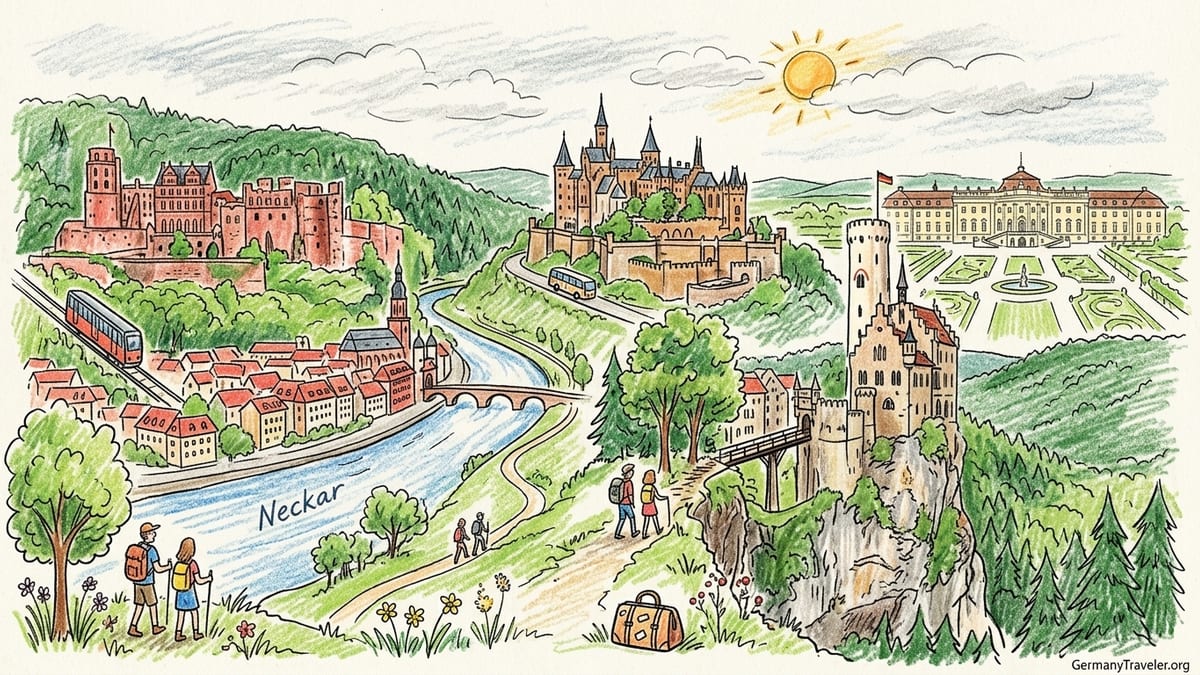
Heidelberg Castle: Romantic Ruins With Real Logistics
Heidelberg Castle is the one place I keep circling back to, and also the one that punishes those who arrive unprepared. Set on the hillside above the Neckar, it looks like every stereotype of a romantic ruin come to life, especially when the façades catch late afternoon light and the old town’s red roofs stretch out below. Trains from Mannheim, Stuttgart or Frankfurt drop you at Heidelberg Hauptbahnhof, from where tram or bus connections into the Altstadt are frequent. You see the castle long before you reach it, a broken red sandstone crown hanging above the river.
Practically, the easiest way up is to walk from the Kornmarkt in the old town and take the lower section of the funicular. A combined castle ticket sold through Heidelberg Marketing and the funicular company currently covers the return ride to the castle station and access to the courtyard, terrace, the Great Barrel and the German Pharmacy Museum. The official funicular tariff shows this as a bundled “castle ticket” product with a clearly listed adult price, and it is widely sold on site rather than requiring advance booking. The alternative on foot is the Burgweg, signed from the Altstadt. It is a stiff uphill slog that locals describe as fine going down and a small workout heading up, and that matches my own sweaty memory.
Once you pass the turnstiles and step into the main courtyard, you understand why Heidelberg appears on every tourism brochure for the state. This is not a manicured Baroque residence, it is a theatrical ruin, all jagged rooflines and half-intact façades that feel more like a stage set than a museum. Your general admission lets you roam the terraces, peer into the moat and disappear into the vaulted cellars to see the infamous giant wine barrel. To go inside the preserved residential wings, however, you must join one of the guided tours that run in German and English. On my last visit I added this tour at the visitor center, paying a modest surcharge per person on top of the castle ticket. The tour is the only way to access much of the interior, and it is worth it if you care about period rooms and court history rather than just the Instagram view.
From a value perspective, Heidelberg Castle justifies its entrance fee if you give it at least two to three hours. That includes half an hour for the Pharmacy Museum, time to wander the terraces and at least some moments leaning on the parapet watching the Neckar. For me, the emotional punch comes less from any single room and more from the combination of ruin and cityscape. It looks best from outside, particularly from the Philosophenweg across the river, or even from the tower of the Heiliggeistkirche, which local church information notes as offering a 38 meter high 360 degree viewing platform after a steep 198 step climb. Once inside the complex, some sections do feel busy and commercial, with souvenir stands in the cellars and large group tours. Yet even on a crowded July afternoon the broken walls and green moat have enough corners where you can briefly be alone.
Burg Hohenzollern: A Mountaintop Fortress That Feels Like A Stage
If Heidelberg is about ruins and river, Burg Hohenzollern is about drama. The castle rises above the countryside between Stuttgart and Lake Constance on an isolated cone-shaped mountain that looks almost exaggerated from the autobahn. Driving from Stuttgart, you follow the signs near Hechingen, eventually reaching a large visitor car park near the base of the mountain. The official FAQ for the castle is very explicit that standard admission includes both the shuttle bus between the parking area and the Eagle’s Gate and the parking fee for cars and motorcycles. That is an important detail, because without the shuttle the walk up is steep and exposed if the weather turns.
On my first visit I stubbornly decided to walk up instead of using the bus. The path that winds through the forest and then along the road is straightforward but feels longer than its distance thanks to the incline. The payoff is the sight of the walls growing in front of you, but I have to admit that by the time I reached the gate, I would have happily taken the bus. Inside, the experience is tightly managed: you exit the shuttle at the entrance, walk through the defensive tunnels and emerge into a tidy inner courtyard with a chapel, souvenir shop and access point for interior tours.
Here the contrast to Heidelberg is immediate. Burg Hohenzollern is not a ruin; it is a 19th century reconstruction of an earlier medieval seat, and it feels curated in almost every corner. The main admission ticket includes access to the grounds, ramparts and some interior rooms, but the most interesting historical spaces are visited as part of set routes that function like semi-guided tours. When I joined one of these circuits, photography was restricted in several of the state rooms, which makes this a less satisfying interior for those who want to capture everything on camera. Emotionally, the castle feels part family shrine, part heritage brand, which is underlined by the FAQ’s reminder that the site is privately owned and maintained without government support.
From the walls, the views are extraordinary on a clear day. You look across layered hills, farmland and small towns that seem toy-sized from this height. In terms of landscape setting, Hohenzollern arguably beats every other castle in this piece, because the castle and the mountain are inseparable. Yet as an interior visit, it did not move me as much as the ruin in Heidelberg or the lived-in feel of Meersburg. The courtyards can feel crowded and commercial during events, with food stands and themed days. I still recommend going once, especially if you enjoy the idea of a mountaintop fortress experience, but for me it is a castle I am glad to have visited rather than one I feel compelled to return to repeatedly.
Lichtenstein Castle: Compact Fairytale Hanging On A Cliff
Lichtenstein Castle, perched on a cliff edge in the Swabian Jura, is the closest thing Baden-Württemberg has to a fairytale illustration drawn into reality. It is small, intricate and theatrical, with a drawbridge leading to a narrow courtyard and a drop into forested valleys on the far side. Trains from Stuttgart or Tübingen will get you as far as Reutlingen or Honau, but the last stretch works far better by car. You wind up through the forest to a modest parking area below the castle grounds and walk the last few minutes past food stands and a playground.
According to the castle’s own visitor information, tickets for the courtyard and interior tours are sold at a ticket office right by the entrance during opening hours. There is no elaborate booking system. Tours of the interior run throughout the day at roughly 20 minute intervals, which matches my experience of a short wait in a shaded courtyard while the previous group finished. The guided visit itself is fairly tight, moving you through well-preserved 19th century Neo-Gothic rooms that were originally inspired by a popular romantic novel of the 1820s. The building is relatively young by castle standards, completed around the 1840s, and it shows in the uniformity of the interiors.
Photography is limited inside, so the real camera work happens outside. On my visit, I spent at least as long walking the perimeter path as I did on the tour, stopping at every break in the trees where you could see the light stone walls jutting out over the void. Emotionally, Lichtenstein gave me the strongest “storybook” feeling of any castle on this list, yet its compact size means you can comfortably do the entire site in 90 minutes to two hours, even with a coffee. Entrance felt fairly priced, given the tight but detailed interior and the unique setting. It is not a place for people who dislike group tours or have mobility issues, because most of the experience involves narrow staircases and close quarters with your fellow visitors.
As an overall package, Lichtenstein would be my choice for travelers who want a castle that looks perfect from the outside in photos, yet does not swallow an entire day. It is easy to fit between Stuttgart and Lake Constance, and it pairs well with nearby hiking on the Albtrauf escarpment. Where it falls short is in historical depth compared to Heidelberg or Ludwigsburg; its story is more about 19th century romanticism than about centuries of political power.
Ludwigsburg Residential Palace: A Full-Day Palace Experience
If you want interiors, Ludwigsburg is where you go. The Residential Palace just north of Stuttgart is one of the largest intact Baroque palaces in Germany, with wings that seem to go on forever and a formal garden park known as Blühendes Barock that wraps around the complex. Getting there by train is easy: regular S-Bahn and regional trains link Stuttgart Hauptbahnhof with Ludwigsburg in under 15 minutes, and from the station it is a straightforward 10 to 15 minute walk through town to the palace gates. There is parking near the complex as well, but on my visits the train was quicker and spared me the search for a space during events.
The state heritage authority that runs Ludwigsburg is very clear in its English-language visitor information that admission to the palace includes a guided tour. You cannot simply wander all the main suites of the residence on your own; instead, you are assigned to timed tours, including English language ones on certain days, that walk you through state apartments, ballrooms and more intimate chambers. That structure shapes the entire visit. On my last trip, I spent about four and a half hours on site, of which roughly two hours were taken up by two different tours and the rest by the fashion and ceramics exhibitions and a slow loop through the gardens.
From an emotional standpoint, Ludwigsburg has the strongest interior of any castle or palace in this article. The state rooms are richly decorated in late Baroque and early Neoclassical styles, with original or carefully restored surfaces rather than wholesale reconstructions. You feel the weight of court life here in a way you simply do not inside the romantic shells of Heidelberg. At the same time, there is no denying that the experience is structured and at times slightly institutional. You are on a schedule; photography rules are explained; you shuffle with your group. For some travelers, that level of curation makes the entrance fee feel more like a museum charge than a castle adventure.
In terms of value, however, Ludwigsburg delivers. A single baroque experience ticket can cover both palace and gardens depending on the season, and the monument brochure for the 2025–26 period emphasizes the breadth of what is included. The amount of accessible interior space is enormous, especially compared with compact sites like Lichtenstein. If you are the type of traveler who loves palace details, from stucco ceilings to porcelain collections, Ludwigsburg can easily justify a full day, perhaps combined with a stroll around the town center. For those who simply want a quick castle photo, it may feel like overkill, and I would recommend Heidelberg or Lichtenstein instead.
Meersburg and Bebenhausen: Lived-In History Versus Quiet Cloister
On the northern shore of Lake Constance, Meersburg Castle offers a very different experience again. Instead of standing alone on a mountaintop or hillside, it is fused into a working town, with alleys and vineyards running right up to its walls. I arrived by regional train to Friedrichshafen and continued by ferry, walking uphill through Meersburg’s lower town from the harbor. Parking in Meersburg is limited on busy days, so unless you already have a car as part of a larger Lake Constance itinerary, public transport plus walking is often less stressful.
Here, the emotional strength lies in how ordinary the extraordinary feels. Meersburg claims to be one of the oldest inhabited castles in Germany, and whether or not every part of that claim stands up to academic scrutiny, the interiors are refreshingly unpolished by comparison with Ludwigsburg. Self-guided tickets let you wander through furnished rooms with low ceilings, old stoves and lake views through small windows. There are informational signs, but the overall feeling is that of stepping into someone else’s sturdy old house rather than entering a pristine palace. Crowds ebb and flow with the day trippers, yet there are usually corners where you can linger without feeling rushed.
Bebenhausen Abbey and its attached hunting lodge, tucked in the forest near Tübingen, sit at almost the opposite emotional register. You cannot really call it a castle in the traditional sense, but the complex combines fortified elements, monastic buildings and a later palace wing used by the kings of Württemberg. Arriving by bus or car, you find parking on the edge of the village and walk a few minutes through half-timbered houses to the gate. Inside, access is structured around tickets that cover both the abbey and the ducal residential rooms. Guided tours open parts of the complex that are otherwise locked, and the atmosphere is contemplative rather than dramatic.
For me, Bebenhausen is the place I would choose on a second or third trip to the region rather than on a whistle-stop tour. The interiors are interesting and the village is picturesque, but the emotional impact is quieter and more reflective than the wow factor of Hohenzollern or the romance of Heidelberg. It is the sort of site where you sit in the cloister listening to your footsteps echo, instead of filling your camera roll. As such, I would not make a long detour across the state solely for Bebenhausen, but I would absolutely combine it with a day in Tübingen or a drive across the Schönbuch forest.
What Truly Justified The Ticket: A Candid Comparison
Looking back over these visits, the question that keeps coming up in conversation with other travelers is not which castle is “best,” but which ones felt worth the money, time and effort once all the small frictions were added up. Heidelberg, despite its crowds and the need to buy an extra ticket for interior tours, remains the strongest emotional experience for me. The basic castle ticket that integrates the funicular makes the access friction low once you have found your way to Kornmarkt, and the combination of ruin, river and old town delivers a full sense of place even if you never step inside the preserved residential wing. It is also the easiest major site to integrate into a rail-based itinerary.
Ludwigsburg, by contrast, is less photogenic from afar but far richer indoors. If you judge value by square meters of historic interior accessible to the public, it wins outright. Its state-run status and clear pricing structure create a transparent experience: you know your general admission includes at least one guided tour, and you can build your day around it. There is little sense of being nickeled and dimed once you are through the entrance. The main trade-off is that spontaneity disappears; you are following set routes at set times rather than letting your curiosity pull you around corners.
Hohenzollern and Lichtenstein occupy an interesting middle ground. Both have spectacular settings and comparatively compact interiors. Hohenzollern’s inclusion of the shuttle and parking in the admission cost softens what would otherwise feel like a premium for its isolated location, yet the visit can tip into feeling commercial during peak times, with events, catering tents and strong branding of the Hohenzollern name. Lichtenstein avoids that partly through its small scale; the castle feels more like someone’s eccentric clifftop residence than a national symbol. Its regular 20 minute tours make planning easy, and the whole visit has the rhythm of a scenic detour rather than a full mission.
In terms of sites I would not make a special detour for, Bebenhausen stands out. I am glad I went, and for travelers already staying in Tübingen or driving through the Schönbuch, it adds depth to a regional day trip. However, if you are based in Stuttgart or Heidelberg with only one castle day to spend, the incremental insight you gain at Bebenhausen does not match the extra hour or more on the road. Similarly, while Meersburg is delightful, I would frame it as part of a Lake Constance itinerary rather than as a goal in itself. Both are best when they fold naturally into a journey you were already making, rather than when they dictate the journey.
The Takeaway
After looping back through these castles over several trips, the pattern feels clear. If you have never been to Baden-Württemberg and want one castle that captures why the region appears on so many tourism posters, choose Heidelberg. It combines history, ruin, cityscape and river in a way that very few sites anywhere in Europe manage, and the practicalities of getting there by train and funicular make it straightforward even for first-time visitors. It also tolerates different attention spans; you can make it a two hour detour or an entire afternoon anchored by a tour and a slow walk back through the old town.
If your priorities lean toward lavish interiors and court culture, Ludwigsburg is your anchor. Plan it as the main event of a day from Stuttgart, accept that you will be on guided tours rather than free-roaming, and let the sheer quantity of preserved rooms and collections justify both ticket and time. For iconic landscape views, Hohenzollern and Lichtenstein each deliver a different sort of drama, the former broad and political, the latter intimate and romantic. Meersburg and Bebenhausen, meanwhile, are best appreciated as part of broader Lake Constance or Neckar-Swabian itineraries rather than as standalone pilgrimages.
Above all, approaching Baden-Württemberg’s castles as distinct experiences rather than interchangeable stops changes how satisfying the trip feels. Instead of trying to conquer a checklist of “top 20” sites, pick two or three that match your travel style, be honest about your tolerance for uphill walks and guided tours, and pay attention to where the emotional impact really comes from. For me, it was rarely the most complete façade or the oldest date on the plaque, but the way each place framed its landscape, its town and its own story.
FAQ
Q1. If I can only visit one castle in Baden-Württemberg, which should it be?
Heidelberg Castle is the best single choice for most first-time visitors because it combines romantic ruins, strong city and river views, relatively easy train access and a mix of outdoor terraces and interior spaces.
Q2. Which castle has the best interior rooms to tour?
Ludwigsburg Residential Palace offers the most extensive and coherent set of historical interiors, with guided tours through richly decorated Baroque and Neoclassical state apartments and additional exhibitions on fashion and ceramics.
Q3. Which castle offers the most impressive landscape views?
Burg Hohenzollern has the most sweeping landscape views thanks to its isolated mountaintop position, while Lichtenstein Castle provides dramatic cliff-edge perspectives over forested valleys on a smaller scale.
Q4. Are guided tours mandatory at these castles?
At Heidelberg and Lichtenstein, guided tours are required for access to key interior rooms but you can explore courtyards and terraces with a standard ticket, while at Ludwigsburg the main palace interiors are primarily accessible on guided tours included with admission.
Q5. Which castles are easiest to reach by public transport?
Heidelberg Castle and Ludwigsburg Palace are the most convenient by train and local transport, with frequent services from major hubs and short connections by tram, bus or on foot from their respective stations.
Q6. How much time should I allow for each castle visit?
Plan roughly two to three hours for Heidelberg or Lichtenstein, three to four hours for Burg Hohenzollern including shuttle and views, and at least half a day, ideally longer, for Ludwigsburg; Meersburg and Bebenhausen fit well into broader regional days.
Q7. Which castle is best for photography?
Lichtenstein is the most photogenic in terms of compact fairytale looks, Heidelberg offers the best combination of castle and city views, and Hohenzollern excels at wide landscape shots from and of the mountaintop fortress.
Q8. Are there steep walks or shuttles I should know about?
Heidelberg involves an uphill walk if you skip the funicular, Hohenzollern has a significant climb from the car park unless you use the shuttle bus included with admission, and Lichtenstein requires a short uphill approach from the parking area.
Q9. Which castle feels least crowded or commercial?
Bebenhausen Abbey and Meersburg Castle usually feel calmer and less commercial than the big headline sites, while Lichtenstein can also be pleasantly low-key outside peak weekends compared with Heidelberg or Hohenzollern.
Q10. Is there a castle not worth a long detour?
Bebenhausen is atmospheric but relatively modest compared to the headline sites, so it is better treated as an add-on to a day around Tübingen or the Schönbuch forest rather than as the sole goal of a long trip.