


I had the same reaction you probably did the first time I saw photos of Burg Hohenzollern and Schloss Lichtenstein. They looked impossibly dramatic, hanging on the edge of the Swabian Alb like something dreamed up for a fantasy film. When a work trip brought me to Stuttgart, I finally built a long weekend around both of Baden-Württemberg’s most photogenic castles. What I found on the ground was more nuanced than the photos suggest, and not always in the ways I expected.
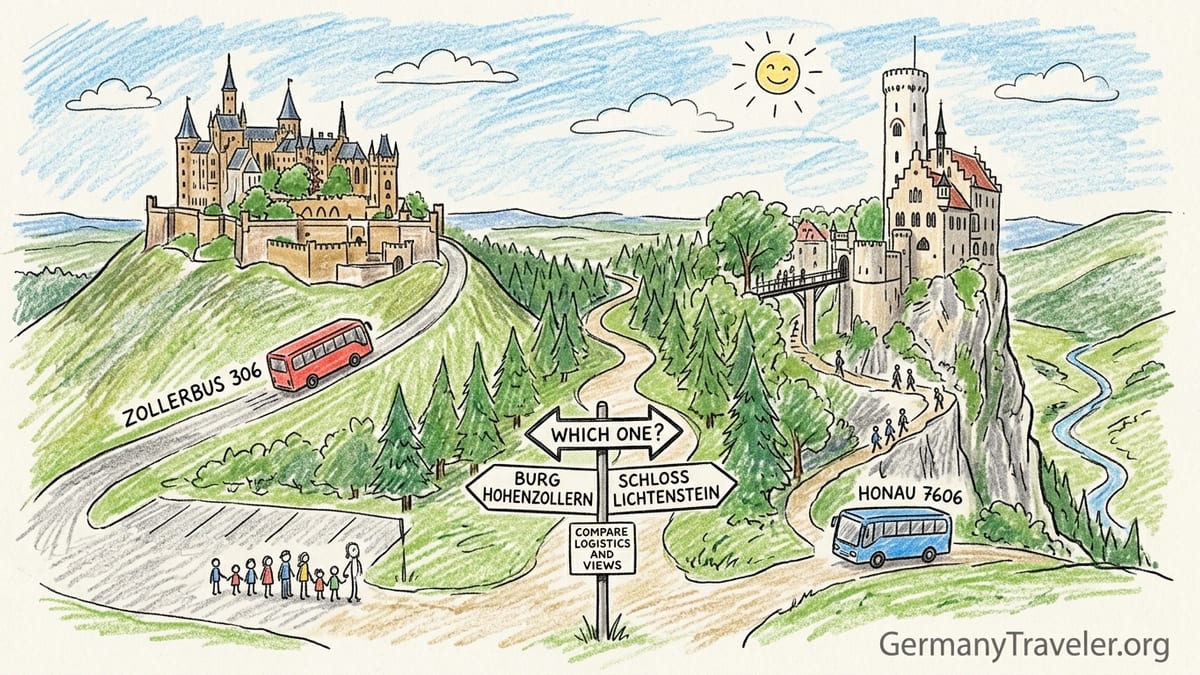
Why I Wanted Both Castles To Be Trip-Defining Highlights
I planned Hohenzollern and Lichtenstein the way many visitors do: as marquee day trips that would justify renting a car and burning precious vacation time. From Stuttgart, guidebooks and tourism brochures present them as two crown jewels of the Swabian Alb, Hohenzollern on its solitary cone-shaped hill near Hechingen and Lichtenstein perched on a cliff above Honau in the Reutlingen district. The state tourism sites show both in perfect light, often above the clouds, and describe them as essential castle experiences.
On paper, it all seemed simple. By train, Hohenzollern is tied to Hechingen on the regional line south from Stuttgart, with a connecting bus up toward the castle parking area. Lichtenstein appears just as feasible via train to Reutlingen and a bus up toward Honau or Traifelberg, or by car along the B312. In practice, the reality involves limited bus timetables, uphill approaches that feel longer than they look on a map, and weather that can erase the famous panoramas in seconds.
My goal that weekend was not just to collect pretty photos but to see how each site actually feels to visit. I paid for my tickets, joined the same queues as everyone else, took the shuttle when my legs gave up, and watched other travelers work through the same decisions. Along the way, I kept asking myself: if I had to pick just one, which castle would I send readers to, and why?
That question became sharper when I realized how much of a day each visit can eat, especially if you rely on public transport. Two castles that look close together on Instagram are, in reality, separate logistics puzzles. That is where the gap between photographic impact and on-the-ground experience really starts to show.
Getting There: Pretty Hills, Real-World Logistics
I visited both castles without a car and then returned later by rental car to understand the difference. For Hohenzollern, the train leg from Stuttgart Hauptbahnhof to Hechingen is the easy part. Regional trains on the Neckar-Alb line run roughly once an hour, and with Baden-Württemberg tickets or Germany-wide rail passes the cost is manageable. The friction starts when you reach Hechingen and need to connect to the bus that climbs toward the castle.
On my first visit, midweek in shoulder season, the dedicated castle buses ran just a few times per day outside weekends and holidays. A local information sheet in 2026 still notes the ZollerBus line 306 and the seasonal “Nauf-Nab-Trauf” bus line 344, but the exact departures are sparse enough that I had to time my train almost to the minute. When I missed one bus by five minutes, the next option was more than an hour away. I watched other visitors pace the small station forecourt, debating whether to call a taxi or attempt the several-kilometer walk along roads that are not designed as a scenic hike.
By contrast, Lichtenstein felt easier once I accepted that there is no train up into the Alb plateau. I took a regional train to Reutlingen Hauptbahnhof, then a bus toward Honau on routes such as 7606 or 400. From stops like “Honau” or “Schloss Lichtenstein Aufberg,” you walk the final 1 to 2 kilometers uphill with about 90 to 120 meters of elevation gain. Buses do not run every few minutes, but I had several departures to choose from across the day, which made the planning feel less fraught than Hechingen’s castle shuttles.
Returning by car was a different story. From Stuttgart, Hohenzollern is around an hour’s drive via B27, with clear signage to the large visitor parking area below the castle. Lichtenstein sits roughly an hour away via Reutlingen and the B312, then a smaller road that curls up past the Nebelhöhle cave and forest car parks to the Schloss Lichtenstein parking lot about 300 meters from the castle entrance. Behind the glossy images, both castles are outposts on the rim of the Alb, and if you underestimate those last kilometers, the journey can feel longer than advertised.
Parking, Uphill Approaches and Shuttles: Where the Effort Adds Up
Both castles sit high above their parking areas, which looks romantic in photos and feels less so when you are staring at the slope after a long drive. At Hohenzollern, the main visitor parking area at the base of the hill is a paved plateau with staff directing cars into rows. From there, you have a choice. You can wait for the shuttle bus that winds up the forested approach to the upper entrance, or you can walk the steep road on foot.
On a clear day, I tried both. The hike from the parking area to the castle entrance took me roughly 20 to 30 minutes at a steady pace, but several families with young children needed much longer, and a few were visibly regretting the decision halfway up. The shuttle bus shortens the effort to a brief ride, but queues form quickly, especially after arriving tour buses. Because buses depart in batches, you can find yourself standing on hot tarmac for 15 to 20 minutes before boarding. It is helpful to factor that into your mental picture. Those iconic photos of Hohenzollern floating in the mist never show the line of people waiting for the shuttle.
Lichtenstein’s approach is shorter but still physical. The parking lot for Schloss Lichtenstein is about 300 meters from the entrance gate, a slightly uphill walk along a forested lane where you already get glimpses of the cliff edge. There is no internal shuttle up from this lot: the expectation is that able-bodied visitors will walk. Travelers arriving by bus and disembarking at lower stops like Honau or Traifelberg face an additional uphill walk of 15 to 30 minutes. For me, the approach had its own charm, but I watched one older couple underestimate the gradient and pause repeatedly, wondering if they should have arranged a taxi drop-off closer to the top.
If mobility is limited or you are traveling with very young children, this is where reality may clash with the fairytale images. Neither castle is truly flat-access, and although staff do what they can, there are simply a lot of slopes and steps built into the setting itself. For some travelers, that uphill effort becomes part of the memory; for others, it colors the rest of the visit with low-level fatigue.
Tickets, Prices and Queues: What I Actually Paid and Waited
Before visiting, I had read older accounts of Hohenzollern that mentioned a choice between cheaper courtyard-only tickets and more expensive full-access options. By 2026, that structure had shifted. At the ticket office near the top, the standard adult admission covered access to the grounds and the main interior route without a separate guided tour surcharge. On my last visit I paid just under 25 euros for an adult ticket, in line with recent online commentary that describes a single, relatively high-priced ticket for “all open doors.” The exact number may change, but the key point is that Hohenzollern has become one of the more expensive castle visits in the region, especially if you add train fares, local buses and shuttle costs.
Queues at Hohenzollern form twice. First, at the lower ticket control if you have not bought online in advance, and again at the interior entrance where staff pace visitors into the state rooms. On a sunny Saturday, I waited around 15 minutes in the first line and another 10 in the second, which did not feel outrageous but did add friction compared with the dreamy photos that suggest solitude.
Lichtenstein’s pricing is more segmented and, for me, more transparent. As of January 2026, an adult ticket to the castle courtyard alone costs 6 euros, while a 30-minute guided tour of the interiors, including courtyard access, costs 16 euros for adults, 14 euros reduced and 10 euros for children aged 6 to 16. These tickets are purchased at a small booth near the entrance. If a given guided tour is full, staff simply book you onto the next slot about 20 minutes later. I appreciated that, on a slightly drizzly afternoon, I could choose to pay the lower courtyard-only price, photograph the famous cliff-side perspective and leave, without committing time and money to the interior.
Queues at Lichtenstein felt shorter. Even in summer, my waits rarely exceeded 10 minutes to buy tickets, and guided tours departed so frequently that the main challenge was staying near the entrance at the right time. One small reality check: interior tours are routinely conducted in German. English-language tours are generally arranged in advance for groups of around 15 or more and are not something you can just show up and request on a random Tuesday. As an independent English-speaking visitor, I joined a German tour and relied on a printed English summary sheet for context while listening for the occasional translation.
Inside vs Outside: How the Interiors Compare to the Photos
The single biggest surprise of my visits was how different the balance between exterior spectacle and interior experience felt at each castle. Hohenzollern’s exterior, especially from distant viewpoints along the B27 or nearby hiking routes, is overwhelming: a massive neo-Gothic fortress on a solitary hill with layers of walls and towers. Walking across the drawbridge and into the courtyard, I expected the inside to feel just as grand. Instead, the interior route covers a smaller sequence of rooms than I had imagined, including the Grafensaal, chapel, library and display spaces for royal memorabilia.
The rooms are richly decorated, with dark wood, stained glass and portraits of Prussian kings and Hohenzollern princes. Yet the sequence is quite tight. With no in-depth guided tour on my visit, the experience became a self-paced shuffle, occasionally bunching up at narrower doorways. Photography was restricted in several of the interior rooms, which meant that the most visually memorable images of Hohenzollern for me remained the courtyard and distant hilltop views rather than anything from inside the palace. I spent about 45 minutes on the interior circuit and felt that I had seen the core without needing more.
Lichtenstein set me up for the opposite kind of surprise. The exterior is almost absurdly photogenic, a compact fairytale structure with a delicate tower rising directly from the cliff edge above the Echaz valley. I honestly wondered whether the interior could offer much beyond that famous facade. The guided tour, however, made the space feel more substantial than it looks from outside. Over 30 minutes, our small group climbed steep, narrow staircases into rooms filled with weapons, hunting trophies, stained glass and furnishings that still echo the tastes of the 19th-century Counts of Württemberg who built it.
Photography inside Lichtenstein was tightly controlled on my tours, with no photos allowed in several rooms. That forced me to simply look: at the painted ceilings, the ornate stoves, the stained-glass windows that filter green forest light. Unlike Hohenzollern, where I felt slightly detached from the interiors, Lichtenstein’s compactness worked in its favor. The castle feels like a lived-in manor layered vertically, the kind of place where narrow passages and sudden views down into the courtyard give you a sense of being in a three-dimensional puzzle rather than a ceremonial palace.
Time Needed On Site: How Long Each Castle Really Takes
When I planned my weekend, I optimistically penciled in “half a day” for each castle. On the ground, “half a day” stretched easily toward a full one, especially without a car. For Hohenzollern, traveling from Stuttgart by public transport, I left just after breakfast and did not return before early evening. The timeline looked roughly like this: one hour by train to Hechingen, up to one hour of margin for the bus connection, 20 minutes for the shuttle or uphill walk, 25 minutes to queue and purchase tickets, about 45 minutes for the interior sections and at least another hour roaming the ramparts, courtyards and viewpoints.
If you add time for lunch at the on-site cafeteria and a coffee break while waiting for the return shuttle and bus, you can easily spend four to five hours between arriving at the parking area and leaving again. That makes Hohenzollern a solid single-focus outing rather than a casual side stop. I never felt rushed, but I did have the sense that once you commit to heading up the hill, your day is mostly spoken for.
Lichtenstein is quicker on paper and in practice, although it can still expand to fill more of the day than you expected. From Reutlingen, the bus ride toward Honau takes under an hour. Once at the Lichtenstein parking area, you can walk up to the ticket booth in about 5 to 10 minutes, then decide how deep you want to go. On one visit, with low clouds hiding distant views, I bought only the 6 euro courtyard ticket, spent 45 minutes exploring the walls and taking photos from different angles, and was back at the bus stop less than two hours after stepping off the first bus.
On another visit with clear weather, I added the 30-minute interior tour, lingered in the courtyard café with a drink and cake, and detoured afterward to the nearby Nebelhöhle cave and ropes course in the forest. That turned Lichtenstein into a more varied five-hour excursion tied into a day of light hiking. The key difference, compared with Hohenzollern, is that you can realistically treat Lichtenstein as either a focused photo stop or the anchor for a broader Swabian Alb day, without feeling that you “wasted” a major detour for a very short interior circuit.
Viewpoints, Weather and the Risk of a Fogged-Out Fairytale
The marketing photos that hooked me on both castles depend heavily on weather. Hohenzollern is often shown floating above a sea of fog or backlit at sunset, while Lichtenstein appears against a sky so clear it looks almost Mediterranean. In reality, the Swabian Alb is notorious for fast-changing conditions, low cloud and mist, especially in spring and autumn. On my first attempt at Hohenzollern, I arrived to solid grey. The castle itself was visible up close, but the legendary panorama over the Alb and the distant Black Forest was gone. From the outer ramparts, everything beyond the nearest trees disappeared into white.
That kind of weather does not ruin the visit, but it shifts the value. Instead of wide open views, I focused on architectural details and corners of the wall-walks that felt atmospheric in the fog. I also noticed several disappointed photographers who had clearly made the trip specifically for that Instagram-friendly ocean-of-clouds shot. If your heart is set on that exact image, it may be worth watching the forecast and building a flexible day in Stuttgart so you can choose the clearest morning for Hohenzollern.
Lichtenstein is just as weather-sensitive, though in a slightly different way. Its primary wow moment is the side-on view across the ravine to the castle jutting from the cliff. When low cloud presses in, the background valleys fade into soft grey and the illusion of height is muted. On my worst-weather visit, I still managed some moody photos from the courtyard, but the wider sense of hanging on the lip of the Alb was largely gone.
Both castles offer additional viewpoints beyond the paid core, though they take effort and may not show up in official brochures. Around Hohenzollern, hiking and cycling routes in the Zollernalbkreis give you distant profiles of the castle framed by fields and forest. Some of those spots, reached by short walks from lay-bys along local roads, ended up producing my favorite photographs of the weekend. At Lichtenstein, following signed trails in the “hochgehträumt” premium hiking area leads to natural balconies where you see the castle from slightly different angles without being inside the ticketed zone. In both cases, it is worth remembering that the most satisfying view of a famous castle is sometimes the one you get from a distance, not from inside the gate.
Did They Live Up To The Detour, and Which One Would I Pick?
By the end of my second loop through the Swabian Alb, I had reached a less romantic but more honest conclusion: the castle that looks bigger in photos, Hohenzollern, felt slightly smaller in terms of interior experience than I expected, while the castle that looks almost toy-like in photos, Lichtenstein, felt more complete relative to the time and money I spent on it.
Hohenzollern is impressive and carries real historical weight as the ancestral seat of the Hohenzollern dynasty that later ruled Prussia and the German Empire. Its exhibitions and chapel have layers of story that history fans will appreciate. Yet, as a visitor balancing time against depth, I came away feeling that a large share of the value lies in external views and the symbolism of the site. If I had slogged up from Hechingen on a day of heavy fog and seen very little of the surrounding landscape, I suspect I would have felt that the high ticket price, shuttle logistics and queues added up to a slightly underwhelming interior payoff.
Lichtenstein, on the other hand, is comfortable in its scale. It has never pretended to rival Neuschwanstein in size or Versailles in grandeur. It is a 19th-century romantic castle planted on medieval foundations, inspired in part by a popular historical novel. Between the cliff-edge courtyard, the compact but richly furnished interior and the surrounding forest trails, I never felt that I had overpaid or overcommitted time. On one visit I was in and out within two hours and perfectly satisfied. On another, I made it the centerpiece of a hiking and cave-exploring day that felt like good value even when the sky refused to cooperate for postcard shots.
If you can only choose one castle and you care primarily about that “this looks exactly like the photo” moment, I would gently nudge you toward Lichtenstein. You stand in the courtyard, look back toward the famous tower and cliff, and what you see with your eyes is very close to the widely circulated images. You also have the flexibility to adapt: if weather or time works against you, the cheaper courtyard ticket still delivers the signature view. If you have more time and interest, the interior tour adds a compact, story-rich layer without eating your whole day.
If, however, your interest leans toward dynastic history, larger grounds and a sense of visiting a symbol rather than just a picturesque spot, Hohenzollern still earns its prominence. I would simply encourage you to treat it as a destination that deserves clear weather and a full day’s bandwidth, rather than a casual bolt-on to an already packed itinerary.
How To Combine Each Castle With Other Swabian Alb Experiences
One of the most practical lessons I took from this trip is that you should never let your day on the Alb hinge entirely on a single photogenic facade. Both castles can anchor a more rounded outing that feels worthwhile even if clouds roll in or tickets sell out for a preferred time slot.
Around Hohenzollern, the broader Zollernalb region is laced with hiking and cycling routes that use the castle as a backdrop rather than a destination. After my hilltop visit, I took time to explore lower-elevation trails near Hechingen and Bisingen, where you walk through orchards and small villages with periodic views back up to the silhouette of the castle. For travelers with a car, short drives open up additional Alb viewpoints, small museums and traditional inns where the focus shifts to local food and landscape instead of just one monument.
Near Lichtenstein, the options are even more obvious. The Nebelhöhle cave lies within a short drive or a steady walk of the castle parking area, offering an underground detour that is completely independent of surface weather. There is also an adventure park in the forest near Schloss Lichtenstein, with ropes courses suited to older children and adults who want a physical challenge. Families sometimes pair Lichtenstein with the family park at the Bärenhöhle area further along the Alb. On my favorite day, I hiked sections of the “hochgehträumt” premium hiking route, looping from castle viewpoints through beech forest to smaller lookouts that tourists who only come for the Instagram shot never see.
Planning this way changes your mindset. Instead of thinking “I must have the perfect castle photo for this trip to be a success,” you treat the castles as strong supporting actors in a wider Swabian Alb experience that might also include caves, hikes on limestone plateaus, village bakeries and even just the pleasure of riding local buses through rolling countryside. The castles remain highlights, but they no longer carry the burden of justifying the entire day on their own.
The Takeaway
Hohenzollern and Lichtenstein absolutely earn their place in the visual imagination of Baden-Württemberg. They do look incredible in photos, and if you hit them in good light with clear horizons, your own shots will probably look just as dramatic. What the photos gloss over is the practical texture of a visit: the limited bus schedules up from Hechingen, the uphill approaches from forest parking lots, the shuttle queues, the interior photography rules, the moments when fog swallows the view you came for.
If you have time and flexibility, there is a compelling case for visiting both, ideally on separate days so each can breathe. You will experience two very different flavors of romanticism on the Alb: Hohenzollern as a large, symbolic fortress with a relatively compressed interior route and huge regional significance, and Lichtenstein as a more intimate cliff-top retreat whose scale feels honest and whose pricing allows you to tailor how deep you go.
If you have to choose, my reality-checked recommendation is this. Choose Hohenzollern if dynastic history, a sense of grandeur from the outside and the idea of standing within walls that symbolized Prussian and German power matter more to you than getting a lot of interior square meters for your ticket price. Choose Lichtenstein if you value a close match between photo and reality, shorter queues, the option of a cheaper courtyard-only visit and easy ways to combine the castle with hiking, caves or forest adventure parks on the same day.
Either way, build your plan around real-world logistics rather than brochure assumptions: check bus timetables if you are coming by train, allow generous margins for uphill walks, and have a backup activity nearby in case the weather turns. Do that, and you will remember your day on the Swabian Alb for more than a single postcard angle, even if the famous photos were what first caught your eye.
FAQ
Q1. Can I visit both Hohenzollern and Lichtenstein in a single day from Stuttgart?
It is technically possible with a rental car in summer, but it makes for a rushed and tiring day. By public transport it is impractical, because each castle already fills most of a day once you factor in train and bus connections, uphill approaches, queues and time on site. For a more relaxed experience, treat them as two separate day trips.
Q2. How much should I budget for tickets at each castle in 2026?
At Schloss Lichtenstein, courtyard-only entry for adults is 6 euros, while a guided interior tour including the courtyard is 16 euros for adults, with reduced and child prices available. At Burg Hohenzollern, expect to pay around the mid-twenties in euros for an adult ticket that covers the grounds and standard interior access. Exact prices can shift, so it is worth checking just before you travel, but Hohenzollern is noticeably more expensive than Lichtenstein.
Q3. Are the castles easy to reach by public transport, or do I need a car?
Both castles can be reached without a car, but it takes planning. For Hohenzollern, you take a regional train to Hechingen, then rely on infrequent buses or seasonal shuttle lines up toward the castle, followed by a shuttle or steep walk to the entrance. For Lichtenstein, you ride a train to Reutlingen and then a bus toward Honau or nearby stops, finishing with a short but uphill walk to the castle. A car makes both visits easier and more flexible, especially if you want to combine them with hikes or caves on the same day.
Q4. How long should I plan to spend at each castle once I arrive?
At Hohenzollern, plan on at least three to four hours from the time you reach the lower parking area or bus stop. That allows for the shuttle or uphill walk, ticket queues, interior visit, rampart walks and a meal or snack. At Lichtenstein, a focused visit with courtyard and interior tour can be done comfortably in two to three hours, while a more relaxed day that adds nearby hikes or the Nebelhöhle cave will stretch to four to five hours.
Q5. Are the interior tours available in English?
At Lichtenstein, regular guided tours are conducted in German. English-language tours can often be arranged for pre-booked groups above a certain size, but individual travelers usually join a German tour and may receive a printed English summary. At Hohenzollern, interior access is often self-guided with multilingual information materials available; structured English-language tours may be offered on specific dates, but you should check the latest information before relying on them.
Q6. How demanding are the walks and stairs for someone with limited mobility?
Both castles involve significant slopes and staircases. Hohenzollern sits high above its parking area; even if you use the shuttle bus, you still face inclined paths and interior stairs. Lichtenstein requires an uphill walk from the parking lot and steep internal staircases during the guided tour. Visitors with serious mobility issues should contact each site in advance for the most up-to-date accessibility details and consider whether the effort fits their comfort level.
Q7. Can I take photos inside the castles?
Exterior and courtyard photography is widely allowed at both sites and is where most visitors capture their favorite images. Inside, rules are stricter. At Hohenzollern, photography is limited or prohibited in parts of the state rooms, and flash is usually banned. At Lichtenstein, interior photography is often not allowed during the guided tour. Always check posted signs and follow staff instructions to avoid problems.
Q8. What happens if the weather is foggy or rainy when I visit?
Fog and low cloud are common on the Swabian Alb and can greatly reduce the long-distance views that make these castles so famous. In bad weather, the hilltop panoramas at Hohenzollern may vanish, and Lichtenstein can look less dramatic without visible valleys below. The visits are still worthwhile for architecture and atmosphere, but if your main goal is wide-open landscape photography, it is worth building flexibility into your schedule so you can choose a clearer day.
Q9. Which castle is better for young children or families?
Lichtenstein generally suits families better if you want a shorter, more flexible outing. The walk from the parking lot is manageable, the interior tour is only about 30 minutes, and you can combine the visit with nearby caves or a forest adventure park. Hohenzollern can be rewarding for older children interested in knights and kings, but the longer access route, higher ticket prices and denser crowds may make it more tiring for very young kids.
Q10. If I have time for only one castle, which should I choose?
If you are drawn mainly by the promise that reality will match the iconic photos and you appreciate a compact experience with clear pricing, choose Schloss Lichtenstein. If you care more about visiting a symbolically important fortress with a commanding presence in German history and do not mind a higher price and more complex access, choose Burg Hohenzollern. In both cases, try to anchor the visit within a broader Swabian Alb day so that your enjoyment does not depend entirely on one castle living up to a single image.