


When Baden-Württemberg brands itself as Germany’s leading spa state, it is not talking about hotel whirlpools. This southwestern region officially recognizes more than fifty spas and health resorts, and in places like Baden-Baden and Bad Wildbad, bathing is a reason to travel in its own right. Curious and slightly naïve, I set out to experience that culture first-hand, expecting an upgraded swimming-pool day. What I found instead was a strict wellness ritual where silence, nudity and etiquette matter as much as warm water.
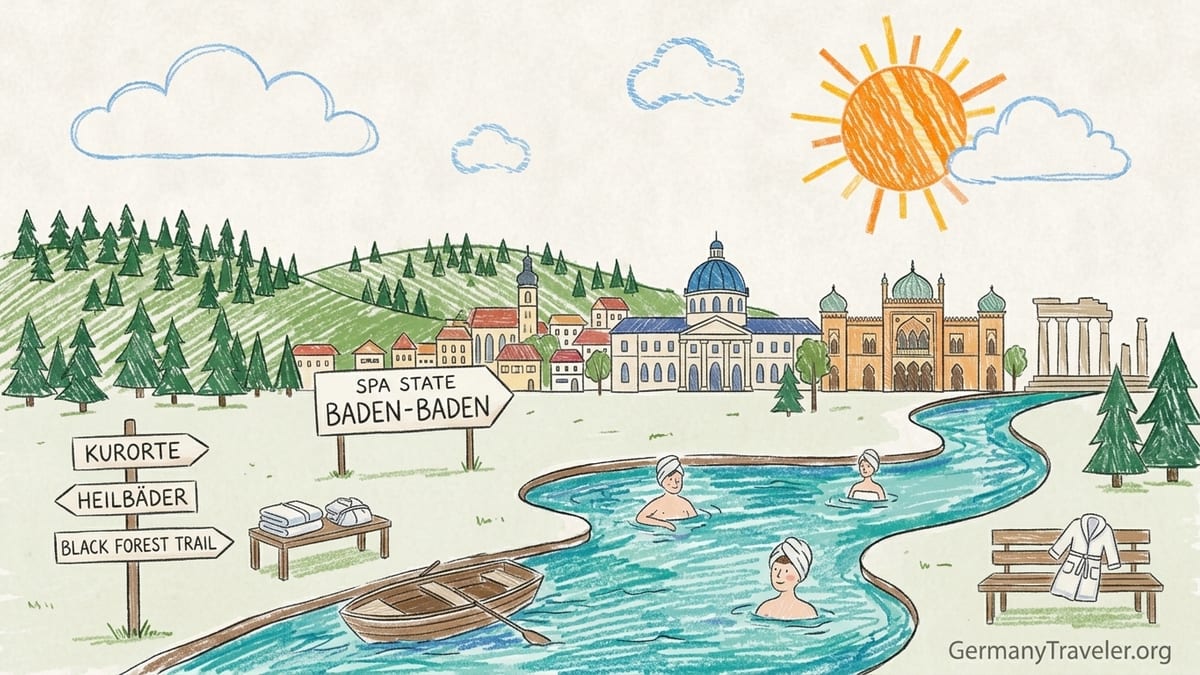
Arriving in Germany’s Self-Proclaimed “Spa State”
Baden-Württemberg’s tourism board proudly promotes the region as Germany’s top spa and health destination, with dozens of officially designated Kurorte and Heilbäder, or spa and health resorts. That status is not handed out casually. Towns have to demonstrate natural healing resources, such as mineral springs or a special climate, as well as medical supervision and dedicated infrastructure. On paper, it sounds like a softer, steamier version of a medical clinic. On the ground, it feels more like a parallel culture with its own rules that visitors are simply expected to understand.
I based myself in Baden-Baden, the famous spa town at the edge of the Black Forest, and added a day trip to Bad Wildbad, a smaller community further up the Enz Valley. Over several full days I visited Caracalla Therme and Friedrichsbad in Baden-Baden, and Palais Thermal in Bad Wildbad. Each facility was a little different, but together they offered a clear picture of how spa-going in Baden-Württemberg actually works, from check-in to the long, towel-wrapped shuffle back to the lockers.
As an English-speaking visitor used to resort spas and family waterparks, I repeatedly misjudged what I was walking into. I underestimated how serious the wellness etiquette would be, and how much of the experience would revolve around shared norms about nudity, quiet and time. None of that made the spas bad. In many ways they were wonderfully run. But it did mean that some moments of luxury sat right next to stretches of awkwardness and boredom that I could have avoided with better research.
What follows is not a ranking, but a candid look at three real visits: what felt indulgent, what felt strange and which parts I would gladly pay for again.
Caracalla Therme: My “Casual Swim” That Wasn’t
Caracalla Therme, a modern thermal complex in the center of Baden-Baden, is exactly the place many visitors picture when they imagine warm outdoor pools with a view of treetops. The building combines tall glass walls and white columns, and the indoor space opens into an expansive outdoor pool area. When I walked in on a Saturday around lunchtime, families with children were queuing at the reception, teenagers clutched pool noodles, and a few couples already wore hotel bathrobes. It looked close enough to a sophisticated public pool for my guard to drop.
Check-in was brisk but slightly opaque to a first-timer. I chose a three-hour tariff at the counter and received a plastic wristband with a chip. Helpful signage in German and English explained that the band locked and unlocked the lockers and also tracked time. Past the turnstile, a coed changing area was divided into small cubicles. Once I had changed into a swimsuit, the flow was: place your bag and clothes into a locker, tap the wristband to close it, then follow signs to the “Badelandschaft,” or bathing landscape.
The main pools were exactly as promised: large indoor basins of turquoise water around 34 degrees Celsius, massage jets, bubbling loungers, a current channel and two outdoor pools steaming in cool air. Swimwear is required in this section, and the vibe felt relaxed, if crowded. On that weekend afternoon almost every loungers chair was occupied, and the whirlpools filled quickly. There were no strict time limits per pool, but the three-hour overall ticket time ticked away while I wandered between features.
What I had not fully grasped is that Caracalla is really two different experiences in one building. The bright, busy pools downstairs coexist with a separate sauna world upstairs that operates under entirely different etiquette. Access to the sauna area costs extra and involves a mental shift from swimsuit leisure to textile-free wellness culture.
Upstairs at Caracalla: Learning Textile-Free Etiquette
Partway through my visit, curiosity won out and I followed signs to the sauna. An attendant scanned my wristband and added the sauna surcharge. A staircase led to a quieter level with a new set of rules: no swimwear, bring a towel into every cabin, and silence or very hushed voices in most areas. The facility describes the sauna section as textile-free, which in practice means you are expected to be naked or wrapped in a towel, but not wearing a swimsuit.
I had brought a robe and flip-flops, which were suddenly essential. In the hallway people moved between saunas wearing robes or towels, but once inside, they spread a large towel on the wooden bench and sat or lay nude on top of it. This is not about exhibitionism. Locals see it as a hygienic and practical norm. Compared to the lively pools downstairs, the atmosphere here felt almost monastic, broken only by the soft thud of the sauna door and the occasional whisper.
Caracalla’s sauna level offers several cabins at different temperatures, along with a steam bath, quiet rooms, and small outdoor terraces for cooling down. There are recommended cycles posted on the wall, but no formal time limits per cabin. You are expected to take a warm shower before entering, stay perhaps eight to fifteen minutes depending on heat, and then cool off with a cold plunge or fresh air before resting. I joined one Aufguss, a scheduled infusion where a staff member pours scented water over the stones and circulates hot air with a towel. It was impressive and intense, but also packed. On a busy weekend seats fill up quickly, and late arrivals can find themselves standing uncomfortably close to strangers.
The tension for me surfaced around expectations and value. I had paid extra for the sauna access on top of my pool ticket, but after about ninety minutes I realized I did not actually want to spend the entire afternoon in silence, cycling through heat and cold. Without a book or phone the quiet rooms felt surprisingly dull, and there was no natural stopping point. Caracalla does serve food, including salads and simple hot dishes in a self-service restaurant, and you pay by scanning your wristband. Yet once I had eaten, the idea of another hour of sweating and cooling began to feel more like duty than indulgence. Guests who adore saunas would disagree, but as a casual visitor expecting more variety, I found my attention span shorter than the opening hours.
Friedrichsbad: Ritual, Rules and Total Immersion
If Caracalla is the contemporary face of Baden-Baden’s spa culture, Friedrichsbad is its historical heart. The 19th century building stands next to the ruins of ancient Roman baths, and the interior is a grand sequence of tiled halls, domed ceilings and stone basins. This is where I intentionally abandoned the idea of a “pool afternoon” and committed to a set ritual: the famous multi-step Roman-Irish bath, which can take two to three hours if followed in full.
Check-in at Friedrichsbad felt more like arriving at a small clinic than a leisure center. Phones and cameras were firmly forbidden beyond the entrance. I paid for the standard package, received a wristband key and paper instructions outlining the recommended sequence of rooms, from warm showers to steam chambers, hot baths, cool pools and a final rest wrapped in warm sheets. Crucially, Friedrichsbad is essentially a textile-free environment throughout the ritual, with only a light sheet provided in some rooms. There are specific days with separate male and female areas, and others when bathing is mixed. On my visit it was mixed, which meant a coed nude experience from the moment I left the locker.
The routine began with supervised showers where an attendant checked that I had washed thoroughly. From there I stepped into progressively warmer rooms, including dry-air chambers around 54 degrees Celsius and then hotter humid spaces. Time suggestions were printed on signs, often recommending five to fifteen minutes before moving on. In the central dome, a deep circular pool around 36 degrees Celsius invited quiet floating. There were no noisy bubbles or jets, just a still, blue basin where echoes of the architecture replaced music.
Massages and soap scrubs are an optional extra at Friedrichsbad. I booked a traditional soap brush massage, expecting something akin to a gentle spa treatment. Instead, it was an efficient, brisk scrub performed by an attendant of the opposite sex, in a shared room where several guests lay on adjacent tables. The treatment was professional and non-sexual, but very intimate by North American standards, with minimal draping. This was a moment when cultural expectations collided sharply. Friedrichsbad assumes its visitors are comfortable treating the human body as simply that, a body, while many international guests carry in a layer of modesty and personal space that does not always dissolve in hot water.
By the end of the seventeen-step sequence, including a cool plunge and a period of quiet rest in a dim relaxation hall, I felt physically heavy and pleasantly tired. Yet it had also been mentally demanding. Unlike a free-form spa where you can dip in and out, Friedrichsbad is a guided ritual that works best if you commit. Guests looking for casual play or chat would likely find it restrictive. For me, the lasting impression was of being temporarily absorbed into a tradition that predates wellness marketing, in a building that treats bathing as serious business.
Palais Thermal in Bad Wildbad: Beauty, Crowds and One Textile Day
Bad Wildbad, set deeper in the Black Forest, feels quieter than Baden-Baden, but its main spa, Palais Thermal, is one of the most visually striking in the region. The complex combines historical Moorish-style halls with modern wellness architecture, and marketing materials openly describe it as a sensual bathing temple for adults. In practice that means ornate tiled pools under domes, candlelit corners and a multi-level sauna landscape with views over the town.
On arrival I parked in the adjacent garage, where spa guests benefit from a few hours of free parking, and walked through a pedestrian passage directly into the building. At reception I chose a three-hour ticket that included the sauna, paid a small rental fee for a bathrobe, and received another chip wristband. The changing area was similar to Caracalla’s, with individual cubicles leading to shared locker corridors. Flip-flops were again a must, as signs asked visitors not to walk barefoot between wet zones.
The ground floor pools at Palais Thermal are filled with warm mineral water and set in small, interconnected rooms. Water temperatures vary, with some basins around 32 to 34 degrees Celsius and others deliberately cooler or hotter. Unlike a typical chlorinated pool, these spaces are more about soaking than swimming. On most days, the bathing area is textile-free, meaning guests use it nude or wrapped in towels. However, the spa operates at least one designated textile bathing day per week, when swimwear is mandatory in those pools and the clientele often includes more first-timers and hesitant visitors.
I deliberately scheduled my visit on a weekend textile day, curious to see how that changed the dynamic. The result: the lower pools felt busier and louder, with small groups chatting and some guests taking cautious selfies in designated areas near the café. Even on that day, though, the upper floors, with saunas and quiet rooms, remained textile-free and strictly controlled. Signs at the stairwell reminded guests to leave swimsuits behind and maintain low voices. Security and staff were noticeably present, gently correcting anyone who tried to bring a phone or break the dress code.
Inside Palais Thermal’s Sauna World: Romance or Too Much Quiet
Palais Thermal’s sauna landscape is spread over several levels, including indoor cabins and an outdoor terrace with panoramic views. Temperatures range from milder bio saunas to intense Finnish cabins above 90 degrees Celsius. There is a steam bath, a salt inhalation room, and quiet zones furnished with loungers and waterbeds. In all of it, the expectation is the same: no swimwear, sit on a towel, shower before and after, and keep socializing discreet.
Compared with Caracalla’s larger, more municipal feel, Palais Thermal struck me as more adult-focused and romantic. Couples lingered in candlelit corners, sharing whispered conversations between sauna rounds. There is a small bar serving drinks and light snacks, and it is not unusual to see guests in robes sipping a glass of wine between sessions. Mobile phones remained off-limits, so conversations and eye contact replaced scrolling. For some, that is the very definition of relaxation. For others, spending five or six hours with the same person, rotating between heat, cold and dim lounge, may start to feel repetitive.
On the crowded weekend I visited, the main challenge was space rather than etiquette. Aufguss ceremonies filled up fast, and arriving even a couple of minutes late meant either standing near the door or skipping that round. Quiet rooms, especially those with views or waterbeds, were in constant use, and it took patience to find two loungers together. There was no strict time limit in each area, so some guests settled in for long naps. Staff patrolled occasionally, but mostly relied on social norms to keep things moving.
Food options inside Palais Thermal were more limited than at Caracalla. There was a café offering cakes, salads and a few hot dishes, but during peak times the wait for service could stretch. Because leaving the facility and re-entering was discouraged for short stays, many guests simply accepted the on-site prices and menu as part of the package. By hour five of my spa day, I realized that my body felt wonderfully loose but my mind was restless. There are only so many cycles of sauna, shower, cold plunge and rest that I personally enjoy in one sitting.
What Felt Luxurious, What Felt Strange and Who It Suits
Across these three visits, certain patterns emerged. On the luxurious side, the quality of the water and facilities was consistently high. Thermal pools felt genuinely soothing on joints, and the architecture, especially at Friedrichsbad and Palais Thermal, added a sense of occasion that no hotel spa can match. The staff took cleanliness seriously. Showers and foot baths were placed logically before and after every major station, and I rarely saw anyone ignoring those expectations. For travelers who love routine, the predictable rhythm of heat, water, rest and repeat can be profoundly calming.
There were also aspects that felt strange or at least unexpected when viewed through a non-German lens. Nudity itself was less of an issue than I had imagined, in part because it was universal and practical. What surprised me more was the strictness around silence and the near-total absence of digital distraction. Phones were banned or discouraged in most areas. Music was minimal. In theory that is exactly what wellness should be. In practice, I caught myself wishing for a book, a notebook or anything to occupy the mind between rounds of sweating and floating.
Expectations about value also played a role. Day tickets for these flagship spas are not cheap, especially if you add sauna access and treatments. At Palais Thermal, a weekday day ticket including sauna runs in the low 30 euro range, with higher prices on weekends, and similar figures at Caracalla. Massage add-ons quickly double the cost of a visit. If you adore the format and plan to stay all day, that can feel like money well spent. If, like me, you realize after three or four hours that you are essentially done but feel obliged to stay longer because of the price, the experience tilts from indulgent to slightly oppressive.
Suitability also varies by traveler type. Families with young children will likely be happiest sticking to the textile pool areas at places like Caracalla, where there is space to splash and talk. Couples who enjoy shared rituals and quiet time may find the textile-free sauna landscapes deeply bonding, especially at more romantic venues like Palais Thermal. Solo travelers who love saunas and meditative spaces can easily spend entire days cycling through different cabins and quiet rooms. However, visitors who crave variety, novelty and casual conversation may find a full spa day in Baden-Württemberg more intense and structured than advertised.
Managing Crowds, Rules and Cultural Differences
Crowding is a practical reality. Weekends, holidays and bad-weather days attract locals and tourists alike. On my Saturday at Caracalla, the main pools were lively but manageable, while the sauna Aufguss sessions were densely packed. At Palais Thermal on a textile day the lower pools occasionally felt more like a stylish party than a sanctuary. Early mornings and weekday evenings, by contrast, are reported by regulars to be calmer, with more space to float or nap without constant turnover.
Photography and phone rules can catch tourists off guard. In all the spas I visited, cameras were either outright banned or heavily restricted to designated zones, usually near entrances or cafés where guests remained robed. Staff took these rules seriously to protect privacy, especially given the textile-free areas. For travel writers and content creators, that means accepting that much of what you experience will remain uncaptured. For ordinary visitors, it creates a rare bubble of time without notifications.
From a cultural perspective, the central tension is not whether German spa etiquette is good or bad, but how it diverges from what many international visitors expect. In North America, spas are often framed as indulgent extras inside hotels, with short treatments and optional facilities. In Baden-Württemberg’s traditional spa towns, the spa is the destination, and the average visit lasts several hours. Guests are expected to take responsibility for their own pacing and comfort. The emphasis is on health and relaxation rather than entertainment. That difference made me realize that my own default idea of “relaxing” involved more stimulation and distraction than I liked to admit.
The most useful adjustment for foreign visitors is to treat these spa visits as cultural experiences, not just wellness services. That means reading each facility’s rules in advance, especially about nudity, coed versus separate days, age restrictions and what counts as acceptable behavior in quiet zones. It also means assessing your own comfort honestly. If fully nude, mixed-gender spaces make you anxious, a Roman-Irish ritual like Friedrichsbad on a coed day may not be the ideal first step into German spa culture.
The Takeaway
By the end of my time in Baden-Württemberg, I understood why the region invests so heavily in its spa identity. When these places work for you, they offer something rare in modern travel: unhurried hours devoted almost entirely to doing nothing productive. Floating under a historic dome at Friedrichsbad, watching steam rise into the rafters, I felt connected to a centuries-old tradition that treats bathing as both medicine and ritual. On the terrace at Palais Thermal, cooling down after a hot sauna while looking over the rooftops of Bad Wildbad, I experienced a quieter kind of luxury than any rooftop bar could provide.
I also learned that not every part of that culture is for everyone, at least not on every trip. Personally, I would choose a modern therme with separate swimsuit and sauna zones next time, such as Caracalla, and plan a half-day rather than a marathon session. I would reserve a specific treatment only if I were sure I wanted that level of intensity and touch. And I would time my visits for a weekday morning or evening to avoid the most crowded hours. For a special occasion, I might return to Palais Thermal with a partner, treating it as a slow, romantic day rather than an all-purpose attraction.
Travelers who should research rules especially carefully before booking include anyone new to mixed-gender nudity, visitors from cultural or religious backgrounds with strict modesty norms, and families unsure whether children will be comfortable in quiet, adult-focused environments. Reading up on each spa’s textile policies, age limits, and coed versus single-sex schedules can prevent unpleasant surprises at the entrance. In a state that has built a reputation on its spa heritage, expectations matter as much as water temperature.
In the end, Baden-Württemberg’s famous spa culture is not simply a collection of pretty pools. It is a lived set of habits, from how you place your towel on a sauna bench to how you accept silence as part of the experience. Enter that world with open eyes and realistic expectations, and it can still feel wonderfully luxurious. Walk in assuming it is just a slightly fancier swimming pool, and you may spend as much time negotiating your own discomfort as enjoying the thermal water.
FAQ
Q1. Do I have to be completely nude in Baden-Württemberg’s spas?
Many major spas such as Caracalla, Friedrichsbad and Palais Thermal require nudity in sauna areas and some pools, while other pools are swimsuit-only. Each facility sets its own rules, so checking dress codes in advance is essential.
Q2. Are German spa visits suitable for children and families?
Some thermal baths have family-friendly swimsuit areas where children are welcome, but textile-free sauna zones and ritual baths like Friedrichsbad are typically adult-focused and better suited to teens and adults comfortable with quiet, coed spaces.
Q3. How long should I plan to stay at a spa in Baden-Württemberg?
Most visitors spend between three and six hours, especially when tickets are sold in blocks of time. Ritual experiences like Friedrichsbad’s multi-step bath often require at least two to three hours to follow the full sequence without rushing.
Q4. Can I use my phone or take photos inside the spas?
Phones and cameras are usually restricted or banned in bathing and sauna areas to protect privacy. Some facilities allow limited photography in designated robe zones near cafés or entrances, but you should expect to be offline for most of your visit.
Q5. What should I bring with me for a spa day?
Bring a swimsuit for textile pool areas, flip-flops, and ideally a bathrobe. Many spas require one or more large towels for sauna use, and you can bring your own or rent them on site for an additional fee.
Q6. Are the spas crowded on weekends?
Yes, weekends, holidays and bad-weather days are often busy, especially in popular destinations like Baden-Baden and Bad Wildbad. For a calmer experience, aim for weekday mornings or evenings when local regulars report more space and quieter facilities.
Q7. How expensive are spa visits in Baden-Württemberg?
Prices vary by facility, but flagship spas commonly charge around 25 to 35 euros for a several-hour ticket including sauna access, with higher rates on weekends and for full-day stays. Treatments such as massages are priced separately and can significantly increase the total cost.
Q8. Is it okay to talk with friends inside the spa?
Low conversation is usually acceptable in pool areas and some lounges, but strict quiet or silence is expected in many saunas and designated relaxation rooms. Follow posted signs and take cues from how other guests behave in each space.
Q9. Do I need to book treatments and massages in advance?
It is wise to reserve massages and special treatments in advance, especially on weekends or during peak seasons. Entry tickets can often be purchased on arrival, but appointment slots for popular therapies may sell out.
Q10. What type of spa should a first-time visitor choose?
First-timers often feel most comfortable at modern thermal complexes that separate swimsuit pool areas from textile-free saunas, such as Caracalla in Baden-Baden, and may prefer to start with a shorter three-hour ticket before committing to a full-day ritual experience.