


On a quiet limestone hillside in southern Germany, a visitor can step into a simple rock shelter or a small local museum and confront objects that reframe human history. In the Swabian Jura of Baden-Württemberg, tiny mammoth-ivory animals, a half-human lion figure and delicate bird-bone flutes attest that modern humans were making sophisticated art and music here roughly 40,000 years ago. UNESCO now recognises six caves in the Ach and Lone valleys as one serial World Heritage Site, making this rural corner of Germany one of Europe’s most compelling destinations for travellers interested in deep time, archaeology and landscape.
Understanding the UNESCO World Heritage: Six Caves, Two Valleys
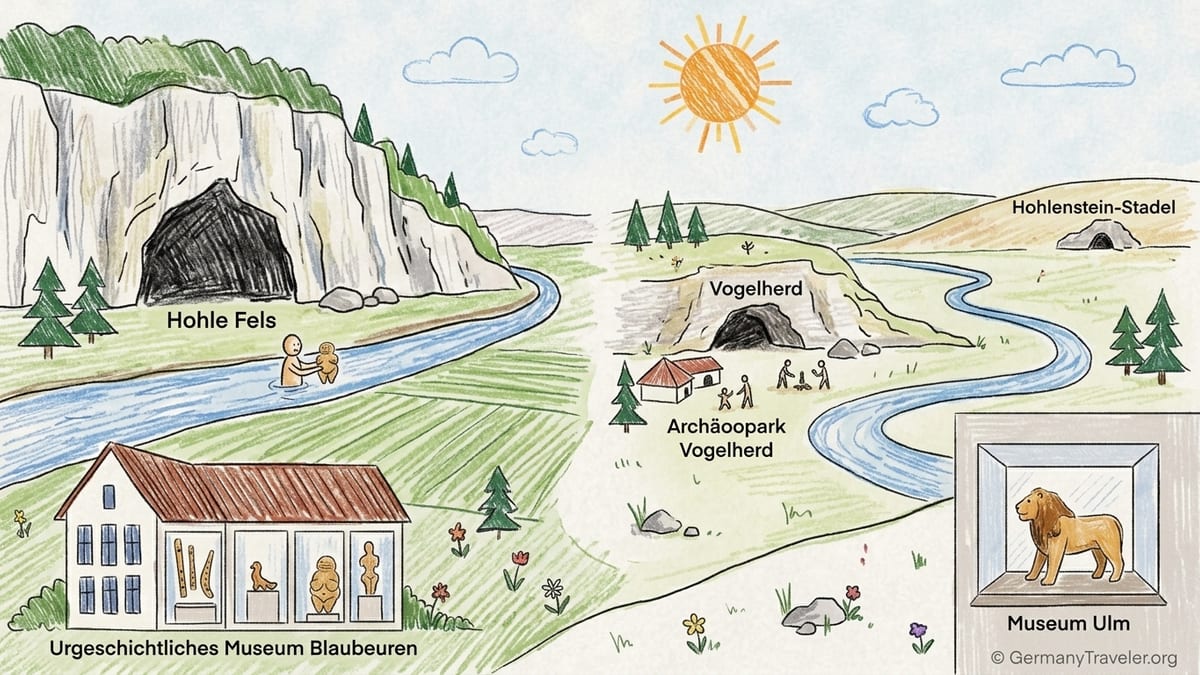
UNESCO’s “Caves and Ice Age Art in the Swabian Jura” is a serial World Heritage property that links six separate caves spread across two small valleys, the Ach Valley west of Ulm and the Lone Valley to the north. In the Ach Valley, the nominated caves are Hohle Fels, Geissenklösterle and Sirgenstein, tucked into steep limestone slopes above the Ach River. In the Lone Valley, the components are Vogelherd, Hohlenstein-Stadel and Bockstein, set along the Lone River in a gentler, open landscape. Together, these sites preserve a dense archaeological record from about 43,000 to 33,000 years ago, when some of the first modern humans in Europe were carving figures from mammoth ivory and experimenting with music.
Crucially, the World Heritage listing protects the caves primarily as archaeological deposits, not as typical show caves filled with stalactites and coloured lights. Many visitors imagine a grand underground cathedral, but the Swabian Jura sites are often modest rock shelters or small chambers. Their significance lies in the layers of sediment that once held figurines, flutes, stone tools and animal bones. Over more than a century of careful excavation, archaeologists have removed most of the fragile objects for study and conservation, which is why the World Heritage documentation stresses that the property must be understood as a combination of caves in the landscape and museum collections in nearby towns.
UNESCO highlights that this region contains some of the oldest known figurative artworks and musical instruments anywhere in the world. Among the animal figurines carved from mammoth ivory are mammoths, cave lions, horses and water birds, often just a few centimetres long but surprisingly lifelike. The musical instruments include flutes made from swan and vulture bones and from carefully hollowed mammoth ivory. Their age, combined with the concentration of finds in a relatively small area, underpins the site’s “outstanding universal value” and turns a quiet corner of Baden-Württemberg into a destination of global archaeological importance.
For travellers, this means that “seeing the caves” is only half the story. A well-planned visit weaves together short walks or hikes to selected cave entrances with time in museums in Blaubeuren, Ulm and the Lone Valley, where the star objects are displayed under controlled conditions. Rather than peering at fragile ivory in a damp rock shelter, you study it at eye level in a climate-controlled gallery, then step back into the landscape that inspired its makers.
What You Can Actually Visit Today
Not every cave in the World Heritage is open for casual exploration, and access conditions change in response to safety assessments and conservation needs. At the time of writing, Hohle Fels near the town of Schelklingen is the most straightforward cave to visit. The local tourism office organises guided access along a short path above the Ach Valley, and information in English confirms that scheduled tours run on specific days, with extra tours during school holidays in Baden-Württemberg. Visitors join a guide at the trailhead, walk a few minutes uphill and enter the impressive main chamber with helmets provided, while the most sensitive excavation areas remain protected behind low barriers.
In the Lone Valley, Vogelherd Cave is integrated into the family-friendly Archäopark Vogelherd. Here, the cave entrance sits just above a landscaped archaeological park with reconstructed shelters, interactive exhibits and fire-making demonstrations. According to recent price information, standard adult admission is around 13 euros, with reduced and family tickets available; entry includes the outdoor park and the cave itself, usually visited on a short guided loop. Travellers should be aware that the park sometimes requires advance telephone reservations, particularly for groups and during busy holiday periods, and that opening hours vary between the main season and the shoulder months.
The other four World Heritage caves are more complex from a visitor perspective. Sirgenstein sits above the Ach Valley on a steep path and may be accessible as a simple rock shelter without developed infrastructure, but there is no permanent on-site staff or installed lighting. Geissenklösterle occupies an even steeper slope near Blaubeuren. Regional visitor information notes that the access path, branded as the “Eiszeitspur Geissenklösterle,” has been closed at times due to rockfall risk, which means that travellers must check current status with local authorities or the dedicated Ice Age art visitor website before planning a hike that relies on this route. In the Lone Valley, Hohlenstein-Stadel and the nearby Bockstein site can often be approached on walking trails, but the caves themselves are not equipped or interpreted as full show caves; their main role is to protect the remaining deposits.
The practical takeaway is that you should plan your Ice Age itinerary around a few reliably visitable anchors and treat any additional cave stops as bonus landscape experiences rather than guaranteed attractions. Hohle Fels and the Archäopark Vogelherd form the core field sites. Blaubeuren and its Prehistoric Museum, plus Ulm Museum and one of the Swabian Alb visitor centres, round out the story. If specific hiking access to Geissenklösterle, Sirgenstein or Hohlenstein-Stadel is essential to your plans, contact local tourism offices or regional heritage websites shortly before travel, as conditions can shift between seasons.
Why the Masterpieces Live in Museums, Not in the Caves
One of the most common misconceptions among first-time visitors is that they will see iconic objects such as the Lion Man or the delicate bird-bone flutes sitting in situ on a cave floor. In reality, virtually all of the world-famous pieces from the Swabian Jura are housed in museums, and there are good reasons for this. Mammoth ivory is highly sensitive to changes in moisture and temperature. Inside a cave frequented by modern tourists, humidity spikes and vibrations from footsteps can accelerate deterioration. Museums provide stable microclimates, sophisticated mounting systems and low light levels, all managed by conservators trained to care for Ice Age materials.
Another reason lies in the way these figurines were discovered. Most were painstakingly excavated from multiple archaeological layers over decades rather than found whole on the surface. The Lion Man from Hohlenstein-Stadel, for example, was recovered in hundreds of fragments, some excavated in the 1930s and others in later campaigns, and was only assembled into its current form after meticulous research. Today it stands as a centrepiece in the Museum Ulm, not in the Lone Valley cave that once sheltered the fragments. The same applies to the female figurine known as the Venus of Hohle Fels, widely considered one of the oldest known depictions of the human body. She was pieced together from small ivory fragments and is now the star object of the Urgeschichtliches Museum Blaubeuren.
The Swabian Jura museums have embraced this separation of landscape and object as a strength. The Urgeschichtliches Museum Blaubeuren presents itself as a core museum for the World Heritage, with galleries dedicated to the Ach Valley caves and to Ice Age music. Visitors find original flutes carved from griffon vulture bone and mammoth ivory arranged alongside reconstructions that can actually be played. The museum in Ulm complements this with a broader art and cultural history collection; the Lion Man is displayed with modern interpretive media that set it in a global context. By concentrating fragile objects in well-equipped institutions, the region can both preserve them and make them far more legible than they would be in a dark, cramped rock shelter.
From a visitor’s perspective, this means that a museum day is not a consolation prize if weather or access conditions make cave visits difficult. Instead, it is where you will have your clearest encounter with Ice Age creativity. Audio guides, films and replicas help bring the prehistoric environment to life. In Blaubeuren, for example, the museum situates the Venus of Hohle Fels in a narrative that links her to hunting camps, seasonal movements and the acoustics of nearby caves. Temporary exhibitions sometimes expand the theme to include tool technologies or comparisons with Ice Age art elsewhere in Europe, giving returning travellers something new to discover.
Blaubeuren, Ulm and the Ach Valley: Building an Ice Age Hub
Most travellers structure their Swabian Jura Ice Age trip around Blaubeuren, a compact town about 20 kilometres west of Ulm. Blaubeuren is already known for the Blautopf, an intensely blue karst spring at the edge of town, and for its half-timbered houses and former monastery. That combination of karst geology, medieval architecture and Ice Age archaeology makes it an unusually rich base for a long weekend. The Urgeschichtliches Museum sits a short walk from the historic centre, and recent visitor information suggests adult tickets in the low single digits in euros, with combination or family tickets available and free entry for very young children. Opening hours follow a typical central European pattern, with closures on some Mondays and reduced hours in winter, so it is worth confirming times shortly before your visit.
From Blaubeuren, the Ach Valley caves are close at hand. Hohle Fels lies near the small town of Schelklingen, reachable by regional train or car in roughly 10 to 15 minutes. Guided tours usually begin from a signed meeting point near the valley floor and last around an hour including the walk. Sirgenstein and Geissenklösterle occupy higher positions on the valley slopes. When paths are open, fit walkers can combine cave viewpoints with sections of the themed “Ice Age trail” routes that link geology, archaeology and village history. Even if specific trail sections are closed because of rockfall risks, there are alternative paths and outlooks along the valley that give a sense of the terrain in which Ice Age hunters operated.
Ulm provides the urban counterpoint. Travellers arriving by long-distance train from Munich, Stuttgart or Frankfurt often stay a night or two in Ulm, visiting the Museum Ulm for the Lion Man and the Cathedral with its record-height steeple, then continuing on to Blaubeuren and the Swabian Alb uplands. This sequence works particularly well for those interested in comparing deep-time objects with later art and architecture: in a single day you might examine a 40,000-year-old figurine in the morning and climb a 19th-century church tower in the afternoon. Accommodation ranges from simple guesthouses in Blaubeuren to business hotels in Ulm, which makes it easy to adjust budget and comfort level.
For visitors without a car, regional trains and buses cover most of the core sites, although service can be sparse in the late evening. Ulm and Blaubeuren are linked by frequent local trains, and the Archäopark Vogelherd is accessible from nearby stations with a short taxi ride or a longer walk. The Swabian Alb tourism authorities also promote “Weltkultursprung” branded experiences, which package cave visits, museum entry and short hikes into bookable excursions for groups and schools. Independent travellers can use the same themes as a framework, picking and choosing caves, museums and geological stops according to interest and mobility.
The Lone Valley, Vogelherd and the Lion Man’s Landscape
The Lone Valley lies north of the Ach, carved into the same Jurassic limestone plateau but opening onto farmland and mixed forest rather than steep karst gorges. Here, the Archäopark Vogelherd acts as both visitor centre and open-air museum. Families can move between reconstructed mammoth-hunter camps, try out replica spears or bow-and-arrow ranges under supervision, and then follow a guided path into Vogelherd Cave itself, which appears today as a modest opening in a low cliff. Interpretive panels explain that the small ivory mammoths and horses now in museum cases once lay in the sediment at visitors’ feet.
A short drive or bike ride west along the valley brings you to the Hohlenstein rock massif, where Hohlenstein-Stadel shelters the archaeological levels that yielded the Lion Man. There is no show-cave infrastructure here, but for travellers comfortable on forest tracks, simply standing near the entrance and knowing that one of humanity’s earliest hybrid creatures was reconstructed from this place can be a powerful experience. Nearby, the Bockstein site offers another rock shelter in a low cliff, also significant for its Stone Age sequences. Access often consists of basic footpaths and occasional information boards rather than organised tours, so these stops work best as part of a slow, landscape-focused day rather than a tightly scheduled group excursion.
The Lone Valley is also where you can most clearly feel the Swabian Alb as a geopark. Limestone escarpments rise in gentle tiers above the valley floor, and sinkholes, dry valleys and small caves are scattered through the fields and woods. This is a landscape that formed in shallow Jurassic seas, then fractured, dissolved and collapsed over millions of years. When Ice Age hunters arrived, they found a ready-made network of rock shelters along the valley edges, close to water and game. Modern hiking trails and cycling routes trace many of the same lines. By following them, you experience the role of topography in shaping where people camped, hunted and made art.
Combining a visit to the Archäopark with informal stops at Hohlenstein-Stadel and Bockstein usually fills most of a day, especially if you factor in lunch at a local inn and time for children to engage with hands-on activities in the park. Because the Archäopark sometimes requires advance telephone reservations during high season and adjusts its opening hours between winter and summer, it is wise to build flexibility into your itinerary. If weather turns wet, you can shift your emphasis to indoor exhibits and short walks. On clear days, longer valley hikes or detours up onto the Swabian Alb plateau reward you with broad views and a better feel for the wider geopark.
Swabian Alb Geology and Hiking: Walking Through Deep Time
Beyond the individual caves, the entire Swabian Alb is recognised as a UNESCO Global Geopark, a roughly 220-kilometre-long mountain range of Jurassic limestone forming a distinctive escarpment across Baden-Württemberg. Travellers who venture beyond the valley floors find rolling plateaus dotted with beech forests, dry grassland slopes and dramatic cliffs where the plateau edge breaks away. Numerous caves, castle ruins and sinkholes stud the landscape. In practice, this means that you can combine world-class archaeology with rewarding day hikes or multi-day walking routes within a compact region.
Well-marked trails connect many Ice Age and medieval sites. Around Blaubeuren, hiking routes loop past the Blautopf spring, climb to vantage points on the valley rim and intersect with paths leading towards Geissenklösterle and other caves when access is permitted. On the Lone Valley side, footpaths follow the river between Vogelherd and Hohlenstein, with spurs up to viewpoints over the valley and across the Alb plateau. For visitors used to Alpine hiking, the Swabian Alb is gentler in elevation but can still demand sturdy footwear, especially on limestone rubble or after rain when paths become slick.
A practical way to structure a trip is to designate certain days as “museum days” in Ulm or Blaubeuren and others as “landscape days” on the Alb itself. On a clear spring or autumn day, you might spend the morning walking from Blaubeuren to a viewpoint above the Ach Valley, picnic overlooking the valley and then descend to visit Hohle Fels with an afternoon guided tour. Another day could begin in Ulm with the Lion Man and a short stroll along the Danube, followed by an afternoon train and bus connection into the Lone Valley for an overnight stay near the Archäopark. Over the course of a week, you might cover parts of both valleys, several caves, two or three museums and dozens of kilometres of karst scenery.
The Swabian Alb’s geology also explains why transportation and accommodation infrastructure are relatively compact. Towns and villages cluster along valley floors and at key passes across the escarpment, which means that public transport and guesthouses tend to follow the same lines. For hikers, this is advantageous. You can often finish a day’s walk in a village with a gasthof, catch a regional bus back to your base or continue along a longer-distance trail the next morning. Tourist information centres in Blaubeuren, Ulm and various Alb towns provide free trail maps and advice on current path closures related to rockfall or forestry work.
How Much Time to Allow and What to Check in Advance
The Swabian Jura Ice Age caves can be sampled in a long weekend, but travellers who are serious about archaeology and hiking will find plenty to fill a week. A three-night trip might include one full day in Blaubeuren with the Prehistoric Museum and Blautopf, plus a guided visit to Hohle Fels; a second day focused on Ulm and the Lion Man; and a third day for the Archäopark Vogelherd and a short Lone Valley hike. This works well for visitors flying into Stuttgart or Munich and relying on trains and buses.
For a deeper experience, plan five to seven nights split between Ulm and a base on the Swabian Alb itself. This allows time to explore both valleys at a slower pace, attempt hikes that connect multiple cave viewpoints, and add non-archaeological highlights such as the castle ruins and panoramic cliffs near other Alb towns. With a week at your disposal, you can also build in rest days in case of rain, adjust plans in response to temporary path closures and join scheduled guided walks offered by local nature parks or geopark centres.
Some elements require advance checking even for a short trip. First, verify opening hours and any seasonal closures for the Urgeschichtliches Museum Blaubeuren, Museum Ulm and the Archäopark Vogelherd, particularly around major holidays and in winter, when reduced schedules are common. Second, confirm access conditions for specific cave paths, especially Geissenklösterle and certain sections of the Ach Valley slopes that have been closed at times due to rockfall hazards. Official regional websites and local tourism offices provide the most current information. Third, if you plan to join a guided cave tour in a language other than German, ask in advance; English-language commentary may be limited on regular tours, although some guides are bilingual.
Budget-conscious travellers will find that site entry fees are relatively modest by European standards, but it is still wise to factor them into planning. Recent information suggests that admission to the Blaubeuren museum is comparable to other regional museums, in the range of a few euros for adults with family and reduced tickets available, while the Archäopark Vogelherd charges around 13 euros for a standard adult ticket that covers both the park and cave access. Ulm’s museum ticket for the Lion Man sits in a similar band to other mid-sized city museums. Public transport between Ulm and Blaubeuren is usually covered by standard regional rail fares, and some guesthouses participate in local visitor cards that offer discounts on attractions.
Why This Is More Than Just Another Castle Trip
Baden-Württemberg is well supplied with castles and palaces, from the baroque complex at Ludwigsburg to hilltop ruins along the Neckar River. Many itineraries focus almost exclusively on this medieval and early modern heritage. The Swabian Jura Ice Age caves offer a radically different timescale and a deeper cultural reason to visit. Instead of marvelling at 18th-century stucco, you are grappling with objects that predate written history by tens of thousands of years yet already display symbolic thinking, musical experimentation and narrative imagination.
Standing in front of the Lion Man in Ulm or the Venus of Hohle Fels in Blaubeuren, you confront minds that were anatomically modern and artistically daring. The Lion Man merges human and animal features in a way that implies myth or ritual, while the Venus emphasises bodily forms that may have carried meanings we can only guess at. Nearby, the Ice Age flutes demonstrate not only craftsmanship but an understanding of acoustics and musical scale. For many visitors, these encounters feel more immediate than yet another ornate chapel because they speak to shared human capacities that transcend any single historical period or region.
Combining these objects with walks through the Ach and Lone valleys amplifies the effect. When you emerge from a cave visit into a beech forest, hear ravens calling over a limestone cliff and watch mist rising from a karst spring, it becomes easier to imagine why people chose these places as shelters and storytelling spaces. The Swabian Alb geopark framework encourages exactly this integration of culture and landscape, inviting travellers to see castles, monasteries, sinkholes and caves as layers in a single long history of human occupation.
For repeat visitors to Germany who have already ticked off major cities and royal palaces, the Ice Age caves of the Swabian Jura provide a reason to return with a new focus. The region is accessible yet not overcrowded, scientific yet visually appealing, and serious in content while remaining very approachable for families. It is one of the few places in Europe where you can combine day walks in a limestone upland, small-town hospitality and direct engagement with some of the oldest known artworks and musical instruments on earth.
FAQ
Q1. Which Ice Age caves in the Swabian Jura can I actually visit as a regular tourist?
Several of the six World Heritage caves can be approached on foot, but the most practically visitable are Hohle Fels near Schelklingen, usually on guided tours, and Vogelherd Cave inside the Archäopark Vogelherd in the Lone Valley. Other caves such as Sirgenstein, Hohlenstein-Stadel, Bockstein and Geissenklösterle are primarily archaeological sites with simple access paths and limited or no formal visitor infrastructure, so they work best as landscape stops rather than developed show caves.
Q2. Where can I see the Lion Man, Venus of Hohle Fels and the famous Ice Age flutes?
The Lion Man from Hohlenstein-Stadel is displayed in the Museum Ulm, while the Venus of Hohle Fels and several of the earliest known flutes are housed in the Urgeschichtliches Museum Blaubeuren. Additional figurines and musical instruments from the caves are distributed between these museums and other regional collections, which is why any Ice Age cave trip should include substantial museum time in both Ulm and Blaubeuren.
Q3. How many days should I plan for an Ice Age caves itinerary?
A focused visit requires at least two full days, enough for Blaubeuren with its museum and a visit to Hohle Fels, plus a second day for Ulm and, if time allows, the Archäopark Vogelherd. Travellers who want to combine archaeology with hiking and broader Swabian Alb geology will be happier with five to seven days, which allows time to explore both the Ach and Lone valleys and add extra walks, castles and viewpoints on the Alb plateau.
Q4. Do I need a car to explore the Swabian Jura caves and museums?
You can reach the core sites using public transport, especially if you base yourself in Ulm and Blaubeuren, which are linked by frequent regional trains. From there, local buses and occasional taxis connect to Schelklingen for Hohle Fels and to stations near the Archäopark Vogelherd. A car provides more flexibility for reaching smaller trailheads in the Lone Valley and on the Alb plateau, but is not strictly necessary for a well-planned itinerary focused on the main caves and museums.
Q5. Are the caves suitable for children and visitors with limited mobility?
The Archäopark Vogelherd is particularly geared to families, with hands-on activities and relatively gentle paths around the park and into the cave. Hohle Fels involves a short uphill walk on a sometimes uneven path and stepping into a natural cave chamber, which may be challenging for those with mobility issues but manageable for many children and adults with basic fitness. More rugged cave paths in the Ach and Lone valleys are usually not adapted for wheelchairs or strollers, so travellers with limited mobility may prefer to focus on the museums, which are much more accessible.
Q6. Why were the original figurines and flutes removed from the caves?
The artworks and instruments were excavated from fragile sediment layers and carved from materials such as mammoth ivory and hollow bird bones that deteriorate quickly under fluctuating humidity and temperature. To prevent damage and allow detailed research, archaeologists transferred the finds to regional museums with controlled climates and professional conservation staff. Today, replicas and interpretive panels in or near the caves help visitors connect the museum objects back to their original settings.
Q7. What is the best time of year to visit the Swabian Jura for this kind of trip?
Spring and autumn are usually ideal, offering mild temperatures for hiking, fewer crowds at museums and, often, clear views from Alb escarpment viewpoints. Summer brings longer daylight and more scheduled guided tours, which can be convenient for families, but also higher visitor numbers and warmer temperatures in the valleys. Winter can feel atmospheric, especially in small towns like Blaubeuren, but shorter days, possible snow and reduced opening hours require more careful planning.
Q8. How much does it cost to visit the main sites?
Entry fees are modest compared with many major city attractions. Recent information indicates that adult tickets for the Urgeschichtliches Museum Blaubeuren are in the low single-digit euro range, with family and reduced tickets available, while the Archäopark Vogelherd charges around 13 euros for a standard adult ticket that covers both the park and access to Vogelherd Cave. Museum Ulm tickets for the Lion Man fall within the typical range for mid-sized German city museums. Travellers should check current prices shortly before visiting, as they can change with new exhibitions or seasons.
Q9. Can I visit the caves or museums on a day trip from Stuttgart or Munich?
Yes, it is possible to visit at least part of the World Heritage region on a day trip from Stuttgart or Munich using train connections to Ulm, but it will be a long and fairly compressed day. A more relaxed approach is to spend at least one night in Ulm, then continue by local train to Blaubeuren for a second night, which allows you to see the Lion Man, Venus of Hohle Fels, some of the early flutes and at least one cave without rushing between sites.
Q10. How can I combine the Swabian Jura caves with other attractions in Baden-Württemberg?
The Ice Age caves fit well into a broader Baden-Württemberg itinerary that might include Stuttgart’s museums, the castle and student traditions of Tübingen, and castles or palaces along the Neckar and in the Black Forest. One common route is to travel from Stuttgart to Ulm for the Lion Man, then base in Blaubeuren for the Ach Valley caves and Swabian Alb hikes before continuing north or west to more familiar castle and wine regions. This sequence adds a deep-time archaeological dimension to a trip that might otherwise focus only on medieval and early modern heritage.