


I arrived in Stuttgart with a neatly pencilled plan that looked brilliant on paper: Mercedes-Benz Museum in the morning, Porsche Museum in the afternoon, then a side trip to the Technik Museum Sinsheim later in the week. Baden-Württemberg bills itself as the cradle of the automobile and Stuttgart leans hard into that story. It felt almost rude, as an enthusiast, not to try and see it all. By the end of my second full museum day, surrounded by racing trophies and cutaway engines, I discovered a problem automotive travelers rarely talk about out loud: you really can have too much motoring history in one trip.
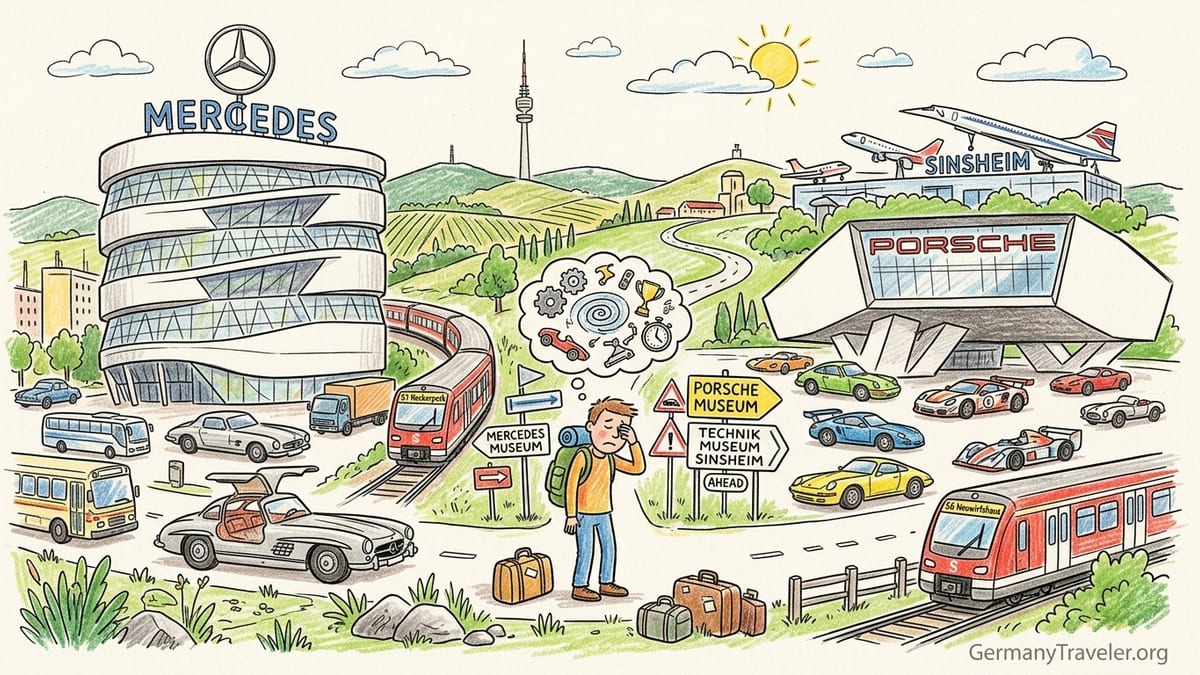
Stuttgart, Capital of the Car: Expectations vs Reality
Stuttgart does not just have car museums, it has shrines. This is the city where Gottlieb Daimler, Wilhelm Maybach and later Ferdinand Porsche helped turn early experiments with internal combustion into an industry. Even the regional tourism office describes the area as the birthplace of the automobile, and their promotional material puts the Mercedes-Benz Museum and Porsche Museum front and center alongside references to Carl Benz and wider mobility heritage. You arrive primed to be impressed, and the truth is that both museums deliver on that promise.
That pedigree is why so many travelers, especially from North America and Asia, try to compress Stuttgart into a tight one or two day stop focused almost entirely on cars. Direct trains link the city with Munich and Frankfurt, and low cost flights to Stuttgart Airport make it a logical detour on a broader Germany itinerary. It feels efficient to cram both Mercedes and Porsche into a single day and maybe add an extra technology museum such as Sinsheim for good measure. On paper, you are simply maximizing value.
The reality is more complicated. Each of these museums is dense, physically large and rich in both vehicles and technical interpretation. If you genuinely like understanding how things work, rather than snapping a few photos and moving on, you will be on your feet for hours reading, listening and climbing ramps. That is where the gap between an enthusiast’s ambition and a body’s limits starts to open up.
Before my visit, I had read glowing comments that you can “easily see both Stuttgart car museums in one day.” It turns out this is technically true if your goal is to walk through, but the experience of trying to do justice to them back to back is another matter. The question is not whether these museums are worth a visit. They absolutely are. The question is whether doing them in rapid succession actually reduces how much you enjoy each one.
Arriving in Stuttgart and Getting to the Museums
Most international visitors will land at Stuttgart Airport or arrive by long distance train at Stuttgart Hauptbahnhof. From the airport, the S-Bahn suburban trains connect directly to the city center in about half an hour, with S2 and S3 operating frequently. Both major car museums sit on those same rail arteries, which makes moving between them deceptively easy and encourages overambitious planning.
To reach the Mercedes-Benz Museum from the main station, you follow S-Bahn line S1 in the direction of Kirchheim unter Teck and get off at Stuttgart Neckarpark. The station was renamed when the museum first opened and exists largely to deliver fans to the football stadium and visitors to the Mercedes site. From the platform, it is roughly a 10 minute walk following clear signs through the NeckarPark event district. Several city bus routes also stop near the museum and there is paid multistorey parking beside the building for those driving, though local traffic restrictions during major events occasionally make public transport the less stressful choice.
The Porsche Museum is almost simpler. From Stuttgart Hauptbahnhof you take the S6 or S60 suburban line toward Weil der Stadt or Böblingen and get off at Neuwirtshaus (Porscheplatz). The stop sits directly in front of the sharply cantilevered museum building. As you emerge from the station you are effectively in the forecourt, with the museum entrance, shop and restaurant all within a short stroll and dedicated parking under and around the complex.
On my first full day I arrived in Stuttgart at 8:30 a.m., dropped my bag at a central hotel near Schlossplatz and boarded the S1 out to Neckarpark. Because trains to both museums leave from the same underground platforms at the main station and journey times are short, it felt entirely reasonable to schedule Mercedes in the morning and Porsche immediately after. If you are used to compact city museums, the logistics almost beg you to double up. The trouble only becomes apparent several hours later when you realize just how much ground you have already covered.
Inside the Mercedes-Benz Museum: Time, Tickets and Exhibition Density
The Mercedes-Benz Museum opens at 9 a.m., usually from Tuesday to Sunday, with Mondays reserved for closures or special dates. Standard adult admission in 2026 is about the middle of the range for major German museums, and there are discounted tickets for children, students and certain promotional days where admission is reduced or even waived. There is also a reciprocal benefit with Porsche: present a ticket from the other museum and you receive a reduced entry price at the second. This discount is widely publicized and quietly encourages visitors to tackle both in a short window.
The museum building itself is a spiraling double helix wrapped in glass and metal. After a brief security check, you take a lift to the very top and then descend on a continuous ramp through nine levels of galleries that trace both the history of the automobile and the evolution of Mercedes-Benz. Even if you do nothing more than stroll, this is a long walk. If you stop to study the early experimental vehicles, read interpretive panels on prewar racing or spend time in the motorsport and commercial vehicle sections, you can easily fill three to four hours.
For an automotive traveler who likes engineering, the Mercedes galleries feel dense in a positive way. Cutaway engines, drive line models and displays on safety innovations such as crumple zones and ABS are set alongside historic cars and trucks. The World War periods, the economic boom of the 1950s and the brand’s role in public transport are all covered in detail. Audio guides and temporary exhibitions add more layers of narrative. It is exactly the sort of place where you promise yourself you will “just skim” then realize you have spent 20 minutes staring at a single chassis.
By late morning, the physical and mental load begins to register. The descending ramp means there are few natural breaks and relatively few places to sit except in designated rest zones and the cafe near the mid point. Your step counter climbs rapidly. For me, somewhere around the motorsport section, the individual stories of racing 300 SLRs, touring cars and modern Formula One machines started to blur. It was not that the exhibits were repetitive. It was that my ability to process yet another finely restored car in yet another heroic context was already running low.
Switching Gears: The Porsche Museum Right After Mercedes
Leaving Mercedes shortly after midday, I took the S-Bahn back into the city and then out again on S6 toward Neuwirtshaus (Porscheplatz). Door to door, including a short wait on the platform, the trip took around 35 minutes. The Porsche Museum also opens at 9 a.m. from Tuesday to Sunday, with adult day passes in 2026 priced at about 15 euros. There are reduced rates for early morning and late afternoon entry, plus family tickets that bring the cost down for two adults with children. As at Mercedes, you receive a 25 percent discount on presentation of a valid ticket from the other museum, and vice versa.
Compared with Mercedes, the Porsche Museum is more compact but no less intense. The architecture is bold and floating, with the main exhibition level raised above the ground on massive supports. Once inside, you move through a sequence of themed zones that follow Porsche’s evolution from engineering consultancy to sports car manufacturer and race winner. The focus here is more narrowly on the brand and its design language, although there are also technical displays and a good spread of prototypes alongside icons such as the 356, 911 and 917.
If you arrive at Porsche after already spending a morning at Mercedes, the contrast can at first feel refreshing. Suddenly you are immersed in racing liveries, minimalistic interiors and a smaller, more tightly curated collection. Yet this is precisely where museum overload creeps in. Within the first hour I found myself skimming through early tractors and engineering projects that, on a fresh day, I would have examined closely. The problem was not Porsche’s curation, which is clear and sharp, but my dwindling concentration span.
Walking fatigue adds up more quickly than most automotive travelers expect. The Porsche galleries involve multiple inclined ramps and a fair amount of backtracking if you want to revisit specific models or the temporary special exhibition space. By the time I reached the end of the motorsport section, with Le Mans trophies glittering under spotlights and a forest of race car wings and spoilers overhead, the emotional impact was blunted. Objectively, the cars were spectacular. Subjectively, my mind was saturated with racing glory stories from the morning.
Too Much of a Good Thing: When Exhibits Start to Blur
The most unexpected aspect of trying to do both museums in one day is how quickly stories and visuals merge. After a combined six or seven hours of engines, bodywork and competition victories, I realized I was mixing up milestones: which record car set which speed, which championship-winning machine belonged to which marque. It is exactly the sort of confusion that would horrify each brand’s marketers, but from a visitor perspective it is almost inevitable.
Certain themes felt sharply repetitive. Both museums devote significant space to motorsport heritage, complete with winning cars, driver suits and trophy cabinets. Both explain their contributions to safety, aerodynamics and lightweight construction. When encountered back to back, these otherwise fascinating stories begin to feel like variations on a single, relentless narrative of innovation and success. The subtle differences in engineering philosophy between a Mercedes saloon and a Porsche 911 risk getting lost simply because there is too much information arriving too fast.
Even the practicalities contribute to fatigue. Museum lighting is bright but controlled, often with darkened backgrounds and spotlights on vehicles. After hours under artificial light, moving from one carefully lit gallery to another with no real daylight break is tiring. Food breaks help, but only to a point. The Mercedes complex has a cafe and restaurant at ground level where you can find soup, salads and hot dishes at prices in line with other German attractions. Porsche’s restaurant and bistro sit overlooking the forecourt and S-Bahn tracks, with similarly mid range pricing. In both cases, a sit down lunch of a main dish and drink can easily consume 45 to 60 minutes. That pause is welcome for your legs but it also compresses what is left of your available museum time.
From a content perspective, the museum that deserves longer depends on your interests. Engineering focused visitors will likely get more out of lingering at Mercedes, where the broader scope allows you to trace industry wide developments in engines, safety and commercial vehicles. Racing and design fans often feel more drawn to Porsche, where the concentration of sports and competition cars and the emphasis on styling evolution are particularly strong. What became clear to me is that either one merits the better part of a day if you care about more than a quick selfie beside a gullwing or a 911.
Would a Non Enthusiast Enjoy Either Museum?
One of the most common questions from partners or friends of car lovers is whether they will enjoy these museums if they are not particularly into vehicles. In Stuttgart, the answer is a qualified yes, provided expectations and pacing are realistic. Both museums understand they are major city attractions, not just brand temples, and they have worked to make the experience visually impressive and broadly accessible.
At Mercedes, the early galleries tell wider social and cultural stories of 19th and 20th century mobility. Historic street scenes, period advertising, buses and fire engines sit alongside passenger cars. Non enthusiasts often gravitate toward these contextual exhibits, the architecture of the building itself and the chance to ride the elevator to the top and descend slowly while the city frames itself through huge windows. For many, two to three hours including a cafe stop is plenty. Beyond that, technical explanations and endless series of model variations begin to feel like homework.
The Porsche Museum is arguably more digestible for the casually interested. The collection is smaller and the visual narrative clearer. You do not need to know the difference between a 964 and a 993 to appreciate the evolution of the 911 shape across decades. The prominent motorsport section, with its noisy liveries and dramatic trophies, has universal appeal even if you do not follow endurance racing. Again, though, the key is restraint. For someone without a deep interest, adding Mercedes and Porsche together in one day is almost certain to feel like too much.
In my own group, the friend who came along “for the architecture” and “to humor the car person” reported enjoying the first three hours at Mercedes and the first ninety minutes at Porsche. After that, the appeal of a quiet coffee in the city center or a walk through the vineyards above Bad Cannstatt was far stronger than the idea of yet another concept study or race car evolution. The museums themselves had not become worse. Our capacity for appreciation had simply been exceeded.
Adding Sinsheim: When Passion Turns Into Museum Fatigue
Several days after Stuttgart, I took a regional train north via Heilbronn to visit the Technik Museum Sinsheim. The complex stands just off the A6 motorway, with a dedicated “Museum/Arena” station on local rail services and enormous parking lots that signal its popularity. The museum is open every day of the year, typically from 9 a.m. until early evening. In 2026, standard adult tickets for the museum alone cost around 25 euros, with combined museum and IMAX cinema tickets priced around 30 euros. Children and families have discounted options, and same day re entry is possible if you leave for lunch.
Where Mercedes and Porsche are brand specific, Sinsheim is eclectic. Halls are packed with classic cars, locomotives, tanks, aircraft and military equipment, including the headline duo on the museum roof: a French Concorde and a Soviet Tu 144 that you can walk through via steep stairs. For an enthusiast, it is intoxicating. It is also, coming after two major car museums in short succession, the point where enthusiasm can tip decisively into museum fatigue.
From the moment I stepped into the first hall at Sinsheim, I recognized a familiar rhythm: polished fenders, technical labels, engines presented at eye level, more vehicles waiting in the next aisle. The difference was that now, on top of the Stuttgart experiences, my threshold for absorbing detail was extremely low. I found myself picking favorites almost at random, spending time with a single prewar car or aircraft and breezing past entire rows of interesting machines because there was simply no mental bandwidth left. Even climbing up into the Concorde, something I had looked forward to for years, felt slightly perfunctory instead of awe inspiring.
This is the hidden cost of trying to link Mercedes, Porsche and Sinsheim in a packed short trip. Each institution individually offers enough to fill a day with comfortable breaks. Experienced travelers often recommend allowing at least three to four hours at Sinsheim alone, not counting the additional cinema program. When all three visits happen in quick succession, particularly if combined with long train rides, jet lag and a change of hotels, the quality of your attention declines. At some point, the photographs you bring home no longer match the emotional memory you hoped to create.
A Smarter Automotive Itinerary for Stuttgart and Beyond
Looking back, the problem with my original plan was not ambition, it was compression. Stuttgart genuinely deserves its status as an automotive destination. The Mercedes-Benz Museum, the Porsche Museum and regional technology collections such as Sinsheim or the sister museum in Speyer can easily anchor a themed trip. The trick is to give each major stop room to breathe and to leave space for the city itself.
If I were planning the same journey again, I would structure it very differently. Rather than stacking Mercedes and Porsche on the same day, I would devote one full day to each, ideally with lighter, non museum activities wrapped around them. For Mercedes, that might mean a morning visit followed by an easy riverside walk in the NeckarPark area or a tram back to the city center for coffee on Schlossplatz and a stroll up to the Stuttgart Stadtbibliothek or through the palace gardens. For Porsche, a museum session could be combined with a short hike in the hills toward Weil der Stadt or an evening meal in one of the residential neighborhoods north of the center.
A third day could then be reserved for Sinsheim or another technology focus, acknowledging that it is a separate excursion requiring at least half a day including travel. Leaving from Stuttgart, you can reach Sinsheim by regional train in roughly an hour and a half with a change at Heilbronn or via direct motorway driving if you have a rental car. Arriving around opening time allows you to explore for several hours, take a break in the on site restaurants or nearby town and still be back in Stuttgart for dinner. Crucially, this spacing means you arrive with a rested mind rather than one already saturated with automotive facts.
For travelers with only two days, the more honest recommendation is to choose one major car museum in Stuttgart and pair it with a lighter automotive or cultural experience. That might be a factory tour, if available during your dates, or a visit to a smaller technology collection within the city. Alternatively, you could spend the remaining time in Stuttgart’s vineyards, explore the Markthalle food market or visit one of the art museums. The goal is not to “waste” time away from cars, but to create enough contrast that the hours you do spend in front of vehicles feel special rather than obligatory.
This revised itinerary respects both the depth of Stuttgart’s car heritage and the limits of real human attention. Instead of proudly ticking off Mercedes, Porsche and Sinsheim as quickly as possible, it invites you to decide which stories matter most to you and to experience them while you are still fresh enough to care. It also leaves you with a sense of Stuttgart as a living city of hills, trams and cafes, not just a backdrop for engine displays.
The Takeaway
Stuttgart rewards car lovers, but it quietly punishes overplanners. The city’s two flagship museums and the broader Baden-Württemberg technology landscape easily justify Stuttgart’s reputation as one of the world’s key automotive destinations. Yet the very abundance of high quality exhibits can undermine your enjoyment if you try to consume everything in a single concentrated burst.
Visiting both the Mercedes-Benz Museum and the Porsche Museum on the same day is physically and mentally possible. Frequent S-Bahn services, reciprocal ticket discounts and manageable travel times make the logistics straightforward. What the brochures do not show is how your appreciation declines over hour six or seven of staring at engines and race trophies. Walking fatigue, information overload and the repetition of similar storylines turn unique machines into background noise.
Adding another major technology museum such as Sinsheim without leaving recovery time only compounds the problem. Instead of deepening your understanding of automotive history, you risk reducing iconic experiences to items on a list. The Concorde on the roof at Sinsheim, a vintage rally car at Mercedes or a Le Mans winner at Porsche all deserve your full attention, not the half focus left after a string of consecutive museum days.
The good news is that the solution is simple. Treat each major automotive site around Stuttgart as a standalone anchor, not a half day filler, and build in generous breaks that take you outside into the city. Plan roughly one big museum per day, add a factory or heritage stop if it fits, and leave space for Schlossplatz, the vineyards or a slow coffee as the S-Bahn hums past. In doing so, you will see fewer museums in total but remember far more of what you saw. The cars do not need you to rush. Neither does Stuttgart.
FAQ
Q1. Can I realistically visit both the Mercedes-Benz Museum and the Porsche Museum in one day?
Yes, you can physically visit both in one day because the S-Bahn links them quickly and each is open from morning until early evening, but most visitors who care about the details find that their energy and attention drop sharply in the second museum. If you want to read displays, use audio guides and really absorb the stories, it is wiser to devote a separate day to each.
Q2. How long should I plan for the Mercedes-Benz Museum if I like engineering?
If you are interested in how vehicles are designed and built, plan at least three to four hours inside Mercedes, not counting time in the cafe or shop. The descending ramp layout, extensive historical sections and numerous technical displays on safety, engines and commercial vehicles mean that even a focused visit quickly expands. Many engineering oriented visitors easily spend most of a day there.
Q3. How much time is enough for the Porsche Museum?
The Porsche Museum is more compact but dense. Enthusiasts often spend three hours or more exploring the main exhibition level, special displays and motorsport section, plus extra time in the shop or restaurant. If you are mainly curious rather than deeply invested in the brand, two hours is usually adequate, provided you avoid scheduling another large museum the same day.
Q4. What are the approximate ticket prices in 2026 for these museums?
In 2026 adult day tickets at the Porsche Museum are around 15 euros, with early and late entry options at reduced prices and family tickets from about 25 euros. The Mercedes-Benz Museum charges a comparable standard adult rate with concessions and occasional promotional days. Technik Museum Sinsheim’s adult ticket for the museum alone is roughly 25 euros, with a combined museum and IMAX ticket around 30 euros. Exact prices can change, so it is sensible to check close to your travel date.
Q5. Is it better to drive or use public transport to reach the museums?
For most visitors, using Stuttgart’s S-Bahn suburban trains is the least stressful choice. Mercedes is served by Stuttgart Neckarpark on line S1 and Porsche by Neuwirtshaus (Porscheplatz) on lines S6 and S60, both around 10 to 20 minutes from the main station. There is parking at each museum and at Sinsheim, but traffic, event day restrictions and unfamiliar city driving make public transport appealing, especially if you plan a full, tiring day.
Q6. Will a non car enthusiast enjoy these museums or feel bored?
A non enthusiast is unlikely to appreciate every technical detail but can still enjoy both Stuttgart museums in moderation. Mercedes offers broader social and historical context, dramatic architecture and varied exhibits such as buses and fire engines, while Porsche provides a clear design story and visually striking race cars. The key is to limit each visit to a few hours and avoid stacking both museums back to back.
Q7. How does Technik Museum Sinsheim fit into a Stuttgart based trip?
Technik Museum Sinsheim lies north of Stuttgart and works best as a separate day trip by regional train or car. It adds aviation, rail and military exhibits to the automotive mix, including walkable Concorde and Tu 144 aircraft on the roof. Because the halls are large and the collection extensive, allowing at least half a day is sensible. Visiting right after back to back days at Mercedes and Porsche often leads to museum fatigue rather than extra enjoyment.
Q8. Which museum is better for racing and motorsport fans?
Both have serious motorsport sections, but Porsche tends to resonate more strongly with fans of sports car and endurance racing because of its concentrated display of 911 race cars, prototypes and Le Mans trophies. Mercedes has important competition vehicles as part of a wider historical narrative, including touring cars and Formula One machines, but its exhibition is broader and less exclusively racing focused.
Q9. Which museum is better if I care more about engineering than brand loyalty?
Travelers primarily interested in engineering often feel that Mercedes offers more breadth, especially in areas like safety systems, commercial vehicles and the wider evolution of the automobile. Its galleries trace developments across different eras and vehicle types, whereas Porsche focuses more narrowly on sports cars and design language. If you must choose only one and your priority is technology over racing or styling, Mercedes usually comes out ahead.
Q10. How many days should I spend in Stuttgart for an automotive themed visit without burning out?
For a balanced trip that avoids museum overload, plan at least three days: one full day for the Mercedes-Benz Museum, one for the Porsche Museum and a third for either a technology excursion such as Sinsheim or non automotive sightseeing in Stuttgart. With only two days, it is often wiser to pick one major car museum and combine it with lighter activities in the city rather than forcing both and ending up too tired to enjoy either fully.