


In Baden-Württemberg, mobility is not just a way to get around. It is a story the region has been writing for nearly 140 years, from Karl Benz’s first practical automobile to today’s high-tech sports cars and sweeping technology museums. Treating automotive history as a destination theme in its own right can turn a weekend in southwest Germany into a road trip through time, tracing the evolution from bicycle experiments to pioneering engines, motorsport legends and even supersonic aircraft.
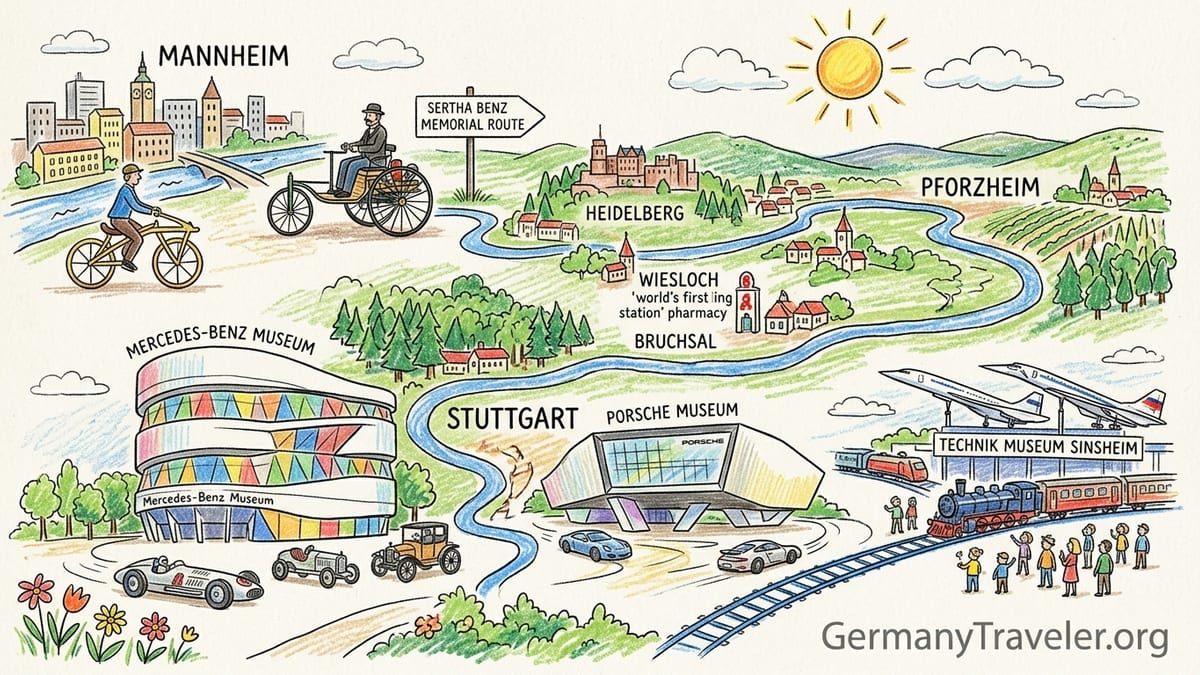
Where the Story Starts: Mannheim, Karlsruhe and the Benz Legacy
The most rewarding way to approach Baden-Württemberg’s car country is to follow the story roughly in chronological order. That means starting in the Rhine plain around Mannheim and Karlsruhe, where early experiments in two and four wheels changed the way the world moves. In Mannheim, Karl Drais’s 1817 “Laufmaschine,” an early precursor of the bicycle, set the stage for a new kind of individual mobility. Later in the same city, engineer Carl Benz developed the Benz Patent-Motorwagen, widely regarded as the first practical automobile, and in 1886 drove it publicly in Mannheim.
Today Mannheim itself does not have a vast flagship car museum, but it does anchor the official Bertha Benz Memorial Route, a signposted tourist road that commemorates Bertha Benz’s 1888 journey from Mannheim to Pforzheim and back. This roughly 194-kilometre loop runs through towns such as Heidelberg, Wiesloch and Bruchsal and has been recognized by the state of Baden-Württemberg as a memorial route to early automotive history. The route is promoted by state and regional tourism organizations, which highlight it as both a driving itinerary and a window into industrial heritage. Information panels and monuments in places like Wiesloch, often called the “world’s first filling station” due to Bertha’s stop at a pharmacy, provide context without requiring you to be a technical expert.
Using Mannheim or nearby Karlsruhe as an overnight base works well if you want to sample this historic route before heading deeper into car country. With a rental car, you can follow a short stretch of the Bertha Benz Memorial Route in half a day, combining it with time in Heidelberg’s old town or the baroque streets of Schwetzingen. Travelers without a car can still engage with the story using regional trains between Mannheim, Heidelberg and Karlsruhe, then joining shorter bus or taxi hops to specific memorials and information points along the route.
For planning purposes, allow at least one full day for the Mannheim and Bertha Benz context if you are interested in the origin story. If your time is tighter and your main goal is the big automotive museums, you can instead treat Mannheim as a brief narrative prologue and continue directly to Stuttgart, where Mercedes-Benz and Porsche carry the story forward into the twentieth and twenty-first centuries.
Stuttgart: Heartland of Mercedes-Benz and the Evolution of the Automobile
Stuttgart is where Baden-Württemberg’s automotive narrative becomes immersive. On the eastern side of the city, the Mercedes-Benz Museum presents the history of the automobile from its earliest days right up to modern mobility. Official visitor information describes opening hours from Tuesday to Sunday, typically 9 a.m. to 6 p.m., with the ticket desk closing one hour earlier. The museum emphasizes that it is barrier-free, with step-free access and elevators throughout the exhibition building. It sits next to the Mercedes-Benz Arena in the NeckarPark complex, with a dedicated car park and a regional rail station a short walk away.
Inside, the Mercedes-Benz Museum is organized as a double-helix path that winds down through nine levels, mixing chronological “legend rooms” with themed sections on topics like design, safety and motorsport. Audio guides are usually included with admission and are available in several languages, helping non-specialists understand why technical milestones matter. For many visitors, the most powerful sections are the early history floors, where you can stand next to recreations and originals of the Benz Patent-Motorwagen and other pioneering vehicles. Families often make a game of spotting how quickly body shapes, lighting and interiors evolve as the displays move through decades of sedans, buses, trucks and race cars.
Reaching the museum is straightforward by public transport. The S1 suburban rail line from Stuttgart Hauptbahnhof stops at Neckarpark (Mercedes-Benz), from where signposted paths lead to the museum in about ten minutes on foot. Drivers follow signage for NeckarPark and can usually park for several hours in the on-site garages; current guidance from the museum and city indicates that the first few hours are either included or modestly priced, though fees increase if you stay all day. During major football matches or events at the arena, road access can be restricted, and the museum itself recommends using S-Bahn or park-and-ride sites linked to the regional rail network.
Time-wise, car enthusiasts routinely spend four to five hours in the Mercedes-Benz Museum, especially if they follow the full audio guide and stop for a break in the café. For a mixed-interest group, plan at least two and a half to three hours inside. Non-car lovers often appreciate the social and design storylines more than the engineering details: wartime production, the evolution of safety features such as crumple zones and airbags, and the displays on advertising, fashion and celebrity cars. The building itself, with its sweeping ramps and glass walls, is an architectural experience in its own right that regularly wins over skeptical travel companions.
Porsche in Stuttgart-Zuffenhausen: From Racing Heritage to Brand Design
Across town in Stuttgart-Zuffenhausen, the Porsche Museum focuses tightly on one brand and its motorsport-heavy legacy. According to current municipal and Porsche information, the museum is typically open from Tuesday to Sunday, with hours around 9 a.m. to 6 p.m., but certain days have altered schedules, so checking current opening times shortly before your visit is essential. Tickets for adults are generally in the mid-teens in euros, with discounts for students, families and children. Admission can be purchased on site or online via Porsche’s booking tools, and combined tickets may be available when adding a factory tour or special events.
What the Porsche Museum does best is illustrate how a single design DNA can be stretched and refined over decades. The exhibition highlights iconic models from the original 356 to successive generations of the 911, as well as race cars that conquered Le Mans and rally stages. Rotating displays frequently bring rarely seen prototypes or motorsport legends from the company’s collection into public view. Serious enthusiasts may want to time their visit to coincide with temporary exhibitions, such as anniversaries of particular model lines, which are advertised by the museum and city tourism boards.
Practical access is simple by S-Bahn or regional train to Stuttgart-Zuffenhausen station, followed by a short walk across Porscheplatz. Drivers will find a modern, multi-level car park integrated into the museum complex, which regular visitors often praise as comparatively stress-free. While parking fees and admission prices can change, the overall cost of a visit usually falls below a typical big-city art museum day, especially when split among a family. Factory tours, when available in English or German, add a behind-the-scenes dimension but must usually be reserved in advance and are sometimes paused during company shutdowns or retooling periods.
For non-enthusiasts, the Porsche Museum can still be engaging if you approach it as a design and cultural space rather than a technical gallery. Exhibits explain how aerodynamics, safety and comfort influence the shape of a sports car, while interactive displays, sound installations and film clips bring racing history alive. The stylish museum building and café also appeal to visitors looking for a sense of contemporary German industrial design. Families with children generally find enough interactive stations, driving simulators and kid-friendly labels to keep everyone involved for at least two hours.
Planning a One-Day Stuttgart Car Itinerary Without Exhaustion
Many travelers ask whether it makes sense to visit both the Mercedes-Benz and Porsche museums in a single day. It is physically possible, especially in summer when opening hours are generous, but it can be mentally exhausting. Each museum can easily absorb three to four hours if you explore thoroughly, so stacking both with travel time and meals often results in twelve hours of almost continuous input.
If you only have one day in Stuttgart and want to see both banners of automotive history, consider a structured approach. Start at the Mercedes-Benz Museum when it opens in the morning. Spend three to four hours following the downward spiral of the exhibition, pausing at highlights like the early Benz vehicles, historic Silver Arrow race cars and the galleries on safety and innovation. Have lunch on-site or at a nearby restaurant in the NeckarPark area, then take S-Bahn or drive across town to Zuffenhausen for an afternoon at the Porsche Museum. Aim to arrive there by mid-afternoon so you still have two to three hours before closing. This schedule gives you a taste of both worlds while recognizing that you may not read every panel.
Travelers who are less obsessed with cars may prefer to focus on just one brand in depth. In that case, choose Mercedes-Benz if you are interested in the broad social and technological story of the automobile, from horse-drawn carriages to electric prototypes. Choose Porsche if you are drawn to motorsport, performance engineering and the aesthetics of sports cars. Use the remaining half-day to enjoy central Stuttgart, perhaps visiting Schlossplatz, the covered Markthalle or one of the city’s art museums for a palate cleanser that has nothing to do with engines.
Accessibility and family-friendliness are strong at both museums. Elevators, ramps and accessible restrooms make them manageable for visitors with limited mobility, and official materials for the Mercedes-Benz Museum explicitly highlight the exhibition’s barrier-free design. Strollers are commonly seen in both institutions, and baby-changing facilities are provided. Audio guides and family-oriented labels help younger visitors stay engaged, and both museums have cafés for breaks. If you are traveling with small children or anyone who tires easily, planning only one museum per day and building in time for playgrounds or parks in Stuttgart can prevent museum fatigue.
Beyond Cars: Technik Museum Sinsheim and the Wider World of Mobility
To understand Baden-Württemberg’s mobility story as more than a tale of two luxury brands, it is worth extending your journey to Sinsheim, roughly one hour by car or regional train from Mannheim or Heidelberg. The Technik Museum Sinsheim is a vast private technology museum that specializes in planes, trains, automobiles and more. Visitor information highlights that it is located directly off the A6 motorway between Mannheim and Heilbronn, with large parking lots, and that it opens every day of the year, typically from morning until early evening. The site also features an IMAX 3D cinema and several food options, which make it easy to stay most of the day.
Sinsheim’s automotive displays cover classic cars, racing machines and heavy vehicles, but what truly sets it apart are its aircraft and large-scale exhibits. The museum is famous for having both a Concorde and a Soviet Tu-144 supersonic airliner mounted on its roof, open for visitors to climb aboard. Inside the sprawling halls, you will find everything from Formula 1 cars and American muscle cars to tanks, locomotives, fire engines and vintage motorcycles. This breadth makes Sinsheim an excellent choice for groups where only some members are car enthusiasts. Aviation fans, engineering buffs and children who simply love big machines all tend to leave with wide eyes.
Ticket prices at Sinsheim depend on whether you combine the museum with the IMAX cinema or with the sister museum in Speyer. As of mid-2026, adult admission for the museum alone is generally a little over 20 euros, with reduced rates for children and family passes that bring per-person costs down. Combination tickets that include the IMAX or a visit to both Sinsheim and Speyer are offered at a discount compared to buying each separately, and current details are published on the museum’s official visitor pages and FAQ. If you plan to do both Sinsheim and Speyer in one trip, consider splitting them over two days rather than rushing.
Getting to Sinsheim without a car is practical from Heidelberg or Mannheim via regional trains that stop at Sinsheim Museum/Arena station, a short walk from the entrance. Travelers using Germany’s monthly flat-fare regional ticket, when on sale, often find it a cost-effective way to cover these legs. Families appreciate that once inside the museum there is space for children to run a bit, and many exhibits can be viewed from mezzanines and platforms, adding a sense of adventure. Sturdy shoes are recommended, as you may climb stairs into planes and over bridges between exhibits.
Designing an Automotive Weekend or Technology Road Trip
Seen together, Mannheim, Stuttgart and Sinsheim form a natural triangle for an automotive-themed weekend. One popular approach starts Friday afternoon in Mannheim or Heidelberg, continues to Stuttgart on Saturday for one of the big brand museums and finishes Sunday in Sinsheim. This pattern works well if you arrive by long-distance train to Mannheim, pick up a rental car or rely on regional trains, and then drop the car back in Stuttgart or Frankfurt at the end of the trip.
For a compact weekend, consider the following rhythm. On day one, visit Mannheim and pick up the context of Carl and Bertha Benz, perhaps following a short signposted segment of the Bertha Benz Memorial Route towards Heidelberg. Stay overnight in Heidelberg or Mannheim. On day two, drive or take the train to Stuttgart and devote most of the day to the Mercedes-Benz Museum, with time in the evening to wander central Stuttgart. On day three, either add the Porsche Museum in the morning before your departure, or head to Sinsheim for a final blowout of planes, cars and technology before returning to your entry point. This structure builds from invention to brand history to a panoramic view of mobility.
Travelers with more time can broaden the circuit into a multi-day southwest Germany technology road trip. The Bertha Benz Memorial Route itself is conceived as a holiday road, looping from Mannheim to Pforzheim and back through the Rhine plain and the northern Black Forest. Combine that with side trips to Sinsheim and to the Technik Museum’s sister site in Speyer, whose strengths include maritime exhibits and space technology, and you have a weeklong journey across industrial history. Along the way, you can weave in non-technical stops such as Black Forest hiking near Pforzheim, wine tasting in the Kraichgau region or castle visits in Heidelberg.
Accommodation choices along this route range from city business hotels near Stuttgart’s main station, which are convenient for S-Bahn access to the museums, to family-run guesthouses in smaller towns on the Bertha Benz Memorial Route. When traveling by car, check hotel parking policies in advance, as central Stuttgart garages can be relatively expensive. Public transport travelers should look into regional day tickets, group tickets and national flat-fare options, which can significantly reduce costs for couples or families moving between these hubs.
Making It Work for Everyone: Non‑Car Fans, Kids and Accessibility
One of the strengths of Baden-Württemberg’s automotive heritage trail is that it does not only appeal to people who can recite engine codes by heart. The Mercedes-Benz Museum frames its collection in terms of social history, design and innovation, using multimedia displays and period settings that connect vehicles to everyday life. The Porsche Museum’s emphasis on aesthetics and brand culture can be read as a story about how design shapes identity and aspiration. Technik Museum Sinsheim, with its aircraft, locomotives and ships, broadens the topic to mobility and technology more generally.
If you are traveling with someone who is indifferent or even skeptical about cars, be upfront about the plan and choose one or two stops that match their broader interests. A design lover might enjoy Porsche and central Stuttgart’s contemporary architecture. A history buff could respond well to the early floors of the Mercedes-Benz Museum and the Bertha Benz story, which speaks to entrepreneurship and social change. Children who like climbing and exploring tend to gravitate toward Sinsheim’s big outdoor aircraft and multi-level halls.
Accessibility is another strong point of this route. The Mercedes-Benz Museum’s official information underlines that the exhibition is barrier-free and that elevators, ramps and accessible facilities are available throughout the building. The Porsche Museum and Technik Museum Sinsheim also provide step-free entries and make efforts to accommodate wheelchair users, although some aircraft and older vehicles can only be accessed by stairs. If you rely on assistive devices, it is worth checking current accessibility details on each museum’s visitor information pages or by emailing in advance, especially if you plan to participate in guided tours.
From a budgeting perspective, a couple visiting one major car museum and Sinsheim over a weekend can expect to spend something in the order of 80 to 120 euros on admission alone, depending on discounts and whether they add IMAX films or combination tickets. Food prices in museum cafés are comparable to other German cultural sites, with simple meals and drinks adding another 10 to 20 euros per person. Transport costs vary widely, but regional train tickets and the availability of national subscription passes often keep per-day travel spending reasonable compared with renting a car, especially for small groups.
The Takeaway
Exploring Baden-Württemberg through its automotive heritage transforms a standard city break into a layered journey through the history of mobility. Starting with Carl and Bertha Benz’s pioneering work in Mannheim and on the Bertha Benz Memorial Route, continuing through the sweeping timelines of the Mercedes-Benz Museum and the focused motorsport energy of the Porsche Museum, and culminating among the aircraft and engineering giants of Technik Museum Sinsheim, you experience how innovation, design and courage reshaped everyday life.
Whether you build a one-day Stuttgart itinerary, a focused automotive weekend or a broader southwest Germany technology road trip, the key is to pace yourself. One major museum a day is usually enough, especially if you are traveling with children or companions who do not share the same level of enthusiasm for cars. Combining these visits with walks through historic city centers, time in the Black Forest or quiet evenings in wine villages keeps the trip balanced and memorable for everyone.
Ultimately, Germany’s car country is less about horsepower figures than about stories. The story of Bertha Benz driving into the future along dusty roads to prove a point. The story of engineers in Stuttgart experimenting with safety, efficiency and performance. The story of postwar Europe reconnecting through highways, air routes and rail. Treating automotive history as a destination in its own right lets you tap into those narratives, and perhaps leaves you looking at your own everyday journeys a little differently when you return home.
FAQ
Q1. Can I realistically visit both the Mercedes-Benz and Porsche museums in one day?
Yes, it is possible to visit both in a single day, but it will be intense. Expect to spend about three to four hours at each museum plus travel time across Stuttgart. Many visitors find this exhausting, especially if they read a lot of information panels, so consider focusing on one museum in depth and using the remaining time for other sights.
Q2. Which museum should I choose if I only have time for one in Stuttgart?
Choose the Mercedes-Benz Museum if you want a broad historical overview of the automobile, covering everything from early experimental vehicles to modern mobility and social history. Choose the Porsche Museum if you are especially interested in sports cars, motorsport and brand-focused design. Both are high quality, so your choice should follow your main interest.
Q3. How much time should I allow for Technik Museum Sinsheim?
Plan at least four hours at Technik Museum Sinsheim, and a full day if you are an aviation or technology enthusiast. The site is large, with multiple halls, rooftop aircraft, an IMAX cinema and several outdoor exhibits. Families often appreciate having enough time for breaks and for children to explore without rushing.
Q4. Do I need a car to follow the Bertha Benz Memorial Route?
A car gives you the most flexibility for following the full 194-kilometre loop, since it is designed as a holiday road linking many small towns and memorial sites. However, you can still experience key elements of the story using regional trains between Mannheim, Heidelberg and Karlsruhe, then using buses or taxis to reach specific stops that interest you.
Q5. Are these museums suitable for young children?
Yes, all of the major museums mentioned are generally family-friendly. The Mercedes-Benz and Porsche museums offer strollers, baby-changing facilities and audio guides that can help keep children engaged. Technik Museum Sinsheim is particularly popular with kids because of its big aircraft, trains and interactive feel. Very young children may tire quickly, so plan regular breaks.
Q6. How accessible are the museums for visitors with limited mobility?
The Mercedes-Benz Museum emphasizes a barrier-free design with elevators, ramps and accessible restrooms throughout the building. The Porsche Museum and Technik Museum Sinsheim also provide step-free access to their main exhibition areas. Some specific exhibits, such as aircraft cockpits or older vehicles, may only be reachable by stairs, so checking current accessibility details before your visit is advisable.
Q7. Is it better to drive or use public transport between these sites?
Public transport works very well for the main museums in Stuttgart, which are directly linked to S-Bahn and regional train lines. For the Bertha Benz Memorial Route and Sinsheim, driving offers more flexibility, but regional trains to Sinsheim Museum/Arena and local services around Mannheim and Heidelberg also make a car-free trip feasible. Your choice depends on whether you value convenience of door-to-door travel or the simplicity of not driving in cities.
Q8. Are there combination tickets or discounts that cover multiple museums?
Technik Museum Sinsheim offers combination tickets with its sister museum in Speyer and sometimes with the on-site IMAX cinema, which can save money compared with separate admissions. Mercedes-Benz and Porsche generally sell tickets separately, though each has reduced rates for children, students and families. It is worth checking current visitor information shortly before your trip, as offers and prices can change.
Q9. What is the best time of year to plan an automotive weekend in Baden-Württemberg?
Spring and early autumn are particularly pleasant, with milder temperatures that make city walking and driving more enjoyable. Museums can be busier during German school holidays and summer weekends. Winter visits are entirely feasible because all major exhibits are indoors, but you will have shorter daylight hours for driving and sightseeing along the Bertha Benz Memorial Route.
Q10. I am not a car enthusiast. Will I still enjoy this kind of itinerary?
Many non-enthusiasts enjoy these museums as cultural and historical attractions rather than purely technical collections. The Mercedes-Benz Museum uses stories, architecture and social context to frame its exhibits, while Porsche emphasizes design and brand culture. Technik Museum Sinsheim’s mix of planes, trains and other technology means there is usually something to capture different interests. Balancing museum visits with time in historic towns, nature and food experiences helps ensure the trip stays enjoyable even if cars are not your main passion.