

From the map alone, Reichenau Island in Lake Constance looks like it should be another classic European holiday isle, all promenade cafes and lakeside hotels. The tourism board calls it a UNESCO monastic island, known equally for early medieval churches, vineyards and intensive vegetable farming. That sounded intriguing enough to turn a short stop into a full day. What surprised me most, though, was how little Reichenau behaves like a typical resort and how much it feels like someone else’s working countryside, with just enough history and lake views to make you linger.
Arriving Across the Causeway, Not by Cruise Boat
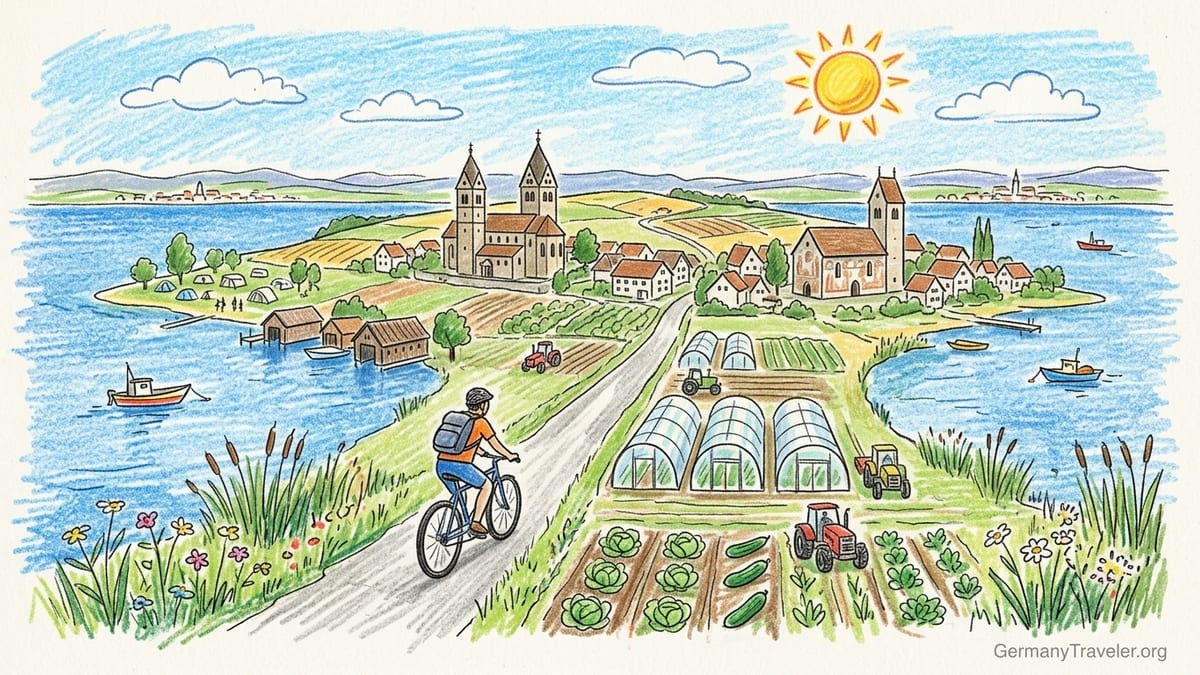
I arrived on Reichenau by the most prosaic route possible: the straight, almost ruler-drawn causeway that links the island to the mainland near Constance. There are seasonal boat connections from places like Constance and Gaienhofen, but timetables are irregular outside the main summer months, and on my early autumn visit the simplest way was a short regional train ride to Reichenau (Baden) station followed by the local bus that trundles out along the dam. The moment the bus left the mainland, the landscape changed from reeds and open water to a narrow strip of road flanked by vegetable fields, greenhouses and the glint of the lake on both sides.
Officially, entry to the island is free, and there are no gates or ticket checks. What there is, just before the dam actually reaches the island, is a cluster of small car parks where many visitors leave their vehicles. I opted to do the same, partly out of practicality because parking in the villages can be tight and partly because Reichenau is small enough to feel more natural on two wheels or two feet. From there, I unloaded a rental bike, tightened the straps on my daypack and rolled onto the island proper with the bus sighing away behind me toward Mittelzell, the main village.
That first stretch makes clear that this is not a manicured holiday island. On one side, tractors moved slowly between strips of soil; on the other, long plastic tunnels sheltered rows of salad and cucumbers. Local tourism information notes that around 4 square kilometres of land support roughly a hundred or more family farms, and you feel that immediately. The air held the humid scent of damp earth and leaves rather than sunscreen and grilled fish. For anyone expecting palm trees and sun loungers, the first impression can be genuinely disorienting.
Only when I reached the junction for Oberzell and glimpsed the tower of St George’s church did the UNESCO label begin to make visual sense. Even then, traffic was light, made up mostly of cyclists with panniers and a few delivery vans heading to the greenhouses. Reichenau announces itself not with spectacle but with a low-key mix of sacred towers and plastic-covered fields.
Following the 12 Kilometre Circuit in Real Life
The official recommendation is a roughly 12 kilometre circuit around the island, possible on foot or by bike. I decided to follow it clockwise by bicycle, starting from the dam, looping through Oberzell and Mittelzell, then out to Niederzell and along the southern shore before returning along the north side. On paper it looks like an easy flat loop. On the ground, it turned into a slow, stop-heavy three and a half hours, closer to five with sightseeing, church visits, photo breaks and a lingering lunch.
The first segment from the dam to Oberzell is shared with local traffic, though speeds are low and drivers are well used to cyclists. Wayfinding is straightforward: small signs marked "Radrundweg Reichenau" point you along quiet lanes, and any wrong turn tends to end at a greenhouse or boathouse rather than somewhere truly confusing. After visiting St George’s, I continued toward Mittelzell on narrow roads that alternated between clusters of houses and long open views across vegetable plots to the shimmer of Lake Constance.
If you are walking rather than cycling, the experience is different. I met a couple from Stuttgart who had left their car at the mainland car park and walked. They had been on the trail for about two hours by the time we chatted near Mittelzell and were realistically facing a 4 to 5 hour island circuit including stops. They described some stretches along the south shore as repetitive, a parade of greenhouses and lettuce fields with occasional gaps for views, but appreciated the slower rhythm that let them detour into small chapels and farm shops.
For me, the only part that truly dragged was a mid-section between Mittelzell and Niederzell where the route follows a straight agricultural track, lake views partly screened by glass and plastic walls. I covered that in around 20 minutes of steady pedalling, conscious that someone on foot might find those same fields less charming. The reward, however, was the final arc along the northern shore back toward the dam, where the views open up, the breeze picks up across the water and the towers of Mittelzell’s basilica recede behind you in a postcard-like perspective.
Romanesque Churches in a Landscape of Glass and Plastic
The UNESCO designation for the Monastic Island of Reichenau rests on three main churches, largely built between the 9th and 11th centuries: the former abbey church of St Mary and St Mark in Mittelzell, St George in Oberzell and St Peter and Paul in Niederzell. I managed to visit all three, parking or locking the bike nearby and stepping from practical farm surroundings into carved stone, frescoes and incense-scented shadows.
St George in Oberzell was my first stop. Approached along a modest street lined with houses, it does not shout for attention from a distance, but inside the nave you are immediately confronted with a sequence of early medieval wall paintings that are part of what makes Reichenau famous among art historians. Entry was free during my visit, with a simple donation box near the door. Low, indirect lighting protects the frescoes, and there are small panels in German and English explaining the scenes from the life of Christ. Without that background, the paintings could appear as muted bands of colour, but a few minutes of reading made their significance clearer.
In Mittelzell, the church of St Mary and St Mark functions as the spiritual and historical heart of the island. Recently elevated to the status of a minor basilica, it dominates the central village. I entered during a quiet mid-morning; aside from a handful of other visitors and a volunteer preparing flowers near the altar, the space felt more like a parish church than a museum. Here, the UNESCO story is less immediately obvious, because the building has been altered over centuries. However, stepping into the cloister with its herb garden suddenly pulls the narrative together. There, a neatly laid out garden recalls the medieval monastic text that described medicinal herbs grown on Reichenau, and even without scholarly knowledge you sense the continuity between the monastery’s agricultural past and the island’s present focus on cultivation.
St Peter and Paul in Niederzell was my final church, reached after cycling through yet more lettuce and cabbage fields. The church stands on a gentle rise near the southern shore, its position giving it perhaps the best immediate lake views of the three. Inside, the atmosphere was peaceful, with simple Romanesque lines and patches of later decoration. I lingered on the low wall outside, looking across the reeds and water toward the distant Swiss shore, appreciating how the churches anchor the island not only historically but also visually, as waypoints between fields, lake and sky.
Vineyards, Farm Fields and Quiet Lake Access
Reichenau’s vineyards are smaller than those around Meersburg or Hagnau on the opposite side of Lake Constance, but they add texture to the landscape. As I cycled the northern edge of the island, rows of vines climbed gentle slopes above the greenhouses. In late season, the grapes hung dark and full, nets drawn over some rows to keep birds away. A few signs advertise local cooperative wines, which you can taste at island cellars or in village restaurants, often described simply as Inselwein on menus.
Most of the terrain, however, belongs to vegetables. Reichenau has a long reputation for salad, cucumbers and tomatoes, and that is exactly what you see on the ground: block after block of glass and plastic where tomatoes ripen off-season, and open fields where heads of lettuce line up in almost military formation. On the lakeside edges, small tractors and workers moved steadily, loading crates that would later appear at regional markets under labels referencing the island. Unlike more decorative wine terraces, these fields feel utilitarian. This is infrastructure, not scenery designed for visitors, and that honesty may be jarring if you arrive expecting only postcard views.
Lake access exists but is not always obvious. The prettiest spot I found was near the campsite and restaurant at Sandseele on the western tip. Here, a modest sandy shore and lawns meet shallow water, backed by a relaxed beer garden and terrace. It is one of the few places where the fantasy of a beach holiday overlaps with Reichenau’s reality. Families spread towels under trees, cyclists leaned bikes against the fence and a few brave swimmers waded into the lake. Elsewhere, access tended to be via small jetties or narrow lanes ending at reed-fringed water, places more suited to a contemplative pause than a full afternoon of sunbathing.
What the landscape never becomes is spectacular in a headline-grabbing way. Instead, it is a persistent mix of growing tunnels, small vineyards, reeds and water, all under the watch of a few stone church towers. For some travellers, that low-key character will be exactly the appeal; for others, the lack of dramatic views could feel anticlimactic compared with the cliffside castles or alpine backdrops elsewhere around Lake Constance.
Eating the Island: Fish, Vegetables and Local Wine
If there is one arena where Reichenau’s identity comes together clearly, it is on the plate. Island restaurants openly celebrate their access to fresh produce and lake fish, and several have reputations that reach beyond the region. In Mittelzell, I stopped for lunch at a traditional inn with a shaded terrace, where the menu highlighted dishes built around Reichenau vegetables and Lake Constance fish. Prices for main courses ranged roughly from 17 to 28 euros, typical for the area when ingredients are regional and fresh.
I ordered a fillet of zander, a freshwater fish popular in central Europe, served on a bed of mixed Reichenau vegetables. The plate arrived with crisp-tender slices of zucchini and peppers, sweet small tomatoes and a handful of herb-dressed salad leaves, all described by the staff as sourced from island growers. The fish itself was simply grilled, the skin lightly crisp, the flesh moist and mild, paired with boiled potatoes and a lemon wedge. It felt honest and grounded, a meal that tasted of the lake and the fields rather than of elaborate technique.
Another day, I tried a vegetarian dish built entirely around the island’s produce, a large baked potato topped with a generous mound of mixed leaf salad, radishes and cucumbers, dressed with a creamy herb sauce. Again, the emphasis was freshness rather than novelty; the appeal lay in the crunch of the leaves and the sense that they had been harvested not far from where I was eating. Seasonal menus in local restaurants often change weekly, reflecting what the farmers are sending in, and during fasting periods in late winter and early spring many kitchens lean more heavily into vegetarian options in a nod to the region’s monastic heritage.
As for wine, Reichenau’s own bottles tend to be light and food-friendly. I tried a glass of local white, labelled from Insel Reichenau, with subtle fruit and enough acidity to cut through the richness of fish and sauce. Prices by the glass were in the range of 5 to 7 euros, comparable to other Lake Constance wines. Serious wine lovers might still head to Meersburg or the north shore estates for broader tastings, but pairing island wine with island vegetables while church bells ring in the background feels pleasantly complete.
Holiday Island Expectations vs Working Countryside Reality
Before arriving, the phrase "Lake Constance island" conjured images of something closer to nearby Mainau, known for its flower gardens and crowds, or even the lakeside promenades of Lindau, with their grand hotels and busy harbours. Reichenau does not fit that pattern. There are no ornate promenade arcades, no sequence of ice cream parlours competing for passing trade, no evening strip of cocktail bars. The island’s economy and daily rhythm are shaped first by agriculture and only second by tourism.
This difference becomes clear early in the day. On my morning circuit, the loudest sounds were the clatter of crates and the murmur of workers, not tourist chatter. Roadside signs advertised salad mixes and cucumbers rather than boat excursions. Even some of the cafes and restaurants keep relatively modest hours, catering to locals and day visitors instead of encouraging long, late nights. For travellers who cherish bustle and nightlife, Reichenau might feel sleepy or underdeveloped.
Yet that working character is what gives the island its unusual identity. You are not walking through a curated open-air museum but through someone else’s place of work, layered over the remains of a powerful medieval monastery. A greenhouse roof may reflect the silhouette of a Romanesque tower; a tractor may rumble past a wayside shrine. The contrast can feel almost surreal if you are used to more polished heritage sites where agriculture happens out of sight.
The UNESCO significance, on the other hand, is not instantly legible unless you already know what you are looking at. Without background reading, the three churches risk blending into the general category of "old European churches," especially for travellers who have already seen many Romanesque buildings. Inside, information panels help, but a short read in advance or a stop at the local museum in Mittelzell can deepen the experience. The island does not over-sell its status with banners or ticket gates, so the weight of its history can remain subtle unless you seek it out.
How Long to Stay and Who Will Appreciate Reichenau
Covering the 12 kilometre circuit by bike, including unhurried visits to all three major churches, frequent photo stops and a full sit-down lunch, took me the better part of a day. I set out in mid-morning and rolled back across the dam in the late afternoon with pleasantly tired legs and the sense that I had seen the island’s main layers. Someone walking the same loop with similar stops would likely need a full day, particularly if they wanted time for a swim at Sandseele or a wine tasting in Mittelzell.
Does Reichenau demand an overnight stay? For most travellers, especially those using Constance or another lakeside town as a base, a well-planned full day is probably enough. Accommodation on the island itself exists in traditional inns and smaller hotels, often attached to restaurants, but the evening scene remains quiet. Staying overnight makes sense if you want early morning light over the fields, sunset over the lake without worrying about the last bus or boat, or simply prefer to wake within walking distance of the churches and vineyards.
Compared with busier Lake Constance attractions, Reichenau appeals to a particular type of visitor. Cultural travellers who enjoy early medieval art and architecture will appreciate the concentration of Romanesque churches and the ability to see them in an unhurried way. Food-minded travellers interested in the link between land and plate will find satisfaction in eating vegetables and fish that have travelled only a few kilometres. Cyclists who prefer gentle, car-light routes with villages and viewpoints rather than demanding climbs will also feel at home here.
Those who might be less enchanted include visitors seeking dramatic landscapes, large-scale attractions or extensive shopping and nightlife. For family holidays focused on beaches and amusement parks, Reichenau may work better as a half-day outing rather than the main base. In that sense, the island functions as a counterpoint to more obvious Lake Constance highlights: not the place where everything happens, but the place where you go to slow down and pay closer attention.
FAQ
Q1. How do you get to Reichenau Island without a car?
Regional trains connect to Reichenau (Baden) station, from where local buses run across the causeway to the island. In summer there are also seasonal boat services from nearby lakeside towns, though schedules vary and should be checked close to travel dates.
Q2. Is it better to walk or cycle the 12 kilometre island circuit?
Cycling makes it easy to complete the full loop with church visits and meal stops in a relaxed full day. Walking offers a more contemplative pace but can turn the agricultural stretches into a long slog, so it suits those comfortable with 4 to 5 hours on their feet.
Q3. Are the churches on Reichenau Island free to enter?
During regular opening hours, entry to the main churches in Oberzell, Mittelzell and Niederzell is typically free, with donation boxes available. Special exhibitions, guided tours or concerts may carry separate charges.
Q4. Can you swim in Lake Constance from Reichenau?
Yes, there are informal swimming spots, the most popular being near the campsite and restaurant at Sandseele on the western tip, where shallow water and a small beach-like area attract families and cyclists in warm weather.
Q5. What kind of food should visitors try on the island?
Look for dishes featuring Lake Constance fish such as zander, trout or whitefish, paired with Reichenau vegetables like salads, tomatoes and zucchini. Many menus highlight seasonal produce and offer vegetarian plates showcasing island-grown ingredients.
Q6. Is Reichenau suitable for children?
Families who enjoy cycling, open fields and low-key lake access can have a pleasant day on Reichenau. However, there are few playgrounds or theme-park style attractions, so children who need constant structured entertainment might prefer a shorter visit.
Q7. When is the best time of year to visit Reichenau Island?
Late spring through early autumn works well, when fields and vineyards are green and restaurants operate full hours. High summer offers swimming and terrace life, while shoulder seasons provide quieter paths and cooler cycling temperatures.
Q8. Do you need to book restaurants in advance?
For popular inns and restaurants, especially on weekends and during school holidays, reserving a table is sensible. More casual spots and cafes often have space for walk-ins at lunchtime but can still fill quickly in good weather.
Q9. Is the UNESCO status obvious when you visit?
The UNESCO designation is rooted in the island’s medieval monastic heritage and Romanesque churches, which can appear understated at first glance. A little background reading or a short guided tour helps reveal why these buildings are considered so significant.
Q10. How long should you plan to spend on Reichenau compared with other Lake Constance sights?
Allow a full day if you want to cycle the circuit, visit all three main churches and enjoy an unhurried meal. Travellers with limited time who prioritise grand views or large attractions might opt for a half-day here and use the remaining time for livelier spots such as Constance, Meersburg or Mainau.