


I arrived in Brandenburg an der Havel on a clear morning with low autumn sun slanting across the train platform, expecting a modest provincial town. Instead, as I walked out of the station and realized the historic center sat on islands in the Havel, threaded by channels and bridges, the city felt immediately more intricate than its reputation as a simple rail stop suggests. Water glinted at the end of side streets, church towers floated above trees, and I had the sense that this was a place whose medieval importance was hiding in plain sight.
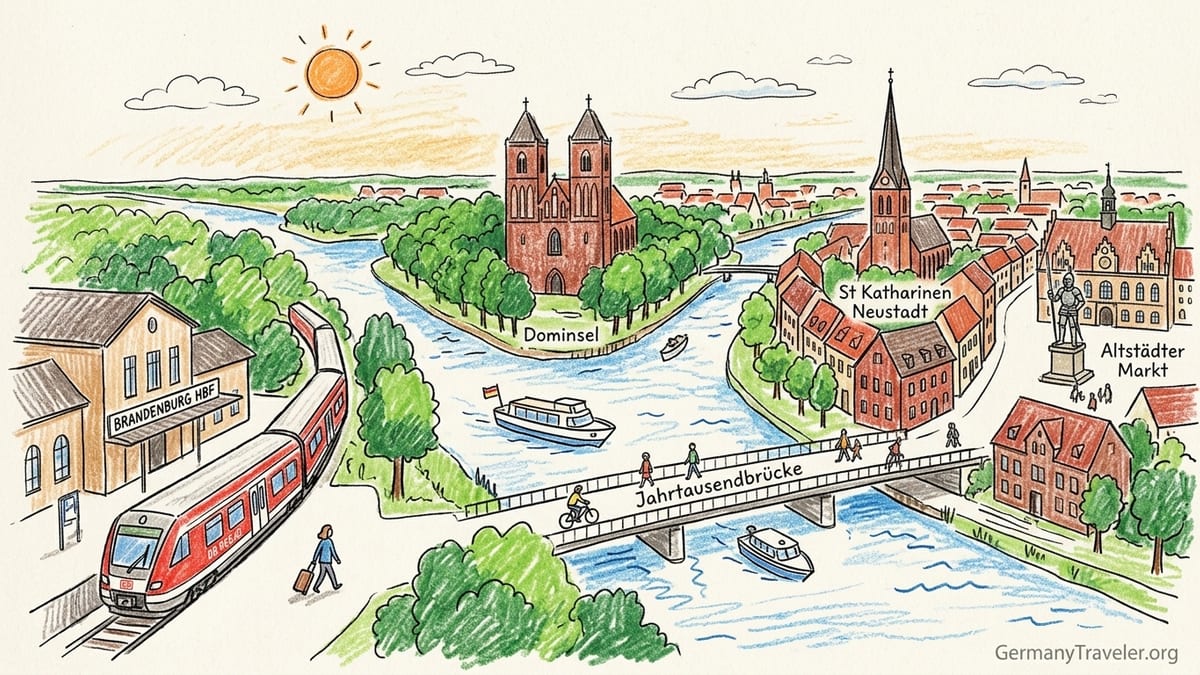
Arriving by Train and Meeting the River City
I came in on a regional train from Berlin Hauptbahnhof, a journey that took just under 50 minutes on the RE1 line and cost a little under 15 euros one way with a standard DB ticket. Stepping out at Brandenburg Hauptbahnhof, the first surprise was how quickly the city pulled me away from rails and asphalt into greenery and water. There is a tram stop right in front of the station, but I chose to walk to get an initial feel for the place, knowing I only had the day and wanted to see if a car-free visit was realistic.
The walk from the station to the Neustadt, the "new" medieval town that is still several centuries old, is about 1.3 kilometers and took me roughly 15 to 18 minutes at an easy pace. I followed the Geschwister-Scholl-Straße north, passing old industrial red-brick buildings that hinted at the city’s more recent manufacturing past, then turned toward the tram lines and the denser streets that signaled the approach to the historic core. It felt like the sort of medium-sized German city where everyday life and heritage sit right on top of each other.
It was only when I reached the edge of Neustadt and saw the Havel branches opening up that the geography really clicked. Brandenburg an der Havel is not just beside the river; its historic heart is scattered over islands between the main Havel and side canals, with bridges tying Neustadt, Altstadt and Dominsel together. Looking toward the cathedral island from the Neustadt quays, with willows dipping into the water and boats moving slowly past, I understood why the Slavic tribes who founded a settlement here chose this defensible, water-rich site long before German expansion reached the area.
There are buses and trams that will shave a few minutes off the walk and take you directly toward Neustädtischer Markt, but for a first visit I recommend walking from the station. You feel the transition from modern neighborhoods into the layered townscape, and that gradual reveal turns what begins as a pragmatic train stop into the entry point of a compact, walkable day.
Dominsel: Starting the Day at the Cathedral of St Peter and Paul
Although Neustadt is geographically closer to the station, I decided to set the historical tone by starting on Dominsel, the cathedral island north of the Neustadt. From the station I cut across Neustadt first, then crossed the Mühlendamm bridge and turned toward the cathedral towers. The route from Brandenburg Hauptbahnhof to the Dom took me about 25 minutes on foot, with a short pause at the river to take in the view.
The Cathedral of St Peter and Paul rises above the trees at the eastern end of Dominsel. It is one of the most important medieval churches in the region, begun in the 12th century after the Christian conquest of the former Slavic stronghold here, and later expanded in brick Gothic form. When I visited, the cathedral itself was open with free entry, in line with the current policy that there is no set ticket charge for the church, only a donation box near the door. The attached museum, which holds medieval art and liturgical objects, had a separate entrance fee of 5 euros for adults and 3 euros reduced, with opening hours generally from late morning to afternoon in the warmer months.
Inside, the Dom felt remarkably quiet given that Brandenburg is only an hour from Berlin. High white walls and red brick ribs lifted the nave into a cool, luminous space, and I could hear my footsteps on the stone. From the side aisles I caught small framed views through the doors to cloisters and the grassy churchyard, which still hints at the time when this was a powerful bishopric whose influence reached across the surrounding Slavic lands. The Slavic fortress known as Branibor gave the wider region and later the state of Brandenburg its name, and standing in the cathedral you sense how this island once anchored the Christianization and Germanization of a Slavic border zone.
Dominsel itself is calm, with residential houses and gardens spreading between the cathedral and the riverbanks. I walked along Burghof and into the open space by the water, where a few tour boats were moored. Small river cruises operate from Brandenburg, typically in the warmer months, but schedules and routes change enough that it is worth checking locally or at the tourist office near the station rather than planning a specific departure in advance. On my visit I decided not to take a boat, partly because I only had a single day and wanted the continuity of a walking route, and partly because the best sense of the city, for me, came from crossing its bridges on foot.
Crossing into Neustadt: Between Everyday Life and Brick Gothic Drama
From Dominsel I crossed back toward the Neustadt via the Mühlendamm bridge. The transition is fast but striking: within a few minutes you leave the almost rural quiet of the cathedral island and find yourself on streets with trams, supermarkets and kids on bicycles. Brandenburg’s Neustadt is not a perfectly preserved old town. There are postwar apartment blocks, practical stores and blank stretches of façade, yet the medieval street grid still peeks through, and then St Katharinen launches itself upward and pulls the eye back into the past.
St Katharinen, the late Gothic hall church that dominates the Neustädtischer Markt area, is one of the finest examples of North German brick Gothic architecture. Approaching from Steinstraße, I walked through narrower side lanes until the west front, a high brick gable with rich tracery, filled my field of vision. The church stands slightly squeezed by later buildings and tram lines, but that tightness only highlights how oversized it must have felt to medieval townspeople. The church usually keeps broad daytime opening hours from spring into autumn, roughly from late morning to mid-afternoon most days, though in January and February open times are limited and often confined to a few hours on Sundays. Entry to the interior during open-church hours was free when I visited, with donations encouraged.
Inside, St Katharinen was the single interior that lodged itself in my memory more than any other in Brandenburg an der Havel. The tall, painted vaults, the fully preserved Gothic high altar dedicated to Saint Catherine and the rich epitaphs along the walls create a space that feels both monumental and closely tied to the city’s merchants and patricians. I happened to arrive just before a short midday organ recital, part of a series that uses the enormous Tokatha organ, which is now the largest organ in Brandenburg state with dozens of registers and multiple manuals. The concert was free, with a voluntary donation, and sitting in a pew listening to the music fill the nave felt like a privilege you rarely stumble across without crowds.
Neustädtischer Markt itself, a few steps from the church, is less dramatically pretty than some German market squares, but I liked its very ordinariness. Tram tracks cross in front of a mix of gabled houses and more austere buildings, there is a small fountain, and locals were cutting across diagonally carrying shopping bags. I grabbed a quick coffee and a pastry from a nearby bakery for under 5 euros rather than sit down for a full lunch, partly to keep my schedule flexible and partly because I knew I wanted a slower meal later in the Altstadt.
Jahrtausendbrücke and the Walk into the Altstadt
From Neustädtischer Markt I followed Hauptstraße westward. This is the main shopping street, and it felt like many other German mid-sized cities: chain stores, pharmacies, mobile phone shops and occasional gaps where older buildings did not survive wartime bombing or GDR-era clearance. It was not especially charming, but it was useful as a direct, legible axis toward the river, and it made the contrast at its far end more powerful.
The street runs straight toward the Jahrtausendbrücke, the bridge that connects Neustadt and Altstadt across the Havel. Just before reaching the bridge I detoured left down to the Heinrich-Heine-Ufer, a promenade along the river. Here the city suddenly became picturesque again. People sat on benches facing the water, a couple of paddleboarders drifted by, and across the river I could see the Altstadt’s church towers and gables rising behind trees. The Jahrtausendbrücke itself is not old in its current form, but its name recalls the thousand-year anniversary of the city at the end of the 1920s, and standing in the middle of the span, watching boats slip under the arches, I felt like I had reached the vantage point that best explains Brandenburg’s layout to a first-time visitor.
Crossing into the Altstadt took only a few minutes, but I recommend lingering on the bridge if the weather is kind. From the middle the city reveals its layered structure: Dominsel to the north, Neustadt behind you, Altstadt and the Marienberg hill ahead, all wrapped around by the river. It was at that moment that I understood why Brandenburg, once a major medieval center, feels so modest today. Its geography is perfect for a regional capital in a pre-industrial world of waterways, yet in the age of rail and highways, its quietly beautiful riverscape makes it easy to overlook compared with Potsdam’s showpiece palaces.
On the Altstadt side, narrow streets fan out from the bridgehead. I followed Ritterstraße first, drawn by a glimpse of brick gables, then turned gradually toward Altstädtischer Markt. This was one of my favorite walking sections of the day. The streets are short and human-scaled, with a mix of freshly painted houses, slightly faded façades with peeling plaster and occasional gaps turned into small gardens or parking areas. It felt lived in rather than curated, the kind of place where you see laundry on balconies as often as you see souvenir shops.
Altstädtisches Rathaus, the Roland Statue and a Late Lunch
The Altstädtischer Markt is the historic heart of the Altstadt and, visually, the most striking square in Brandenburg an der Havel. When I stepped into it from one of the side streets, the red-brick mass of the Altstädtisches Rathaus immediately dominated the scene. This town hall, a jewel of North German brick Gothic, has a richly articulated façade of pointed arches and tracery that looks almost delicate despite its size. In front of it stands the Roland statue, over five meters of sandstone representing a medieval guardian figure and symbol of civic freedom and justice.
Standing between the town hall and the Roland, with the open square around me, felt like the moment when the city’s medieval importance became material rather than abstract. This was once one of the key urban centers of the Northern March and later the Margraviate of Brandenburg, a place that drew wealth from trade routes running through Slavic and German lands. The Roland here, like others in German towns, signaled that the city had certain market rights and freedoms. Today tourists pass by in ones and twos, rather than groups, and I ended up with several minutes where the square was almost empty, giving me space to look up at the brick details without dodging selfie sticks.
There is a small tourist information point and sometimes exhibitions inside parts of the town hall complex, but access can vary with events and seasons, so it is worth checking opening times on arrival in the city rather than banking on a specific slot. What is reliable is that the square offers several options for a sit-down meal. I chose a simple local restaurant on one corner and ordered a plate of Königsberger Klopse with potatoes and beetroot salad and a non-alcoholic drink. The meal came to around 16 euros including tip, which felt reasonable for a central historic square in a city so close to Berlin.
Eating there, with the Roland statue in my line of sight and tram bells occasionally ringing in the distance, I noticed again how different the ambiance was from Potsdam. In Potsdam’s old town or near Sanssouci, even in the shoulder season, restaurant terraces fill with tour groups and Instagram scavenger hunts. In Brandenburg I was surrounded mostly by locals having lunch, office workers on a break and a few cyclists. If you have already done a Potsdam day trip and want a follow-up that is quieter yet just as steeped in history, Brandenburg an der Havel is an ideal second excursion.
Looping Back through Side Streets and Everyday Corners
After lunch, I spent about an hour threading through the Altstadt streets between Altstädtischer Markt and the river. I walked along the Salzhofufer for more river views and then looped back past Nicolaiplatz and side alleys framed by modest houses. Nothing here felt spectacular, but it was precisely this unspectacular combination of water, trees and brick that made Brandenburg linger in my mind. The city’s medieval street plan is clearly legible, yet it coexists with very ordinary scenes: children playing in small squares, an elderly couple tending flowers in front of a rental block, a cyclist loading groceries into panniers.
By mid-afternoon I began to feel the day’s walking in my legs. Checking my phone later, my route from the station to Dominsel, then across Neustadt, over the Jahrtausendbrücke into the Altstadt and back to the station via a slightly different line came to just under 9 kilometers. It is perfectly manageable in four to five hours if you are reasonably fit and give yourself time for a couple of church visits and a proper meal, but travelers with limited mobility might want to rely more heavily on trams to bridge the longer stretches between the station, the cathedral and the old town squares.
On my way back to the station, I chose to recross the Jahrtausendbrücke, walk along the Heinrich-Heine-Ufer again and then head down Hauptstraße into Neustadt before picking up the route I had followed in the morning. This second pass confirmed my earlier impression: Brandenburg’s historic fabric is not flawless or museum-like, but when the late afternoon light caught the brick front of St Katharinen and the spire cast a long shadow across the tram tracks, the contrast between holy architecture and everyday infrastructure felt underpinning rather than jarring.
Practicalities: Opening Hours, Costs and Time Well Spent
Practically, Brandenburg an der Havel works well as a half-day or full-day trip from Berlin. The RE1 line runs frequently between Berlin and Brandenburg, with travel times around 45 to 55 minutes depending on the departure. Ticket prices vary according to the specific fare and discount you use, but a standard adult one-way fare from central Berlin to Brandenburg an der Havel is usually a bit under 15 euros, and regional day tickets or the Deutschlandticket (if you have it) can make the excursion more economical.
Within the city, I paid nothing to enter the Cathedral of St Peter and Paul on Dominsel, although I left a donation in the box. The attached Dom museum charged 5 euros for adults, with a reduced rate of 3 euros and family tickets available. At St Katharinen, the church was open for quiet visits without a fixed fee, again with a donation basket near the door. Short midday organ concerts linked to the Tokatha project were advertised as free, with voluntary contributions for organ maintenance.
Food and drink felt moderately priced. My light morning snack in Neustadt cost around 5 euros, and my main meal in the Altstadt was about 16 euros including a soft drink and tip. Coffee and cake in a small café between Altstädtischer Markt and the river added another 6 euros. If you plan to sit at the most central tables right on the squares or riverfront, budget accordingly, but overall I spent far less in Brandenburg than on comparable meals and admissions during a day in Potsdam.
It is worth being aware of seasonal patterns. Both the cathedral and St Katharinen reduce their opening hours in winter, and there are days, particularly around religious holidays or special events, when parts of the buildings are closed to visitors. If you are traveling outside the main April to October season, it is wise to check opening times for the Dom and churches either at the tourist information point near the station or on their official noticeboards in the city, and to accept that a particular tower climb or exhibit might not be available on your specific date.
Why Brandenburg an der Havel Matters Historically
Walking through Brandenburg an der Havel, it is easy to take the layers of brick and plaster at face value and miss the deeper history beneath your feet. Long before this was a quiet regional city best known to Berlin commuters, it was a Slavic stronghold. The name Branibor, from a Polabian Slavic language, probably described a fortified place in marshy terrain. That origin still makes sense when you stand on Dominsel and look at the web of water surrounding it. For the Slavic Hevelli tribe, this was a defensible, strategic site at the edge of their world.
In the 10th and 12th centuries, as the Holy Roman Empire pushed eastward, Brandenburg became the seat of a bishopric and later one of the power centers of the Margraviate that would eventually lend its name to the wider state and, much later, to the Kingdom of Prussia. The cathedral on Dominsel and the brick town halls in Neustadt and Altstadt are tangible outcomes of that shift from Slavic stronghold to German medieval city. The Roland statue in front of the Altstädtisches Rathaus is part of a northern European tradition of symbols of civic autonomy, emphasizing that this was a place where urban law and market rights mattered.
Yet Brandenburg’s political star faded as Berlin and later Potsdam rose. Today, that relative decline is a gift to visitors. Unlike Potsdam, which remade itself in the 18th and 19th centuries as a showpiece of Prussian royal power with baroque palaces and gardens, Brandenburg preserved more of its medieval and early modern profile without being polished into a pure tourist stage. The scars of wartime damage and GDR housing projects are visible, but so is an authenticity that you rarely find in cities whose historic centers have been heavily reconstructed as backdrops for mass tourism.
Spending a day on foot here, you are walking through a place that was once central to the shaping of northeastern Germany and still carries the name that resonates in the state and beyond. That alone would justify a visit, but combined with the ease of access from Berlin, the quiet river landscape and the concentration of churches and civic buildings, it makes Brandenburg an der Havel feel like one of the most underappreciated historic cities in the region.
The Takeaway
By the time I boarded the evening train back to Berlin, Brandenburg an der Havel had shifted in my mind from a dot on the regional rail map to a city with its own distinct texture. My day had been entirely on foot, with informal pauses at the river, two major church interiors, a handful of squares and about 9 kilometers of walking, and I never once felt rushed. I had seen Dominsel in the soft morning light, St Katharinen under a midday organ recital, the Roland statue casting its shadow across Altstädtischer Markt and the Havel reflecting the muted afternoon sky from the Jahrtausendbrücke.
For travelers wondering how much time to allocate, four to five hours is an excellent starting point. In that window you can comfortably walk from the station to Dominsel, visit the cathedral and possibly the museum, backtrack through Neustadt to St Katharinen, cross the Jahrtausendbrücke into the Altstadt, explore Altstädtischer Markt and its side streets and sit down for one unhurried meal. If you add a river cruise, multiple museum visits or a detour up to the Marienberg hill, you may want to stretch the visit into a full day or even consider an overnight stay in one of the small hotels or guesthouses.
Who should come? If this is your first trip to Berlin and you only have time for one big excursion, Potsdam is still the more obvious choice for its palaces and parks. But if you have already seen Sanssouci, or you are more drawn to brick Gothic churches, medieval market squares and quiet river walks than to royal interiors, then Brandenburg an der Havel rewards your curiosity. It suits travelers who enjoy walking, who do not mind a few rough edges between restored monuments and everyday apartment blocks, and who appreciate places where history has settled into normal life rather than been lifted onto a podium.
As for whether Brandenburg an der Havel deserves more than a convenient rail stop, my answer is unambiguous. This is not just somewhere to change trains on the way to somewhere else. It is a compact, historically weighty city shaped by Slavic roots, medieval ambition and river geography, close enough to Berlin for a spontaneous half-day yet rich enough to hold a history-minded traveler for much longer. If you let yourself follow its bridges and brick towers instead of the timetables alone, you may find that one day in Brandenburg quietly rearranges your mental map of northeastern Germany.
FAQ
Q1. How long do I need for a first visit to Brandenburg an der Havel?
For a first impression focused on Dominsel, Neustadt, the Jahrtausendbrücke and Altstadt with one sit-down meal, plan four to five hours in the city, not counting train travel.
Q2. Is Brandenburg an der Havel a good day trip from Berlin without a car?
Yes. Frequent regional trains connect Berlin and Brandenburg in about 45 to 55 minutes, and the historic areas are compact enough to explore mainly on foot, with trams as backup.
Q3. How far is the walk from Brandenburg Hauptbahnhof to the historic center?
The walk from the main station to Neustädtischer Markt in the Neustadt is about 1.3 kilometers and takes roughly 15 to 18 minutes at an easy pace, mostly on level ground.
Q4. Are there entrance fees for the cathedral and main churches?
Entry to the Cathedral of St Peter and Paul and St Katharinen was free when I visited, with donation boxes available, while the Dom museum charged a small separate admission fee.
Q5. Can I fit a boat trip on the Havel into the same day?
Short river cruises do operate from Brandenburg, especially in warmer months, but schedules vary, so it is best to check locally if you want to add a boat trip to your walking route.
Q6. How does Brandenburg an der Havel compare to Potsdam as a day trip?
Potsdam offers palaces and landscaped parks and draws more visitors, while Brandenburg an der Havel is quieter, more medieval in character and better for low-key river and church-focused walks.
Q7. Is the city center suitable for travelers with limited mobility?
The historic areas are fairly level, but distances between the station, Dominsel and Altstadt can add up, so using trams and buses is advisable if walking several kilometers is difficult.
Q8. What did you spend on food during your visit?
I spent around 5 euros on a coffee and pastry in Neustadt, about 16 euros on a main meal and drink in the Altstadt and roughly 6 euros on coffee and cake later in the afternoon.
Q9. Are there enough sights to justify staying overnight?
If you enjoy slow travel, additional churches, the Marienberg hill, museums and potential boat trips, an overnight stay lets you expand beyond the core route I followed on my single-day visit.
Q10. Is Brandenburg an der Havel worth visiting if I am mainly interested in history?
Yes. Its Slavic origins, role in the early Margraviate of Brandenburg, brick Gothic churches, medieval town halls and Roland statue make it a rewarding destination for history-focused travelers.