


Most visitors treat Brandenburg as the green fringe around Berlin or a quick dash to Potsdam. In reality, the state of Brandenburg is a destination in its own right, a wide ring of forests, rivers, villages and former mining landscapes that begins just beyond the city limits. This guide looks at Brandenburg as a standalone region, clearly separate from Berlin itself and from the smaller city of Brandenburg an der Havel, and focuses on why you might travel here: for palaces and gardens, canal landscapes, dark skies, deep forests and striking post-industrial scenery.
Understanding Brandenburg Beyond Berlin
Brandenburg is the federal state that completely surrounds Berlin, but it is not a suburb. Its territory stretches from the Elbe in the west to the Oder near Poland, with landscapes that range from pine forests and wetlands to former open-cast mines now filling with water. Berlin is a separate city state, and Brandenburg an der Havel is a mid-sized town within Brandenburg, about 70 kilometres west of Berlin, with its own medieval core and cathedral. When planning trips, it helps to think of Brandenburg as a hub of distinct sub-regions rather than a single day-trip belt.
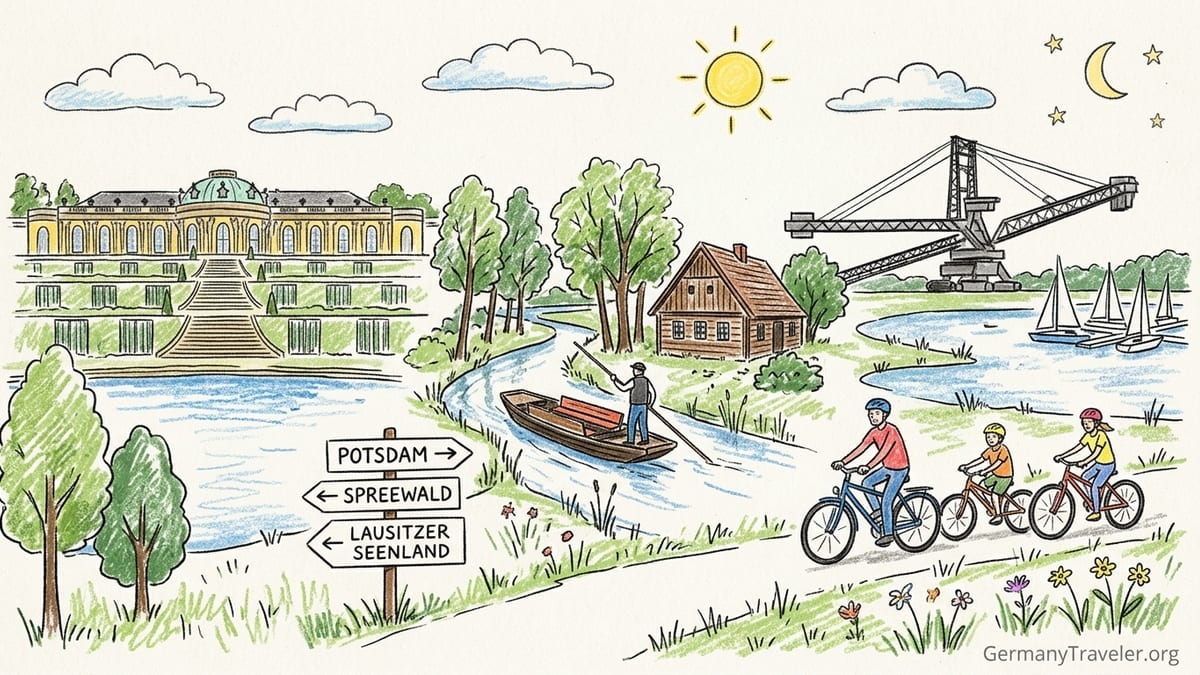
From a traveller’s point of view, Brandenburg divides naturally into several motivations. To the southwest, Potsdam offers Prussian palaces and lakefront villas. South of Berlin, the Spreewald is a flat maze of canals and Sorbian villages. Further southeast, the Lusatian Lake District shows how former brown-coal pits are becoming beaches and marinas, with the F60 visitor mine as a spectacular industrial landmark. North and northwest of Berlin, Schorfheide-Chorin and Westhavelland appeal to forest walkers and stargazers, while smaller towns such as Rheinsberg and Brandenburg an der Havel combine water, history and a quieter pace.
Public transport from Berlin reaches all of these areas, but the level of effort varies. Rail lines radiate towards Potsdam, Brandenburg an der Havel, Cottbus, Senftenberg, Rheinsberg, Eberswalde and Angermünde, and regional buses or bikes fill many of the gaps. A car, however, makes it much easier to combine smaller villages, trailheads and lakes in a single trip, especially in the Lusatian Lake District and Westhavelland where bus frequencies are modest and night services limited.
Seasonality is another key factor. The Brandenburg countryside feels very different in January compared with June. Canal trips, lake swimming and beer gardens drive summer visits, while shoulder seasons suit palace interiors, forest walks and quieter towns. Deep winter can be atmospheric yet limited, with some attractions on reduced hours and early nightfall affecting activities like stargazing or long hikes.
Potsdam: Palaces, Gardens and Lakes
Potsdam is Brandenburg’s most famous draw, yet it is often treated as an extension of Berlin. In fact, it is the state capital with its own historic quarters and a cluster of royal palaces in parkland. The core motivation to visit is the ensemble of Sanssouci Park, the New Palace and lakeside villas, rather than nightlife or shopping. A typical first-time visitor spends most of a day walking through formal terraces, baroque façades and landscaped views towards the Havel lakes.
What visitors actually do in Potsdam is relatively straightforward. They book either a stand-alone timed ticket for Sanssouci Palace or a combined sanssouci+ ticket, currently around 22 euros for adults and valid for one day at most open Prussian palaces in Potsdam, with a fixed entry slot for Sanssouci itself. Inside, you move through Rococo interiors and galleries; outside, most travellers spend several hours on the terraces, Orangery, New Palace and the Orangerie axis without paying additional park admission. In summer, it is common to combine a palace morning with a lakeside walk in the Neuer Garten or a short Havel boat tour from the city centre.
Potsdam works extremely well as a day trip from Berlin. Regional trains from central Berlin reach Potsdam Hauptbahnhof in around 25 to 40 minutes, depending on the line, and from there trams and buses connect to Sanssouci Park and the Dutch Quarter. You can realistically see Sanssouci Palace, parts of the park and the baroque city centre in one long day. However, staying overnight changes the rhythm. With a night in Potsdam you can visit additional sites like Cecilienhof Palace or Belvedere Pfingstberg without rushing, enjoy evening walks along the Havel when day-trippers have gone and make a relaxed early-morning loop through Sanssouci’s gardens.
Potsdam is best suited to travellers who enjoy architecture, landscaped gardens and history. Children often enjoy the open park space more than the palace interiors, and older travellers appreciate the density of sights within walking distance. Seasonality matters: interiors are open year-round but some palaces operate shorter hours outside peak summer, and occasional Mondays see closures that can surprise day-trippers. A main limitation is crowding in high season, especially on sunny weekends, so pre-booking a time slot and starting early pays off. Potsdam is entirely feasible without a car; inner-city parking can be awkward, and public transport plus walking covers most needs.
Spreewald: Canals and Sorbian Culture
South of Berlin, the Spreewald is one of Germany’s most distinctive lowland landscapes. Here the River Spree divides into hundreds of narrow channels that weave through alder woods, meadows and small farmsteads. The area is also a cultural centre for the Sorbs, a Slavic minority with its own language, traditional costumes and food. Travellers come above all for slow journeys on the water, either in traditional flat-bottomed barges or self-paddled canoes, and for the combination of wetlands with village life.
In practice, a classic visit involves taking a barge tour from Lübbenau or Burg. In Lübbenau’s main harbor, a two-hour shared barge ride through nearby canals is typically around 16 euros per adult, while three-hour trips with a village stop cost about 19 euros. Longer five-hour circuits with a lunch break run closer to the high twenties. These tours glide past waterside farmhouses and gardens, with the bargeman using a long pole rather than an engine. More active visitors rent kayaks or canoes for a full day, often paddling between Lübbenau, Lübben and the tiny museum village of Lehde, where open-air exhibits explain traditional Sorbian farm life and pickled gherkins are everywhere on menus.
From Berlin, reaching the Spreewald by train is realistic for a day trip. Regional trains to Lübbenau or Lübben usually take about one hour. A typical day might be a three-hour barge ride, an hour or two in Lehde or Burg, and a late-afternoon return. To experience the quieter early-morning canals or stay out for sunset without worrying about return trains, an overnight in Lübbenau, Burg or another village works better. Cyclists often base themselves for several nights and use the signposted levee paths to combine paddling and biking.
The Spreewald suits travellers who like gentle outdoor activity rather than mountain-style hiking. Families appreciate the calm water and the novelty of barge rides, while photographers enjoy reflections and morning mists. The canal season is strongest from late April to early October, when boat services are frequent and most restaurants open daily. In high summer, mosquitos can be intense in the forest and on still evenings, so repellent and long sleeves help. Winter visits are quieter, with some barge operators offering special trips if the canals are not frozen, but many services and small museums run reduced hours. Without a car, you will be limited mostly to hubs like Lübbenau and Burg, though that still offers plenty; with a car you can more easily reach trailheads, scattered guesthouses and smaller harbors.
Historic Towns and Watersides: Brandenburg an der Havel and Rheinsberg
Brandenburg an der Havel is not the same as the state of Brandenburg. It is a city within the state, historically the capital of the medieval margraviate. Today it offers an attractive mix of cathedral island, brick churches and riverside promenades along the Havel and side canals. Travellers come less for blockbuster sights than for a smaller-scale waterside town atmosphere that contrasts with Berlin’s density.
A realistic day in Brandenburg an der Havel combines architecture and water. Many visitors start on the Dominsel, the cathedral island between the Beetzsee and the Havel, where the brick Gothic cathedral and its cloisters define the oldest part of the city. From there you can walk into the Old Town and New Town districts, passing remnants of the medieval city wall and towers, and then follow the Brandenburger Stadtkanal along tree-lined banks. In summer, boat rentals along the Havel allow for short self-drive electric boat trips or stand-up paddle sessions through the town’s canals. Cafes set right on the water make it easy to spend an afternoon without a fixed itinerary.
Trains from Berlin to Brandenburg an der Havel take roughly 45 to 60 minutes, making the city an easy day trip. A full day is usually enough to explore the core sights without rushing. Overnight stays are more about slowing down than ticking extra attractions: with a night in town, you can add a longer boat excursion on the lakes north of the city or use Brandenburg as a quieter base for exploring surrounding villages by bike. The town is well suited to travellers who enjoy modest-scale history and relaxed riverside cafés rather than intense museum-going.
Rheinsberg, north of Brandenburg an der Havel and west of the Mecklenburg border, is another small-town option focused on water and a single major palace. The white Rheinsberg Palace stands directly on the Grienericksee lake, with sculpted parkland behind it and boat piers in front. Visitors tour the palace interiors for a couple of hours, then walk the park alleys or sit on the lakeside terraces. A key local experience is renting a canoe, kayak or small motorboat for a few hours to explore the connected lakes, something that several local outfitters offer during the warmer months.
Rheinsberg is slightly more effort from Berlin, typically reached by a regional train to Neuruppin or another hub and then a branch line or bus, leading to about two hours of travel. That makes it borderline for a relaxed day-trip unless you start early. Staying one or two nights in Rheinsberg turns it into a gentle lake holiday, ideal for couples and older travellers who want quiet evenings by the water. Both Brandenburg an der Havel and Rheinsberg can be visited without a car if you plan around train times, but having a car widens your choice of lakeside accommodation and lets you combine village stops more easily.
Forests and Biosphere Reserves: Schorfheide-Chorin
North of Berlin, the Schorfheide-Chorin biosphere reserve appeals to travellers motivated by forests, lakes and rural silence. This UNESCO-designated area covers extensive beech and mixed woodland, glacial lakes and moors, along with historic sites such as the brick Gothic Chorin Abbey. It is not a single attraction but a broad landscape where the main activity is time outdoors, whether walking, wildlife watching or swimming in clear forest lakes.
From Berlin, several regional trains head directly into the surrounding area. Services to Eberswalde and Chorin take about 30 to 40 minutes, and the RB27 Heidekrautbahn reaches Groß Schönebeck in roughly 40 minutes from Berlin-Karow. From these small stations, local buses and marked trails lead to places such as Wildpark Schorfheide, Werbellinsee or the Grumsin beech forests. A common choice is to base a day around an easy circuit hike near Chorin Abbey, combining the monastery ruins overlooking the Amtssee with a loop through surrounding woods and lakeshore lunch stops.
A single day trip allows time for one focused walk or a visit to a specific site like the Wildpark or Chorin Abbey. However, Schorfheide-Chorin lends itself to two- or three-night stays in guesthouses or simple hotels, especially for travellers who want to slow down and explore different corners by foot and bike. Public transport works reasonably well in the main corridors, particularly between Berlin, Eberswalde and Chorin, but buses into smaller villages or trailheads may be infrequent, especially on weekends or outside summer. A car makes it simpler to reach quieter lakes and to change plans if weather shifts.
The region is best for visitors comfortable with unstructured nature days: people who like walking, birdwatching or mushroom foraging in season. Families also appreciate the wildlife park and safe lakeshore swimming areas, while photographers benefit from misty mornings and long, quiet views. Spring and autumn are particularly appealing, with fresh green or foliage colour but fewer mosquitos than high summer. In winter, the forests can feel moody and beautiful, though some smaller services scale back, and early darkness shortens day hikes. The main limitation is the lack of big-ticket attractions; Schorfheide-Chorin is not about a single must-see site but about the cumulative experience of a landscape.
Big Skies and Dark Nights: Westhavelland
Westhavelland, northwest of Brandenburg an der Havel, is one of the best places in Germany to experience a genuinely dark night sky. Its low population density and wetlands around the Havel have earned it recognition as an International Dark Sky Reserve, often referred to as the Sternenpark Westhavelland. For travellers, the main motivation here is stargazing and a sense of open space, with birdlife and river scenery as daytime companions.
In daytime, visitors explore wide meadows, river loops and small villages. Walking or cycling along the Havel near towns like Rathenow or the small settlement of Gülpe offers broad horizons and big skies even before nightfall. Short river trips, observation towers and seasonal birdwatching, especially during crane migration, fill the hours before dark. Local guesthouses and simple inns cater to small numbers of visitors rather than mass tourism.
At night, the focus shifts to the stars. On clear autumn or winter nights, the Milky Way is often visible to the naked eye, a rare experience so close to a major capital. Amateur astronomers frequently gather at known viewing spots, and informal meetups to watch events like the Perseid meteor shower are common. Because public lighting is reduced in many parts of the reserve, a headlamp with red light mode, warm clothing and a good understanding of the route back to your accommodation are essential.
Westhavelland is more demanding to visit without a car. Trains from Berlin reach Rathenow in roughly an hour, but many of the darkest areas lie another 20 to 30 kilometres away on minor roads, with limited bus service and almost no public transport late at night. That makes a rental car or organised transfer highly advisable for serious stargazing. An overnight stay is almost mandatory; returning to Berlin the same night after a meteor shower would mean driving very late or cutting the experience short. The main limitations here are weather and clouds, especially in the darker, damper months, and the need to respect local regulations regarding parking and night-time access to sensitive areas.
Post-Mining Landscapes: Lusatian Lake District, F60 and Branitz Park
The most visually surprising part of Brandenburg lies to the southeast, where former brown-coal pits are turning into a new water landscape known as the Lusatian Lake District. Here, artificial lakes linked by channels are gradually forming a network between towns like Senftenberg and Großräschen. The motivation to visit is less traditional scenery and more curiosity about how an industrial region is reinventing itself as a recreation area with beaches, bike paths and marinas.
On the Brandenburg side, Lake Senftenberg and its surrounding paths are the most developed. Travellers rent bikes from local outlets to follow paved trails around the lake, stopping at small beaches and viewpoints, or take sailing or stand-up paddleboarding lessons in season. Interpretive boards along the way explain how the former Meuro open-cast mine has been rehabilitated, with water levels rising over years to form new lakes. Other emerging lakes, such as Großräschener See, remain in more transitional stages, giving a more raw impression of earthworks, new embankments and wind turbines.
One of the district’s standout attractions is the F60 visitor mine near Lichterfeld-Schacksdorf, sometimes nicknamed the lying Eiffel Tower. The F60 is a 502-metre-long overburden conveyor bridge, once used to move earth in an open-cast mine and now preserved as a walkable industrial monument. Guided tours lasting about 90 minutes lead visitors up onto the steel structure, with helmet and safety briefing included. Current prices are around 16 euros for adults and 7.50 euros for children aged roughly 6 to 15, with reduced rates for groups and students. Open hours usually run from mid-March to the end of October daily during the day, with shorter hours on winter days. Many travellers combine the tour with a walk along the shore of the adjacent Bergheider See to see how the mining void is becoming a recreational lake.
Nearby Cottbus adds a very different post-industrial experience through Branitz Park, created from 1846 by Prince Hermann von Pückler-Muskau. This landscape park was shaped on flat farmland into gentle hills, lakes and sightlines. Its most unusual feature is a water pyramid, where the prince himself lies buried on an island in a small lake, and a land pyramid built from the earth excavated for the water. Visitors stroll along curving paths, photograph the twin pyramids and visit the palace that anchors the park. A couple of hours on-site allows time to appreciate the design without going deep into horticultural detail.
The Lusatian Lake District and F60 are reachable from Berlin by a combination of regional trains and buses, usually involving a change in Cottbus, Finsterwalde or Senftenberg. Expect roughly two to two-and-a-half hours of travel each way, which makes a same-day visit to F60 possible but tight. In practice, these landscapes reward at least one or two nights in the region, so you can bike multiple lake circuits, join a boat tour and visit F60 without watching the clock. Public transport can get you to major hubs and to Lichterfeld during the day, but services are thinner in the evening and on Sundays; having a car significantly increases flexibility, especially if you want to move between lakes, view platforms and the visitor mine on your own schedule.
These areas best suit travellers with an interest in industrial history, landscape change or long-distance cycling rather than those seeking traditional village charm. Summer and early autumn are the most comfortable for water-based recreation and bike touring, while spring can be windy and exposed around the newer lakes. The main limitations are ongoing construction in some zones, variable water access while safety works continue and the need to check opening times carefully, particularly for F60 tours and local visitor centres.
Beelitz-Heilstätten: Treetop Walk and Sanatorium Ruins
Closer to Berlin, Beelitz-Heilstätten offers one of Brandenburg’s most unusual combinations: early twentieth-century sanatorium architecture partly reclaimed by forest, viewed from a modern treetop walkway. The abandoned hospital complex, once used for treating tuberculosis and later as a Soviet military hospital, now mixes decaying brick pavilions with new visitor infrastructure, including an elevated boardwalk that winds above the ruins and forest canopy.
For visitors, the main activity is the treetop path. After buying a ticket at the entrance, you follow a gently rising ramp that leads 20 to 30 metres above ground, with views over red-brick roofs, tree canopies and the characteristic Alpenhaus building where birches and pines grow through the collapsed roof. Information boards explain the site’s history and ecology. Ticket prices in recent seasons have been under 20 euros per adult, with separate, more expensive guided tours available for those who want to go inside selected buildings. Families often combine the walkway with a visit to the nearby barefoot park, where you follow a loop of varied surfaces without shoes.
Beelitz-Heilstätten works very well as a half-day or full-day outing from Berlin without a car. Regional trains from Berlin’s urban stations reach Beelitz-Heilstätten station in roughly 30 to 40 minutes, depending on departure point, and the station is a short walk from the treetop path entrance. A half-day visit is enough to walk the treetop circuit, spend time at viewing platforms and grab a meal or snack at on-site outlets. Those who add a long guided tour inside some of the buildings, or a relaxed afternoon in the barefoot park, will naturally fill a full day.
This destination suits travellers interested in photography, history and slightly eerie atmospheres, as well as families looking for an easy, car-free nature outing with a twist. It is particularly appealing in spring and autumn, when the surrounding forest is colourful but temperatures on the exposed walkway remain comfortable. In high summer, the metal and wood surfaces can feel hot at midday, and in winter parts of the walkway can be closed or less pleasant in bad weather. A key limitation is that most of the interior of the historic buildings is off-limits except on specific guided tours; visitors should not attempt to explore closed-off ruins on their own for safety reasons.
Day Trips vs Overnight Stays and Getting Around
For travellers based in Berlin, the first decision is often whether to stick to day trips or to sleep in Brandenburg. Potsdam, Beelitz-Heilstätten, Brandenburg an der Havel and parts of the Spreewald are straightforward day excursions by regional train, fitting comfortably into eight- to ten-hour outings. In these cases, day trips make sense if your main aim is to sample a highlight: a palace interior, a barge ride, a short forest hike or a treetop walk.
Overnight stays become more attractive when distance, reduced transport frequency or the nature of the experience demand more time. Westhavelland’s dark skies require you to be outdoors late at night far from bright stations; the Lusatian Lake District rewards multiple loops and changing light around the lakes; Schorfheide-Chorin’s trails and lakes feel more satisfying when you can spend several unhurried days. Even the Spreewald changes character when you wake beside canals and set out early before the bulk of day-trippers arrive. In each of these regions, one to three nights is usually enough for a rich but focused experience.
Public transport supports many itineraries. The core rail network radiating from Berlin is dense enough to reach most hubs within one to two hours, and day tickets from the regional transport association often cover both trains and local buses. This makes a car unnecessary for the main axes of Potsdam, Beelitz-Heilstätten, Brandenburg an der Havel, Lübbenau, Lübben, Cottbus, Eberswalde and Rathenow. However, once you start aiming for small villages, scattered lake beaches or specific dark-sky fields, bus schedules and early last departures become restrictive. In Westhavelland and in parts of the Lusatian Lake District, a car or at least a bike carried on the train significantly reduces logistical friction.
When planning, match your own travel style to each region’s character. Architecture and garden enthusiasts can chain Berlin and Potsdam with minimal travel stress and no car. Slow nature lovers may prefer to pick a single base in Schorfheide-Chorin or the Spreewald and simply walk or paddle in different directions each day. Those drawn to unusual landscapes and industrial heritage might focus on the Lusatian Lake District and F60, accepting longer travel times in exchange for something visually distinctive. Brandenburg’s strength as a state is that these very different motivations all fit within a few hours of Berlin, yet each feels like a separate trip.
The Takeaway
Brandenburg is far more than Berlin’s hinterland. It is a varied state whose palaces, forests, canals, towns and post-mining lakes reward travellers willing to look beyond the capital. Potsdam offers concentrated architectural splendour; the Spreewald brings quiet waterways and Sorbian culture; Brandenburg an der Havel and Rheinsberg provide lived-in waterside towns; Schorfheide-Chorin and Westhavelland open up big skies and deep woods; and the Lusatian Lake District, together with F60 and Branitz Park, shows how industrial terrain is being transformed.
Whether you are based in Berlin or arriving directly into Brandenburg, think in terms of motivations rather than a checklist of sights. Decide whether you are chasing palaces, paddles, forest paths, star fields or steel giants, and then choose one or two regions that match, allowing enough time to settle in rather than rushing between them. With realistic expectations about transport, seasons and effort, Brandenburg becomes one of Germany’s most rewarding regions for slow, grounded travel just beyond the city’s edge.
FAQ
Q1. Is Brandenburg safe to explore for solo travellers outside Berlin?
Brandenburg is generally considered safe for solo travellers, including those using trains and buses to reach smaller towns. As in any rural area, services thin out in the evening, so it is wise to plan return connections in advance, carry a charged phone and avoid wandering off marked paths at night, especially in forest and wetland areas.
Q2. Can I visit both Potsdam and the Spreewald in a single day from Berlin?
Technically it is possible but not advisable if you want to enjoy either place. Each direction involves around an hour of travel from central Berlin, and both destinations reward several hours on site. Most travellers find it more satisfying to dedicate one day to Potsdam’s palaces and another to canals or paddling in the Spreewald.
Q3. Do I need to speak German to travel around Brandenburg?
Basic German helps, but you can manage with English in most tourist-facing services such as palace ticket offices, larger hotels and main boat operators. In smaller guesthouses, rural restaurants or village shops, English may be limited, so learning a few key phrases, carrying written reservation details and using translation apps can smooth interactions.
Q4. When is the best season to visit the Spreewald?
The main boating season runs from late April to early October, with the most reliable barge schedules in summer. June and September often offer a good balance of warm weather and manageable crowds. In midsummer, mosquitos can be intense near the canals and forests, while winter brings a much quieter atmosphere and reduced services, with some operators closing entirely.
Q5. Is it realistic to go stargazing in Westhavelland without renting a car?
It is possible but logistically awkward. You can reach towns like Rathenow by train, yet the darkest observation spots are often several kilometres away on minor roads, with little or no public transport late at night. For a comfortable and safe stargazing experience, most visitors either rent a car, join a group outing with transport included or stay very close to a known viewing field reached on foot or by bike.
Q6. How suitable are Brandenburg’s lake and forest areas for families with children?
Many of Brandenburg’s regions work well for families. The Spreewald’s calm canals, Wildpark Schorfheide, lake beaches around Senftenberg and the F60 visitor mine are frequent favourites. Parents should factor in travel times, bring appropriate clothing for changeable weather and choose age-appropriate activities, such as short barge rides instead of full-day paddling for younger children.
Q7. Are attractions like F60 and the Beelitz-Heilstätten treetop walk open year-round?
Both sites operate with seasonal hours. F60 usually runs daily with extended hours from mid-March to the end of October and switches to shorter, mainly daytime openings in the colder months. The Beelitz-Heilstätten treetop walk is also subject to reduced winter schedules and occasional weather-related closures. It is important to check current opening times shortly before your visit, especially from November to March.
Q8. Can I rely on cycling to get around Brandenburg’s countryside?
Cycling is an excellent way to explore flatter regions such as the Spreewald, Lusatian Lake District and areas around Brandenburg an der Havel, where dedicated bike paths follow canals and lake shores. However, distances between villages can be longer than they look on the map, and services like bike repair or sheltered rest spots are not available everywhere, so carrying basic tools, water and weather protection is important.
Q9. How far in advance should I book accommodation in Brandenburg?
In smaller towns and rural areas, the number of rooms is limited, so advance booking is sensible for weekends and school holidays, especially in July and August or around public holiday periods. Outside these peaks, you can often find rooms on shorter notice, but booking at least a few days ahead gives better choice, particularly near popular lakes or canal hubs.
Q10. Is it worth renting a car if I mainly want to see Potsdam and Beelitz-Heilstätten?
If your plans focus on Potsdam, Beelitz-Heilstätten and perhaps the Spreewald’s main hubs, you can rely entirely on regional trains and local transport, avoiding parking and traffic around Berlin. A rental car becomes more valuable once you start targeting less connected areas such as Westhavelland’s dark-sky fields, quiet lakes in Schorfheide-Chorin or scattered beaches and viewpoints in the Lusatian Lake District.