


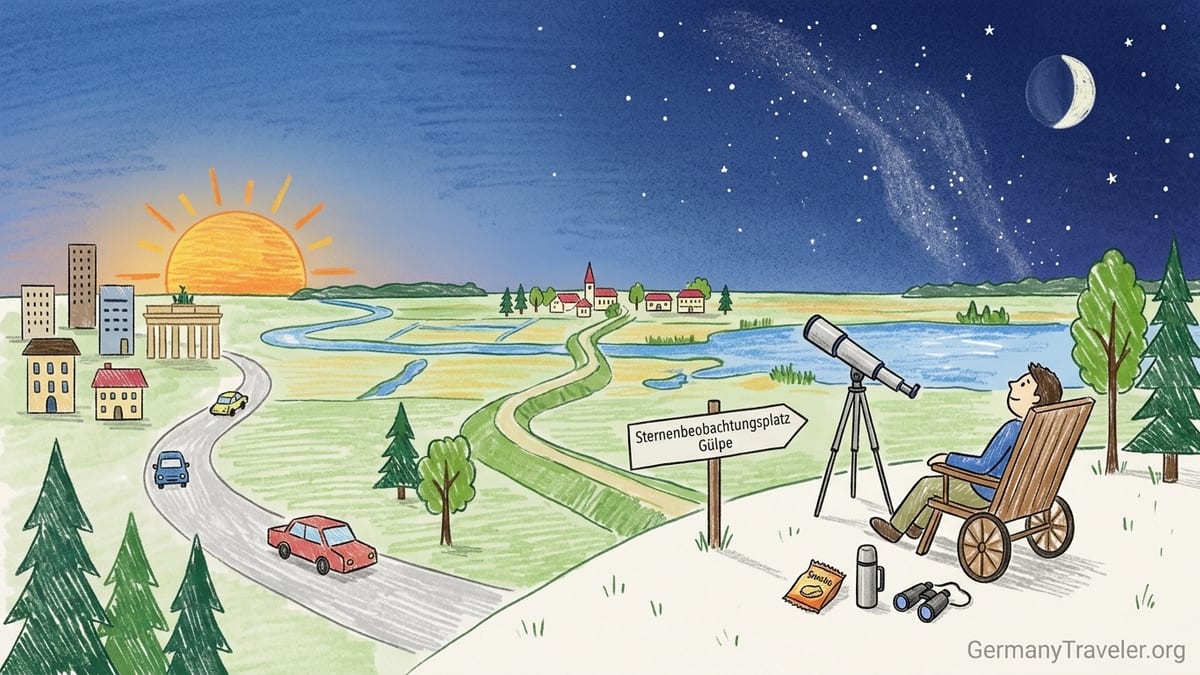
Leaving Berlin after work on a cool late-spring afternoon, I watched the city’s neon and traffic lights slip away in the rear-view mirror and felt my eyes slowly relax. I was heading west to the Natur- und Sternenpark Westhavelland, Germany’s first certified Dark Sky Reserve, to see what the night really looks like when Berlin’s glow finally fades. My goal was simple: one honest overnight stargazing session aimed at what a traveler or photographer can genuinely expect, rather than the postcard fantasy of a blazing Milky Way every clear night.
Choosing Westhavelland and Planning the Escape from Berlin
The Natur- und Sternenpark Westhavelland lies about 70 kilometers west of Berlin, near the border with Saxony-Anhalt, and has been protected as a nature park since 1998. In February 2014 it was designated an International Dark Sky Reserve by DarkSky International, making it the first area in Germany to earn that status. The combination of low population density and strict nature protection allows the night sky to remain far darker than in the Berlin-Potsdam area, even though the metropolis is only a short drive away.
I chose Westhavelland precisely because it balances remoteness with practicality. From western Berlin, the fastest route by car runs along the B5 via Nauen toward Rathenow. Without traffic, the drive to the darker core around the village of Gülpe takes roughly 1 hour 45 minutes. On my trip, leaving Charlottenburg just after 17:30 on a Friday, it was closer to 2 hours 15 minutes with commuter traffic and a fuel stop along the way.
Public transport is technically possible but far less convenient for late-night observing. Regional trains such as the RE4 traditionally link Berlin and Rathenow, and connections via the RE8 and local lines reach stations like Friesack and Neustadt (Dosse). However, timetables change and there have been recent line disruptions, so anyone relying on rail needs to check current schedules carefully and plan for a taxi or bicycle for the last miles into the darkest zones. For an overnight stay that ends well after midnight, a car remains the most realistic option.
Because I wanted to focus on sky quality rather than logistics mishaps, I treated this as a typical Berlin weekend micro-adventure: rental car booked for 24 hours, simple guesthouse bed in a nearby village, and a grocery bag of snacks, water and a Thermos of coffee. Counting car rental, fuel, accommodation and food, the entire trip came to roughly 160 to 190 euros for one person, which is a realistic range for a single overnight escape from the city.
Arriving at Gülpe and Finding a Legal Observation Spot
For my observing base I chose the area around Gülpe, a village within the municipality of Havelaue near the Gülper See nature reserve. Gülpe is often cited by astronomers and local tourism boards as one of the darkest accessible places in Germany, and it sits inside the core zone of the Dark Sky Reserve. The region is flat, dominated by meadows, river polders and low dikes along the Havel, which means broad horizons and minimal obstructions.
In recent years, local initiatives have created several official observation points. One of the most practical is the star observation site in Gülpe itself, which was formally inaugurated in 2024 as part of a regional development project. It offers simple but well-thought-out amenities like reclined seating and an information panel that help visitors orient themselves and reduce the temptation to wander into sensitive areas in the dark. Importantly, this is a legal, publicly accessible location specifically intended for stargazing, which removes much of the uncertainty about where to park or stand at night.
I approached Gülpe from the direction of Rathenow, following small country roads that narrowed gradually as I left the main highway. In the village, there are several signed parking possibilities near the sports field and public facilities used for the annual Westhavelländer Astrotreff, an amateur astronomy gathering that has made the hamlet a minor pilgrimage site for German stargazers. I parked in a marked public parking area near the sports ground where overnight parking is allowed as long as you do not block access or behave like you are setting up an informal campsite.
From the car it was a short, safe walk along a paved or compacted track to the observation structures. There was no need to cross fields, climb fences or walk on unmarked dikes. That point matters. Much of the surrounding landscape lies in nature and landscape protection zones linked to the Havel wetlands and Gülper See bird sanctuary. Visitors are legally required to stay on paths and avoid disturbing wildlife, especially during breeding and migration seasons. An official star-watching point like the one in Gülpe gives you permission in both a legal and social sense to simply settle in and look up.
What the Sky Really Looked Like That Night
The afternoon had been partly cloudy in Berlin, with scattered cumulus clouds and a thin veil of high haze. By the time I reached Gülpe around 20:00, the western sky was still pale blue and streaked with cloud remnants. The sun set behind a line of distant trees, and the temperature dropped from about 16 degrees Celsius down to near 8 degrees by midnight. In late spring this part of Germany never becomes completely dark in the way it does in autumn or winter, because astronomical twilight barely ends, so I knew I would not experience the absolute best the site could offer.
As civil twilight deepened and the first bright stars appeared, what struck me was not an instant “wow” of a blazing Milky Way but a gradual realization that there were simply more stars everywhere than I was used to above Berlin. Toward the east and south, the sky was a deepening blue-black with only a faint, low glow from distant towns. To the southeast, nearer the direction of Berlin, there was a more noticeable light dome just above the horizon, but it remained well below the main star fields.
The moon phase turned out to be the main limiting factor. I had scheduled my visit for a weekend predicted to have a thin waxing crescent, but thin cirrus near the horizon scattered the moonlight, making the sky a touch brighter than forecast. That subtle milky veil also caught the light from nearby towns such as Rathenow and Brandenburg an der Havel, softening the contrast of fainter stars. Under these conditions, the band of the Milky Way was only faintly visible overhead in the darker hours after midnight, not the bold river of light shown in many promotional photos.
Despite that, the naked-eye sky was still impressive by central European standards. Constellations that are partially lost in Berlin’s glow, such as Cygnus and Sagittarius, were fully drawn out with dozens of background stars. Averted vision revealed a textured, grainy character in the densest star fields, but I would describe it as subtle rather than spectacular on this particular night. The reality is that a dark-sky reserve does not override the laws of physics. Cloud cover, haze and moonlight can easily downgrade a Bortle 2 level sky to something closer to Bortle 3 or 4 for an evening, even in one of Germany’s darkest regions.
Naked Eye, Binoculars and Camera: Honest Performance
I brought three levels of equipment: my own eyes, a pair of 8x42 roof-prism binoculars and a mirrorless camera with a 24 mm f/1.8 wide-angle lens plus a compact travel tripod. For most travelers, this mix is realistic. It does not require a dedicated telescope or heavy astro mount, but it lets you see what the reserve can offer visually and photographically.
With the naked eye, the immediate change compared with Berlin was the presence of third and fourth magnitude stars everywhere across the sky. The Little Dipper, which is often washed out in the city, was fully visible, and the Great Rift in the summer Milky Way was dimly perceptible overhead once my eyes dark-adapted for 20 to 30 minutes. I could see satellites drifting across the sky and an occasional faint meteor, but there was no constant meteor shower and certainly not the cinematic “shooting star storm” some visitors might secretly hope for.
Through the 8x42 binoculars, the experience improved dramatically. Open clusters like the Pleiades and the Double Cluster in Perseus appeared as tight sprays of diamond-like points instead of fuzzy patches. The Andromeda Galaxy showed a brighter core and an elongated disk, though without dramatic spiral structure. This is the level where Westhavelland really rewards you: the binocular field is full of stars from edge to edge, unspoiled by the orange haloes that dominate so much of central Europe’s sky.
For photography, the conditions were good but not perfect. I set the camera to 20-second exposures at ISO values between 3200 and 6400, shooting at f/1.8. On the back screen, the Milky Way appeared clearer than it did to my eyes, as is typical, but it lacked the strong contrast and intricate dust lanes captured under truly pristine skies in the Alps or Canary Islands. There was a faint gradient from the Berlin light dome and some subtle glow from moisture in the air. For a traveler’s portfolio, the resulting images were absolutely usable: clearly star-filled, with a recognizable Milky Way arch and a calm rural foreground. They simply did not match the most dramatic marketing images you might see for the region, and it is important to set expectations accordingly.
Living With Real Darkness: Cold, Insects and Facilities
As full darkness settled, I discovered the part many city dwellers underestimate: this is not an urban park at night but a genuinely rural landscape. Human sounds dwindled to almost nothing once a few other visitors left. What remained were the croaks of frogs near drainage ditches, wind in the grass and the occasional bird call. For some travelers this is enchanting; for others, especially those alone without a group, it can feel more unsettling than expected.
The temperature drop was significant. By midnight I was wearing a base layer, fleece, synthetic insulated jacket, beanie and thin gloves, along with lined hiking trousers and wool socks. Standing or lying still under a clear or partially clear sky cools the body quickly, even when the day has felt warm. Many first-time visitors arrive in spring or autumn with only a city coat and trainers and find themselves shivering after an hour. It is wise to pack as if you were spending an evening on a mountain viewpoint rather than at a lakeside beer garden.
Insects were another realistic factor. Near wetlands such as Gülper See, mosquitoes can be persistent between late spring and early autumn, especially just after sunset when the air is still. On my visit they were noticeable for the first hour after dusk but diminished as temperatures fell. I had long sleeves, a buff for my neck and a small bottle of repellent, which was enough to stay comfortable. In warmer months or after heavy rain, they can be intense, and visitors who are sensitive to bites should factor this in.
Facilities at night are minimal. The official observation points provide seating, sometimes simple information boards and occasionally nearby public toilets associated with sports grounds or community centers, but you cannot rely on these being open after dark. Shops and restaurants in nearby villages close relatively early. I carried all my water and snacks, and I used a red-light headlamp to preserve night vision. There are no streetlights at the observation area, and even the nearest roads are only softly lit, which is positive for stargazing but requires good personal preparation.
Protected-Area Rules, Camping Restrictions and Respecting Wildlife
Westhavelland is first and foremost a nature park with extensive wetlands, meadows and bird habitats. The dark-sky designation exists to protect nocturnal ecosystems as much as it does to please astronomers. As a visitor, you are entering a landscape where wildlife comes first, and the rules reflect that priority. Large sections are designated as nature or landscape protection areas in which you must stay on marked paths and avoid noise, bright lights and any off-road driving.
One of the most important points is that wild camping with tents or caravans is not allowed in the protected landscape or nature reserves. Local authorities and the Sternenpark Westhavelland organization emphasize that camping in open fields, on dikes or along access tracks is prohibited. This includes apparently “empty” spots beside observation areas. If you need to sleep before driving back, you are expected either to book legal campgrounds and official motorhome pitches in the region or to sleep discreetly in your vehicle in a village street without setting up a campsite atmosphere.
There are several established camping options connected with the dark-sky area, such as sites near Steckelsdorfer See and other lakes around Rathenow, along with smaller guesthouses and holiday apartments scattered through villages like Gülpe, Strodehne and Milow. On my trip I stayed in a simple private guest room in a nearby village, booked directly. The cost was about 60 to 80 euros for one night, including basic breakfast. After the observing session I drove 15 minutes back to the guesthouse, which kept me out of sensitive zones and allowed for proper rest before returning to Berlin.
Noise and light discipline also matter. Car headlights should be used only as necessary for safety, then switched off as soon as you park. Interior lights, music and voices carry far across open fields and can disturb both wildlife and other observers. A red-filtered headlamp is highly recommended. Flash photography for selfies at the observation site may seem harmless, but repeated flashes and bright screens degrade the experience for everyone.
Costs, Gear Checklist and Practical Logistics
The total cost of my overnight trip from Berlin broke down into three main categories: transport, accommodation and food. Renting a compact car for 24 hours from a mainstream provider in Berlin cost around 60 to 80 euros including basic insurance. Fuel for the roughly 250 to 300 kilometer round trip added about 25 to 35 euros at current prices. My guesthouse stay was in the 70-euro range, and I spent under 15 euros on groceries and snacks. In total, that put the trip at approximately 170 euros, which could easily be shared between two people if you split car and room costs.
In terms of equipment, I found a modest but targeted kit more than sufficient. Warm clothing in multiple layers, a hat and gloves were non-negotiable. Waterproof hiking shoes made it easier to walk along dew-covered paths. I carried a thermos of hot tea and high-calorie snacks like nuts and chocolate, which make a surprising difference to comfort in the small hours. For light, I used a headlamp with a red mode, plus a small backup torch in my pocket in case of failure.
For photography, my mirrorless camera and one fast wide-angle lens were enough to capture the atmosphere of the place. A sturdy but compact travel tripod allowed 15 to 25 second exposures without blur. I also packed extra batteries, since long exposures in cool air drain them quickly. I deliberately left heavy tracking mounts or telescopes at home; they can be rewarding but add complexity and weight that are unnecessary for a first recon trip.
Parking at the Gülpe observation area was free at the time of my visit, with no barrier or ticket machine, and there is no general entrance fee to the dark-sky reserve itself. The Sternenpark Westhavelland is publicly accessible without gates or opening hours. That said, it is still wise to arrive before full darkness so you can find the parking spaces and paths in daylight. Bridges over the Havel and small ferries in the region have limited or no night-time operation, so check routes in advance, especially if you are coming from less common directions.
Was the Overnight Effort Worth It and What I Would Do Differently
Was one night under Westhavelland’s skies worth the effort, money and fatigue of driving back to Berlin the next day? For me, the answer was yes, with qualifications. I did not experience the type of pristine, crystalline Milky Way that you might see in high-altitude deserts. The combination of thin high cloud, a brightening crescent moon and permanent summer twilight meant that the sky was very good but not exceptional. What the trip did provide was an honest sense of how much darker a protected rural sky can be compared with Berlin and a realistic preview of what is possible on a truly clear, moonless night.
If I could plan the same trip again, I would be more conservative about weather and moon phase. I would choose a night within two or three days of new moon during the darker half of the year, from late September through March, when astronomical night is longer and twilight less intrusive. I would watch satellite cloud maps closely on the day of departure and be prepared to postpone if high cirrus spread in from the Atlantic. For photography, I would bring a second lens in the 14 to 20 mm range to capture broader sections of the Milky Way in case conditions turned out better than expected.
I would also seriously consider adding a second night, either in the same guesthouse or in a small holiday apartment. A single night places everything on one roll of the dice: if clouds arrive or the moon is brighter than forecast, your only option is to accept the conditions or stay awake until dawn on the chance of a brief clearing. Two nights would double the cost of accommodation but greatly increase the odds of at least one excellent observing session, and it would make the long drive feel more proportionate to the experience.
Even with the imperfect conditions I encountered, the psychological effect of standing in genuine darkness, hearing only wind and animals while a sky full of stars arced overhead, lingered for weeks afterward. It reminded me that near a city of millions there is still a place where the night mostly belongs to itself. That alone justified the effort.
A Cloudy-Night Plan B in and around Westhavelland
Not every trip to a dark-sky reserve will deliver clear skies, and Westhavelland is no exception. Cloud cover, haze or fog along the Havel can fully obscure the stars, especially in autumn and winter. On such nights it helps to treat the region not only as an astronomical destination but also as a quiet rural retreat where the darkness contributes to a different kind of experience.
One realistic cloudy-weather alternative is to refocus the trip on the daytime landscape and small towns. The wetlands around Gülper See and the Havel lowlands are excellent for birdwatching, cycling and photography of wide, open horizons. Villages like Milow and Rathenow offer nature park information centers, small museums and riverside walks. You can still visit the observation points by day to scout compositions, foregrounds and access, take notes for future astro images and understand how artificial light sources such as farmyards or distant wind turbines affect the night scene.
If the clouds are only partial, a session of “public outreach” astronomy among your own travel group can still be rewarding. You can use a star map app in red-night mode to point out constellations between gaps in the cloud, practice using binoculars on brighter celestial objects like Jupiter or the Moon, or work on foreground-focused long-exposure photography that uses clouds as moving texture instead of treating them purely as an obstacle.
For those who decide at the last minute that the skies are hopeless, returning earlier to Berlin does not have to end the night-sky theme. Several Berlin institutions and local clubs run public observatory sessions and planetarium shows that can complement a physical visit to Westhavelland. While they cannot replicate the feeling of a dark rural sky, they can help you identify what you saw or would like to see next time under better conditions.
The Takeaway
Spending a night in the Natur- und Sternenpark Westhavelland is not a guarantee of cinematic astrophotography, but it is a realistic, reachable way for Berlin-based travelers and photographers to experience a darker sky and a genuinely rural nightscape. The combination of official observation sites near Gülpe, clear protected-area rules and free access to the reserve makes it comparatively easy to plan, provided you bring your own transport, warm clothing and patience.
The key lessons from my overnight visit are straightforward. Choose dates near new moon, favor the darker seasons, and remain flexible enough to shift your plans if high cloud or haze appears. Respect the prohibition on camping within nature and landscape protection zones, use established parking and paths, and keep noise and light to a minimum to protect both wildlife and the experience of others. Accept that some nights will be merely good rather than spectacular, and treat a first trip as reconnaissance for a future visit under prime conditions.
If you do that, Westhavelland’s dark skies can offer something rare in modern central Europe: a credible taste of natural night within a couple of hours of a major capital. The stars may not always burn as bright as the tourism posters suggest, but the quiet, the depth of the darkness and the simple act of looking up from a truly rural field will likely stay with you long after you re-enter Berlin’s glow.
FAQ
Q1. How far is Westhavelland’s Dark Sky Reserve from central Berlin by car?
From central Berlin to the core area around Gülpe is roughly 90 to 110 kilometers by car, usually taking between 1.5 and 2 hours depending on traffic and route.
Q2. Can I camp with a tent at the observation sites in Westhavelland?
No. Camping with tents or caravans is not allowed in the protected nature and landscape areas, including fields and dikes near observation points. Use official campgrounds or accommodation in nearby villages instead.
Q3. Is there an entrance fee or closing time for the Sternenpark Westhavelland?
No. The dark-sky reserve is a freely accessible landscape without gates, opening hours or entrance fees, although individual facilities such as visitor centers follow their own schedules.
Q4. Where can I legally park for night-time stargazing near Gülpe?
You can use marked public parking areas in and around Gülpe, including those near the sports grounds and official observation sites, provided you do not block access or behave as if you are camping.
Q5. Do I need a telescope to enjoy the dark sky in Westhavelland?
No. The naked-eye view is already far better than in Berlin, and a simple pair of binoculars significantly enhances clusters and galaxies without complicating your trip.
Q6. What clothing should I bring for an overnight visit in spring or autumn?
Bring multiple warm layers, including a base layer, fleece, insulated jacket, hat, gloves, long trousers and sturdy shoes, as temperatures can drop close to or below 5 degrees Celsius at night.
Q7. How do clouds, haze and moon phase affect what I will see?
Thin high cloud and haze scatter city and moonlight, brightening the sky and washing out faint stars. A bright or even moderate moon can make the Milky Way barely visible, so dark, moonless nights offer the best views.
Q8. Is Westhavelland safe to visit at night?
The area is sparsely populated and generally considered calm. Normal rural common sense applies: keep valuables out of sight, park legally, inform someone of your plans and carry a charged phone.
Q9. How much should I budget for a simple one-night trip from Berlin?
For one person, a basic car rental, fuel, guesthouse room and food typically total around 150 to 200 euros, depending on vehicle choice and accommodation comfort.
Q10. What is a realistic cloudy-weather alternative activity in Westhavelland?
If clouds block the stars, focus on daytime activities such as birdwatching, cycling, photography around Gülper See and visits to nature park centers, while scouting observation sites for a future clear night.