


I had meant to book a summer weekend around Berlin in familiar places like Potsdam’s palaces or the waterways of the Spreewald, but in the end it was the gaps on the map that pulled me north. The Uckermark, and especially the small towns of Lychen and Templin, promised something quieter than headline destinations: lakes stitched together into a cross, a medieval wall still circling a town, and just enough infrastructure to get there with public transport. It also promised complications. Buses that run every couple of hours, seasonal canoe rentals, and restaurants that close when Berlin is only getting started. That tension between the promise of rural calm and the reality of limited options defined my two and a half days there.
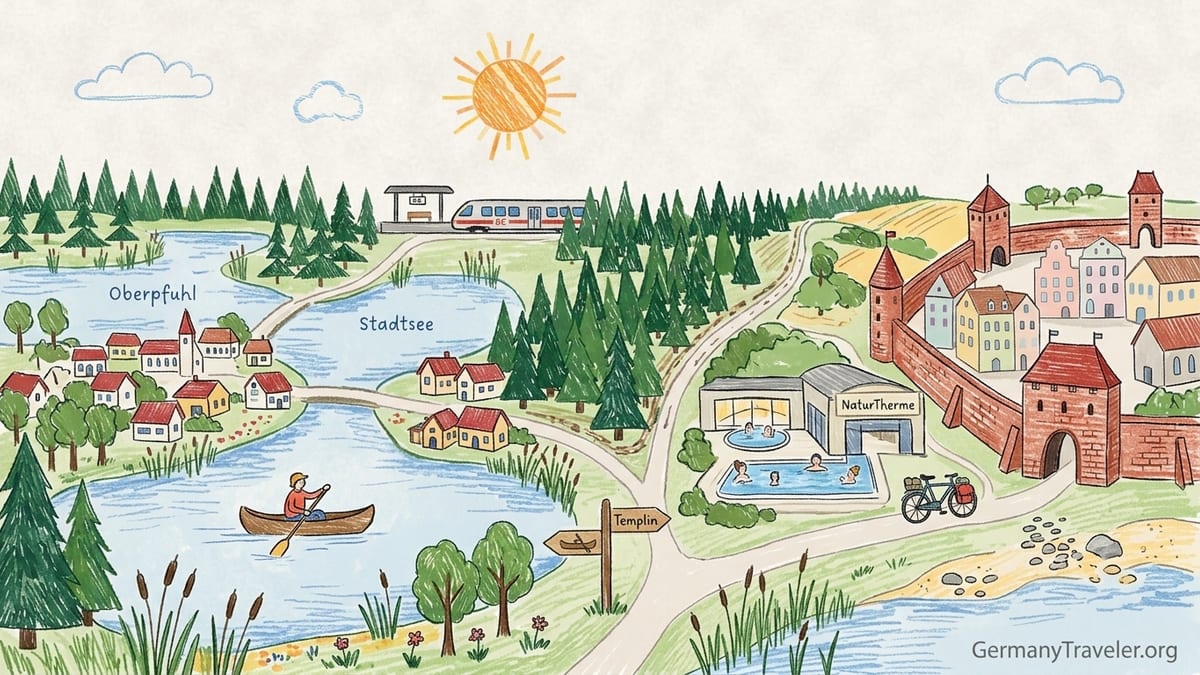
Choosing Uckermark Over Potsdam and Spreewald
The decision to head for the Uckermark started as a price check. When I looked at summer weekends to Potsdam and the Spreewald from Berlin Hauptbahnhof, rail connections were frequent and easy, but accommodation prices had crept up, especially near the historic centers and main waterways. At the same time, photos of the Uckermark showed big skies, quiet lakes and small towns that felt like they were still figuring out tourism rather than built entirely around it. Lychen in particular, branded locally as the “Flößerstadt” or raftsman town, sits within the Naturpark Uckermärkische Seen, surrounded by a cluster of lakes often called the Lychener Seenkreuz. That mix of water and forest sold me more than another manicured palace park.
There was also the appeal of contrast. Potsdam and the Spreewald are built around well-known highlights: Sanssouci gardens in Potsdam, and Spreewald’s canals lined with punts and cucumber stands. Lychen and Templin promised smaller pleasures: paddling across a lake that is busy only with grebes and weekend anglers, or walking a complete town wall while knowing there will be no tour groups around the next corner. I wanted to see how that played out over one real weekend in peak season, rather than treating Uckermark as an abstract “quiet alternative” on a list.
What tipped the balance finally was the combination of water activities and a rainy-day fallback. Templin has the NaturTherme, a thermal brine spa complex with indoor and outdoor pools and several saunas, where an adult day ticket without sauna in 2026 costs about 28 to 29 euros, rising to around 32 euros at weekends according to the official tariff. That meant even if the weather turned, there was somewhere genuinely relaxing to retreat to, rather than sitting in a café hoping the drizzle would stop.
I planned the weekend as a triangle: Berlin to Templin by train, Templin to Lychen by bus, then back to Berlin from Templin again. The order could easily be reversed, but starting in Lychen felt right, placing the lakes and boats first and keeping the medieval wall and spa as a gentle landing before returning to the city.
Getting There: Trains, Buses and First Glimpses of Water
I left Berlin on a Friday afternoon from Berlin Gesundbrunnen, which is one of the main departure points for regional trains heading into Brandenburg. The regional services towards Templin usually involve a change, often in towns like Löwenberg or Zehdenick depending on the current timetable, but the total travel time to Templin Stadt station comes in at around two hours. From central Berlin, a VBB day ticket that covers Berlin and the outer Brandenburg zones is still markedly cheaper than renting a car for a weekend, especially if you travel alone or as a couple.
From Templin Stadt, the weekend’s first compromise appeared before I even reached a lake. The bus connection to Lychen runs with line 517, which links Templin, Lychen and Fürstenberg/Havel. The official tourism information in Lychen describes it as the central public transport lifeline, and it is, but frequencies are modest: roughly every two hours during the day, with fewer services on Sundays and limited evening departures. I arrived between buses and had nearly 90 minutes to spare. In a city, that would be a lost hour. In Templin it became an appetizer: a short walk to the medieval wall, a first look at the town gates and a coffee on the quiet market square before heading back to the bus station.
The bus ride from Templin to Lychen takes about 30 minutes, mostly along forest roads, passing fields, small lakes and scattered villages. A standard single ticket within the regional tariff sits under 5 euros, and bikes can be carried on some services when space allows, though in high summer that is never guaranteed. By the time we approached Lychen, the road dropped slightly and the first glimpse of water appeared on the left, part of the lake system that almost encircles the town. The bus stop “Lychen Markt” sits a short walk uphill from the waterfront, and it is here that the difference from Potsdam or Spreewald becomes tangible: there is no station square bustle, just a small cluster of houses, a church tower and the faint smell of lake water down the hill.
For this trip I booked a small guesthouse in Lychen within walking distance of the Stadtsee lakeshore. Prices in high season tend to run from about 80 to 110 euros per night for a double room with breakfast in basic but comfortable pensions, and more for full-service hotels or holiday apartments. I paid just under 95 euros per night for a simple attic room with lake glimpses, which would have been difficult to match in equally popular corners of Brandenburg closer to Berlin.
First Evening in Lychen: A Quiet Town Wrapped in Lakes
By the time I checked in and dropped my bag, it was early evening. Summer days in Uckermark linger, but Lychen’s services do not. On this Friday in late August, air temperatures hovered around 24 degrees during the day and dipped to around 18 degrees by evening, which weather data for the area suggests is typical for the second half of summer. The nearby lakes, which reach average surface temperatures in the mid- to high-teens Celsius in August according to long-term climate analyses, still held enough warmth for a quick swim if you were willing to brace for a cooler first step.
I walked down to the Stadtsee shore. The lakes that form the Lychener Seenkreuz, including Stadtsee, Nesselpfuhl, Wurlsee and Großer Lychensee, clasp the town almost island-like. From the town center you can reach several small bathing spots and boat jetties within a ten to fifteen minute walk. On this evening, a family packed up an inflatable canoe while a pair of paddleboarders glided reluctantly back towards shore. The water was calm with only small ripples from passing ducks and the occasional angler’s boat heading in.
Lychen’s atmosphere at this hour feels far removed from Berlin. The waterfront is understated: a few piers, a small promenade in places, low houses behind. There is no neon, no loud music, and by 20:00 many cafés have already closed their kitchens or switched to a reduced menu. I had dinner at a simple lakeside restaurant, ordering a plate of local fish with potatoes for around 18 euros and a beer for 4 euros. Service was friendly but clearly winding down; by the time dessert might have sounded tempting, the kitchen was already cleaning down for the night. This is one of the practical drawbacks of choosing somewhere like Lychen for a weekend: if you arrive late or count on spontaneous late-night dining, you may find only one or two options open, and reservations on peak summer weekends are a good idea.
After dinner, I followed a narrow lakeside path past clusters of reed and the occasional small jetty reserved for guesthouses. Apart from a handful of people sitting on benches, the shore was quiet. The last light was still on the water at 21:00, dragonflies hovered over the reeds, and the distant sound of a dog barking floated across the lake. As promised, the rural tranquility was real; the trade-off was that, without a car or late-running bus, you were more or less committed to staying in town and keeping your evening simple.
A Day on the Water: Canoe Rental and the Lychener Seenkreuz
Saturday was reserved for the lakes. After breakfast, I walked down towards the Oberpfuhl lake, where several canoe rentals cluster. Lychen has become a modest hub for “Wasserwandern” or water hiking, with outfitters like Seenland Kanu, Treibholz and the Kanuvermietung at Kolbatzer Mühle offering canoes and kayaks along routes that tie Lychen into the surrounding lakes and, beyond, the Mecklenburg Lake District. I chose Treibholz on Oberpfuhlstraße, partly because it was within a ten-minute walk and partly because they specialize in quality touring kayaks.
Prices in summer 2026 for a one-person kayak with steering at Treibholz stand at around 30 euros per day, and a two-person kayak or small Canadian-style canoe at about 40 euros for the day, including paddles and life jackets. Another outfitter, the rental at Kolbatzer Mühle slightly outside town, offers two-person canoes from roughly 25 euros per day and single kayaks from just over 20 euros. The difference comes down to location and equipment. Because I was on foot and wanted a simple day trip starting and finishing in Lychen, convenience mattered more than shaving a few euros off the price.
After a short safety briefing that emphasized keeping a respectful distance from reed zones and bird nesting areas, I launched into the Oberpfuhl. The weather cooperated: scattered clouds, mostly sunshine, and afternoon highs around 25 degrees, with only a light breeze. The water surface was mostly smooth, reflecting spruce and pine forests in long green bands. Given recent environmental restrictions, one popular nearby lake section, the Dreetzsee, is no longer available as part of the standard Feldberg to Lychen water trail, so outfitters now suggest circular or there-and-back routes entirely within the Lychener Seenkreuz and its linked lakes.
I paddled slowly along the shore, passing wooden boathouses and a campsite tucked among trees, then crossed towards a narrow channel linking to another lake. Traffic was light: a couple in a red canoe, a family in a large Canadian canoe, and a group of teenagers on a guided tour. Motorboats are limited here, so the soundtrack is mostly water against the hull and the occasional call of a grebe. Watching dragonflies skate above the surface, it was easy to forget how close Berlin is in absolute distance, barely 100 kilometers away.
Stopping for lunch, I pulled up at a small public landing spot and unpacked sandwiches I had bought in Lychen earlier that morning. This is another area where rural reality intervenes. Outside peak weekends, and especially before 11:00, bakeries and small supermarkets keep shorter hours or close for a midday pause. For a full day on the lakes, planning ahead for food and water is essential. There are a few lakeside restaurants and guesthouses with jetties, but counting on them without checking opening times can leave you hungry mid-afternoon.
Cycling Forest Roads and Returning to Lychen
In the afternoon, I returned the kayak and switched to two wheels. Lychen lies on several regional cycling routes, and hiring a bike is easy through guesthouses or small local outfitters, usually for around 10 to 18 euros per day depending on the bike’s quality. I paid 15 euros for a sturdy trekking bike and set out on a loop that would take me south towards Rutenberg and back.
The route I actually rode began by following a minor road out of Lychen towards Rutenberg, roughly 10 kilometers away, with gentle undulations and little motor traffic. This is not a manicured cycling superhighway, but a mix of asphalt, compacted gravel and short sandy patches where tires can squirm. Forest alternates with open fields, and every few kilometers a side track dives off towards another lake. About halfway, a simple wooden sign pointed to a small bathing spot on a side lake; I pushed the bike down the track, locked it to a tree and walked the last meters to the water. The shore here was completely unmarked, just a narrow strip of sand, scattered pine cones and a makeshift fire ring that suggested local use rather than official designation.
From Rutenberg I turned north-east on minor roads and then followed forest tracks back towards Lychen, completing a loop of around 28 kilometers in total. While it looked straightforward on the map, the reality involved reading small waymarks on trees and occasionally checking my offline map when tracks forked unexpectedly. Mobile reception in the forest can be patchy, especially with some operators, which matters if you are counting on always-on navigation. I met two other cyclists in the space of an hour, both carrying panniers and likely on multi-day trips. We compared notes briefly on the surface conditions ahead and the fact that some small café marked on older cycling maps had recently closed.
Back in Lychen, the town felt almost busy by its own standards. Weekend visitors strolled the market square, a handful of people sat outside the remaining open café, and a small group queued at an ice cream counter. I returned the bike, showered off the day’s sunscreen and lake water, and went out in search of dinner. Once again, the tranquil atmosphere and the limited evening dining went hand in hand. One restaurant was closed for a staff holiday, another was fully booked, and the place I eventually chose had a small sign explaining that the kitchen would close at 20:30 even on Saturday. The meal itself, another fish dish with salad and a glass of white wine for roughly 24 euros total, was excellent. Yet the experience underlined that in Lychen it pays to book ahead and accept that nightlife is not on the menu.
Templin: Medieval Walls, Gates and a Modern Spa
On Sunday morning I caught the late-morning bus back to Templin, again with line 517, and checked into a small hotel near the historic center for one night. The ride followed the same forest-framed route but in reverse, and once more it struck me how dependent non-drivers are on this single bus line. Miss a departure and you have a long wait, particularly on Sundays when frequencies drop. With a car, the journey from Lychen to Templin takes about 25 minutes; by bike it is a pleasant but longer ride of just over 20 kilometers, partly on forest tracks.
Templin itself has a completely different feel to Lychen. Where Lychen spreads softly along its lakeshores, Templin presents a compact old town still wrapped in a nearly complete medieval brick wall with town gates and towers. Walking the perimeter on the inside takes about 30 to 40 minutes, more if you stop at every tower and gateway. The wall gives the center a defined shape, and within it the streets are narrow and low-rise, with pastel-colored houses and a central market square anchored by the town hall.
I spent the late morning exploring the wall and gates, entering through one tower and exiting by another, then crossing a short footbridge over the moat-like lake on one side. Unlike many larger historic towns, there were no groups following flag-waving guides. Signage is modest, so a small printed town map or downloaded guide helps to make sense of the different gates and their history. This quietness is a double-edged sword for visitors. You get space and calm, but if you are hoping for several museums, galleries or a busy café culture within the walls, you may find options limited, especially on Sundays when some businesses close entirely.
After a simple lunch of soup and bread at a café just off the square for about 10 euros including a drink, I walked the 20 minutes out to the NaturTherme on Templin’s edge. The approach is anything but medieval: a modern complex of glass and low buildings with a spacious car park out front. Inside, the atmosphere is relaxed and family-friendly rather than hushed. The thermal brine pools, with water temperatures generally around 30 to 32 degrees Celsius, are set among artificial rocks and jets, and on the day of my visit a steady stream of families, couples and a few solo wellness seekers moved between indoor and outdoor sections.
I bought an adult day ticket without sauna for just under 30 euros, storing my clothes in a locker and renting a towel for a small extra fee at the counter. Prices change periodically, but in 2026 an adult day pass sits in the high twenties on weekdays and low thirties on weekends, with supplements for sauna access. For anyone considering Uckermark largely for nature, the spa might sound like an unnecessary extra. In reality it ties the weekend together: after days on sometimes cool lakes, having a reliably warm pool and whirlpools to soak in felt like a luxury, and on less sunny weekends it becomes a strong fallback option.
Cycling Around Templin’s Lakes and Heading Home
Late afternoon brought a change in light and energy. After several hours in warm water, I wanted some movement again, so I hired a city bike from a rental shop near the station for about 12 euros for half a day. My aim was not to tick off a mapped cycling route but to follow the actual paths around the nearest lakes. From the town center, I rolled out past the wall and joined a lakeside path that skirts one of the small bathing lakes just beyond the historic core.
The circuit I ended up riding traced the edge of a lake, ducked in and out of light forest and passed a couple of small official bathing spots, each with a patch of sand, a few benches and occasionally a simple changing hut. Families packed up folding chairs as the day cooled, and a group of teenagers made last use of a small floating platform anchored a short swim from shore. In total the loop measured only around 12 kilometers, but surface conditions varied from smooth asphalt to tree-root-lifted path and a stretch of cobblestones near one village. Unlike some glossy route descriptions, the reality of cycling in and around Templin involves sharing paths with walkers, paying attention to occasional car traffic on narrow roads and being ready to slow down often.
Back in town, I returned the bike and picked up my small bag from the hotel before walking to Templin Stadt station. Evening regional trains back towards Berlin can be quieter than morning departures, but services are not hourly in all directions, so it is wise to check the timetable and aim for a specific departure. My connection took just under two hours, with one change, and cost less than 20 euros with a regional ticket. As the train rolled back into the denser suburbs of Berlin, the last images of the weekend were of sun on still lakes, pine forests and the sense of having been somewhere that still treats visitors as guests rather than a constant stream.
Looking back, the combination of Lychen’s lakes and Templin’s medieval shell made the Uckermark feel roomy despite its small population. The practical drawbacks were also clear: sparse evening dining, limited public transport and a need to plan around opening hours. Whether those trade-offs are acceptable depends heavily on how much you value uninterrupted quiet.
The Takeaway
For a two- or three-day escape from Berlin, basing yourself around Lychen and Templin delivers on the promise of water, forest and small-town atmosphere, but only if you go in with realistic expectations. In Lychen, lake activities are the heart of the experience. Renting a canoe or kayak costs in the range of 25 to 40 euros per day depending on the boat and provider, and spending six or seven hours meandering among the interconnected lakes feels like time genuinely away from urban rhythms. Water temperatures in late summer are cool but inviting, and the near absence of motorboats keeps noise down to paddles and birds.
Templin adds a different layer. The intact medieval wall, gates and compact old town create a sense of structure and history, while the NaturTherme provides a modern, comfortable way to recover from long days outdoors or rescue a rainy weekend. At roughly 30 euros for a day ticket, it is not cheap, but as a once-per-trip splurge it rounds out the experience and offers something for travelers who value wellness as much as wild lakes.
On the cost side, my own weekend broke down roughly as follows for one person: about 90 to 100 euros per night for accommodation across three nights, around 60 euros total for train and bus travel from and to Berlin, approximately 35 euros for a full day’s kayak rental, 15 euros for a day of bike hire, around 30 euros for the spa day ticket and another 80 to 100 euros for meals and café stops. Adding small extras like entrance fees and snacks, the total for the weekend landed near 380 to 420 euros without any major luxuries. Traveling as a couple and sharing accommodation would spread some of those costs more favorably.
The remaining question is transport. Does renting a car make the trip enough easier to justify the extra cost and environmental impact? For solo travelers on a relaxed schedule, the answer leans towards no. The combination of regional trains and the 517 bus line, plus bike rentals, is sufficient if you are comfortable planning around fixed timetables and accepting that once you are in Lychen for the evening, you stay there. For families with children, groups, or anyone traveling outside the main season when bus frequencies may drop further and canoe rentals shorten their operating months, a car can significantly improve flexibility. It opens up smaller lakes, dispersed guesthouses and restaurants that are simply unreachable otherwise, and it makes late arrivals or early departures less stressful.
If your ideal weekend centers on spontaneous dinners at 21:30, varied nightlife and frequent rail departures, Uckermark will likely feel too quiet and constrained. If, on the other hand, your priority is to paddle across a nearly empty lake at your own pace, cycle forest lanes where you may not see another person for twenty minutes, and end the day in warm brine under a darkening Brandenburg sky, then a weekend around Lychen and Templin is worth choosing over the more polished appeal of Potsdam or the Spreewald. Just book your dinners ahead, pack a timetable, and decide in advance whether you want to be at the mercy of a single bus line or prefer the keys to a rental car in your pocket.
FAQ
Q1: How long does it take to get from Berlin to Lychen by public transport?
From central Berlin to Lychen via Templin or Fürstenberg/Havel typically takes around two and a half to three hours, including at least one train change and the regional bus line 517 for the final leg.
Q2: Do I need to book canoe rentals in Lychen in advance?
In peak season from late spring to early autumn it is sensible to reserve a canoe or kayak at least a few days ahead, especially for weekends, as rental fleets can be fully booked on sunny days.
Q3: How much should I budget for a day of canoeing?
Expect to pay roughly 25 to 40 euros per day for a canoe or kayak, including paddles and life jackets, depending on the size of the boat and the rental company.
Q4: Is the water warm enough for swimming in summer?
In July and August lake surface temperatures in the Uckermark are usually in the mid-teens to low twenties Celsius, cool but comfortable for most swimmers on warm, sunny days.
Q5: Are there vegetarian or vegan dining options in Lychen and Templin?
Both towns offer some vegetarian choices, often salads, pasta or vegetable dishes, but dedicated vegan options are limited, so travelers with strict diets may want to bring some supplies or check menus in advance.
Q6: How family-friendly is the NaturTherme in Templin?
The NaturTherme is geared towards families, with warm pools, slides and shallow areas for children, alongside quieter zones and sauna areas better suited to adults seeking relaxation.
Q7: Can I manage this weekend trip without renting a car?
Yes, it is entirely possible using regional trains and buses, but you will need to plan carefully around bus times and accept limited flexibility in the evenings and on Sundays.
Q8: When is the best season to visit Lychen and Templin for outdoor activities?
Late spring through early autumn, roughly May to September, offers the best combination of open canoe rentals, pleasant air temperatures and longer daylight hours for cycling and walking.
Q9: Is cycling around Lychen and Templin suitable for beginners?
Most routes use quiet roads and forest tracks with gentle gradients, which are manageable for reasonably fit beginners, though occasional sandy patches and uneven surfaces require some confidence.
Q10: How many days should I plan for a balanced visit?
A long weekend of two or three days is enough to spend a full day on the lakes around Lychen, explore Templin’s old town and walls, and enjoy at least half a day at the spa without rushing.