

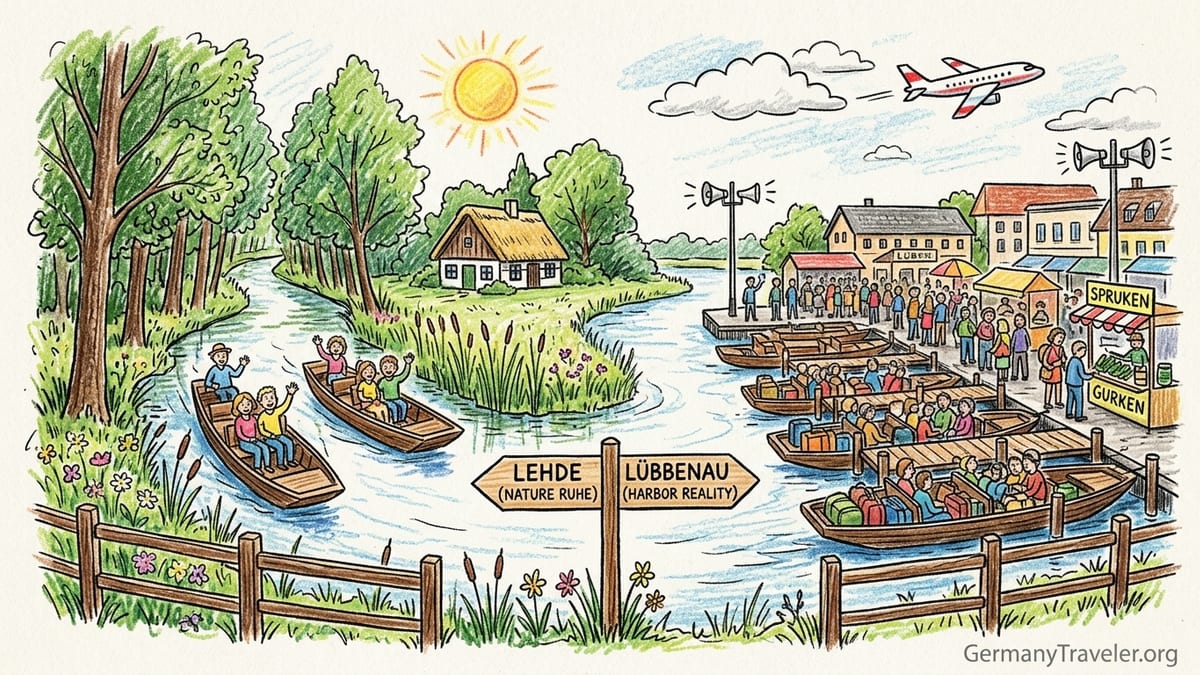
On a still summer morning I arrived in Lübbenau with a very specific picture in mind: a narrow wooden punt gliding almost silently through green corridors of reeds, maybe six or eight people on board, birdsong the loudest sound for hours. After years of seeing those tranquil Spreewald images in brochures and on social media, I had finally booked my own Kahnfahrt. What I found at Lübbenau’s Großer Hafen, the region’s classic departure point, was something far more commercial and crowded than the peaceful marketing suggests.
The Promise of a Spreewald Kahnfahrt vs. the Harbor Reality
I chose Lübbenau’s Großer Spreewaldhafen on purpose. It is the historic heart of organized tourism in the Spreewald and still the busiest starting point for boat trips into the biosphere reserve. Prices there in 2026 for the standard three hour “Rundfahrt Lehde” are listed at 20 euros per adult and 11 euros per child, with shorter two hour options a little cheaper, and longer Schleusen or Hochwald tours costing up to the high 30s or low 40s per adult. That felt reasonable for what is marketed as an immersive nature experience.
Arriving around 10:30 on a sunny August Saturday, the first surprise was not the boats but the density of people. Instead of a quiet riverside landing, the Großer Hafen functions almost like a small open air bus terminal for punts. There were several dozen Kähne moored side by side, captains calling out departure times, and a public address system announcing tours. The soundscape was a mix of clattering boarding ramps, rolling suitcase wheels and families debating which route to choose.
It is important to say that this is not some accidental side effect. Lübbenau’s main harbor is deliberately set up for volume. Operators advertise departures roughly from 11:00 “flexibly nach Auslastung,” which in practice means that in high season boats leave as soon as the benches are filled. Brochures celebrate the breadth of daily departures. That convenience is a strength for visitors who want to show up and go, but it is the first crack in the illusion of a quiet, contemplative waterway.
Standing near the ticket boards, my own expectations began to shift. Yes, I would still be in a wooden punt, but clearly I was joining an industrialized flow of nature excursions. The question became not whether the Spreewald is beautiful, but how much of that beauty you can realistically feel when you start from one of its most heavily trafficked hubs.
Waiting, Boarding and the Hidden Cost of the “Classic” Route
For my three hour Lehde round trip I bought a seat on one of the shared boats that form the backbone of operations in Lübbenau. I paid 20 euros in cash at a central ticket counter which coordinated with several captains. By the time my ticket was processed it was 10:45, and I was directed to one of several boarding piers. The sign said the boat would depart “sofort nach Besetzung,” essentially as soon as it filled.
The actual waiting time was about 35 minutes. That is still within any reasonable tolerance for a popular attraction, but it did mean that almost an entire quarter of the advertised three hours passed before the pole even touched the water. The waiting itself was not unpleasant, yet it played out in a tightly packed zone. Lines for multiple routes snaked across the same space, loudspeaker announcements overlapped, and every few minutes another group of 20 to 26 passengers shuffled down a narrow gangway to board a Kahn.
Boarding confirmed what the harbor vibe had suggested. My boat, a classic Spreewaldkahn with bench seating, was filled to capacity. The benches themselves are narrow, backrests are short, and the legroom is tight once every place is taken. That design has tradition on its side, but less so ergonomics, especially for taller or older passengers. By the time everyone had stowed backpacks and found a position, shoulders and knees were almost touching on both sides.
Only when we were finally pushed away from the quay at 11:20 did I realize how much of my “three hour Kahnfahrt” would be spent in close quarters. The ticket price in Lübbenau is competitive with other harbors, but the hidden cost is that you pay not only for scenery but for long stretches of social proximity, including the noise that inevitably comes with it.
On the Water: Between Nature Experience and Boat Convoy
The first 20 minutes along the main channel leaving Lübbenau were, bluntly, traffic. Our Kahn slotted into a steady queue of boats, each one just a few punt lengths ahead of the next. Conversations from at least three neighboring craft were clearly audible. Individual captains tried to keep their commentary low and local, but the combined voices of perhaps 80 or 100 passengers in immediate proximity created an atmosphere closer to a river festival than a quiet nature excursion.
There were glimpses of the Spreewald the brochures promise. Where side channels branched off and the vegetation pressed tighter against the water, the cans of beer, smartphone cameras and excited children fell momentarily silent. But those interludes were relatively brief on my midday departure. The fixed route toward Lehde followed designated waterways that can support commercial traffic, and on a prime season Saturday that means you are rarely alone on the water for more than a minute or two.
The convoy effect peaked at the first small lock. Here, multiple loaded punts arrived in close succession and waited their turn. Lock passages are part of the charm for many passengers and the captains handle them with practiced ease. Yet the bottleneck compressed several boatloads of people into a very small acoustic space. The lock keeper’s instructions, captains’ jokes and tourist chatter bounced off the water. It was convivial, even fun, yet far from the softly rippling tranquility of the posters that had drawn me here.
One could argue that solitude is an unreasonable expectation on a well known route in high season. I agree, and I do not fault any individual operator for meeting evident demand. Still, it is worth being honest about the trade off. If you start at Großer Hafen between roughly 10:00 and 13:00 on a sunny weekend in summer, you are buying into a social group experience on the water rather than personal communion with the biosphere reserve.
Fixed Routes, Commercial Stops and the Limits of Freedom
Part of my disappointment came from realizing how constrained a standard Kahnfahrt is. The Spreewald is a maze of narrow channels, yet as a passenger on a shared punt you cannot simply ask the captain to explore a quieter arm or linger in a bird rich backwater. Your route follows what licensing, water level management and group schedule allow. In Lübbenau these routes are well defined. The three hour Lehde tour includes at least one commercial stop in a village or restaurant area, and any variation tends to be minor.
There are sound reasons for this. The Spreewald is both UNESCO biosphere reserve and a network of regulated waterways. Local rules limit which channels commercial boats may use, under which conditions motors are allowed and at what times of day passenger traffic can operate. Not every romantic looking side canal is open to group tours. Channels can be seasonally closed for habitat protection or weed cutting. Even where use is allowed, larger punts need a certain width and depth to pass safely with a full load.
On my tour the scheduled stop came after about ninety minutes of actual travel time at a cluster of restaurants and kiosks in Lehde. Visitors could buy the iconic pickles, order a plate of Kartoffeln mit Quark or an ice cream, visit a small open air museum or simply sit by the water. It was, in itself, a pleasant enough place. Yet it was unmistakably commercial. Multiple boats docked and unloaded almost simultaneously, queues formed at the most popular food stands, and the quiet of the surrounding meadows stayed at a distance behind the clink of plates and the whirr of coffee machines.
The captain had to keep to a turnaround schedule. Our stop was 40 minutes long, which made it just enough time to use the restroom and grab a snack, but not to wander off onto one of the walking paths that lead deeper into nature. Watching the crews coordinate departure slots, I understood that these tours are essentially fixed packages. The trade for convenience and safety is a loss of personal agency. If you want real exploratory freedom in the Spreewald, you likely need to rent a paddle boat or arrange a truly private Kahnfahrt that is willing and permitted to deviate from the standard loops.
Comfort, Group Dynamics and How “Intimate” It Really Feels
Even if you accept a fixed route and scheduled stop, the quality of a Kahnfahrt still depends a lot on what happens on board. Here the experience from Lübbenau’s main harbor can be mixed. My captain was skilled and informative. He pointed out traditional farmsteads, explained water level management and told stories about Sorbian customs. His voice, however, had to compete constantly with conversations among fellow passengers and with commentary drifting over from other boats running alongside or just behind us.
On a full shared punt the social tone is largely set by whoever occupies the most space vocally. On my trip it was a trio of friends who treated the excursion like an outdoor living room. They were friendly enough, but between open bottles, loud laughter and running commentary about houses along the bank, any potential for meditative silence disappeared. Earshot is inescapable at this density. If one group turns up the volume, everyone shares that choice.
Physical comfort interacts with this social factor. Traditional bench seats without much contour or padding are manageable for an hour or two, but by the third hour many passengers shifted repeatedly in search of relief. Narrow spacing meant each adjustment interfered slightly with a neighbor. In cooler weather operators sometimes provide blankets, yet there is only so much they can do about basic ergonomics on a hull originally designed for cargo and agricultural use.
That said, there were moments of intimacy. When the channels narrowed and overhanging trees muffled external sound, when our boat had a hundred meters of water to itself, a different mood settled. In those windows the gentle rasp of the pole against the gravel bottom and the subtle steering shifts felt almost hypnotic. Dragonflies skimmed the surface and ducks watched us pass. The problem was not that such moments did not exist, but that they had to be savored between stretches of chatter, traffic and scheduled logistics.
Comparing Lübbenau with Quieter Departure Points
To see whether the crowded feel was inherent to all Spreewald punts or specific to Lübbenau’s main harbor, I visited Burg on a separate day, focusing on the Spreehafen area and the smaller harbors nearby such as the Kleiner Spreewaldhafen and a couple of landing stages out in Burg-Kauper. Burg has invested heavily in Kahnfahrten, but its dispersed “Streusiedlung” layout means the traffic spreads out more. Even on a busy afternoon, the harbor there was significantly less congested than Großer Hafen in Lübbenau.
Price wise the differences were small. Two to three hour tours from Burg’s main harbors were broadly comparable, hovering in the high teens to around 20 euros per adult for standard daytime routes. What changed was the atmosphere at the pier and on the first kilometer of water. Instead of a near continuous convoy, there were often only one or two other boats in sight. This matched the marketing claim that Burg is somewhat quieter and more “streusiedlung” focused, with fewer massive group arrivals from coach tours.
Further out, small landing stages in Burg-Kauper or at harbors labeled as being “abseits vom Haupt-Tourismus-Strom” felt more in tune with the Spreewald imagery so often used to sell the region. They typically used smaller boats, sometimes with local captains who knew many houses along the bank by name. Departures there are less frequent and often require prior booking, but passengers stepping on board shared more of an expectation of calm.
Speaking with captains in both Lübbenau and Burg confirmed that Lübben, Schlepzig and Alt Zauche occupy something of a middle ground. They see seasonal peaks but rarely the same level of concentration as the classic Lübbenau harbor funnels through its main piers. If your priority is hearing birdsong over group banter, moving a little away from the flagship departure point tilts the odds in your favor, though it does not guarantee solitude.
Why the Spreewald Cannot Be a Free-for-All Playground
To be fair to operators, many of the constraints that shape a Kahnfahrt have less to do with commercialization and more to do with environmental regulation. The Spreewald is an intricate wetland. Its network of “Fließe” supports not only tourism but also traditional agriculture, fish spawning grounds and sensitive habitats. As a result, Brandenburg’s navigation and nature protection rules specify which waterways are open to which kinds of craft, and at which times commercial tours may operate.
Passenger punts that carry tourists count as commercial traffic. They have to abide by limits on group size, nighttime operations and motor use. Certain narrow or ecologically sensitive channels are entirely closed to larger boats or only open in one direction or during certain months. Locks and weirs are managed to maintain water levels not just for tourism but also for irrigation and flood control. If every captain simply took whichever side arm looked prettiest on a given day, the combined effect of dozens of boats might quickly damage banks, disturb breeding birds or conflict with other users such as small scale anglers.
Viewed through this lens, fixed routes and standardized stopovers take on a more understandable logic. Concentrating boat traffic along a set of robustly maintained channels and at a limited number of landing places contains the ecological footprint and makes it easier for authorities to monitor impacts. The downside for visitors is predictability. You share your route not only with other punts but sometimes also with organized canoe tours, and you are unlikely to slip into some unmapped backwater far from human influence.
This does not mean visitors are locked out of a more personal Spreewald encounter. Paddlers operating small canoes or kayaks under their own power, or hikers following towpaths between villages, may access areas unsuited to larger boats, albeit still within the bounds of local rules. Some Kahn operators hold special certifications that commit them to more environmentally sensitive practices, including avoiding particularly fragile channels. The key point is that the biosphere status is not mere branding. It legitimately limits how free commercial tours can be, no matter how adventurous their brochure language sounds.
The Takeaway
By the time my Kahn returned to Lübbenau’s Großer Hafen, the full circuit had taken just under three and a half hours from scheduled departure to final docking. Of that, roughly three hours were on the water and about forty minutes were spent at the Lehde stop. The cost came to 20 euros for the ticket plus around 10 euros for a snack and drink during the break. Taken purely as value per hour of activity, it was hard to complain. Yet compared to the tranquil, almost solitary experience I had imagined from years of photos and brochures, it fell noticeably short.
What failed to match expectations was not the landscape. The Spreewald’s low meadows, alder stands and narrow water lanes are exactly as atmospheric as the images suggest when you can focus on them. Nor was it the captains, who in my experience handled their boats with skill and often good humor. The main gap lay in scale. Starting from Lübbenau’s busiest harbor at a prime time in high season places you in the middle of a mass nature experience, which changes the feel from meditative to social.
If I were to plan again, I would treat Lübbenau’s Großer Hafen as a trade off: the place for easy access and classic routes, best tackled on a weekday outside the peak summer window, ideally in the early morning or in the softer light of a late season afternoon. I would look more seriously at departures from Burg’s quieter harbors, from Lübben or Schlepzig, or from small outlying landing stages that explicitly advertise themselves as away from the main tourist stream. I would consider paying extra for a smaller shared boat or a private charter where group size and mood can be shaped more deliberately.
Is the Spreewald overrated? The landscape itself, no. The expectation that any Kahnfahrt from the most famous harbor will feel like a private journey into untouched nature, yes. A traditional punt ride remains worth paying for if you calibrate timing and departure point to your tolerance for crowds, remember that environmental rules shape where you can go, and accept that on popular routes you are sharing both the boat and the moment with many others. With that realism in mind, the slow rhythm of the pole and the water can still cast a quiet spell, even if you have to listen for it between the voices.
FAQ
Q1: Is a Kahnfahrt from Lübbenau’s Großer Hafen still worth doing?
Yes, if you want an easy, classic introduction to the Spreewald and you do not mind sharing the experience with many other visitors, especially in high season.
Q2: How much should I expect to pay for a standard Kahnfahrt in 2026?
For a shared three hour tour from a major harbor such as Lübbenau or Burg, expect around 20 euros per adult, with longer themed or lock tours costing more.
Q3: How crowded does it really get at Lübbenau’s main harbor?
On sunny weekends from late spring to early autumn, several full punts may depart within minutes of each other and waiting areas can feel like a small outdoor bus station.
Q4: Can I ask the captain to change the route during a shared Kahnfahrt?
Usually not. Shared tours follow fixed routes that comply with local waterway regulations and scheduled stopovers, so individual route changes are rarely possible.
Q5: Will I see wildlife on a busy standard tour?
You will likely see ducks, herons and smaller birds, but the constant passage of boats and general noise mean encounters with shyer animals are less common on main routes.
Q6: Which departure points feel quieter than Lübbenau’s Großer Hafen?
Smaller harbors in Burg, Burg-Kauper, Alt Zauche or Schlepzig generally feel less crowded, especially outside peak hours, though they still see seasonal busy periods.
Q7: When is the best time of day for a more peaceful Kahnfahrt?
Early morning and later evening departures outside school holidays are usually quieter than late morning and early afternoon slots on weekends in midsummer.
Q8: Are private punts much more expensive than shared boats?
Private charters typically cost more overall but can be good value for small groups, allowing more control over group size, atmosphere and sometimes route emphasis.
Q9: Why can’t boats just use any canal they like in the Spreewald?
The area is a protected biosphere reserve with rules that restrict commercial traffic to certain waterways to protect banks, habitats and breeding areas from overuse.
Q10: Should I choose a Kahnfahrt or rent a canoe for a quieter experience?
If you are comfortable paddling and can navigate with a map, a canoe offers more independence and potential solitude, while a Kahnfahrt provides guided commentary and less effort.