

I arrived in Berlin with the smug satisfaction of a traveler who has done their homework. I had my Deutschlandticket on my phone, a neat grid of VBB regional lines saved offline, and a romantic plan to criss-cross Brandenburg for a week without ever touching a steering wheel. The brochures promised “good connections” and “strong public transport links” to lakes, rivers and quiet villages. What I actually found, moving step by step from easy destinations like Potsdam to tiny hamlets in the Uckermark and Westhavelland, was more complicated. Brandenburg without a car is possible, but the effort, waiting and uncertainty are far greater than most travel guides suggest.
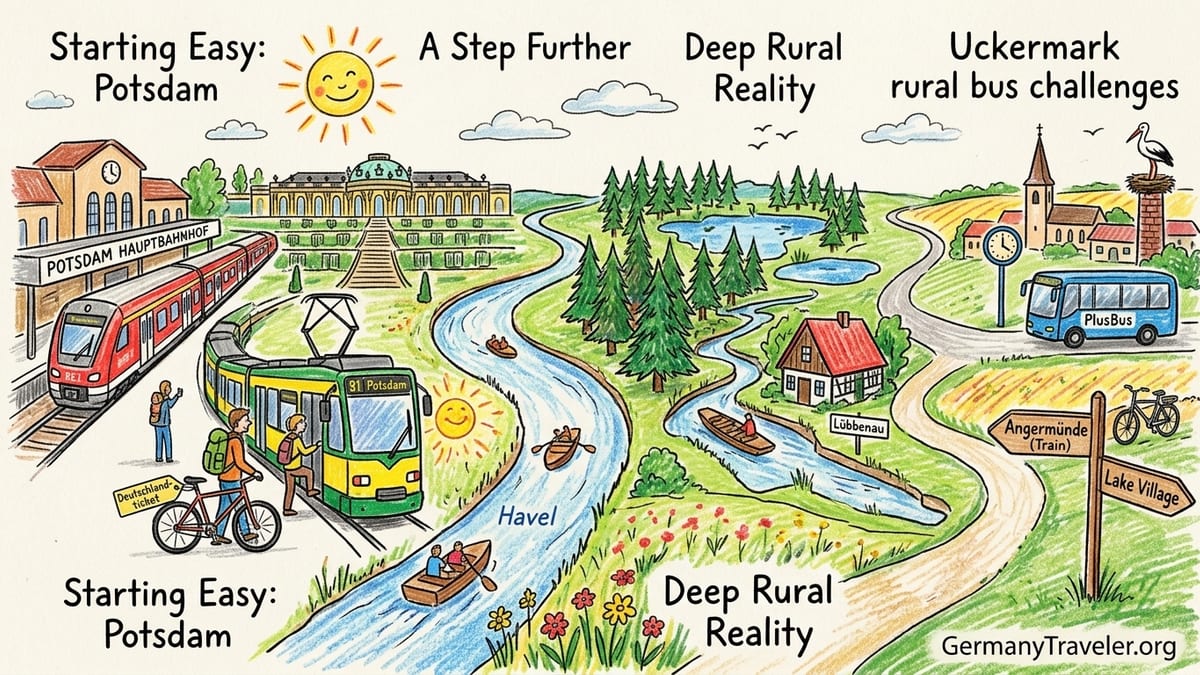
Starting Easy: Potsdam as the Benchmark
Like many visitors, I tested my assumptions close to Berlin. Potsdam is the obvious benchmark because, on paper, it behaves almost like an outer Berlin district. I left Berlin Hauptbahnhof shortly after 09:00 on a weekday, boarded an RE1 towards Magdeburg, and 27 minutes later stepped out at Potsdam Hauptbahnhof. The train runs at least every 30 minutes in the daytime, usually more often when you count the overlapping S7 and additional regional services. Even if you miss the RE1 by a minute, there is almost always another option in 10 to 20 minutes.
From Potsdam Hauptbahnhof, tram line 91 carried me to the Dutch Quarter, while tram 93 took me towards Park Sanssouci. The trams arrive roughly every 10 minutes during the day and still every 20 minutes in the evening. I never checked a timetable more than casually; I simply walked to the stop and something came. That “turn up and go” feeling is what most guidebooks mean by “good public transport.” Potsdam genuinely deserves that label.
Crucially, the safety net remains in the evening. Returning to Berlin after dinner at around 21:30, I caught an RE1 with a scheduled journey of under half an hour, with another following within 30 minutes. Missing a train did not feel like a crisis. The worst case was another drink in Potsdam or a quiet wait on a lit platform where all departures are clearly displayed.
This Berlin–Potsdam corridor is where the Deutschlandticket shows its best side. For 49 euros a month according to federal regulations in place since 2025, it covers almost all local and regional public transport in Germany, including VBB regional trains, S-Bahn, U-Bahn, trams and buses in Berlin and Potsdam. It is digital, cancellable monthly and valid on second class only. In Potsdam, it behaves as advertised: tap in, hop on and forget about fares. The problem is that Potsdam is the exception, not the rule.
A Step Further: Brandenburg an der Havel by Rail
My next test was Brandenburg an der Havel, about 70 kilometers west of Berlin. The RE1 regional express line links Magdeburg, Brandenburg, Potsdam and Berlin in an approximate 30-minute pattern on weekdays, though in 2026 the timetable is complicated by construction and the temporary loss of some peak extras. The journey from Berlin Hauptbahnhof to Brandenburg Hbf currently takes roughly 45 to 55 minutes, depending on the exact train. It is still a straightforward rail trip and fully covered by the Deutschlandticket, but the safety net is already thinner than to Potsdam.
I left Berlin shortly after 10:00 on a weekday, reached Brandenburg an der Havel just before 11:00, and then faced the next question: how to reach the lakes north of town without a car. Inside the city, there is a small tram network and several city bus lines. Trams 1 and 2 connect the old town, the station and the Havel waterfront at intervals of around 10 to 20 minutes during the day. This makes exploring the historic centre, cathedral island and waterfront relatively easy.
The challenge arrived when I tried to reach a lakeside settlement on one of the outer lakes for an afternoon hike. The regional bus I needed ran only every 60 minutes in the early afternoon and then dropped to every 120 minutes later. Miss the 14:15 departure and you are not looking at an urban-style 10-minute wait, but an hour on a bench opposite a supermarket. On Saturday the frequency was slightly reduced again; on Sunday it was skeletal, with some journeys not operating at all.
On the return leg, I started watching the clock nervously already at 17:00, with dusk due around 18:00 in autumn. The last realistic bus back to Brandenburg Hbf that still met an evening RE1 to Berlin left before 19:00. Theoretically, there was a later bus, but that one would have left me with a long, cold wait at the station for a late-evening train, and any delay could have meant arriving back in Berlin close to midnight. The guidebooks tend to describe Brandenburg an der Havel as “well connected by regional trains,” which is true for the city itself. Once you add a lake or a small village, the reality changes sharply.
Spreewald in Practice: Lübbenau as an Excursion Base
Encouraged by the relative success of my Brandenburg an der Havel trip, I chose Lübbenau in the Spreewald as a classic excursion. This is where the RE2 and the newer RE20 regional express lines enter the story. According to the current VBB and DB Regio timetables, the RE2 runs hourly between Nauen, Berlin and Cottbus, with Lübbenau as a key stop, while the RE20 now supplements it between Berlin Hauptbahnhof, the BER Airport, Lübben and Lübbenau. Together they provide roughly two regional express trains per hour from Berlin to Lübbenau during the daytime, although exact times and stopping patterns are shaped by ongoing construction and will shift again after December 2026.
On a Saturday, I boarded an RE20 at Berlin Hauptbahnhof a little after 09:00. Despite the train’s detour via the airport and the Dresdner Bahn, I reached Lübbenau in around 1 hour 15 minutes, which is competitive with driving in free-flowing traffic. The stadium atmosphere inside the double decker train, packed with hikers and paddlers, told its own story. The Spreewald is one of the few Brandenburg destinations where public transport demand is obviously high enough to justify the enhanced service.
From Lübbenau station, the town centre and the Spreewald harbour are roughly 15 to 20 minutes away on foot, or a short ride on a local bus run by the regional operator. I chose to walk, threading through a mix of 1980s apartment blocks and tidy detached houses before reaching the tourist-focused centre. Here, the no-car plan worked perfectly: I rented a paddle boat within five minutes of arrival and was in the labyrinth of canals by late morning.
The problems started again when I looked at the return journey in detail. In summer, extra evening trains sometimes run, but outside peak season the last convenient RE2 or RE20 back towards Berlin can leave Lübbenau before 21:00. There may be later trains towards Cottbus or Berlin on certain days, but the pattern is not uniform, and during the current period of extended construction between June and December 2026, departure times change enough that you must re-check them close to travel. On my Saturday visit, I had to end a relaxed Spreewald dinner abruptly at 19:30 and walk briskly back to the station for a train around 20:10. The next reasonable Berlin-bound option was close to an hour later and significantly busier.
Sunday is even more fragile. While the RE2 still runs hourly, and the Deutschlandticket is fully valid on it, local buses from outlying Spreewald villages back to Lübbenau or Lübben often thin out sharply after 17:00. A missed bus in a village like Raddusch can translate into over an hour of waiting on a quiet roadside under darkening trees, with no streetlights at the stop itself. The national ticket and dense mainline timetable cannot fix a last-mile gap that simply is not scheduled.
When PlusBus Helps – And When It Does Not
At this point, I turned to one of the official success stories of rural transport in Brandenburg: the VBB PlusBus network. The PlusBus label is awarded to bus routes that meet criteria such as hourly daytime frequency from morning to evening on weekdays, regular-interval timetables, connections with rail at key hubs and some level of weekend service. In Brandenburg, several dozen PlusBus lines now operate, including in counties such as the Uckermark, Elbe-Elster and Oberhavel.
On paper, PlusBus sounds like precisely what a car-free traveler dreams of. All PlusBus lines accept VBB tickets and the Deutschlandticket. Timetables are designed to connect with regional trains at hubs like Eberswalde, Angermünde or Prenzlau. Frequencies are better than the classic rural pattern of two school buses in the morning and one in the afternoon. So I planned a weekday outing in the Uckermark using a PlusBus route from a railway hub into smaller villages and lake areas.
I started in Berlin at around 08:00, caught a northbound RE3 towards Schwedt, and arrived in Angermünde not long after 09:00. Here I had a scheduled PlusBus departure about 15 minutes later to reach a village near a forest lake. The connection worked: I walked off the train, crossed the station forecourt and onto the waiting bus. After 35 minutes on quiet country roads, I stepped out in a roadside village with storks on chimneys and a lake in walking distance. The system had functioned exactly as promised.
Returning was the moment of truth. The PlusBus offered an hourly schedule in the afternoon, but the last bus that would comfortably meet a train back to Berlin before 21:00 left the village slightly after 18:00. The next bus, about an hour later, technically still connected, but left only a narrow margin for delays. When combined with an early sunset, any delay of even 10 minutes would have meant waiting at a tiny rural station in darkness for another hour. Furthermore, while the PlusBus maintains hourly service into the early evening on weekdays, the pattern is weaker on Saturdays and thinner still on Sundays, with some early morning and late evening trips simply missing.
PlusBus is an honest improvement. It makes many medium-sized Brandenburg villages reachable for a day trip without heroic effort. Yet it is not Berlin-style service. If you miss a PlusBus because your hike overran and you arrived at the stop three minutes late, you do not simply wait 10 minutes for the next. You wait an hour, possibly two on weekends. It is easy for this to turn into the dominant concern of your trip: you plan your day around the bus, not around the landscape.
Deep Rural Reality: Uckermark, Westhavelland and the Small Lakes
To test the limits, I tried to reach a small lakeside settlement in the Uckermark that was not on a PlusBus route at all, only on a standard rural bus line. The journey chain on a Saturday in early autumn looked like this: Berlin to Prenzlau by RE3, wait approximately 35 minutes, local bus for about 40 minutes to a village, then either a second short bus or a 4 to 5 kilometer walk along a quiet district road. Everything was technically possible with the Deutschlandticket plus a little patience.
The reality felt very fragile. My RE3 arrived five minutes late, reducing the connection time at Prenzlau to barely 10 minutes. If the delay had grown to 15 minutes, I would have missed the only lunchtime bus to that village. The next bus in the right direction was more than two hours later, and it did not go all the way, which would have increased the walk by several kilometers. There was no taxi rank at the village I was aiming for, and local taxi companies would have required a phone call and a waiting time I could not predict. In other words, a modest railway delay in Berlin early in the morning could have derailed the entire rural day trip schedule.
Westhavelland, the wide, flat region west of Brandenburg an der Havel, presented similar constraints. Here, villages along the Havel river and around the lakes rely on a patchwork of bus lines that often follow school needs more than leisure travel. On weekdays in term time, the morning and early afternoon timetables look surprisingly busy. On Saturdays, they thin out, and on Sundays they can almost disappear, with only two or three usable journeys all day on some routes. I attempted to plan a Sunday visit to a dark sky area near Gülpe, sharing the roads with stargazers rather than commuters. The final version of my plan involved a mix of train, one bus, and a 6 kilometer walk each way. Once the sky turned dark, there would have been no public transport option back until mid-morning on Monday.
In small lake settlements across both Uckermark and Westhavelland, street lighting can be minimal and mobile reception inconsistent. If a bus does not show up, or you misread the timetable, the backup is not another bus in 20 minutes. It is a long walk to the next village, then a hoped-for connection, or a phone call to a taxi firm that may be 40 kilometers away. None of this makes rural Brandenburg unsafe in a dramatic sense, but it means that the mental load and time risk for a car-free traveler are high. Travel guides that show a little bus icon next to a village name often understate this reality.
Deutschlandticket and Bicycles: What It Covers and What It Does Not
Part of my plan for avoiding last-mile problems was to combine public transport with a bicycle. Here the nuances of the Deutschlandticket matter. The Deutschlandticket covers local and regional public transport throughout Germany, including all VBB regional and local services in Berlin and Brandenburg, but it does not automatically include bicycle transport. In the VBB area, the official rules state clearly that anyone taking a bike must buy an additional bicycle ticket according to the VBB tariff or a nationwide bicycle day ticket for regional trains. There are different options, from single-journey tickets to day tickets and monthly bicycle passes that can be combined with the Deutschlandticket.
Practically, this means that my monthly ticket did not on its own entitle me to roll my bike onto an RE1 or RE2. I had to buy a separate bicycle ticket via the DB Navigator app or at a machine for each longer excursion day, adding several euros to each outing. On buses and trams, carriage of bikes is often restricted, particularly at busy times. Wheelchairs and prams take priority, and if the space is needed, you and your bike might have to get off and wait for a quieter vehicle.
The Deutschlandticket also excludes almost all long-distance trains such as ICE and IC services, with only a few special regional exceptions that no longer apply in the VBB area after late 2025. For a traveler hoping to “cheat” by jumping on an ICE for an hour to reach a Brandenburg town faster, the answer is mostly no unless a separate long-distance ticket is bought. In practice, if a regional line is disrupted or a replacement bus is deployed, you cannot assume that the Deutschlandticket plus a bike will be convenient or even accepted in the same way as on a standard regional express.
None of this makes the Deutschlandticket a bad product. It is generous in geographic scope and removes a major mental barrier around fares. But it is not a magic key to every seat and every mode. Especially with a bike, you need to read the local VBB rules carefully and budget extra time, money and flexibility for each leg of your journey.
Car Versus Public Transport: Costs, Parking and Trade-Offs
For fairness, I rented a small car for two days to repeat some of the same routes in Westhavelland and the Uckermark. The daily base rental from a Berlin outlet was just under 60 euros with basic insurance, to which I added fuel for approximately 200 kilometers at current fuel prices. Parking in rural Brandenburg is often free at lakeside car parks and along village streets, though in more touristy spots around the Spreewald and at large lakes a modest parking fee applies for official car parks.
Door to door, the car cut travel times for rural destinations by between one third and one half. A chain of Berlin RE train, rural bus and long walk that took nearly three hours became a 90-minute drive depending on traffic. I could leave later, stay out after dark and change plans mid-journey if I saw a promising detour sign to a lake. In Westhavelland, I was able to visit three separate birdwatching sites in a single day that would have been logistically impossible by bus.
Financially, the comparison depends entirely on how many people are traveling and how intensively they move. For a solo traveler based in Berlin who makes one or two long day trips each week, the Deutschlandticket is dramatically cheaper than renting a car. Even adding bicycle tickets and occasional regional supplements, you are unlikely to approach the cost of car rental and fuel. For a family of four traveling together to a remote lake or dark sky area, a single car hire split between them can be competitive with four Deutschlandtickets and extra local tickets, especially if they only stay a week or two.
The environmental balance is also not straightforward. Regional trains in Brandenburg are often busy enough that each additional passenger makes very little additional impact, while buses can be almost empty outside school times. A half-empty diesel bus crawling between villages does not automatically win over a small modern petrol or hybrid car with four people on board. However, from a policy perspective, Brandenburg has chosen the bus and regional rail network as its main tool for sustainable mobility. The issue is not the principle but the detail: a system built primarily around school runs and commuter peaks still struggles to serve visitors after dark or on Sundays.
What Really Is Easy Without a Car – And What Is Not
After a week of testing, patterns emerged. Some Brandenburg destinations genuinely are easy without a car for most travelers. Potsdam, as already mentioned, behaves like part of Berlin’s urban area, with overlapping rail and tram routes, late-evening services and plenty of margin for missed connections. Brandenburg an der Havel, while more fragile at the edges, works well for town-based stays where you remain near the Havel river, cathedral island and museums, using local trams and walking. Lübbenau and Lübben in the Spreewald are also feasible bases, especially in season, provided you plan your evening return trains carefully and accept some walking between the stations and harbour areas.
Towns such as Eberswalde, Oranienburg and Cottbus also slot into this “genuinely reachable” category. Each sits on at least one strong regional rail line from Berlin, with reasonable evening services and a network of buses and, in some cases, trams that cover the main urban area. For a car-free traveler content to explore town centres, nearby forests within walking distance and well-known lakes close to stations, the system works.
The problems become dominant once you step towards the last mile: small lake settlements, dark sky areas, tiny villages perched between two minor bus routes or nature reserves without any formal bus stop at all. In large parts of the Uckermark and Westhavelland, the bus is still scheduled around school bells and the morning commute, with only a skeleton network left for evenings and weekends. PlusBus helps along certain corridors, but even here you must build your day around an hourly schedule, not the other way around. A missed connection or an unscheduled rail delay can easily translate into a two-hour hole in your plan.
There are alternatives that work better than angry complaining. One is to base yourself in a town with strong rail links and then use local bicycle rental, ideally at the station, to cover last-mile distances of up to 10 or 15 kilometers. Another is to focus on destinations directly on major rail lines, like the lakes near Bad Saarow or the stations along the RE2 and RE3 that are within walking distance of trails and waterways. A third option is to travel with more people and accept that for one or two key days a rental car will unlock parts of Brandenburg that the current bus and rail network simply does not reach at times that suit visitors.
FAQ
Q1: Is the Deutschlandticket enough to explore Brandenburg without a car?
In terms of fares, yes: it covers almost all regional and local public transport in Brandenburg. In terms of practical access, no: many rural and lakeside destinations still have such limited evening and weekend service that the last mile, not the ticket, becomes the main obstacle.
Q2: How reliable are weekend and evening buses in rural Brandenburg?
Weekend and evening buses run, but often with gaps of one to two hours and very limited late services. In many Uckermark and Westhavelland villages, the last realistic bus that connects to a Berlin-bound train can leave before 19:00, especially on Sundays.
Q3: What exactly is VBB PlusBus, and does it solve the rural transport problem?
PlusBus is a label for bus routes that offer hourly daytime service, regular-interval timetables and rail connections, all valid with the VBB tariff and Deutschlandticket. It significantly improves access along its corridors but does not create dense urban-style frequencies or guarantee late-evening journeys to every village.
Q4: Can I take my bicycle on Brandenburg trains with the Deutschlandticket?
The Deutschlandticket alone does not include bicycle transport. In the VBB area you must buy an additional bicycle ticket, such as a VBB bicycle ticket or a nationwide regional bicycle day ticket, and carriage can be restricted at busy times.
Q5: Are places like Potsdam and Lübbenau genuinely easy without a car?
Potsdam is very easy thanks to frequent RE1, S-Bahn and tram services. Lübbenau is feasible because RE2 and RE20 trains run regularly, but you must plan evening returns carefully and be prepared to walk 15 to 20 minutes between station and harbour.
Q6: Which types of destinations are hardest to reach without a car?
Small lake settlements, dark sky parks, isolated villages and nature reserves far from railway stations are the hardest. They often depend on infrequent rural buses, with very few services after dark and on Sundays, and may require several kilometers of walking.
Q7: Is renting a car in Brandenburg worth it for a short visit?
For solo travelers doing mostly town-based trips, public transport with a Deutschlandticket is usually more economical. For groups or visitors aiming at very remote spots with tight time windows, a short car rental can be cost-competitive and far more flexible.
Q8: How should I plan connections to avoid being stranded?
Always check current VBB and DB Regio timetables close to travel, build in at least one connection margin of 15 to 20 minutes at key hubs and know the time of the last bus and last train you are willing to take back towards your base.
Q9: Are taxis a realistic fallback in rural Brandenburg?
Taxis exist but are often based in larger towns, can take a long time to arrive in small villages and may be expensive over long distances. They are better treated as an emergency option than as a routine part of a day trip plan.
Q10: What are practical alternatives if I want to avoid renting a car?
Choose bases on strong rail lines, use bicycles for last-mile sections, focus on destinations close to stations, travel on weekdays when bus services are fuller and consider staying overnight in rural guesthouses so you are not racing the last bus back each evening.