


I arrived at Sanssouci Palace with that particular kind of confidence you only get from glossy guidebooks and breathless social media captions. Potsdam, I kept reading, was essentially shorthand for Sanssouci: the Rococo jewel, the must-see, the unquestioned highlight of any day trip from Berlin. I had blocked out an entire afternoon for the palace itself, booked my timed ticket in advance, and fully expected this single building to be the unquestionable star of my visit. By the time I left, I was not so sure.
What I Expected From Sanssouci, and What Actually Hit Me First
On paper, Sanssouci Palace is everything I usually love. An 18th century summer residence of Frederick the Great, perched above vineyard terraces, described by nearly every source as the crown jewel of Potsdam’s UNESCO World Heritage park. I had seen the famous façade in a hundred photos long before I boarded the S-Bahn from Berlin. I imagined stepping straight into an opulent interior, wandering at my own pace through gilded rooms, then spilling out onto the terraces whenever I needed air.
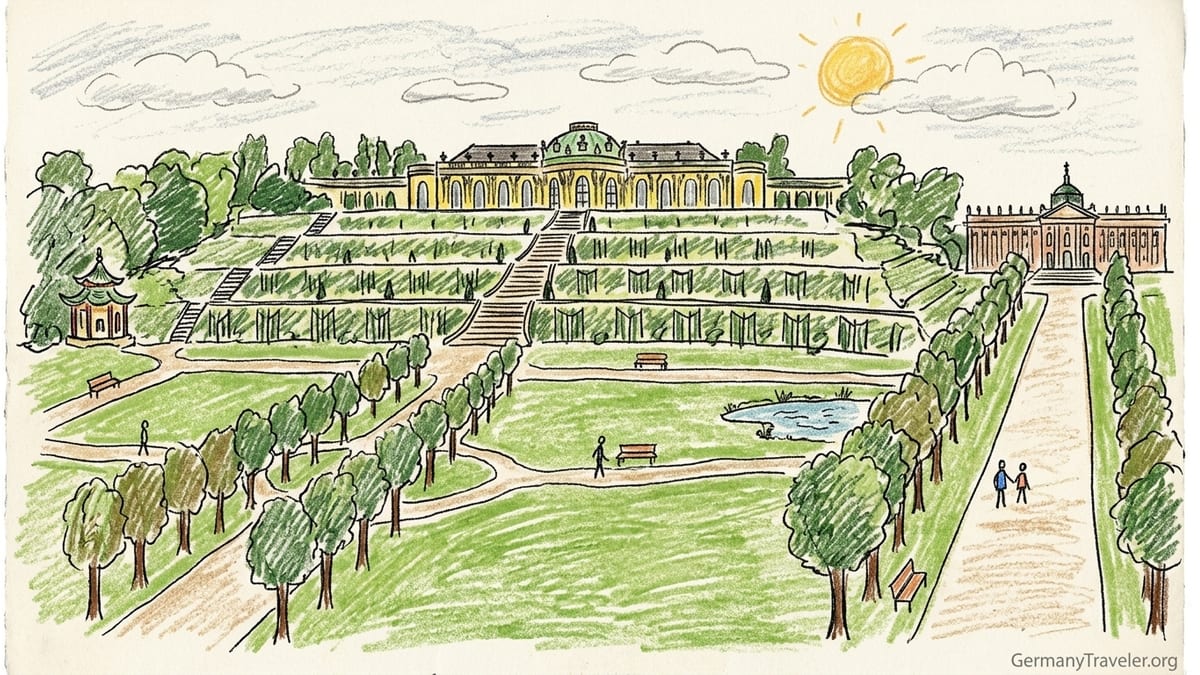
The reality is structured quite differently. The very first impact of Sanssouci is not the palace interior at all but the scale of Sanssouci Park itself. The park stretches close to 2 to 3 kilometers from east to west and covers roughly 300 hectares, and it is completely free to enter. You walk past long alleys of linden and chestnut trees, ponds, pavilions, follies, and, eventually, the vineyards that climb toward the palace. The famous green-and-yellow façade crowns the slope but it is the approach, with Berlin well behind you and Potsdam’s domes on the horizon, that really sets the tone.
Standing at the foot of the terraces, looking up at the symmetrical vineyard steps and the palace above, I felt that familiar rush of “this is it, I am really here.” It was only later, once I actually went inside the building I had paid for, that I began to question whether the palace itself was the unquestioned centerpiece of the whole experience, or simply one strong element in a much wider landscape that might be better appreciated in other ways.
Free Park, Paid Palace: Understanding What You Actually Get
The most important distinction for any visitor, and one that many casual descriptions blur, is that Sanssouci Park and Sanssouci Palace are two different experiences. The park is open daily from early morning until dusk, and entry to the grounds is free. You can roam the vineyard terraces, the lawns, and the paths around Sanssouci, walk all the way to the imposing New Palace at the western end, or detour to the Chinese House, the Historic Mill, or Charlottenhof, all without ever showing a ticket.
Access to the interiors is where the fees and the logistics begin. To step inside Sanssouci Palace itself you need a dated, timed ticket. As of late 2026, a standard adult ticket for the palace on its own is advertised at roughly 14 euros. There is also the broader sanssouci+ day pass, around 22 euros for adults, which covers Sanssouci Palace plus most of the other open palaces and galleries in Potsdam run by the Prussian Palaces and Gardens Foundation, including the New Palace and the New Chambers, when they are open. Those prices are current at the time of writing, but it is wise to check again before you travel in case of changes.
Crucially, daily ticket numbers for Sanssouci Palace are limited, and entry is tied to fixed time slots. On busy spring and summer days, tickets for prime late-morning and early-afternoon slots can sell out in advance, especially weekends and holidays. The foundation recommends booking online rather than just turning up. That rigidity means your entire day in Potsdam can end up revolving around a 30- to 45-minute window inside one building. If you arrive in the park full of spontaneous wanderlust, it can feel oddly constraining.
Inside Sanssouci: Beauty, Bottlenecks and a Surprisingly Short Visit
When my entry time finally came, I was ushered through the side of the palace along with a small wave of other visitors. Inside, movement is essentially one-way through a defined sequence of rooms. You cannot backtrack, and you cannot linger indefinitely. In my case, the full circuit from first room to exit lasted just under 40 minutes, including pauses to listen to audio guide snippets and to let slower visitors ahead of me move on.
Some rooms do justify the hype. The Marble Hall, used historically for concerts and gatherings, is gorgeous, with its high dome, statues and light bouncing off marble surfaces. The Voltaire Room, with its exuberant floral wood carvings and vivid colors, feels personal and slightly eccentric compared to many colder royal interiors. The library, though small, offers a glimpse of Frederick’s intellectual world, and the series of guest rooms facing the gardens make sense of the palace as a place to actually live, not just impress.
Yet I was surprised by how quickly the route was over and how tightly managed it felt. The timed entry system is understandable in a delicate historical building, but it creates a steady flow that subtly encourages you to keep moving. There were a few points where I wanted to step back for a second look or let the room empty for a moment of quiet, but the next cluster of audio-guided visitors had already arrived. It never descended into crowd chaos, and the staff were consistently polite and efficient, but it did feel more like a controlled procession than a leisurely exploration.
By the time I exited back into the light, I checked the time and realized that the centerpiece of my day, the palace visit itself, had taken less than an hour from queueing at the entrance to walking out. For a stand-alone ticket of around 14 euros this is not outrageous, but I also could not help comparing it to the several hours I had already enjoyed in the park for free.
Time Slots, Closures and Seasonal Quirks That Matter in Practice
Unlike many European palaces where you can simply show up, buy a ticket, and wander in more or less at will, Sanssouci runs on stricter rules. The first is the timed entry system mentioned above. Tickets are assigned to specific entry times and the last admission is half an hour before closing. In the main season from April to October, the posted opening hours for the palace are generally Tuesday to Sunday, roughly 9:00 to 17:30, while in winter months the closing time is earlier, often around 16:30. Mondays, the palace interior is closed to visitors, though the park remains open as usual.
Those closures matter if you are trying to maximize a short stay in Potsdam. There is also a seasonal element: some smaller interiors and pavilions in the park only open in the warmer months, and certain restoration projects can temporarily close individual sites. For example, the Orangery Palace has had long-term closures for restoration, and Cecilienhof in the New Garden is undergoing works that affect access to its interiors. The upshot is that the sanssouci+ ticket is not always equally valuable; on a winter weekday with several secondary sites closed, you might pay the combined price yet only be able to use it for a couple of buildings.
Limited daily ticket supply adds another twist. On my visit in late summer, same-day tickets for mid-afternoon entry into Sanssouci Palace itself were still available at the on-site ticket counter, but some morning slots were gone. On higher season weekends or around special events such as “Potsdam Palace Nights” in August, it is easy to imagine less flexibility. If you build your day around a specific time slot and then end up delayed by a late train, you may have to accept a shorter visit or miss your booked window.
The combination of restricted opening days, seasonal reductions, and fixed time slots means Sanssouci is not the spontaneous drop-in experience many travelers expect from the photos. Planning ahead pays off, but it also locks you into a schedule in a landscape that otherwise invites open-ended wandering.
Distances, Stairs and the Reality of Getting Around With Prams or Limited Mobility
One of the great strengths of Sanssouci Park is its scale. That is also one of its main challenges. The park spreads out over nearly 300 hectares, with sandy paths, cobblestones, slopes and occasional gentle hills. The distance from the main visitor center and car parks near the Historic Mill to the New Palace at the western end of the park is roughly 2 kilometers one way. If you also loop through side paths, detours to the Chinese House or Charlottenhof, and then back to your start point or onward to the New Garden, you can easily clock 8 to 10 kilometers of walking in a day without really noticing until your feet complain.
For most reasonably fit visitors in comfortable shoes, this is a pleasure. For anyone pushing a pram, managing small children, or dealing with limited mobility, it can be a serious factor. The core paths are mostly firm, but some sections are sandy or uneven, and there are few benches in certain stretches. Public toilets are not as frequent as you might assume in such a popular destination, and some are tucked near specific pavilions rather than spread evenly across the grounds.
Accessing Sanssouci Palace itself involves a climb. The most iconic approach is straight up the central flight of terrace steps between the vineyard levels, which are not pram or wheelchair friendly. There are alternative side routes that wind up more gently, but the palace still sits on a rise, and thresholds and interior surfaces can pose difficulties. Official information notes that accessibility is limited and that there is a designated accessible route, but “limited” in this case genuinely means that visitors with significant mobility issues should plan carefully and, if possible, contact visitor information in advance to clarify current conditions.
With prams, the park is more workable than the palace. You can enjoy long, free walks, let children run on the lawns where permitted, and simply skip interiors that involve tight doorways or stairs. Inside Sanssouci Palace, prams are not practical. Even if allowed into the entrance area, the sequence of historic rooms, narrow passages and guided flow make it far easier to use a baby carrier. For anyone traveling with grandparents or others who tire quickly, it may make more sense to focus on shorter loops near the main terraces or consider the more compact New Garden area instead of trying to “do everything” in the entire Sanssouci complex in one go.
New Palace, New Garden and the Dutch Quarter: Where the Real Value Hid for Me
Here is where my day in Potsdam diverged sharply from my expectations. I had gone in convinced that Sanssouci Palace would be my highlight, and that everything else would be a pleasant add-on. By late afternoon, I realized that some of the best value, both in time and money, lay elsewhere.
The New Palace, at the western end of Sanssouci Park, is a sprawling Baroque residence built after the Seven Years’ War. From the outside, it looks almost like a state building rather than a pleasure palace. Inside, however, the sequence of grand halls, galleries, and rooms feels more extensive than Sanssouci’s intimate scale. While visit durations vary, it is easy to spend well over an hour working through the interiors, especially if you pause to study details in the Grotto Hall or the lavish festival rooms. The New Palace has its own opening pattern, usually closed on Tuesdays rather than Mondays, which conveniently complements Sanssouci’s schedule.
Time-wise, if you are comparing where to devote a scarce hour indoors, the New Palace can feel like a richer investment. The architecture and decoration are less delicate Rococo and more late Baroque drama, so the aesthetic is different, but the sense of moving through a large, coherent royal residence is stronger. If you buy the sanssouci+ ticket and actually use it here, it feels like you are spreading that 22-euro cost across more substantial interior time than you get from Sanssouci Palace alone.
Stepping outside the main park, the New Garden north of the city center was another surprise. It stretches along the shore of Lake Heiliger See and connects to Cecilienhof, the palace associated with the Potsdam Conference. Even with Cecilienhof’s interior affected by restoration work, the lakeside walk, the greenery and the views back toward Potsdam and the Babelsberg park skyline gave my day a calm, lived-in feel that pure palace interiors often lack. Crucially, the New Garden itself, like Sanssouci Park, is free to enter; any paid interiors are only part of the picture.
Then there is Potsdam’s Dutch Quarter, a brick-red grid of 18th century gabled houses just a short walk from the historic center. After hours of royal imagery, strolling between these townhouses, stopping for coffee and cake, and watching local life, felt refreshingly human-scale. If you are weighing where to spend your limited time, a slow hour in the Dutch Quarter costs nothing beyond whatever you order at a café, yet it can be just as memorable as a tightly scheduled palace visit.
Is the Single-Palace Ticket Worth It, or Should You Go All-In With sanssouci+?
This brings us to the question travelers most often dance around: is paying roughly 14 euros to enter just Sanssouci Palace, or 22 euros for the sanssouci+ pass, the best use of your budget in Potsdam? My answer is a cautious “it depends,” shaped heavily by how much you enjoy historic interiors compared to open-air wandering.
If you are primarily drawn to landscapes, gardens and atmospheres, Sanssouci Park itself delivers extraordinary value entirely for free. You can spend an entire day walking from the vineyard terraces to the New Palace, watching boats on the Havel River, and dipping into the New Garden, without ever scanning a ticket. In that scenario, paying just to step into Sanssouci Palace may feel like a brief, pretty detour rather than an essential investment.
The single-palace Sanssouci ticket makes sense if you are a dedicated fan of Rococo interiors, architecture, or Frederick the Great specifically, and you are confident you can hit your time slot. For a history or art enthusiast, 14 euros for a concentrated 30 to 45 minutes in rooms of this importance can feel justified, especially if you pair it with the free terraces and a longer park walk. For more general travelers, especially families counting every euro, the cost-to-minute ratio may raise eyebrows once you realize how fast the one-way interior route goes.
The sanssouci+ day ticket becomes attractive only when you treat Potsdam as more than a quick side trip. If you plan to visit at least two substantial interiors, such as Sanssouci Palace and the New Palace, and perhaps add the New Chambers or the Picture Gallery, the combination pass starts to pay off. It also locks in your timed entry for Sanssouci itself, which is valuable on busy days. However, if your visit falls in shoulder season or winter, or on a day when several sites are closed, the math is less generous. Paying 22 euros when you only end up using it for Sanssouci and one other building is less compelling than it first appears.
The Takeaway
As I walked back toward the tram stop in the late afternoon light, I realized that my assumptions about Potsdam had quietly shifted. Sanssouci Palace is beautiful and historically significant, but it is not automatically the best-value or even the most impactful part of a visit. The free park and the broader city, from the New Palace to the New Garden and the Dutch Quarter, carry at least as much weight, sometimes more.
If you are visiting on a tight budget or you have limited time, you can have a deeply satisfying Potsdam experience without ever stepping inside a single palace. Spend your hours among the terraces and avenues of Sanssouci Park, walk along the lakes of the New Garden, and finish in the Dutch Quarter with a coffee. Your only real costs will be transport and refreshments, and you will still leave with a strong sense of the city’s character.
If you have a half day and a particular interest in Frederick the Great or Rococo art, the standalone Sanssouci Palace ticket can be worth the outlay, provided you understand that the visit is structured, time-bound and comparatively short. Treat it as a jewel-like highlight within a broader, mostly free day outdoors, not the sole reason to travel to Potsdam.
For travelers who can commit a full day and genuinely enjoy palace interiors, the sanssouci+ pass begins to make better sense. Use it to combine Sanssouci with the New Palace and at least one additional site, building your schedule around alternating indoor and outdoor segments so that the time slots feel less restrictive. In that scenario, the roughly 22 euro cost spreads over several hours of indoor exploration and a full day in one of Europe’s great historical landscapes, which is much closer to the value I had expected when I first set out.
FAQ
Q1. Is Sanssouci Park really free to visit?
Yes. Sanssouci Park, including the vineyard terraces and the grounds around the palaces, is free to enter. You only pay if you want to go inside Sanssouci Palace or other palace interiors.
Q2. How much time should I plan for the interior of Sanssouci Palace?
Most visitors spend around 30 to 45 minutes walking through the one-way route inside Sanssouci Palace, not counting any waiting before their timed entry slot.
Q3. Do I need to book Sanssouci Palace tickets in advance?
Advance booking is strongly recommended, especially from spring to autumn and on weekends, because entry is limited to timed slots and daily ticket numbers are capped.
Q4. Is Sanssouci Palace open on Mondays?
No. The interior of Sanssouci Palace is generally closed on Mondays, although Sanssouci Park remains open. The New Palace often opens on Mondays but closes on Tuesdays instead.
Q5. Is Sanssouci suitable for visitors with limited mobility?
Sanssouci Park has some accessible routes, but distances are long and surfaces can be uneven. The palace itself sits on a rise and has limitations, so visitors with reduced mobility should plan carefully and allow extra time.
Q6. Can I visit Sanssouci with a pram?
Yes, the park is manageable with a pram, although some paths are sandy or uneven. Inside Sanssouci Palace, a pram is impractical due to narrow rooms and a fixed one-way route, so a baby carrier is easier.
Q7. Is the sanssouci+ ticket worth the extra cost?
The sanssouci+ ticket around 22 euros offers better value if you plan to visit Sanssouci Palace plus at least one or two other interiors, such as the New Palace or the New Chambers, on the same day.
Q8. How far is the New Palace from Sanssouci Palace?
The walk through the park from Sanssouci Palace to the New Palace is roughly 2 kilometers one way. Allow at least 25 to 30 minutes at a relaxed pace, more if you stop for photos.
Q9. What should I not miss if I skip the Sanssouci interior?
If you skip the interior, focus on the vineyard terraces, the exterior of Sanssouci, the walk to the New Palace, the New Garden by the lake, and Potsdam’s Dutch Quarter in the old town.
Q10. When are the free gardens enough, and when should I pay to go inside?
The free gardens are enough if you mainly enjoy landscapes, walking and photography. Pay for Sanssouci alone if you love Rococo interiors, and choose the sanssouci+ pass if you want a full day of palace interiors, including the New Palace and at least one additional site.