


The forest closed in around the train just before we reached Beelitz-Heilstätten. One moment I was watching the suburbs of Berlin slide past, the next I was looking at tall pines and sandy soil, the kind of quiet woodland that usually promises a hiking trail or a lakeside picnic. Instead, when I stepped off the train, the trees parted to reveal something very different: the red-brick silhouettes of one of Europe’s largest former tuberculosis sanatoriums, now watched over from above by a steel treetop walk called Baum & Zeit.
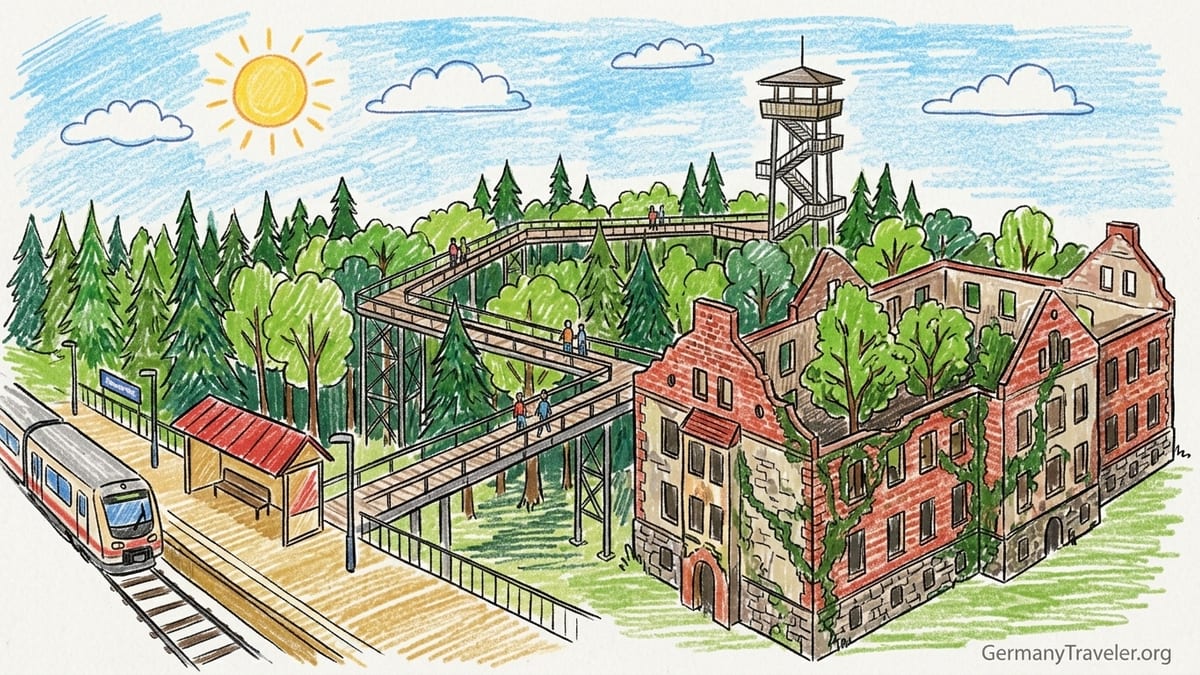
Arriving Between Forest and Red-Brick Ruins
I arrived at Beelitz-Heilstätten on a clear late-summer morning, taking the regional train from Berlin in just under 40 minutes to the small Beelitz-Heilstätten station. As the doors opened, there was no grand tourist entrance, only a simple platform and, beyond it, the outline of long, low buildings hiding in the trees. The contrast was immediate: a forest that still feels like Brandenburg countryside on one side, and on the other a dense cluster of historic pavilions, once a self-contained medical town.
The walk from the station to Baum & Zeit took about ten minutes at a relaxed pace. A short path led under the pines, then out towards the main access road where signs pointed to the Baumkronenpfad, the treetop walk. The former sanatorium buildings appeared one by one along the way: long facades with high windows, peaked roofs and decorative brickwork that speak of optimism from another era, now blurred by peeling plaster, boarded doors and climbing ivy.
At the entrance area of Baum & Zeit, the atmosphere shifted again. Ticket counters, a café terrace, an information board and families unloading strollers from cars on the main P1 parking lot made it clear that this is no longer a forbidden zone. Yet, only a few dozen metres away, the shell of the historic Alpenhaus rose out of the trees, its roof mostly gone, the forest literally growing through the upper floors. It was this tension between everyday outing and slow decay that set the tone for the whole visit.
Practicalities are straightforward. As of autumn 2026, I paid a little under 15 euros for a standard adult ticket that covered access to the treetop walk and the fenced park grounds. There are discounted tickets for children and family packages, and combination options with the nearby Barfußpark. I chose to keep it simple for a first visit: the basic Baum & Zeit ticket plus a separate guided tour of the interiors later in the day.
Stepping Onto the Treetop Walk
The treetop walk begins as a gently sloping ramp that spirals upward from forest floor to canopy height. The path itself is steel and wood, solid underfoot and wide enough for wheelchairs and strollers. The gradient is mild, and I noticed several visitors with mobility aids making their way up without difficulty. Handrails on both sides and high mesh barriers create a feeling of security, even for those nervous about heights.
From a distance the structure looks industrial, but once you are on it the trees reclaim the scene. The first section threads through the crowns of pines and younger deciduous trees, so close that I could see the textures of bark and the sway of branches in the light wind. Through gaps in the foliage, the brick facades of the sanatorium buildings appeared like fragments of a film reel: a tower here, a row of balconies there, sometimes half hidden, sometimes startlingly close.
It took me about twenty minutes to stroll from the entrance up to the main viewing platform above the Alpenhaus, stopping often to look over the railings and take photographs. Signboards along the way briefly outline the history of the site in German and English. They mention the opening of the first buildings in 1902, the purpose-built tuberculosis pavilions, and the later conversion to a military hospital in both World Wars and during the Soviet period until 1994. These panels give essential dates and context, but they are short snapshots rather than in-depth explanations.
Photography on the treetop walk is allowed and almost inevitable. Nearly everyone had a phone or camera in hand, and I saw tripods only in the observation areas where there is more space. There are no aggressive restrictions, but staff do remind visitors not to block the path for extended photo sessions. On my visit, clear skies meant plenty of bright light and strong contrasts between red brick, green trees and blue sky, perfect for wide shots across the complex.
The View Over the Alpenhaus and Observation Tower
The emotional high point of the treetop walk for me was the section right above the historic Alpenhaus. This building was originally a sanatorium block, later heavily damaged during the Second World War and left without a roof for decades. From above, you look down into a rectangle of crumbling walls that now cradle full-size trees. Their crowns rise nearly to the level of the walkway, so that you are almost eye to eye with a forest growing out of masonry.
From this vantage point, the layers of time become visible. Close to the Alpenhaus ruins are carefully stabilized sections: brick edges capped with protective metal, railings that keep visitors at a safe distance from sensitive structures. Beyond them stand other pavilions that have already been renovated for modern medical or residential use, their facades cleaned and windows replaced. In the distance, blockier Soviet-era hospital buildings and the water tower protrude above the canopy, reminders that this was a working medical campus well into the late twentieth century.
The treetop path culminates in an observation tower that rises significantly higher than the rest of the walkway. Access is via stairs, not an elevator, so the tower itself is not barrier-free. Climbing it took me around five minutes, with several pauses on intermediate platforms where the view gradually opens up. From the top platform the complex finally resolved into something like a map: long parallel wings, cross-corridors, internal courtyards, and the checkerboard of forest blocks that once provided fresh air and sun terraces for patients.
Up here, the history panels feel further away than the wind on your face. The tower gives a broad geographic sense of Beelitz-Heilstätten, including the nearby Barfußpark and the Neurological Rehabilitation Clinic, but it does not tell personal stories. I watched a family point out the train line and the Autobahn that slice past the forest, and it struck me how close the modern infrastructure runs to what was once a self-contained therapeutic world.
Understanding the Medical Past: Facts vs Legends
It helps to arrive at Beelitz-Heilstätten with some basic historical knowledge, because the place is often overshadowed by sensationalist ghost stories and urban legends. In reality, the complex began as a flagship project of the Berlin workers’ health insurance institution around the turn of the twentieth century, when tuberculosis was one of the leading causes of death among industrial workers. Contemporary accounts describe Beelitz-Heilstätten as one of the largest and most modern sanatorium complexes in Europe, with over a thousand beds across more than 60 buildings set in designed parkland and forest.
Patients were housed in separate pavilions for men and women, with open verandas and balconies where they could spend hours in recliners taking in fresh air, part of the then-standard “rest cure” for tuberculosis. Treatment focused on climate, nutrition and rest long before antibiotics made the disease curable. Architectural records credit architects such as Heino Schmieden and Julius Boethke with the design of the early pavilions, which combined functional layouts with ornate brick and plaster details and generous daylight.
During the First World War, the sanatorium expanded its role as a military hospital for the Imperial German Army, treating wounded soldiers. Similar use continued in the Second World War, when parts of the complex were damaged by bombing. After 1945, the Soviet Army took over the main grounds and turned them into a central military hospital and restricted zone, which remained in operation until the early 1990s. This Soviet chapter explains why so many buildings survived in their original form, albeit in a neglected state, once the troops withdrew.
The myths that now cling to Beelitz-Heilstätten often focus on alleged hauntings, unexplained noises and invented dark rituals in abandoned wards. Baum & Zeit takes a clear position on this. The official information panels and guided tours that I joined later in the day address the real history and do not feed into ghost narratives. Guides will sometimes acknowledge that urban explorers and film crews have popularised a more lurid image of the site, but they firmly distinguish between documented facts, like patient numbers or architectural phases, and unverified legends that flourish on the internet and in horror forums.
What You Can See: Public Areas, Tours and Closed Doors
With a standard Baum & Zeit ticket, you gain access to two main areas: the treetop path itself and a roughly 7.5-hectare fenced section of the grounds beneath it. Within this park-like zone you can walk marked paths between several former sanatorium buildings, viewing them from outside at relatively close range. The Alpenhaus ruins, some adjacent pavilions and the historic water tower form the visual core of this area. Information boards identify specific buildings and explain their original function, such as men’s lung sanatorium, women’s sanatorium or service facilities.
However, you cannot simply wander inside whichever building catches your eye. For safety and conservation reasons, interiors are tightly controlled. Some structures are structurally unsound, with missing floors, unstable ceilings or open shafts, and remain completely inaccessible to visitors. Others are used for ongoing medical, residential or hospitality purposes and are off limits except to those who live or work there.
To see inside the iconic abandoned wards that appear in many photo series, you need to book a guided tour. These are offered by Baum & Zeit and partner guides and usually focus on specific buildings such as the Alpenhaus or former surgical pavilions. I booked an early afternoon architectural tour that lasted around 90 minutes. Our group of about fifteen people was led through locked gates and into selected interiors where flooring has been stabilized and safe paths have been installed. Hard hats were not required on my tour, but we were instructed to stick strictly to the marked routes.
During the tour, we walked through long corridors lined with peeling paint, past tiled treatment rooms and up broad staircases designed for stretcher transport. In some wards, old radiators and remnants of fixed furniture still hint at past use. The guide pointed out details I would have missed: separate staircases for staff and patients, original ventilation shafts for tuberculosis treatment, and differences between pre-war German construction and later Soviet alterations. Without the tour, these interiors would remain unseen, since casual entry is both prohibited and physically impossible due to locked doors and barriers.
Logistics: Getting There, Tickets, Accessibility and Weather
Reaching Baum & Zeit is relatively simple from Berlin. Regional trains and the S-Bahn run to Beelitz-Heilstätten station, with journey times usually around 35 to 45 minutes from central hubs such as Berlin Hauptbahnhof or Potsdamer Platz, depending on the connection. From the station it is a short, signposted walk to the entrance area. If you drive, the A9 Autobahn has a dedicated exit for Beelitz-Heilstätten, from which it is only a couple of minutes to the main P1 visitor parking area. On my weekend visit there were still spaces available late in the morning, but on public holidays and during special events such as Halloween light festivals, arriving earlier would be wise.
Baum & Zeit sells tickets on site and online. In 2026, adult admission for the treetop walk and park grounds alone was in the mid-teens in euros, children and seniors paid less, and there were family deals that reduced the per-person cost if you visit with kids. Guided interior tours come with a separate fee, so a full day with treetop walk plus one tour can easily reach the mid-twenties or slightly higher per adult. I found the pricing comparable to other major heritage or nature attractions in Germany, such as large open-air museums or forest canopy walks in national parks.
The site is relatively well prepared for visitors with mobility needs. The treetop path itself has a gentle incline, with gradients kept under roughly six percent and a minimum width that allows wheelchairs and strollers to pass each other. There are rest areas and benches at several points, as well as accessible toilets near the entrance area. However, the observation tower is only reachable by stairs, and most interior tours are not fully accessible due to uneven floors and historic staircases. If accessibility is crucial, the treetop walk and the ground-level park paths will likely be the best focus of a visit.
Weather plays a significant role in how enjoyable Baum & Zeit feels. The entire treetop walk is open to the elements. On my sunny, dry visit, it was pleasant to linger at viewpoints and photograph reflections in puddles left from overnight rain. In strong wind, heavy rain or winter ice, access to the treetop path can be restricted or temporarily closed for safety reasons. It is worth checking for current notices before travelling, especially in late autumn and winter. Even in fair weather, you will want a jacket, since the elevated walkway catches more wind than the forest floor.
How Informative Is the Treetop Walk Without a Tour?
Walking the Baum & Zeit treetop path on its own is visually powerful. You see the massive scale of Beelitz-Heilstätten laid out beneath you, the way the forest has grown into abandoned courtyards, and the architectural rhythm of pavilions spreading among trees. For many visitors, especially photographers and families, that visual encounter is enough. The panorama over the Alpenhaus, where entire trees rise from a roofless shell, is the kind of sight that stays with you long after you leave.
In terms of historical understanding, however, the treetop walk alone feels more like an introduction than a full story. The interpretive panels are concise and designed for casual readers. They mention the tuberculosis era, the war hospital phase and the Soviet military hospital period, and they briefly note that the area fell into disrepair after 1994 before redevelopment efforts began. But they do not delve into individual patient stories, the social politics of workers’ health insurance in early twentieth-century Berlin, or the ethical questions around preserving a site of illness and military use as a leisure destination.
My own experience was that the treetop walk triggered curiosity more than it satisfied it. From above, I could see details that begged for explanation: a bricked-up passage here, an inner courtyard there, a chapel rising between treatment blocks, chimneys of a former central heating plant at the edge of the woods. Without a guide, these remained intriguing shapes rather than fully understood places. I heard snippets of similar conversations among other visitors: “I wonder what that building was” and “Was this part already Soviet, or older?”
If you only have a couple of hours and mainly want atmospheric photographs and a sense of how nature and architecture have intertwined, the treetop walk may be sufficient. If you care about the medical history of tuberculosis treatment, twentieth-century German social policy or the specifics of hospital architecture, the walk on its own will likely feel surface-level and you will benefit from a deeper experience, whether through a tour, a good guidebook, or prior reading.
Inside on a Guided Tour: Added Depth or Just More Photos?
The guided interior tour I joined in the afternoon shifted my relationship to Beelitz-Heilstätten from spectator to guest. Having spent the morning looking down on facades, it felt almost transgressive to step through side doors and into stairwells that most visitors only photograph from outside. The guide unlocked heavy metal gates and led us into rooms where dust and plaster fragments still covered the floors, yet safe pathways had been clearly laid out.
Our tour concentrated on one former treatment pavilion and adjacent service areas. Inside, the scale of the building was more tangible than from above. Wide corridors allowed staff to push beds and equipment efficiently, while high ceilings and large windows were designed to flood wards with sun and air. In one room, the guide pointed out rails in the ceiling once used to hang therapeutic lamps. In another, a faded painted line on the wall marked the original height of radiators that were later removed.
Beyond architecture, the tour filled in human details. We heard how working-class tuberculosis patients from Berlin would arrive here by train, often staying for weeks or months, and how daily routines balanced strict medical regimens with walks in the surrounding forest. Stories about the Soviet period were more fragmentary, based on records and oral histories, but still anchored in fact: specialised wards for different ranks, a maternity wing used by families of Soviet officers, and the eventual withdrawal in the early 1990s that left a semi-abandoned complex behind.
Did the tour justify the extra cost? For me, yes. Without it, Beelitz-Heilstätten would have remained mostly an impressive backdrop. With it, the treetop scenes of roofs and courtyards gained narrative weight. I would not describe the tour as academic; it is still pitched at a broad audience, and there is limited time in each room. Yet it turned individual bricks and tiles into parts of a story. If your budget is tight and you must choose, I would say the treetop walk offers the more universally appealing experience, but anyone with a real interest in the place should seriously consider adding at least one interior or architectural tour.
The Takeaway
By the time I walked back down from the treetop path in the late afternoon, the light had turned warmer and longer shadows crossed the ruined walls of the Alpenhaus. Families were queuing for ice cream near the exit, teenagers were comparing photos on their phones, and a few older visitors lingered quietly at the edge of the grounds, looking up at buildings that may have been part of their own or their families’ histories. Beelitz-Heilstätten today is many things at once: a forest outing, a photographic playground, a carefully managed heritage site and a survivor of turbulent twentieth-century politics.
In all honesty, my first impression was that the place is more photogenic than informative. The treetop walk in particular is designed to offer dramatic views and a sense of discovery, and it succeeds. The patina of decay, the interplay of brick and birch, and the unusual perspective from above make it an excellent subject for photography. If you are primarily drawn by the visual allure of abandoned architecture reclaimed by nature, you will likely leave satisfied after two to three hours on site.
However, if you hope to come away with a deep grasp of how this vast sanatorium complex functioned, what it meant for tuberculosis patients from Berlin’s working class, and how it evolved through wars and occupation, you need more than the treetop path. The guided tour I joined did not answer every question, but it provided enough architectural and historical explanation to transform the site from a backdrop into a lived space in my imagination. That difference was what I found most worthwhile.
For a first-time visitor, I would recommend allocating at least half a day. Two hours are enough for the treetop walk and a relaxed circuit of the park grounds in good weather. Add another 90 minutes to two hours if you plan to take an interior or architectural tour. If the weather is poor or high winds close the treetop path, consider rescheduling, as the elevated views are central to the experience. Either way, Beelitz-Heilstätten rewards those who look beyond the ghost stories and approach it as a complex intersection of medical history, architecture and landscape.
FAQ
Q1: How long does a visit to Baum & Zeit at Beelitz-Heilstätten take?
Most visitors spend around two to three hours on the treetop walk and in the surrounding park area. If you add a guided interior or architectural tour, plan for a total of four to five hours on site, including short breaks.
Q2: How much does it cost to visit the treetop walk?
In 2026, a standard adult ticket for the Baum & Zeit treetop walk and park grounds cost in the mid-teens in euros, with reduced prices for children, students and seniors, and family packages that lower the per-person cost. Guided interior tours require an additional ticket and increase the total price into the mid-twenties or slightly more per adult.
Q3: Can I visit the interiors of the abandoned sanatorium buildings on my own?
No, interiors of the historic sanatorium buildings are not freely accessible for safety and conservation reasons. You can only enter selected buildings as part of an organized guided tour, which follows fixed, secured routes inside.
Q4: How do I get to Beelitz-Heilstätten from Berlin?
You can reach Beelitz-Heilstätten by regional train or S-Bahn from central Berlin stations in roughly 35 to 45 minutes, then walk about ten minutes from the Beelitz-Heilstätten station to the Baum & Zeit entrance. Drivers can use the A9 Autobahn exit for Beelitz-Heilstätten and park in the main visitor car park P1 near the site.
Q5: Is the treetop walk accessible for wheelchairs and strollers?
The treetop path is designed with gentle gradients and sufficient width to accommodate wheelchairs and strollers, and there are accessible facilities near the entrance. However, the tall observation tower is only reachable by stairs, and most interior tours are not fully accessible due to historic staircases and uneven floors.
Q6: Are there any restrictions on photography at Baum & Zeit?
Photography for personal use is generally allowed on the treetop walk and in the park grounds, and many visitors take photos or videos. Tripods and more elaborate setups may be restricted in narrow areas or during busy times, and commercial or professional shoots usually require prior permission.
Q7: What happens in bad weather or strong wind?
The treetop walk is outdoors and exposed to the elements. In heavy rain, strong wind, ice or storms, sections of the path or the entire walkway may be temporarily closed for safety. It is advisable to check for current information before travelling, especially in winter or on days with severe weather forecasts.
Q8: Is Baum & Zeit suitable for children?
Yes, many families visit with children. The treetop walk’s gentle slope and solid railings make it manageable for school-age kids, and the mix of forest and unusual architecture keeps the walk engaging. Very young children will need close supervision, especially on the observation tower stairs and near barriers.
Q9: Do I need to book a guided tour in advance?
Booking in advance is recommended for guided interior or architectural tours, particularly on weekends, holidays and during special events. While some same-day spots may be available, tour group sizes are limited for safety reasons, and popular time slots can fill up quickly in peak season.
Q10: Is Beelitz-Heilstätten mainly a “dark tourism” destination?
While the abandoned buildings and their history attract some visitors interested in dark tourism, the official Baum & Zeit experience focuses on architecture, landscape and documented medical and military history rather than ghost stories. Many visitors treat it as a forest and heritage outing that combines striking visuals with a thoughtful look at a complex past.