


Brandenburg’s lakes promise clear water, sandy coves and quiet forests, but not every beautiful shoreline is a convenient place to spend a summer day. Parking can be distant, toilets may be missing, and cyanobacteria alerts can turn a picture-perfect bay into a no-swim zone. This guide compares some of Brandenburg’s strongest lakes for swimming and lake holidays, focusing on where the mix of water quality, access and infrastructure really works in practice.
Scenic Versus Practical: What Makes a Good Swimming Lake
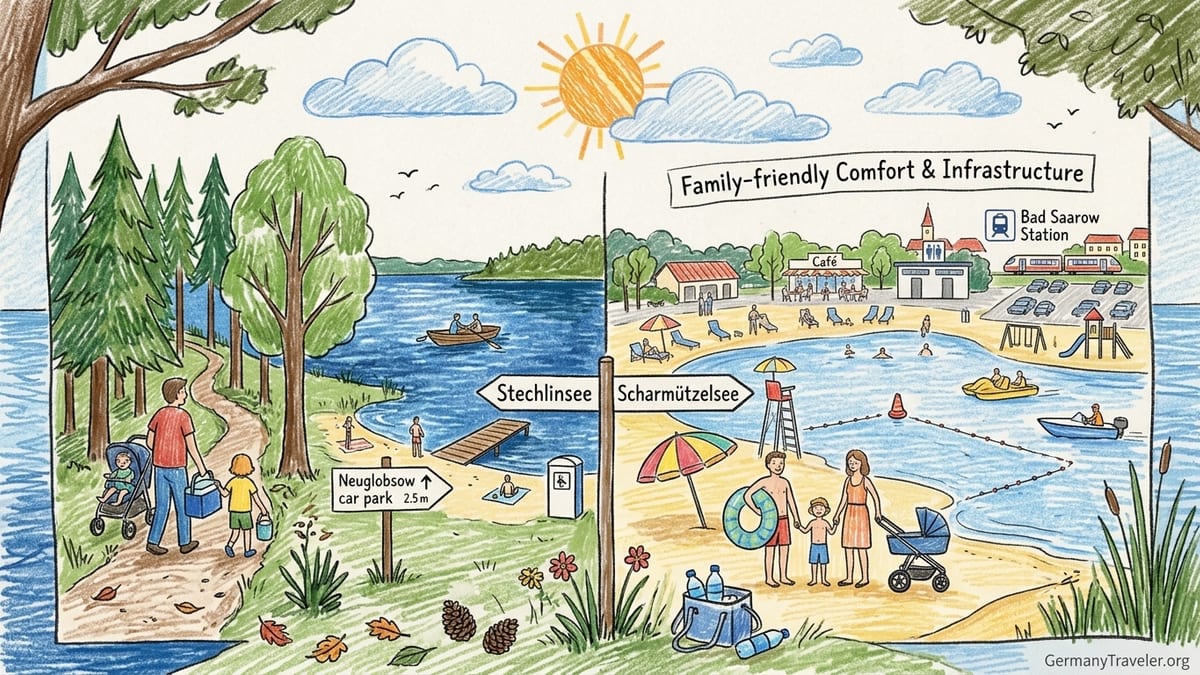
Many of Brandenburg’s most photographed lakes are ringed by forest with narrow paths to the shore, barely any official bathing areas and no toilets in sight. They look idyllic in social media posts, but for families arriving with cool bags, inflatables and a buggy, the experience can be frustrating. The contrast between visual appeal and everyday usability is important when planning a lake holiday, especially if you need parking close to the water, lifeguards or reliable public transport.
Officially designated bathing sites in Brandenburg are listed by the state environment authorities. These usually have at least basic facilities such as a marked swimming area, some form of waste disposal and a simple access path. However, “official” does not automatically mean convenient. At Stechlinsee near Neuglobsow, for example, the main car park is set back from the lake and visitors walk several hundred meters through the village or forest to reach the water. This preserves the landscape but may be a challenge with small children or heavy picnic gear.
There is also a trade-off between crowds and comfort. Lakes with lidos, cafés, large lawns and easy train access, such as Scharmützelsee at Bad Saarow, can feel busy on hot weekends, especially around midday. Quieter spots such as some shorelines of Ruppiner See or smaller bays at Werbellinsee may mean simple lake access with no formal beach, no changing cabins and only a portable toilet at best. Travelers need to decide whether they prioritize amenities, quiet or natural atmosphere.
Finally, water quality is not the same as water safety on a specific day. A lake can have an “excellent” long-term classification while temporary cyanobacteria blooms or low visibility after storms still make swimming unappealing or even risky. Understanding how to interpret official monitoring and on-site warnings is as important as choosing the right lake on the map.
Scharmützelsee: Wellness Infrastructure Versus Family Holiday Village
Scharmützelsee, south-east of Berlin, is one of Brandenburg’s classic holiday lakes and offers some of the strongest swimming infrastructure in the region. The spa town of Bad Saarow on the north-eastern shore combines a promenade, hotels, lake saunas and a public lido. Bad Saarow’s Strandbad area offers a managed bathing zone with a sandy entry, lawn for sunbathing, toilets and nearby cafés. Public car parks are spread around the spa area, including park-and-ride facilities close to Bad Saarow station and paid parking in streets near the lake. Regional trains from Berlin connect via Fürstenwalde, making it realistic to arrive with just swimwear and a towel rather than a car full of equipment.
On the opposite shore at Wendisch Rietz, the lake feels more like a purpose-built holiday village. Here, family-focused accommodation dominates, with a large holiday park, self-catering cottages close to the water and a compact central promenade. The main bathing area in Wendisch Rietz has a shallow sandy bay, small playground elements and quick access to ice cream stands and casual restaurants. Toilets are available either at the bathing area itself or within a short walk in the holiday complex, and day visitors find marked parking along Strandstraße and by the local visitor center. The atmosphere suits families who want short walking distances and a ready-made mix of swimming, pedal boats and mini-golf without needing a car all day.
Bad Saarow and Wendisch Rietz therefore serve different audiences along the same lake. Bad Saarow works well for couples or wellness travelers combining lake swims with spa treatments, lakeview dining and evening walks on the promenade. Bathing areas can be slightly steeper and less obviously child-focused, though there are shallow entries in some bays. Wendisch Rietz is more informal and child-oriented, with quick access to holiday cabins, playgrounds and pedal-boat piers. The trade-off is that it can feel more like a resort village than an authentic town, and public transport options are somewhat more limited, so many visitors still arrive by car.
From a pure swimming perspective, Scharmützelsee offers several public access points around the shore, but not all are convenient. Some smaller bathing spots have only narrow strips of shoreline, limited shade and basic or seasonal toilets. For travelers planning multi-night stays, choosing accommodation within a short walk of either Bad Saarow’s lido or the main Wendisch Rietz beach eliminates the parking question entirely and allows early-morning or late-evening swims when the lake is quiet.
Stechlinsee and Werbellinsee: Clear Water, Limited Shore Comfort
Stechlinsee, north of Berlin, is often cited as one of Brandenburg’s clearest lakes. The officially designated bathing site near Neuglobsow offers a sandy entry, grassy areas and a mix of shade and sun. There are toilets, a children’s playground, simple gastronomy and a small boat rental where visitors can hire rowboats or similar craft. Parking is organized via larger car parks set back from the lake, including an affordable lot at a road junction before the village, with visitors then walking to the waterfront. This keeps the shore largely free of cars and helps preserve the forest setting, but it also means that beach trolleys, buggies and cool boxes need to be hauled for some distance.
The facilities at Neuglobsow make Stechlinsee attractive for visitors who prioritize water quality and natural landscape over convenience. However, outside the official beach and a handful of informal access points, much of the shoreline is steep, forested or ecologically sensitive. There are no continuous promenades, and public transport is limited to regional buses that may run only a few times a day. For a spontaneous late-afternoon swim after work, especially from Berlin, Stechlinsee is ambitious unless you have a car, plenty of time and are prepared for a walk.
Werbellinsee, further east, combines similarly clear water with a somewhat broader range of entry points. The lake is long and narrow, with several villages and campsites providing access. In places like Altenhof and near youth recreation centers, managed bathing areas offer small sandy sections, lawns, basic toilets and snack stands. Boat rentals along the shore let visitors hire paddle boats, kayaks or small motorboats, which is part of the appeal for paddlers and mixed groups who want both swimming and leisurely touring on the water.
The drawbacks again relate to infrastructure and distribution of services. Many of Werbellinsee’s nicest swimming spots are linked to campsites or holiday complexes, where non-residents may pay a small day fee for beach access or parking. Public transport is available via regional trains to Eberswalde plus buses or seasonal boat services along the lake, but schedules can be sparse outside peak holiday weeks. Travelers relying on public transport should check return times carefully, particularly in the evening. For serious swimmers and paddlers who accept a bit of planning and walking, both Werbellinsee and Stechlinsee provide some of the most satisfying fresh-water experiences in the region.
Liepnitzsee and Schwielowsee: From Forest Island Lake to Havelwide Waters
Liepnitzsee, north of Berlin, is a classic example of a visually stunning lake that is not automatically convenient. Surrounded by beech forest and featuring the island Großer Werder, it attracts day-trippers from Berlin seeking a more secluded atmosphere than the city lidos. The main access points involve either forest walks or the small passenger ferry that shuttles bathers to the island during the season. Shorelines offer narrow sandy coves and small clear-water entries, but there are relatively few wide lawns close to the water. Facilities range from basic to moderate, with a designated Waldbad area that offers a supervised swimming zone, boat rental and simple catering, alongside toilets and changing options.
Parking for Liepnitzsee is typically located at the edge of the forest, with visitors following marked trails to the water. On hot weekends, these car parks can fill early, and road-side parking may be restricted or actively controlled. Public transport, such as regional trains to nearby stations followed by a walk or bike ride, is feasible for determined visitors but not effortless, especially if carrying gear for children. For agile adults or couples seeking a quiet swim plus a forest hike, Liepnitzsee remains highly attractive. Families needing pushchair-friendly paths or quick toilet access may find the experience more challenging.
Schwielowsee, by contrast, is integrated into the Havel waterway system and sits close to Potsdam and Werder (Havel). Rather than a single forest lake, it feels like part of a broader river-lake landscape with harbors, sailing clubs and waterfront villages such as Caputh, Ferch and Geltow. Bathing areas here often combine small sandy beaches with grassy banks, piers and restaurants or cafés within a few minutes’ walk. Schwielowsee is particularly strong for travelers who want to mix moderate swimming with boating. Numerous hire points around the lake area offer pedal boats, kayaks, small motorboats and stand-up paddleboards, making it easy to spend part of the day on the water and the rest on the beach.
Public transport is one of Schwielowsee’s major advantages. Buses link Caputh and other villages to Potsdam, from where regional and suburban trains continue into Berlin. Day-trippers can, for example, take a morning train to Potsdam, change onto a bus to Caputh, spend the day at a lakeside bathing area with toilets and simple gastronomy, and still be back in central Berlin by evening without using a car. The trade-off is that Schwielowsee’s shores are more built up than those of Liepnitzsee, with more jetties, boat traffic and weekend bustle. Water can also feel more disturbed near busy shipping lanes, which may not suit those looking for long, uninterrupted swim laps.
Senftenberger See and Ruppiner See: Purpose-Built Lake Holiday Versus Traditional Town Lake
Senftenberger See in southern Brandenburg was created as a flooded open-cast mine and has been deliberately developed into a recreational lake. Its shoreline features wide artificial beaches, campsites, holiday villages and cycling paths. Designated bathing areas typically offer large sandy sections with gentle entry, marked swimming zones, playgrounds, toilets and changing cabins. Car parks are signed along access roads and often lie within a short walk of the beach, making it practical for families to carry inflatables, coolers and shade tents. There are multiple boat rentals, from pedal boats and stand-up paddleboards to small sailing boats, depending on the specific base.
Because Senftenberger See is planned as a resort area, the trade-off is that it can feel less “wild” than natural forest lakes. Much of the shore is managed land, and on peak summer weekends the main beaches become busy from late morning onwards. Public transport exists via regional trains to the nearby town of Senftenberg and local buses or bikes to the lake, but visitors with heavy gear often prefer to arrive by car. For travelers planning a multi-night stay with children who want playgrounds, mini-golf and restaurants in easy reach, Senftenberger See is one of Brandenburg’s most straightforward all-round lake holiday choices.
Ruppiner See, by contrast, reads as a long natural lake aligned with the historic town of Neuruppin. The town’s lakeside promenade offers several public bathing spots, including simple swimming steps and small sandy entries. There are also beaches and bathing areas outside the town proper, some linked to guesthouses, campsites or holiday apartments. Facilities vary, but in Neuruppin itself swimmers often find toilets in nearby public buildings, restaurants or lakeside cafés, rather than stand-alone beach infrastructure. Boat rentals in town provide access to rowing boats, pedal boats or motorboats for short tours, giving visitors the option to combine a morning swim with an afternoon on the water.
One of Ruppiner See’s strengths is the combination of lake swimming and urban services. Travelers staying in Neuruppin can walk from a hotel or guesthouse through the town directly to the lakeshore, swim at public access points, then return for dinner without needing a car. Public transport links via regional trains make weekend trips from Berlin realistic. However, the shoreline is not continuous sandy beach. Some stretches are reed-fringed or private, and good swimming spots may require local knowledge or a willingness to accept simple access, such as metal ladders or small clearings rather than a wide official lido. For quieter nature stays, accommodation on the less developed stretches north or south of Neuruppin offers more seclusion at the cost of fewer facilities.
Water Quality, Cyanobacteria and Realistic Safety Decisions
Brandenburg’s official bathing-water monitoring classifies lakes over several seasons based on microbiological parameters. Many of the lakes in this comparison, such as Stechlinsee, have long-term ratings that indicate consistently good or excellent water quality. Federal assessments for Germany in recent years have also highlighted high overall standards for monitored bathing waters. However, these classifications represent long-term averages and do not guarantee safe or pleasant conditions on a particular summer day.
Cyanobacteria, often called blue-green algae, are a recurring issue during warm, stable weather. Local health authorities in Brandenburg inspect bathing sites visually and may sample water if dense green streaks or surface films appear. Where there is a suspected bloom, they issue warnings at the site, sometimes recommending that people avoid swimming, particularly small children, pregnant women and individuals with weakened immune systems. These alerts might remain in place for several days or longer, irrespective of the lake’s previous annual rating.
For travelers, the key practical lesson is that pre-trip checks and on-site observation are essential. Before heading out, it is advisable to consult the state or district bathing-water information portals for current notes on closures or restrictions. Once at the lake, swimmers should look at the water in the shallows: if it is hard to see their own feet in knee-deep water, or if there are thick greenish streaks, it is sensible to avoid immersion, particularly for children who might swallow water while playing. After heavy rain, short-term bacterial spikes are also possible near inflows, leading to precautionary advisories.
Other real-world hazards can be more mundane but equally important, particularly on natural shores. Some lakes have steep drop-offs a few meters from shore, making them unsuitable for non-swimmers without flotation aids. Unmarked stones, submerged tree trunks or sudden changes in depth can surprise inexperienced bathers at less formal access points. Official bathing areas that are supervised by lifeguards for part of the season offer clearer demarcation of safe zones, regular checks of the swimming area and quicker emergency response. However, even at supervised beaches, parents remain responsible for children, and flotation devices are not a substitute for close supervision.
Comparing the Lakes: Uses, Access and Drawbacks
Across Brandenburg, certain lakes lend themselves more naturally to specific types of use. Scharmützelsee and Senftenberger See are strong choices for classic multi-day lake holidays, thanks to their concentration of holiday parks, hotels and family-oriented bathing infrastructure. Bad Saarow brings spa facilities and more upscale hotels into this mix, which particularly appeals to couples and wellness travelers. Wendisch Rietz and the surroundings of Senftenberger See prioritize short walks between accommodation, beach and activity providers, which is convenient for families with young children.
In contrast, Stechlinsee, Werbellinsee and Liepnitzsee are better suited to visitors who prize water clarity and natural forest settings over immediate convenience. Main bathing areas at Neuglobsow on Stechlinsee or at managed spots on Liepnitzsee and Werbellinsee provide toilets and basic services, but parking can be some distance away, and capacity is limited on peak days. Public transport is often sufficient for determined day-trippers but rarely seamless. These lakes reward early starts, lightweight packing and a willingness to walk, which makes them more attractive for fit adults or older children than for families with toddlers and pushchairs.
Schwielowsee and Ruppiner See occupy a hybrid position. They offer solid, if not spectacular, swimming infrastructure alongside stronger cultural and urban experiences. Schwielowsee integrates easily into visits to Potsdam or Werder, with lake swimming combined with boat tours and town strolls. Ruppiner See allows travelers to base themselves in Neuruppin, enjoying restaurants, museums and lakeside walks, while still having public bathing spots available on foot. For travelers who do not wish to commit to a pure “beach holiday” but still want regular swims, these lakes provide a practical compromise.
In a simple comparison, the lakes differ by best use and main drawbacks. Scharmützelsee is versatile but can feel busy and relatively expensive around Bad Saarow. Stechlinsee is outstanding for clarity but demands effort in access and early arrival on hot weekends. Werbellinsee is diverse and excellent for water sports but somewhat fragmented, with access varying by village or campsite. Liepnitzsee is atmospheric and photogenic, yet parking limitations and forest walks reduce its suitability for heavily laden families. Schwielowsee and Ruppiner See shine when combined with cultural sightseeing, at the cost of more developed shorelines. Senftenberger See offers the most clearly structured resort environment with wide beaches and services, albeit in a less natural setting.
Practical Recommendations by Traveler Type
For families with small children, convenience and safety tend to outweigh wilderness appeal. Wendisch Rietz on Scharmützelsee and the main resort zones around Senftenberger See are strong candidates, thanks to shallow sandy entries, nearby playgrounds, toilets within a short walk and concentrated parking. Families who prefer an urban base might also consider Neuruppin on Ruppiner See, where older children can enjoy a mix of lake swimming and town activities without long car journeys each day. It remains important to check current bathing-water conditions before travel and to arrive early on hot weekends to secure parking and shade.
Couples looking for a quieter escape or wellness touch will likely gravitate towards Bad Saarow on Scharmützelsee, Schwielowsee near Potsdam or selected guesthouses around Werbellinsee. In Bad Saarow, the combination of spa facilities, lakeside dining and evening walks along the shore adds a resort feeling that extends beyond the beach. Around Schwielowsee, small waterfront hotels and holiday apartments in villages such as Caputh provide a softer, river-lake mood with ready access to boat hire and nearby city excursions. For those who value more nature and fewer buildings, smaller accommodations on Werbellinsee or Stechlinsee deliver forest-framed sunsets in exchange for slightly more complex logistics.
Paddlers and active water-sports travelers are likely to be most satisfied at Schwielowsee, Werbellinsee, Scharmützelsee and Senftenberger See. These lakes offer multiple boat-rental operators, from kayaks and SUP boards to small motorboats, and have enough open water to plan half-day loops or point-to-point tours. Schwielowsee connects directly into the Havel waterways, which appeal to those curious about short touring sections. Werbellinsee has a strong tradition of sailing and paddling, though wind, boat traffic and open stretches may challenge beginners. Scharmützelsee and Senftenberger See also accommodate stand-up paddling and relaxed pedal-boat trips from their main bathing hubs.
For strong swimmers and those seeking quiet nature breaks, Stechlinsee, Liepnitzsee, less frequented parts of Werbellinsee and some stretches of Ruppiner See can be particularly rewarding. Early-morning or evening swims from forested access points, combined with long walks or bike rides, offer a sense of immersion that busy resort beaches cannot match. However, minimal facilities and intermittent supervision make it essential to be realistic about one’s own swimming ability, to avoid solo long-distance swims far from shore and to keep an eye on changing weather and water conditions.
FAQ
Q1: Which lake in Brandenburg is best for a week-long family lake holiday?
For a classic week-long family stay with short walking distances, wide beaches and many activities, Senftenberger See and Wendisch Rietz on Scharmützelsee are among the most practical options. Both areas offer holiday parks or lakeside cottages, shallow bathing zones, playgrounds and boat rentals, with parking and basic services close to the shore.
Q2: Where can I find the clearest swimming water near Berlin?
Stechlinsee, Werbellinsee and Liepnitzsee are often mentioned for particularly clear water, especially on calm days. Among these, Stechlinsee near Neuglobsow is widely regarded as one of the clearest deep lakes in Brandenburg, while sections of Werbellinsee and Liepnitzsee can also offer very good visibility when weather and nutrient conditions are favorable.
Q3: How can I check if a lake in Brandenburg is safe for swimming today?
To assess same-day safety, travelers should consult the official bathing-water information services operated by the state of Brandenburg or local health authorities, which publish current notes on closures, cyanobacteria warnings or short-term pollution issues. Once at the lake, they should also visually inspect the water near shore and heed any warning signs or flags posted at official bathing areas.
Q4: Do all official bathing areas have lifeguards?
No, not all designated bathing areas are supervised. Some larger lidos and popular beaches, particularly around Scharmützelsee, Senftenberger See or more built-up lakes, may have lifeguards during peak season and certain hours, while many small or more natural bathing sites are unsupervised. Information boards at the site typically indicate whether supervision is in place.
Q5: Which lake offers the best combination of swimming and cultural sightseeing?
Schwielowsee and Ruppiner See are strong choices for combining lake swimming with cultural visits. From Schwielowsee, travelers can easily reach Potsdam’s palaces and gardens, while Ruppiner See allows guests to explore the historic town of Neuruppin. In both cases, visitors can swim in the morning, then spend afternoons in museums, historic districts or cafés.
Q6: Is a car necessary for visiting Brandenburg’s lakes?
A car is not strictly necessary, but it makes access easier, especially to forest lakes such as Stechlinsee, Werbellinsee or Liepnitzsee, where bus services are limited and parking lots can be some distance from the shore. Lakes like Scharmützelsee (Bad Saarow), Schwielowsee and Ruppiner See are more realistic by public transport, as they connect to regional trains and buses, reducing or eliminating the need for a car.
Q7: Are dogs allowed at the bathing areas?
Rules on dogs vary by lake and even by specific bathing area. Many official beaches restrict dogs during the main bathing season, sometimes providing separate dog beaches nearby. Visitors should check local signage at each site or consult municipal information in advance to avoid fines or conflicts with beach staff and other guests.
Q8: What should I bring to less developed bathing spots?
At more natural lakes and informal bathing areas, it is wise to bring drinking water, snacks, a picnic blanket, sun protection, basic first-aid items and a bag to take rubbish home. There may be no kiosks, limited shade and only rudimentary or seasonal toilets. In addition, water shoes can be useful where the lake bed is stony or where roots and branches are present.
Q9: Which lakes are best for stand-up paddling and kayak rentals?
Scharmützelsee, Schwielowsee, Senftenberger See and Werbellinsee all have multiple hire points for stand-up paddleboards and kayaks, especially near their main bathing hubs and promenades. These lakes offer enough open water to make a rental worthwhile, and the presence of marked boating lanes or established rental operators adds a degree of orientation and safety for less experienced paddlers.
Q10: How early should I arrive at popular lakes on hot weekends?
On hot summer weekends, it is advisable to arrive at popular lakes such as Scharmützelsee, Liepnitzsee or Stechlinsee by mid-morning, particularly if you need a parking space close to the beach or a shady spot on the lawn. By late morning or lunchtime, car parks at sought-after access points can fill up, and access roads may become congested, significantly reducing the quality of the day-trip experience.