


By the time our regional train pulled out of Berlin Hauptbahnhof, I had already spent more on a single day at Tropical Islands than I usually do on an entire weekend of lakes and saunas around Brandenburg. I had pictured a lush indoor Bali under a giant dome, turquoise water, soft sand, a warm breeze and a vaguely relaxing all‑inclusive feeling. What I got instead was a noisy, packed water park with theme‑park pricing, constant upcharges and only a few genuinely enjoyable hours before fatigue and crowds set in. If you are wondering whether Tropical Islands in Krausnick is worth the money, this is what our disappointing day actually cost, and how the experience really felt on the ground.
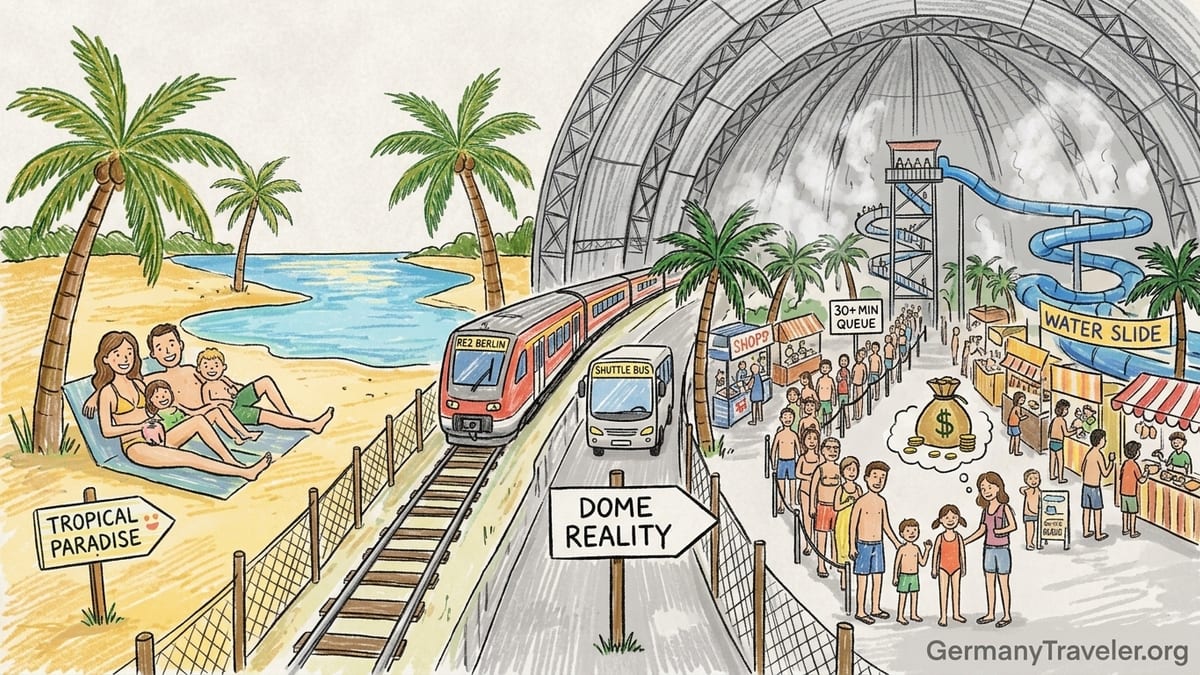
Expectations of a Tropical Paradise vs Reality Under the Dome
My expectations were high, and very specific. I wanted an easy tropical escape from Berlin in the middle of a grey week: a warm dome where my family could drift between pools, nap on loungers, hear quiet background music and maybe birdsong, and have lunch that did not feel like it came from a motorway service station. The marketing images of palm trees, blue lagoons and families strolling along a sandy beach at 26 degrees all year round are persuasive. Combined with the idea of a one‑hour train ride from Berlin and a free shuttle, it felt like a clever alternative to a budget flight to the Canary Islands.
Walking into the cargo‑hangar‑sized dome in Krausnick, the first emotion was not relaxation but sensory overload. The air was warm, yes, but heavy with chlorine and humidity. The entrance area buzzed with queues at the ticket counters, children running in all directions and loud music echoing up into the steel ceiling. The palm trees and theming are real enough at a glance, yet the illusion dissolves quickly once you notice the corrugated metal of the dome curving over your head and hear the constant shriek of people on the water slide tower.
Instead of a laid‑back resort atmosphere, it felt much more like a busy suburban water park that had been dropped inside a gigantic aircraft hangar. That is not inherently bad, but it clashed hard with the expectation of a relaxing tropical resort. The disappointment started there and deepened as each extra cost and minor frustration appeared across the day.
The Real Cost of a “Simple” Day at Tropical Islands
Before you even see the sand, the meter is running. Tropical Islands uses variable online pricing for its day tickets, with higher prices at weekends, holidays and popular dates. On several test dates in 2026, I saw online day tickets for the basic Tropical World area for adults in the range of roughly 55 to 65 euros, with children somewhat lower and small reductions for advance online purchase compared with walk‑up prices. The official site makes it clear that gate prices are usually higher than the best online offers, which is exactly what I experienced: the same day that showed a cheaper rate online the night before was several euros more per person at the counter the next morning.
Our family of four paid a little over 230 euros for admission at the gate for Tropical World, without the sauna upgrade. Parking added around 10 euros for the day in the main car park. The paid locker system is included in the sense that you receive a wristband linked to your locker and spending account, but if you want an additional locker or a valuables locker that can be an extra charge. By the time we had parked, queued, checked in and changed clothes, we were already close to 250 euros down without having eaten or drunk anything.
Food and drink are where the spending accelerates. The restaurants and snack bars around the lagoon and South Sea lagoon charge typical theme‑park prices: a simple self‑service lunch for four with drinks came to just over 60 euros. Later in the day, two coffees and four soft drinks were around 20 euros, and an afternoon snack of fries and ice creams easily added another 25 euros. We did not drink alcohol and did not order any cocktails, which were clearly more expensive again. It is entirely realistic for a family to spend 100 euros or more on food and drinks during a full day on site, especially if you are swimming, getting hungry and do not want to argue over every juice or slush drink request.
Then there is the sauna upgrade. Tropical Islands separates the Tropical World water park from the Tropical Sauna & Spa complex. To access the saunas, you pay a supplement on top of the basic ticket. On the dates I checked, that surcharge was broadly in the band of 16 to 20 euros per adult on top of the day ticket, depending on date and offer. For two adults, that would have added roughly another 35 to 40 euros to our already hefty total. We chose not to buy the supplement on this visit precisely because the original price had already felt inflated, but that meant cutting ourselves off from the quieter adults‑only area that might have salvaged some relaxation.
Transport is the final piece. If you come from Berlin, the standard option is the regional RE2 train to Brand Tropical Islands station, which takes around an hour from Berlin Hauptbahnhof, plus the free shuttle bus run by Tropical Islands between the station, resort and associated accommodation. With Berlin–Brandenburg public transport tickets, the cost depends heavily on what ticket you already hold. For a family of four without any discount cards, return tickets for the day can easily end up in the 40 to 60 euro range depending on which regional day ticket or group ticket you choose. In our case, we paid just under 50 euros return from Berlin.
By the time we were floating in the lagoon, the real cost of our “simple” day at Tropical Islands, excluding the sauna and without any overnight stay, was already around 400 euros: roughly 230+ for admission, 10 for parking, 90 to 100 for food and drink and just under 50 for regional train tickets. That is a number much closer to a city‑break day or a short spa getaway than a casual water park outing.
Queues, Noise, Atmosphere and Cleanliness on a Busy Day
Cost would be easier to swallow if the experience matched the price. Our day was in shoulder season on a weekend that was dry but cool. It was by no means the peak of school summer holidays, yet the resort already felt near capacity. From around 11:00 onwards, the queue for the big water slide tower snaked down the stairs and around the base, with posted waiting times of 30 to 45 minutes for the most popular slides. My teenagers were willing to stand that once. After the first round, they declared the slides fun but not worth repeating at those waits, especially when each ride itself lasted under a minute.
The main lagoons were absolutely crowded in the early afternoon, with people shoulder to shoulder at the pool edges and very few loungers unoccupied. The swooping shape of the dome amplifies sound. Even when we found spots farther back under the artificial jungle, the echo of lifeguard whistles, squealing children, music from a nearby bar and the thud of feet on wet concrete created a permanent background roar. If your aim is a restful day, this acoustic reality matters far more than any marketing photo of palm trees.
Cleanliness was mixed. To be fair, the pool water itself looked clear, and I saw staff testing and checking levels. In high‑traffic changing rooms and toilets, however, floors were often wet and sandy, and several times I walked into a cubicle only to turn immediately around again due to rubbish or dirty surfaces. It did not feel outright unhygienic, but it did feel worn and stressed by the sheer volume of people. Common areas along the sand sections were strewn with plastic cups and leftover trays in the middle of the afternoon, which staff did eventually clear but not fast enough to keep up.
We genuinely enjoyed the family time in the water from roughly 10:30 to 13:00. The initial hour wandering around and exploring the big dome is undeniably impressive. But after lunch, a sort of collective fatigue set in. The kids were bored with the slides because of the queues. The adults had nowhere quiet to read. The air began to feel heavy and slightly oppressive, and by about 16:00 it felt that we were forcing ourselves to “get our money’s worth” rather than actually having fun. That is not a good sign for a day that cost as much as some weekend trips.
How Ticketing, Upcharges and Parking Shape the Experience
Tropical Islands’ pricing model is a large part of why the day feels so expensive. The resort uses variable online pricing with different rates for specific days, similar to many theme parks. Popular dates, weekends and school holidays carry noticeably higher admission prices. If you walk up and buy at the door, you almost always pay more than the lowest online rate that was available earlier. From a revenue management perspective this makes sense, but as a visitor it creates a strong sense that you are being penalised for late decisions or for not doing detailed ticket research in advance.
The operator divides access into the Tropical World water park and the Tropical Sauna & Spa. The basic ticket gets you into the water park pools, lagoons and slides. The sauna area costs extra per person. This supplement is not cheap when you add it for two adults, and once you are inside the dome it feels psychologically difficult to justify yet another 30 to 40 euros when you have already spent over 200 at the door. The result is that many parents stay out of the saunas and instead endure the noisy main dome all day, even if they would happily have paid a single higher all‑inclusive price for a calmer mixed‑use experience.
Parking is another small but telling charge. Tropical Islands has a huge car park directly in front of the dome and charges a daily parking fee, noted in its information sections as paid parking even for day guests. It is not an outrageous amount by itself, but it contributes to the paid‑everywhere feeling. You pay to park, you pay for your basic entry, you pay again for saunas, and then you pay theme‑park prices for food and drink once inside a captive environment with no real competition.
The free shuttle from Brand Tropical Islands station is one of the few guest‑friendly touches that genuinely work well. According to the resort’s own service information, a free shuttle runs regularly between the station, the Tropical Islands hall, Shop & Bistro and the on‑site OHANA Town accommodation. The bus has a fold‑out ramp for wheelchairs and buggies, and in practice it made the last leg of the journey relatively painless. The regional RE2 trains stop directly at Brand Tropical Islands station, so the combined train plus shuttle journey from Berlin does function almost like a dedicated resort transfer, without any extra shuttle fee on top.
Day Trip from Berlin vs Staying Overnight
For many visitors the big decision is whether to attempt Tropical Islands as a long day trip from Berlin or to stay overnight in one of the resort’s tents, rooms or nearby lodges and mobile homes. Having done the day trip, I can say clearly that the single‑day option is physically and financially punishing if you try to squeeze every last minute out of your ticket.
A typical day trip from Berlin involves an early start to catch a morning RE2 train, the shuttle, then arrival at the dome mid to late morning. You swim, queue, eat and explore, perhaps stay until the evening, then catch the shuttle and train back. Including door‑to‑door time in Berlin, this easily becomes a 12‑ to 14‑hour day, with several hours of it spent in transit or waiting for connections. For families with young children, the return journey in the evening can feel very long, especially when everyone is tired and has had too much sugar and sunlamps.
Overnight stays come in many categories: from “tents” under the dome to hotel‑style rooms, holiday homes and mobile homes outside. Prices fluctuate heavily by season and can climb into city‑hotel territory in peak periods. On dates I checked for a weekend family stay with two adults and two children, it was common to see overnight packages well over 250 to 300 euros per night, sometimes significantly higher, often including admission. On paper this can actually make sense compared with buying separate day tickets, especially if you plan to use the water park across two days.
The catch is that the atmosphere under the dome does not magically become calm at night. Some families like the novelty of camping among palm trees and waking up by the lagoon, but for guests mainly seeking rest, the combination of artificial light, lingering daytime noise and warm, humid air is not objectively relaxing. Staying in the outdoor lodges or mobile homes can provide more natural quiet and fresh air, yet at that point you are paying high resort prices for accommodation that is functionally similar to other Brandenburg holiday parks that sit next to real lakes and forests.
If your goal is simply to swim and slide, a long day trip from Berlin is feasible, but factor in the cumulative exhaustion and that you will likely leave before closing time because everyone has had enough. If your goal is relaxation, an overnight stay only makes sense if you see it as a novelty resort experience and not as a serious wellness break.
Comparing Costs with Other Water Parks and Brandenburg Spa Days
To judge whether Tropical Islands is worth the money, it helps to compare like for like. Across Germany, full‑day tickets for higher‑end thermal baths and saunas tend to fall in the range of 40 to 50 euros per person, sometimes less, for access to both pools and saunas. A discussion on spa resorts pricing noted that a full day with sauna access at many well‑regarded thermen costs around that band, with total per‑person daily spending including food ending up closer to 130 to 150 euros if you add treatments. In Brandenburg near Berlin, several specific price lists confirm that pattern.
For example, the SaarowTherme spa at Bad Saarow, a popular lake town south‑east of Berlin, lists 2026 prices of roughly 32.50 euros for a three‑hour thermal bath ticket and around 47.50 euros for a full‑day bath and sauna ticket. Local guides summarising the official tariff confirm these amounts. The public information on Bad Saarow’s thermal spa pricing and opening hours states that a full‑day bath and sauna ticket in 2026 sits just under 50 euros. Similarly, information on Spreewald Therme in Burg in the Spreewald region shows a SoleBad day ticket (brine bath only) around 37 euros, with combined bath and sauna tickets higher but still broadly in the same region as SaarowTherme. Even hotel‑linked day spas around Bad Saarow advertise day spa packages with pool and sauna starting from under 30 euros on some offers according to their published price lists.
Compared with these, Tropical Islands’ combination of a 55 to 65 euro base day ticket plus an additional sauna supplement of roughly 16 to 20 euros pushes the total very clearly beyond many conventional spa days. For a single adult, a full water park plus sauna day at Tropical Islands can therefore land around or above 75 to 80 euros before you have bought any food. For a family of four, that difference multiplies quickly. A family could conceivably spend a full day at a place like SaarowTherme or Spreewald Therme with combined bath and sauna for two adults, reduced‑price tickets or cheaper pools for children, and still end the day significantly under our 400‑euro Tropical Islands total, even including regional train fares.
Local Berlin pools and simple sauna add‑ons are cheaper again. Public Berlin pools run by Berliner Bäder charge under 10 euros for a typical swim ticket even after recent price increases, with some indoor pools offering early or late discounts. While those facilities lack the palm trees and slides, they illustrate just how far at the premium end Tropical Islands now sits. If all you want is water, warmth and a bit of fun, a combination of a Berlin pool in the morning and a walk around a Brandenburg lake in the afternoon costs a fraction of a dome day.
Who Gets Value Here: Families, Teens, Couples and Spa Seekers
Value at Tropical Islands is very uneven across visitor types. Families with small children arguably get the highest subjective value. Young kids are less bothered by queues and noise, and the sheer novelty of sand under a giant roof, a kids’ play area and warm water can occupy them for hours. Several parents I spoke to in the queues felt that as long as their under‑tens were happy, the high price was tolerable once every few years. The problem is that even for this group, the total cost for a full day can approach what many households might consider a modest holiday budget.
Families with teenagers like mine sit in the most awkward middle ground. Teens are old enough to notice the pricing and to become bored once they have done each slide a few times. They are also the ones most likely to buy slushies, snacks and extra treats, which drives up spending. After the first rush of sliding and exploring, my two were fairly blunt: fun, yes, but not remotely worth doing more than once at this cost when the same money could fund an entire weekend in the Spreewald or a short city trip.
Couples fare even worse on the value scale, especially if they are mainly seeking relaxation. A pair of adults pays premium prices to share overcrowded pools and to sit on scarce loungers in a high‑noise environment. Unless you pay the sauna supplement, there is very little genuinely quiet space. Even with sauna access, you are still inside an indoor resort complex, not in a calm thermal spa surrounded by nature. Many Berlin‑based couples choose places like Bad Saarow or Vabali‑style saunas in the city precisely because they want extensive, quiet sauna gardens and dim relaxation rooms that Tropical Islands cannot replicate inside a metal dome.
For adults primarily interested in wellness and spa culture, Tropical Islands is poor value. The themed Tropical Sauna & Spa area is large and architecturally interesting according to the resort’s own descriptions, with multiple saunas inspired by Asian and Indian sites. Yet by the time you add the supplement to the already expensive base ticket and then pay for food and perhaps a treatment, you could easily have enjoyed a dedicated thermal spa day elsewhere with more refined facilities for the same or less outlay. Many spa regulars I know view Tropical Islands as a family water park in disguise, not a serious spa destination.
Would Off‑Peak Timing, Advance Booking or an Overnight Stay Fix It?
There are real ways to reduce the financial and physical pain of a Tropical Islands visit, but none turn it into a budget day out. Booking online in advance for low‑season weekdays can cut a noticeable percentage off the headline ticket price, especially if you are flexible. The resort clearly incentivises guests to lock in dates early, and avoiding school holidays and weekends usually means slightly lower prices and somewhat fewer people. If you must go, an off‑peak Tuesday in November will beat a Saturday in August for both noise and crowding.
Arriving very early and leaving by late afternoon can also make the experience feel less punishing. In our case, the first two to three hours before midday were genuinely enjoyable. If I were forced to return, I would arrive shortly after opening, claim a good lounger, swim, do the slides before queues build and then treat myself to a proper dinner back in Berlin or at a lakeside restaurant elsewhere rather than eating another expensive tray meal under the dome.
Overnight accommodation only makes sense in narrow circumstances. If you live far from Berlin and want to bundle the water park into a broader Brandenburg trip, or if your children are obsessed with the idea of sleeping under the dome, then a one‑time overnight stay might be worth the premium as a birthday treat. For everyone else, two separate days of high prices do not improve the underlying issues of noise, crowds and artificial atmosphere.
If I ever went again, there are specific expenses I would refuse to pay a second time. I would not buy gate‑price tickets at the last minute; if no reasonable online offer was available in advance, I would simply choose a different destination. I would not pay the sauna supplement on top of an already pricey family ticket, because for adults focused on wellness it makes more sense to visit a dedicated thermal spa instead. I would avoid buying full meals inside and instead eat breakfast and an early dinner elsewhere, limiting spending under the dome to the occasional drink. And if driving, I would at least factor the parking fee into my comparison with other places, because paying to park in a vast empty field in rural Brandenburg feels particularly unnecessary when so many lakeside saunas include parking in the base price.
The Takeaway
After a full day and a sobering look at the receipts, my conclusion is simple. Tropical Islands is a spectacular piece of infrastructure and an impressive engineering project that has evolved into a very expensive day out. For a one‑off treat, particularly with small children who will remember the huge dome and sandy beach for years, it can be worth doing once if you can comfortably afford it and approach it with realistic expectations of crowds and costs.
For most travellers and Berlin residents weighing up how to spend a spare 300 to 400 euros, however, Tropical Islands compares poorly with its alternatives. A weekend split between a Brandenburg thermal spa like Bad Saarow, a real lake and a modest hotel or guesthouse can deliver more peace, more authentic nature and at least as much water time for similar or less money. Even a simple mix of a Berlin pool visit and a lakeside walk with a good meal will feel less like being financially squeezed.
The dome is warm, the water is blue and the palm trees are real enough, but when I think back on our day in Krausnick, I remember mostly the queues, the noise and the sting of watching the total cost quietly climb with every small decision. Tropical Islands may suit a narrow set of visitors seeking a once‑in‑a‑lifetime novelty. For everyone else, especially those chasing real relaxation or good value, your money is almost certainly better spent on the many spa towns, pools and lakes that Brandenburg and Berlin already do so well.
FAQ
Q1. How much should I budget for a family day at Tropical Islands from Berlin?
For a family of four, a realistic total is around 350 to 450 euros including admission, parking, food and regional train tickets, without the sauna upgrade or hotel.
Q2. Is it cheaper to buy Tropical Islands tickets online or at the gate?
Online advance tickets are usually noticeably cheaper, especially for off‑peak weekdays. Walk‑up gate prices tend to be higher for the same day and can add several euros per person.
Q3. Is the Tropical Islands sauna area included in the standard ticket?
No. Access to the Tropical Sauna & Spa requires a separate supplement on top of the basic Tropical World ticket, which can add roughly 16 to 20 euros per adult depending on date.
Q4. How crowded is Tropical Islands on a typical weekend?
On weekends and holidays it can feel very busy, with long queues for the main slides, packed lagoons and most loungers taken by late morning, plus high general noise levels.
Q5. Does the free shuttle from Brand Tropical Islands station work well?
Yes. The resort operates a free shuttle bus between the station and the dome and nearby accommodation. It runs regularly, is step‑free and makes the last leg of the journey straightforward.
Q6. Is Tropical Islands good value for couples seeking a quiet spa day?
Generally no. By the time you add the ticket, sauna surcharge and food, you pay more than many dedicated thermal spas while putting up with more noise and a less relaxing setting.
Q7. How does the cost compare to a Brandenburg thermal spa like Bad Saarow?
Thermal baths such as SaarowTherme typically charge under 50 euros for a full day with sauna. Adding train fares, a spa day there usually comes in well below a comparable Tropical Islands visit.
Q8. Is it worth staying overnight at Tropical Islands?
Overnight stays can be worthwhile only if you want the novelty of sleeping under the dome or in resort housing and plan to use the water park over two days. For pure relaxation, other spa hotels offer better value.
Q9. Can you bring your own food into Tropical Islands to save money?
The resort focuses on on‑site catering. Policies around bringing your own food can change, but in practice most visitors rely on the internal restaurants and snack bars, which are priced like a theme park.
Q10. What is the best way to make a Tropical Islands visit less stressful and expensive?
Book online for an off‑peak weekday, arrive early, limit on‑site food spending to drinks and small snacks, and consider skipping the sauna upgrade in favour of a separate, calmer spa day elsewhere.