


I arrived in Lübeck on a cool, bright morning, the kind that makes brick glow softly instead of blaze. As I stepped off the bus near the Holstentor, the twin round towers rose in front of me like a red-brick gateway to another century. Freight trains once rolled in and out of this side of town; today it is mostly camera-toting visitors and commuters, but the hulking late Gothic gate still looks like a customs barrier waiting for medieval cargo. This would be my starting point for a day tracing Lübeck’s Hanseatic merchants on foot, following the route their goods and money once took through the old town island.
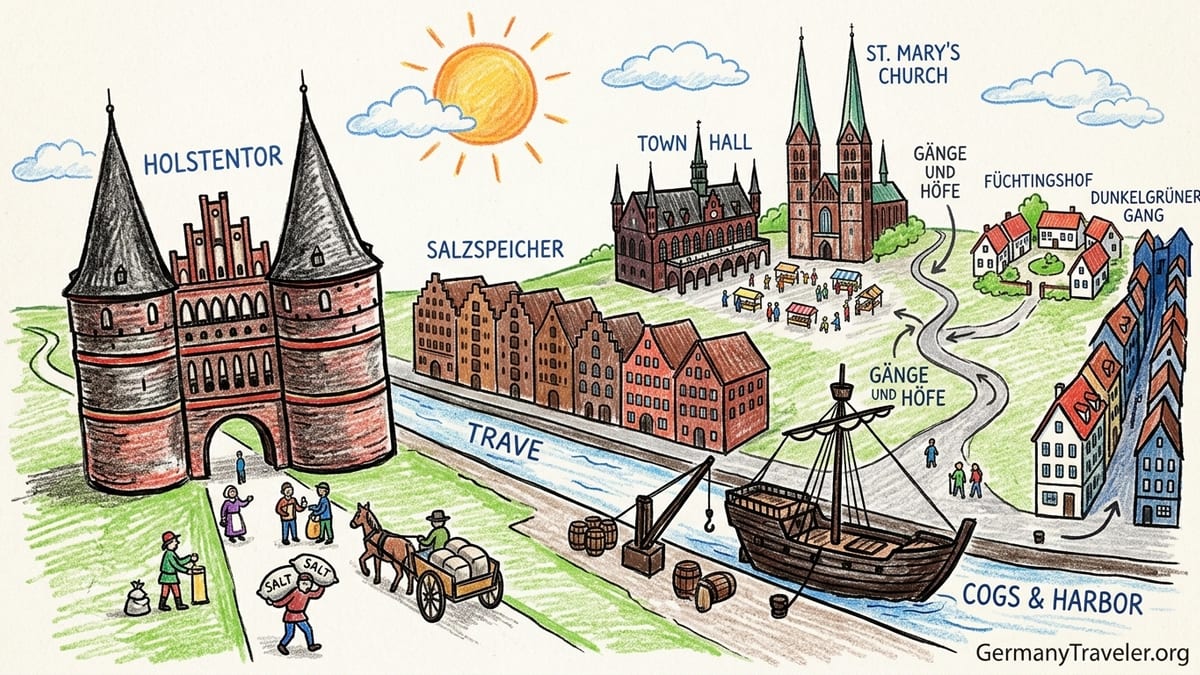
First Glimpse of the Hanseatic City at Holstentor
Standing in front of the Holstentor, I immediately understood why it has become Lübeck’s emblem. The brick is almost black in places, with patterns picked out in lighter glazed tiles and white stone medallions. Slightly leaning due to unstable ground, it looks less like a perfect monument and more like an aging defensive work that had to survive centuries of salt-laden air and shifting trade fortunes. In the late Middle Ages this western gate was where wagons loaded with cloth, salt, and herring rolled in and out. Walking toward it from the station side, you have the same perspective a visiting merchant would have had when arriving from the land routes.
I did not go inside the Holstentor museum on this visit, partly to save time and partly because the displays lean more toward general city history than the wider Hanseatic trading network. Having visited on a previous trip, I knew I would rather invest my museum time later in the day at the European Hansemuseum. Skipping the gate’s interior also kept my total museum spending more focused. From the grassy ramparts I turned left for a quick look at the Salzspeicher warehouses on the Trave, then looped back toward the old town’s heart.
The Salzspeicher are a row of stepped-gable granaries facing the river, their weathered brick facades reflected in the slow water. These were functional buildings, once stacked high with salt from Lüneburg that Lübeck merchants shipped onward to Scandinavia and the Baltic. Today their lower levels house offices and shops, but if you stand across the street and squint a little, you can still imagine barges tied up below and porters carrying sacks up narrow internal stairs. It was here, on the edge of the island, that merchant families moved from hauling goods to financing and insuring them.
From Holstentor and the Salzspeicher I followed the stream of pedestrians through Holstenstraße, then along Breite Straße toward the market square. The distance is short, around 700 meters, but the feeling changes from defensive edge to civic showcase. Shop windows give way to gabled patrician houses, and the smell of coffee begins to overpower the faint river scent. Like Hanseatic merchants shifting from the risk of open sea to the controlled world of contracts and councils, I was moving from the outer ring of warehouses into the inner ring of power.
Market Square, Town Hall and the Churches of Power
Stepping into the market square, I found myself almost surrounded by brick. On one side the ornate Gothic-Renaissance Town Hall rises with its perforated brick screen and high towers, proof that Lübeck’s council invested its wealth in showpiece architecture as much as in ships. On another side stands the stern mass of St Mary’s Church, the merchants’ parish and their preferred place for swearing oaths, endowing altars, and being buried under slabs that still line the floor. Together, the Rathaus and Marienkirche form a brick statement of civic and mercantile authority.
I ducked briefly into St Mary’s. As of 2026, adult admission for the church interior is set around 4 to 5 euros depending on whether any special exhibitions are running, collected at a small desk inside the entrance. The vast nave, with its high vaults and delicate ribs, feels less like a parish church and more like an architectural boast: our city is rich enough to build in brick what others built in stone. In a side chapel, a model cog evokes the cargo ships that once crowded Lübeck’s harbor, while the famous broken bells in the south tower chapel still lie where they fell in a bomb attack in 1942. It is a sobering reminder that even a city grown rich on peaceful trade is not immune to war.
From there I crossed the square to glance into the Town Hall courtyard. Guided tours of the interior are available for a separate fee, but I chose not to go inside this time. The architecture you can see from the square already tells much of the story: brick Gothic walls from the thirteenth century pierced by later Renaissance and Baroque additions, a patchwork of prosperity layered over itself. Merchants here were not only traders but also councilors, judges, and sometimes mayors; the Town Hall was where they negotiated privileges with foreign rulers and settled disputes over ships and cargoes.
Before leaving the square, I grabbed a mid-morning coffee and Franzbrötchen from a bakery along Breite Straße. A cappuccino and pastry came to just under 6 euros, a reminder that while Lübeck is not a budget destination, it is gentler on the wallet than cities like Hamburg a short train ride away. Refueled, I cut north toward the narrow streets where the real fabric of merchant life once lay, and where the most evocative traces survive today: the Gänge und Höfe, or alleys and courtyards tucked behind the grand facades.
Discovering the Gänge und Höfe Behind Merchant Facades
At first glance Lübeck’s old town seems to be a long sequence of broad streets lined with four and five story gabled houses. Many of these were merchant homes and offices, with storage lofts accessed by hoists under the gables. The real surprise lies behind them. Beginning in the fourteenth century, as Lübeck’s trade exploded and living space within the city walls became scarce, property owners began to squeeze small one-story dwellings into their backyards. Narrow alleys cut through the front houses to reach these tiny “booths,” which they rented out to sailors, day laborers, and later widows of merchants and seamen. Today around 80 such alleys and courtyards survive, many still residential and some freely accessible during the day.
To reach my first example I headed north from the market, zigzagging via Kleine Burgstraße and past narrow fronts that gave little away. Between conventional doorways, small arches and doorframes opened onto darker gaps marked with names: a “Gang” here, a “Hof” there. Most of these do not have ticketed access. They are part of the city’s UNESCO-listed fabric and are, during daytime hours, open to anyone willing to walk respectfully through what is effectively a shared front garden. The rule of thumb is simple. If a gate is open and there is no sign prohibiting entry, you may step through, keeping noise down and cameras discreet. If it is closed or clearly marked private, you move along.
These passages show a different side of Hanseatic wealth. The merchants in their brick palaces on the street did not simply hoard space; they monetized every square meter, turning their backyards into dense clusters of simple dwellings. Nearly 80 percent of Lübeck’s population once lived in such cramped conditions, a sharp contrast to the airy counting houses where big deals were struck. As I walked, I kept thinking about clerks and porters who might leave a windowless booth in one of these alleys before dawn, cross the yard, and step directly into the polished front entrance of a mercantile house where they spent the day handling tallies and letters of credit.
My route for the late morning aimed at two specific and contrasting examples that are still accessible today: Füchtingshof, a grand charitable courtyard founded by a wealthy merchant, and the far more modest Dunkelgrüner Gang, a tight alley that offers a glimpse of how densely the backland was once built.
Füchtingshof: A Merchant’s Charity and a Baroque Courtyard
From the center I walked northwest toward Glockengießerstraße, one of the richest streets in terms of surviving courtyards. The name itself hints at older crafts, but by the seventeenth century this was also a stronghold of merchant foundations. After about ten minutes on foot from the market square, I found the discreet entrance to Füchtingshof at numbers in the mid twenties, a brick arch with a small sign and a glimpse of greenery beyond. There was no gate across the entrance, only a notice reminding visitors to be considerate. According to the city’s tourism information, the courtyard is accessible daily, most clearly between roughly 9 to 12 in the morning and 15 to 18 in the afternoon, when residents expect the trickle of sightseers.
Stepping through felt like entering a parallel Lübeck. Inside, a paved path led between low, whitewashed houses with green doors and tiny gardens in front, all oriented toward a dominant central building at the rear. This main block, built in the mid seventeenth century, once held the assembly room for the courtyard’s overseers and is often cited as one of the most beautiful Baroque interiors in the city. It is not regularly open to casual visitors without a tour or special event, and I did not enter, but the exterior alone tells a story of philanthropic self-confidence. Johann Füchting, the merchant who endowed the courtyard, created this complex to house widows of merchants and skippers. The foundation still exists today, and the apartments remain social housing, which makes it important to move quietly and avoid photographing windows at close range.
Füchtingshof can be visited without a ticket, so it did not add to my day’s expenses, but it did demand time. I lingered for almost twenty minutes, reading a small plaque and picturing the lives that played out here. Merchant wealth in Lübeck did not only finance tall ships and counting houses; it also underpinned these carefully regulated communities where the less fortunate wives of traders could live with a degree of dignity. The courtyard rules once extended even to dress, admonishing residents to avoid flashy jewelry and to lead quiet, respectable lives. Walking back out into Glockengießerstraße, I had the sense of having stepped through a social contract preserved in brick.
Just along the same street other passages tempted further exploration: Glandorps Hof, Schwoll’s Thorweg, and more. I chose to limit myself to glancing into a couple of them, mindful both of time and of the fact that there is a very fine line between architectural curiosity and turning someone’s doorstep into a tourist attraction. Still, this short stretch of road alone could occupy an hour or more for anyone deeply interested in urban history.
Dunkelgrüner Gang and the Modest Side of Hanseatic Housing
From Glockengießerstraße I crossed northward toward the streets that parallel the Trave, heading for Engelswisch and the intriguingly named Dunkelgrüner Gang. It took about ten minutes of leisurely walking to reach the area, passing more rows of stepped gables and glimpses of the river. The entrance to Dunkelgrüner Gang is easy to miss, a narrow opening between street houses that looks like it might be a service passage rather than a public route. There was no ticket booth or signboard here, just the simple name on the wall.
Within a few steps the light dimmed. The alley narrows so much that you can almost touch both sides with outstretched arms, and in places it bends slightly, hiding what lies ahead. This, I realized, was the lower end of Hanseatic housing: tiny plots, small garden strips, and modest facades that once pressed hard against one another. Historical notes describe this whole cluster of Gänge between Untertrave and Engelswisch as a labyrinth of little booths, gardens, and cul-de-sacs. Today some houses have been modernized and painted in soft colors, with bicycles leaning against walls and potted plants softening the edges.
Walking here felt different to Füchtingshof. There was less of the conscious display of philanthropy and more of a lived-in intimacy. I kept my steps quiet and focused on the paving stones underfoot, punctuated by small drains and the occasional patch of moss. It is easy to imagine that sailors who spent months at sea might have returned gratefully to such tiny spaces, close to both the harbor and the taverns but tucked behind the grander fronts. Merchant families could keep their own refined lives on the street side separate while still extracting rent and labor from those who lived in the rear yards.
Importantly, Dunkelgrüner Gang is still residential, and while it is described in local walking guides as open to the public by day, there is no sense that it is a formal tourist site. I did not linger long and only took a couple of quick, wide photos without aiming my camera at specific windows. Of all the places I saw that day, this was the one that most vividly conveyed the density and inequality embedded in Lübeck’s success, layered just meters behind the proud merchant houses.
Northward to the Hospital of the Holy Spirit, Burgtor and the European Hansemuseum
By early afternoon I began to follow the old merchants’ route north. From Engelswisch I threaded back toward the central spine of the old town, then walked along Königstraße to the Hospital of the Holy Spirit. This late medieval complex, originally a charitable hospital and almshouse, sits close to where northern traders once entered the city. Its long hall and painted roof beams speak to a different form of wealth distribution: endowments from successful merchants who hoped to care for the poor and secure their own salvation in the process. There is a modest entrance fee of around 4 euros for adults to see the interior when it is open, though hours can vary with special events and markets.
I chose just to step into the courtyard and admire the gables instead of paying for a full interior visit, partly because I wanted to reach the Hansemuseum with enough time. This is one of those triage decisions that a one-day visitor has to make. If you are especially interested in medieval hospital care and religious art, the ticket is worthwhile. If your focus is trade and urban space, a brief look at the exterior and the street context may be enough.
From the hospital it is only a short walk north to Burgtor, the city’s less-famous but equally atmospheric northern gate. Passing beneath its tower, you cross what was once the threshold between the commercial island and the roads to Scandinavia and the eastern Baltic. Today the ramparts are softened by trees, and cyclists zip past on their way to modern suburbs, but the sense of passing through a defended choke point remains. Medieval merchants heading for ships on the Trave would have known this gate well.
Just beyond Burgtor, following the curve of the canal and the modern waterfront, I reached my final major stop: the European Hansemuseum. Located on the north side of the old town, where castle and harbor installations once stood, this museum has positioned itself as the flagship institution for understanding the Hanseatic League across the Baltic region. It would end up being my single largest expense of the day and the experience I was most curious to assess.
Inside the European Hansemuseum: Worth the Time and Ticket?
As of autumn 2026, the permanent exhibition at the European Hansemuseum charges 16 euros for an adult ticket. That price includes access to the former castle friary on the same site. Children and teenagers under 18 go in free, and there are various concessions for students and other groups. The museum is open daily from 10:00 to 18:00, and while you can buy tickets on site, timed entry may apply during busy periods. I arrived around 14:00 and had no problem getting a same-day slot.
The museum starts with an orientation area, then leads you down into a series of recreated environments arranged roughly chronologically and thematically. Instead of glass cases full of coins and seals from the start, you walk into staged spaces: a quayside, a counting house, a council chamber, even merchant homes in different Hanseatic cities. Ambient soundscapes recreate the creak of ships or the murmur of debates, while wall texts and interactive displays explain what is going on. Purists might find the theatrical approach a bit much, but I found that it helped anchor the abstractions of trade, law, and credit in physical situations.
One of the strongest sections follows a single Lübeck merchant family as they build and then manage a trading network over several generations. Contracts projected on tables illustrate how they chartered ships or partnered with other houses, and bilingual panels unpack concepts like joint liability and commercial law that once gave the Hanseatic League its cohesion. Another room reconstructs a Novgorod trading courtyard, complete with snow crunching underfoot and discussion of how distant outposts functioned during the fur trade. Here the museum does a good job of shifting the perspective away from Lübeck alone to the wider web of cities from Bergen to Riga.
I spent just under two and a half hours in the permanent exhibition and the friary, moving at a moderately attentive pace. In my view the 16 euro ticket was justified, especially if you plan to spend more than ninety minutes inside. The interpretive material is clear without being simplistic, and the recreated environments, while occasionally theatrical, helped me connect what I had been seeing on the streets outside to the mechanics of long-distance commerce. If your budget is tight or your interest in economic history is mild, you might consider focusing only on the old town’s free sights. For anyone who has come to Lübeck specifically because of the Hanse, however, this museum earns both the time and the entrance fee.
By the time I emerged into the late afternoon light, my feet reminded me that I had now walked most of the island from south to north, with plenty of zigzags. Including diversions into courtyards and the museum visit, my total walking distance for the day was somewhere between 8 and 10 kilometers. Nothing extreme for a reasonably fit traveler, but enough that I was glad I had worn comfortable shoes rather than trying to dress up for Instagram.
Eating, Costs and What I Would Skip Next Time
After the Hansemuseum I was ready for a break. Conveniently, there are several cafes within a few minutes’ walk. I settled into a small place near the museum for a late lunch: a bowl of fish soup paired with dark bread and a non-alcoholic drink, which came to roughly 18 euros including tip. Earlier I had spent around 6 euros on coffee and pastry near the market, and I picked up a simple takeaway sandwich and bottle of water in the early evening for another 8 euros. That brought my food and drink total for the day to about 32 euros, without feeling deprived or splurging on a restaurant dinner.
For admissions, I paid 4 to 5 euros to step inside St Mary’s Church and 16 euros for the European Hansemuseum, so call it approximately 21 euros in entrance fees. I did not pay to go inside the Holstentor museum, the Town Hall, or the Hospital of the Holy Spirit, choosing instead to spend my time and money on the Gänge and the Hansemuseum. Local public transport to and from the station cost around 3 to 4 euros each way depending on the specific ticket type, though the walk from Lübeck Hauptbahnhof to Holstentor is short enough that you can easily skip transit altogether. In my case, my total out-of-pocket spending for this day trip, excluding the train ticket from Hamburg, landed in the range of 60 to 70 euros.
As for what I would skip next time, two things stand out. First, I would not prioritize going inside every church. Lübeck is blessed with major brick Gothic churches, and it can be tempting to step into each one, but the interiors begin to blur and each ticket adds up. St Mary’s, as the merchants’ church beside the Town Hall, felt essential. The cathedral and others, while impressive, might wait for a second visit. Second, unless you are particularly devoted to military architecture, I would continue to skip the Holstentor museum itself. The exterior is unmissable, and the small park around it gives excellent views, but the displays inside are more general city history than focused Hanseatic trading material. Those with limited time may get a better return by investing fully in the Hansemuseum instead.
On the positive side, I would absolutely spend even more time in the Gänge und Höfe on another visit, perhaps exploring a few additional passages south of the cathedral and around Hartengrube. With a good city map in hand, you could easily design a focused two-hour loop visiting half a dozen alleys, always observing local etiquette. That felt like the part of Lübeck that most directly connected the invisible machinery of trade to the lives of thousands of ordinary people.
A Realistic One-Day Itinerary in the Merchants’ Footsteps
Based on this walk, a realistic one-day itinerary for a traveler interested in following the Hanseatic merchants might look like this. I will first describe what I actually did, then add a few researched alternatives for those with different interests or energy levels.
My firsthand route looked like this. I arrived near Holstentor just after 9:30, spent half an hour walking around the gate and Salzspeicher exteriors, then strolled into the old town via Breite Straße. Around 10:15 I reached the market square, made a quick circuit of the Town Hall facade, and spent about forty minutes inside St Mary’s Church. After a short coffee break I departed the square around 11:30 and headed toward Glockengießerstraße, arriving at Füchtingshof close to noon. I spent around twenty minutes there, then another half hour ambling along the street, glancing into one or two additional alleys.
By about 13:00 I turned north toward Engelswisch and Dunkelgrüner Gang, reaching that area at 13:20. I kept my time in the alley itself to roughly fifteen minutes to avoid feeling intrusive, then walked via Königstraße past the Hospital of the Holy Spirit, pausing only in the courtyard for a few minutes without paying admission. Around 14:00 I passed through Burgtor and arrived at the European Hansemuseum. I spent just under two and a half hours there, emerging after 16:30, then took a late lunch and slow wander back toward the southern end of the island, admiring facades in the soft afternoon light before leaving around 18:00.
For travelers who want alternatives, research suggests a few adjustments. If you are very interested in institutional history and decorative interiors, you might swap out the time spent peeking into multiple smaller alleys for a paid interior visit of the Hospital of the Holy Spirit or a guided tour of the Town Hall. That would still keep your walking manageable while deepening your understanding of how civic and charitable institutions underpinned trade. On the other hand, if your focus is architecture and residential life rather than museums, you could shorten the Hansemuseum visit to ninety minutes and use the saved hour to explore additional Gänge south of the cathedral or around Hartengrube and Wahmstraße.
One important researched note applies regardless of itinerary. Local tourism and heritage organizations emphasize that many Gänge and Höfe are still lived-in residential spaces. Most remain open to the public during the day, some close at night with gates, and a few are fully private. There is no admission charge for these, and no formal visiting schedule beyond common sense hours, but visitors are asked to keep noise low, to avoid photographing residents directly, and to move steadily rather than treating courtyards like open-air cafes. Walking the merchants’ city means sharing it, however briefly, with today’s inhabitants.
The Takeaway
By the end of my day in Lübeck, the outline of the Hanseatic merchants’ world had shifted from abstraction to something you can trace with your feet. Holstentor and the Salzspeicher mark the outer ring where goods and customs officials once met at the city’s edge. The market square, Town Hall, and St Mary’s Church reveal the civic and spiritual heart where merchants wielded political power and shaped policy. Behind them, the Gänge und Höfe show how prosperity rested on dense, often precarious housing for less wealthy citizens and dependents.
The European Hansemuseum, with its 16 euro ticket and immersive displays, tied these elements together in a way that justified both cost and time for me. Its recreated environments, from counting houses to distant trading posts, enriched what I had seen outside by explaining the contracts and networks that held the league together. Between the free exploration of alleys and the structured narrative of the museum, I came away with a sense of Lübeck as both a physical city of brick and a node in a far-reaching web of trade, law, and credit.
Practically speaking, a traveler with moderate fitness and a full day can comfortably follow a similar route, spending around 60 to 70 euros on food, local transport, and admissions, not counting intercity trains. Good walking shoes, a map highlighting the Gänge, and a willingness to balance curiosity with respect for residential privacy will go a long way. If I were to return, I would deepen my exploration of the alleys and perhaps add a single additional interior like the Town Hall, but the basic structure of the day would stay the same. It felt, quite literally, like walking in the merchants’ footsteps.
FAQ
Q1. Can I really walk all of Lübeck’s old town in one day?
Yes, if you focus your route. The old town island is compact, and a loop from Holstentor through the center to the Hansemuseum and back is roughly 8 to 10 kilometers with diversions.
Q2. Are Lübeck’s Gänge und Höfe open to the public?
Many are open during the day and form part of the UNESCO-listed old town. Some close at night with gates, and a few are private, so always respect signs and closed doors.
Q3. Do I need to pay to enter Füchtingshof and Dunkelgrüner Gang?
No. There is no admission charge for these passages, but they are residential, so visitors are expected to move quietly, avoid intrusive photography, and visit during daytime hours.
Q4. Is the European Hansemuseum worth the 16 euro ticket?
If you are interested in Hanseatic trade and history and can spend at least 90 minutes inside, the museum offers in-depth, well-presented exhibits that justify the cost.
Q5. How much should I budget for a Lübeck day trip excluding trains?
Allow around 60 to 70 euros for a full day, which covers a couple of admissions like St Mary’s and the Hansemuseum, plus modest meals and local transport if needed.
Q6. Can I skip the Holstentor museum without missing key Hanseatic history?
Yes. The Holstentor exterior is iconic, but the interior focuses on general city history. For Hanseatic trade, the European Hansemuseum gives a more comprehensive picture.
Q7. Which church interior is most important for understanding merchant life?
St Mary’s Church beside the Town Hall is the key one. It was the merchants’ parish and contains memorials, artwork, and exhibits closely tied to Lübeck’s trading elite.
Q8. Are the alleys and courtyards safe to walk alone?
By day, the Gänge und Höfe feel safe for solo travelers. They are narrow but central, and you are rarely more than a minute or two from a main street and other pedestrians.
Q9. How much time should I plan for the European Hansemuseum?
Plan at least two hours for the permanent exhibition and the friary if you like to read panels and engage with interactive elements. Quick visits can feel rushed.
Q10. What should I wear for a full day following this route?
Wear comfortable walking shoes suitable for uneven cobbles, dress in layers for changeable weather, and carry a small bag for water, snacks, and any maps or brochures.