


I arrived in Lüneburg on a cool, bright morning with a simple question in mind: how did this modest inland town, set back from the North Sea, become one of the wealthiest cities of the Hanseatic League through something as ordinary as salt? By the end of the day, after tracing salt routes from the station to the old harbor, standing under tilted church pillars and finishing in the former saltworks, the answer felt vividly, physically real beneath my feet.
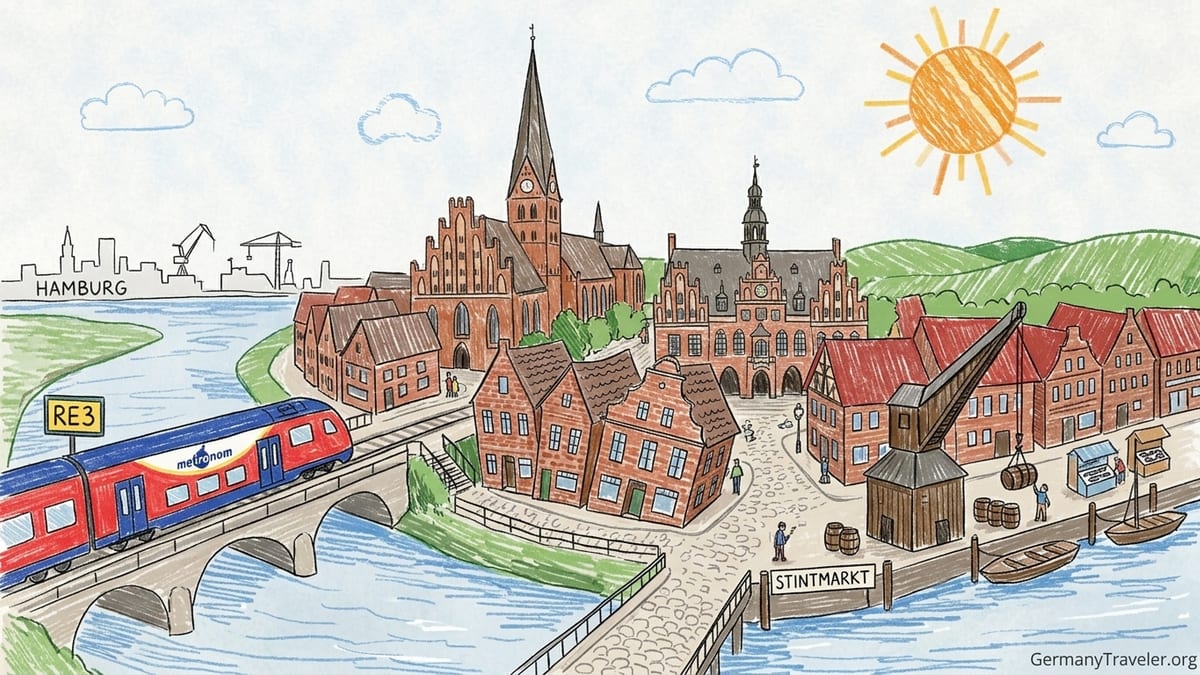
Arriving from Hamburg: A Short Ride into the Hanseatic Hinterland
The journey from Hamburg to Lüneburg is short enough that you barely have time to finish a coffee. From Hamburg Hauptbahnhof, I boarded a metronom regional express on the RE3 line, part of the Hanse network running south toward Uelzen. Trains typically leave at least every hour, with additional services at busy times, and the ride to Lüneburg usually takes around 30 minutes. Long distance ICE trains also cover the route in roughly 25 to 30 minutes, a reminder that the modern rail corridor more or less follows an ancient axis of movement between the Elbe and the Baltic.
Stepping out at Lüneburg’s station, I joined commuters and students heading toward the center. The walk into town takes about 10 to 15 minutes, along streets that look unremarkable at first. Only when the brick gables of the old town begin to rise ahead does it become clear that you are entering a city that somehow escaped the worst of war and fire. The closer I moved toward the historic core, the more the roofs seemed to ripple and the facades to lean, subtle signs that the ground beneath Lüneburg is not entirely stable.
Following the stream of people, I made for the square of Am Sande, the historic marketplace. This route from the station into the old town is the most natural starting point for understanding Lüneburg’s story. You arrive not at the saltworks where the money came from, but in the merchants’ quarter where that money was spent and displayed in brick.
First Impressions at Am Sande: Merchant Wealth in Brick and Gables
Am Sande opens suddenly, like a stage set. What was once a sandy market square is now paved, but the long rectangle of space is still framed on both sides by rows of gabled houses. Many of them date in substance back to the 15th and 16th centuries, with stepped or curved gables and intricate brick patterns that show just how profitable salt could be. Lüneburg never needed to shout its wealth with marble; it had brick, labor and a steady flow of Hanseatic money.
Standing in the middle of the square, I tried to picture it as it might have looked around 1400. Salt from the nearby saline would be carted here in barrels, then onward toward the Elbe and north to Lübeck. The square was the commercial heart of the “Sand Quarter,” one of the city’s early districts. Today, instead of carts and fish traders, there are cafés, bakeries and boutiques in the old merchant houses. I stopped at a café on the west side of the square for a late breakfast, ordering a simple Brötchen with cheese and a milky coffee while admiring the crooked rooflines.
Even here, away from the actual saltworks, the impact of salt extraction is visible. The city tourism information notes that parts of the old town, especially between the former saltworks and the Kalkberg hill, have sunk significantly over the centuries as groundwater was pumped to produce brine and the salt dome below was hollowed out. Walking from Am Sande down toward the Grapengießerstraße, you can feel a gentle but unmistakable dip in the street, a reminder that the foundations under all this brick prosperity are literally dissolving.
From St John’s Church to the Town Hall: Faith, Power and Soft Ground
From Am Sande I headed west toward St John’s Church, or St. Johannis. Its tall brick tower is a landmark, visible from much of the city. Inside, the story of salt and subsidence becomes surprisingly tactile. Due to the long-term sinking of the ground above the salt dome, several of the massive interior columns are noticeably tilted. It is not legend; city and regional information explain that centuries of brine pumping and underground cavities have caused varying degrees of subsidence, particularly in the area between the saltworks and the Kalkberg. The result is a church that stands slightly askew, like a body leaning into the wind.
Standing under those leaning columns, I felt for the first time how unusual Lüneburg’s wealth really was. Most medieval cities sat on solid stone or ordinary soil. Here, the entire urban organism grew over a resource that was being pumped out from beneath it. The spiritual life of the city, symbolized by St John’s, rested on a commodity destined to preserve herring in barrels hundreds of kilometers away, on the Baltic and North Sea coasts.
From St John’s, I walked the few minutes back toward the market square by the Town Hall. The Rathaus complex is a patchwork of styles, expanded over centuries as Lüneburg’s political and economic importance grew. This was the administrative brain of a city that belonged to the Hanseatic League and supplied salt across northern Europe. The halls and chambers inside, accessible on guided tours, make clear that the merchants and councilors who governed from here were thinking on a regional, not just local, scale.
In front of the Town Hall, life is thoroughly contemporary. Trams do not rattle through, but buses stop nearby, and stalls sell fruit and flowers on market days. Students from Leuphana University mix with visitors, and the conversation languages shift constantly. It is easy, amid the bustle, to forget that much of this civic landscape was built with profits from an industry that began as simple evaporation pans beside a brine spring.
Down to Stintmarkt and the Alter Kran: Where Salt Met Fish
To understand how inland salt turned into maritime wealth, I continued my route northward toward the Ilmenau River, heading for the Stintmarkt and the Alter Kran, the old harbor crane. From the Town Hall, it is an easy stroll along narrow streets that suddenly open onto the water. Here the town’s relationship to the wider Hanseatic world comes into focus.
The Stintmarkt is lined with narrow, tall houses, many now housing bars and restaurants. The name recalls “Stint,” a small type of smelt fish that was once traded here in huge quantities. In the Hanseatic era, Lüneburg’s salt was vital for preserving fish caught in the North and Baltic Seas. Herring and other species were cleaned, packed in layers of coarse salt and shipped to markets from London to Novgorod. Cities like Lübeck and Visby were the outward faces of this northern trade, but they depended on a steady stream of salt from inland suppliers like Lüneburg.
I stopped at a riverside restaurant at Stintmarkt for lunch, choosing pickled herring with fried potatoes and a side salad. It felt appropriate to eat preserved fish a few meters from where salt and fish once changed hands. While my plate was prepared with modern methods, it was easy to imagine barrels of heavily salted herring being rolled along similar cobbles toward low, broad cargo vessels bound for the Elbe and the Baltic beyond.
A few steps downstream stands the Alter Kran, the historic harbor crane. Records mention a crane at this spot in the 14th century, and the monumental wooden structure that visitors see today dates to the early modern period. With its heavy double boom and internal treadwheels, it could load and unload barrels and bales from ships on the Ilmenau. This was the mechanical muscle that translated Lüneburg’s invisible underground wealth into visible merchandise on the river. Watching modern excursion boats glide past, the link between salt, river traffic and the broader Hanseatic network felt surprisingly direct.
Walking the Subsiding Streets: Salt, Geology and a Sinking Quarter
In the afternoon light I climbed slightly away from the river, back through the old streets that cover the salt dome. Local information panels and city documentation speak of “Senkungsgebiet,” the subsidence area, where the earth has slowly sunk as cavities in the salt dome collapsed. The area between the former saltworks and the Kalkberg hill is particularly affected. Modern surveys and engineering reports, not just legend, confirm that the hollow visible in some streets, such as the area beyond the Grapengießerstraße, used to lie at the same level as the surrounding quarters before centuries of extraction.
In practical terms, subsidence has meant cracked facades, tilted houses and expensive stabilization projects. City history sources describe how large sections of the affected quarter were once considered for demolition because of ongoing ground movement. Instead, in many cases, buildings were reinforced or carefully rebuilt, preserving the picturesque crooked skyline that visitors admire today. When you stand in front of an obviously slanting house in Lüneburg, you are seeing the physical cost of a millennium of salt production, recorded in brick and plaster.
Further out, information from the city notes that sudden ground collapses, called “Erdfälle,” have become rare but still occur occasionally at the city’s edges where geological conditions are complex. One documented event took place as recently as 2016 along the Ochtmisser Kirchsteig. These are not superstitious tales about a city sinking into the ground; they are documented geological reactions to human extraction of a resource that once made Lüneburg’s elite rich.
Compared with many other Hanseatic cities, this intimate link between geology and urban fabric is distinctive. Lübeck, for example, impresses with its city gates and merchant houses, but its foundations are stable. In Lüneburg, the walk from Am Sande down into the subsidence area is itself a kind of open-air exhibit about the long-term consequences of economic success.
At the German Salt Museum: Inside the Former Saltworks
The clearest explanation of how salt turned into wealth in Lüneburg comes at the German Salt Museum, housed partly in the buildings of the former saltworks southeast of the old town. From the center, it is a comfortable 15- to 20-minute walk, or a short ride on local buses that serve the area. I chose to walk, following signs that pointed toward the “Deutsches Salzmuseum” and passing gradually from medieval streets into an industrial-looking complex.
The historic core of the museum includes industrial structures associated with the saline, where brine was once boiled in large pans to separate out salt. Regional visitor information describes how salt production in Lüneburg runs back at least a thousand years. At the height of its activity, the saline is reported to have produced on the order of tens of thousands of tons of salt per year, around 25,000 tons in especially successful years. This output did not just supply local needs; it fed a far wider network of fishers, merchants and cities throughout the Hanseatic world.
At the museum reception, I paid my admission as an adult. While the exact pricing structure for the Salt Museum and Museum Lüneburg is periodically updated, recent public documents from the city indicate a standard adult ticket in the 8 to 10 euro range, with the current goal of aligning on about 10 euros for general adult admission. Crucially, both Museum Lüneburg and the associated institutions emphasize that children and young people under 18 are admitted free, a policy that has been explicitly confirmed in museum visitor information and municipal planning papers. Combination tickets that include both the German Salt Museum and Museum Lüneburg are also advertised through the city’s tourism channels, offering good value for travelers who want to spend more time indoors.
Inside, permanent exhibitions guide visitors through the technical steps of salt production. Panels and reconstructed equipment explain how brine was pumped from underground, then heated in shallow iron pans over wood fires. As the water evaporated, crystals formed and were raked out, dried and packed. Model scenes and multimedia displays show workers tending fires and rakers handling the heavy, humid air inside the boiling houses. The process demanded huge amounts of firewood, which meant that Lüneburg’s salt wealth was intertwined with extensive forest exploitation in the surrounding region.
The museum also pays close attention to trade. Maps trace the “Old Salt Road” toward the Elbe and on to Lübeck, and exhibits illustrate how barrels of Lüneburg salt traveled to Baltic herring fisheries. There, fish were packed in coarse salt that slowed bacterial growth, allowing them to survive long transport times in an era before refrigeration. In this way, a local geological oddity became the linchpin of a pan-European protein supply chain. Without inland saltworks like Lüneburg, the Hanseatic cities on the coast could not have dominated the preserved fish market so thoroughly.
Modern University City, Historic Trading Hub
When I stepped back outside the Salt Museum in the late afternoon, school groups and university students were milling around, some heading back toward buses, others continuing their visit. Lüneburg today is shaped as much by Leuphana University as by its salt heritage. Academic buildings sit on the edge of town, and a constant stream of students flows between campus, train station and the old center. Contemporary café culture, international food options and a lively bar scene at Stintmarkt and elsewhere give the city the feel of a youthful university town more than a museum piece.
To feel this contrast, I walked back via the old harbor once more. In the golden evening light, the riverfront was crowded with people sitting on the steps, drinking beer from bottles or glasses, and chatting in German, English and other languages. Boats used for sightseeing tours and small private craft shared the water that once floated low, heavily laden salt barges. The Alter Kran towered above, now a picturesque backdrop for selfies rather than a working machine.
For dinner, I chose a restaurant in one of the gabled houses just off Am Sande, opting for a plate of pan-fried fish from northern waters with new potatoes and a local beer. The atmosphere was relaxed, with a mix of visitors and locals. It struck me that for most of the diners, salt is simply something on the table. Yet outside the window stood architecture that only exists because salt once commanded high prices across northern Europe.
In practical terms, Lüneburg is an easy and rewarding day trip from Hamburg. With frequent trains, you can comfortably arrive by mid-morning, spend six to eight hours exploring Am Sande, St John’s, the Town Hall area, Stintmarkt, the Alter Kran and the German Salt Museum, and be back in Hamburg before late evening. If you want to add Museum Lüneburg or the Ostpreußisches Landesmuseum, both located close to each other in the old town, staying overnight becomes attractive, especially since museum tickets are valid for a full day and children and teenagers under 18 are admitted free at these institutions.
Lüneburg and Lübeck: Two Faces of Hanseatic Power
As someone interested specifically in Hanseatic history, I found it useful to compare my impressions of Lüneburg with those of Lübeck. Lübeck was the self-styled “Queen of the Hanse,” the maritime hub with monumental city gates and a skyline of soaring brick churches visible from the Trave River. Lüneburg, by contrast, is smaller and inland. Its river, the Ilmenau, feels almost intimate alongside Lübeck’s harbor basin. Yet economically, Lüneburg’s salt was one of the raw materials that made Lübeck’s dominance possible.
In Lübeck, the story is told through warehouses, shipowners and international trading relationships. In Lüneburg, it is told through brine pans, forest exploitation, and streets that have literally sagged under the weight of centuries of extraction. Lübeck shows you the outward face of Hanseatic trade: ships at anchor, diplomatic missions, foreign quarters. Lüneburg shows you the hinterland engine room, where local resources were mobilized at scale.
For travelers, this means the two cities complement each other. If you begin in Lübeck, you might come away thinking the Hanse was primarily about shipping routes and merchant councils. After a day in Lüneburg, you see how vulnerable that maritime network was to reliable supplies of everyday commodities, from grain to salt. The preserved fish that fed urban populations and long-distance voyages started their journey in places like Lüneburg, boiled out of brine by workers tending fires in sweltering buildings.
It is easy to underestimate Lüneburg because it lacks the flamboyant city gates of Lübeck or the dramatic setting of Wismar and Stralsund on the Baltic coast. Yet for anyone tracing the logic of Hanseatic trade, Lüneburg fills in a crucial piece of the puzzle. It reminds you that power in the Middle Ages came not only from ships and harbors but from control over mundane resources like salt, extracted year after year from a single, remarkable patch of ground.
The Takeaway
By the time I boarded the evening train back to Hamburg, the story I had come seeking felt complete. I had begun the day watching the gables at Am Sande catch the morning light, puzzled by how an inland square of brick houses could possibly be tied to Baltic herring. I had stood under leaning pillars in St John’s Church, walked across subsiding streets above the old salt dome, eaten by the water at Stintmarkt and watched the shadows lengthen across the Alter Kran. Finally, at the German Salt Museum, I had seen the brine pans and trade maps that turned geological luck into commercial strategy.
For a traveler, Lüneburg offers more than postcard charm. It is a place where the abstract idea of “Hanseatic trade” becomes concrete in the simplest of substances. You taste it in your lunch, see it crystallized in the brick facades and feel it underfoot in the uneven streets. The city’s modern identity as a university town with free museum admission for young visitors, frequent rail connections and a lively bar scene overlays but does not erase its past as a salt powerhouse.
If your interest in northern Europe’s history runs deeper than surface impressions, pairing Lüneburg with a visit to Lübeck creates a compelling two-part story. In Lübeck you stand at the maritime crossroads of the Hanse, looking outward to the Baltic world. In Lüneburg you stand over a salt dome, looking inward at the resource flows that fed that maritime empire. Both are within easy reach of Hamburg, and each sheds light on the other.
As my train pulled away from Lüneburg’s station, I glanced back at the town’s distant tower and uneven roofline. The city may not dominate maps the way it once dominated regional salt production, but its historical significance is far greater than its modest size suggests. For a single day’s journey, it offers a remarkably tangible lesson in how something as overlooked as salt can build, tilt and slowly sink an entire Hanseatic city.
FAQ
Q1. How long does it take to travel from Hamburg to Lüneburg by train?
Regional express and long-distance trains between Hamburg Hauptbahnhof and Lüneburg usually take around 25 to 30 minutes, with at least hourly departures and additional services at busy times.
Q2. Is Lüneburg a realistic day trip from Hamburg?
Yes. With frequent trains, you can comfortably spend six to eight hours in Lüneburg, visiting the old town, harbor, and German Salt Museum, and still return to Hamburg by evening.
Q3. What is the current admission price for the German Salt Museum?
Recent public information and planning documents indicate a standard adult ticket in roughly the 8 to 10 euro range, with ongoing moves to standardize general adult admission around 10 euros.
Q4. Do children and teenagers pay admission at Lüneburg’s museums?
At Museum Lüneburg and related institutions in the city, children and young people under 18 are admitted free according to current visitor information and municipal documents, and similar policies apply at other local museums.
Q5. How much time should I plan for the German Salt Museum?
A focused visit typically takes 1.5 to 2 hours, but travelers with a strong interest in industrial or Hanseatic history may want up to three hours, especially when combining it with nearby Museum Lüneburg.
Q6. Is the route through Am Sande, St John’s, the Town Hall, Stintmarkt and the harbor walkable?
Yes. All these sights lie within Lüneburg’s compact historic center and can be comfortably explored on foot, with only gentle inclines and some cobbled surfaces.
Q7. What are typical food options for a Hanse-themed day in Lüneburg?
Many restaurants in and around Stintmarkt and Am Sande serve northern German dishes such as herring, other fish specialties, schnitzel, and hearty potato sides, along with local beers and simple lunch menus.
Q8. Can I combine the German Salt Museum with other museums on one ticket?
City tourism information promotes combination options that link the German Salt Museum with Museum Lüneburg, allowing visitors to explore both industrial salt history and broader regional culture at a favorable combined price.
Q9. Is subsidence in Lüneburg just a legend or a real phenomenon?
Subsidence in parts of Lüneburg is well documented. Official city and tourism sources explain that centuries of salt extraction above the salt dome have caused ground sinking, tilted houses and occasional ground collapses at the city’s edges.
Q10. How does Lüneburg compare with Lübeck for Hanseatic history enthusiasts?
Lübeck showcases the maritime face of the Hanse with major harbors and city gates, while Lüneburg reveals the inland resource base, especially salt production and its physical impact on the city, making the two cities highly complementary for understanding Hanseatic power.