


I arrived in Hamburg expecting to walk into a medieval Hanseatic merchant city: narrow alleys lined with gabled warehouses, crooked churches looming over timbered quays, and salt and cloth being imagined out of every brick. The brochures and glossy airport posters seemed to promise exactly that, with bold type declaring “Hanseatic Heritage” over brooding views of Speicherstadt’s canals at dusk. Within an hour on the ground, tracing a route from the Rathausmarkt toward the famous red-brick warehouses, I realized that my mental picture of a Hanseatic city, and the reality of Hamburg’s surviving fabric, were two very different things.
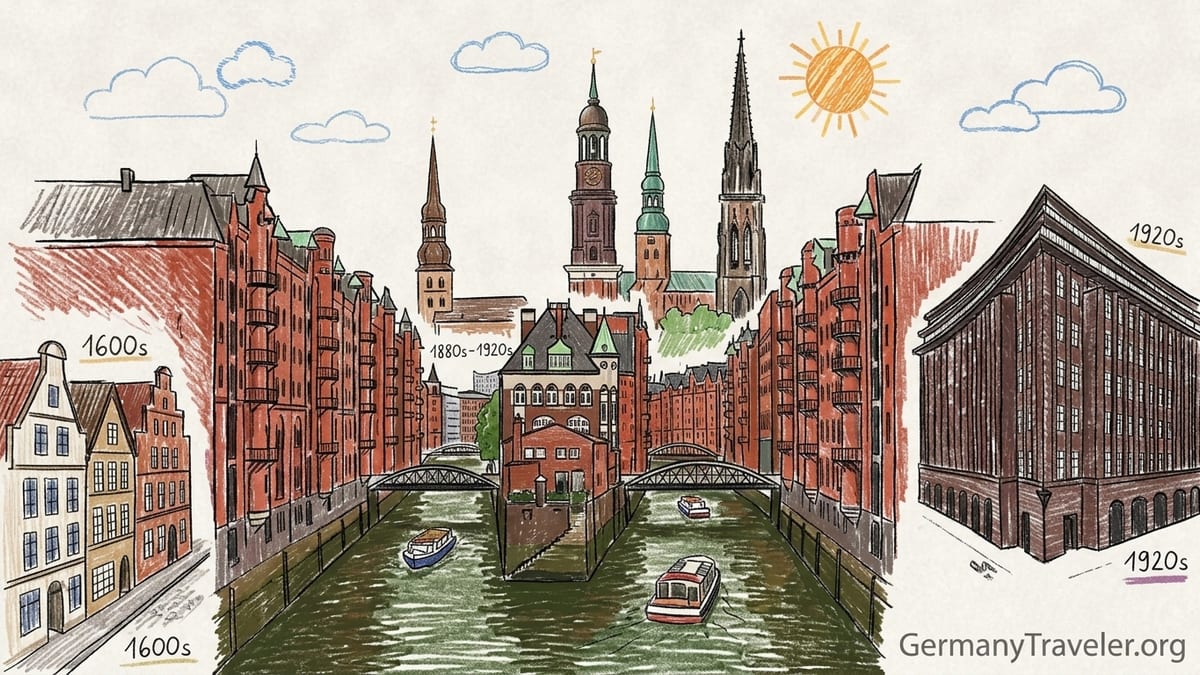
Expectation: A Medieval Hanseatic Metropolis
I came to Hamburg with a map of the Hanseatic League in my head. For anyone who has walked Lübeck’s Holstentor, Lüneburg’s salt warehouses or Stralsund’s market square, “Hanseatic” conjures a specific built world: stepped-gable facades from the 13th to 15th centuries, brick Gothic churches, and street patterns that still follow medieval property lines. Hamburg’s tourism slogans lean into that same imagination. The city officially calls itself the Free and Hanseatic City of Hamburg, a reminder that this was once one of the league’s leading ports and later an independent city-state that traded on that maritime reputation.
The image is powerful enough that many visitors, like me, land assuming that the famous Speicherstadt warehouses are medieval. The red brick, pointed gables and canals fit the stereotype. Promotional photos show small tour boats slipping through green-brown water by lantern light and assure you that this is “historic Hamburg.” Only when you look more closely at dates from sources like UNESCO and Hamburg’s own cultural authorities does the truth come into focus. Speicherstadt is historic, but it is not medieval, and that difference matters if you are deliberately chasing Hanseatic fabric.
Hamburg absolutely was a Hanseatic city. It participated in the league’s trade networks from the Middle Ages and retained “Free and Hanseatic City” as part of its constitutional title well into the modern era. But the physical city that powered that trade has largely disappeared. Fires, planned demolition and war all played a role, and what rose after each catastrophe reflected the needs, technologies, and aesthetics of a different age. My walk through the city center became less a hunt for photogenic alleys and more a lesson in how fragile urban memory can be when measured in brick.
First Steps: Rathausmarkt to the Lost Merchant City
I began at Rathausmarkt, the grand square in front of Hamburg’s city hall. The neo-Renaissance Rathaus itself dates from the late 19th century, completed in 1897 after the Great Fire of 1842 had destroyed its medieval predecessor and much of the Altstadt. The building is ornate and self-consciously historical, with statues of emperors and allegorical figures crowding the facades. It evokes an older civic pride, but it is a product of the industrial era, not the Hanseatic height of the 14th century. Standing here, you feel the weight of merchant wealth, yet almost nothing you see is medieval.
From the square, I followed the short walk toward the Nikolaifleet, the narrow canal that once formed part of the medieval harbor front. Along Deichstraße, just south of the fleet, Hamburg finally offers a tangible glimpse of its mercantile past. Here, a short run of gabled townhouses survives, mostly from the 17th to 19th centuries, with deep, narrow plots that combined living quarters, offices and storage under one roof. The city’s own heritage information points to Deichstraße as the last substantial ensemble of traditional merchant houses near the original harbor, and as a visual reminder that before Speicherstadt existed, Hamburg merchants worked and lived in exactly this kind of integrated setting.
Even this fragment comes with a caveat. The Great Fire of 1842 started in Deichstraße and raged for three days, destroying around a third of the buildings in the Altstadt. Many of the houses you see today are careful reconstructions or heavily restored survivors, reconstructed in a traditional style that nods to earlier centuries. The street pattern here, hugging the old canal, is perhaps more authentically medieval than the facades themselves. You can trace property lines that follow the logic of a cramped riverside town, even if the windows and stucco are younger than they appear at first glance.
Walking the Churches: Tracing Medieval Footprints, Not Facades
From Deichstraße, I crossed toward the ruins of St. Nikolai, once one of Hamburg’s principal churches and a landmark of the medieval Neustadt. The present ruins mostly date from the 19th century Gothic Revival church that replaced earlier buildings on the same site. The tower and some outer walls survived Allied bombing in 1943 and now stand as a memorial to the firestorm that devastated large parts of the city. The lower crypt has been converted into a small exhibition about Operation Gomorrah and the destruction of Hamburg during the Second World War, with an elevator that takes you up the tower for views over the rebuilt center.
Historically, St. Nikolai’s parish marked the heart of Hamburg’s merchant quarter. Around here merchants built counting houses and maintained quays along the Nikolaifleet and Alster arms. Today, you see mostly postwar office blocks and widened streets. Only when you compare old maps inside the memorial with the view out the tower windows does it become clear how radically the area’s grain changed. The medieval lanes around Hopfenmarkt and the original Neustadt were first reshaped in the 19th century after the fire, and then again when planners after 1945 sought broader thoroughfares and more light. The church site is medieval in origin, but its surroundings tell a story of loss and reinvention rather than continuity.
I then headed toward two other major churches that still define Hamburg’s skyline. St. Petri, near Mönckebergstraße, retains a mainly 14th and 15th century footprint with a Gothic tower rebuilt in the 19th century. Inside, fragments of medieval stonework and a bronze baptismal font hint at the building’s age, but extensive restoration after wartime damage has left the interior feeling cleaner and newer than its centuries suggest. St. Jacobi, slightly further north, is similar: medieval foundation, repeatedly rebuilt, with a significant Baroque organ and postwar repairs. Together with St. Katharinen, whose location close to the old harbor also dates back to the Middle Ages, these churches preserve the vertical markers of Hanseatic Hamburg even as the fabric around them has been repeatedly rewritten.
As a traveler, it is easy to be seduced by a church tower and assume the surrounding city belongs to the same era. Hamburg forces you to separate the footprint from the facade. The towers still rise over the center, but step away from the church square and you are quickly in streets laid out after 1842 or after 1945, with architecture that speaks more to Gründerzeit ambitions, car-friendly planning and the postwar need for office space than to medieval waterfront trade.
Into Speicherstadt: A World Heritage Port That Is Not Medieval
From St. Katharinen it is only a short walk across modern bridges into Speicherstadt. The transition is abrupt. Suddenly the streets narrow again, the sky closes in between high walls of dark red brick, and water appears at every cross street. This is the Hamburg that fills Instagram: rows of seven- and eight-storey warehouses on timber piles, their facades ridged with projecting bays and turrets, all mirrored in silent canals. It looks old. It looks, at least at first glance, like the archetype of a Hanseatic city.
Yet UNESCO’s listing makes the timeline clear. Speicherstadt was developed in stages between 1885 and 1927 as part of Hamburg’s free port, replacing entire inner-city quarters that had housed earlier merchants. The adjacent Kontorhaus district, centered on large office buildings like Chilehaus, followed from the 1920s into the 1940s. These complexes reflect the architecture of industrial modernity and expressionism, not the medieval era. They are brick for practical and stylistic reasons, using clinker brick and steel frames, not load-bearing medieval walls. Many buildings suffered damage in the Second World War and were partly rebuilt in the 1950s and 1960s, which adds yet another layer of mid-century detail.
Walking along Brooksfleet and Holländischer Brook, I could see how easily the eye is tricked. There are pointed gables, small tower forms, and repetitive window rhythms that echo Gothic precedents. But the overall scale, the standardized floor heights and the presence of iron winches and modern loading bays all speak to late 19th century mass logistics. When I crossed to the Poggenmühlenbrücke, where photographers cluster for the classic view of Wasserschloss framed by two canals, I tried to imagine a 14th-century Hanseatic merchant recognizing this scene. The answer, I suspect, is no. They would recognize the idea of warehouses by the water, but not this architecture.
That does not make Speicherstadt any less impressive. It is one of the largest coherent historic warehouse districts in the world and a fascinating testimony to a later chapter of maritime trade. Coffee, spices, carpets and tea moved through these buildings for over a century. Today the warehouses host attractions like the Miniatur Wunderland model railway and the Hamburg Dungeon, as well as offices and showrooms. What is misleading is not the site itself but the way it is often framed in brochures, which can blur its 1880s to 1920s origins into a vague “age of the Hanse.” If you come here looking for medieval fabric, you are a few centuries off.
Kontorhaus and the 20th Century City of Commerce
Leaving the warehouses, I headed north past the Speicherstadt’s eastern edge and climbed toward the Kontorhaus district. Here, the streets open out around large office blocks built for shipping and import-export firms in the interwar years. Chilehaus, the best known, cuts a dramatic wedge profile into the meeting of Burchardstraße and Pumpen, its long facades rippling with brick ornament. Completed in 1924, it is a textbook expressionist office building, designed to impress with both mass and detail.
Other blocks such as Sprinkenhof and Meßberghof repeat the theme at slightly different scales. Together they form an ensemble that UNESCO recognized alongside Speicherstadt as a World Heritage site. The reasoning is about function and form: these buildings illustrate how a port city organized modern commerce in the age of telephones, typewriters and global shipping lines. Like the warehouses, they also represent a shift from the old mixed-use merchant house to specialized buildings. Counting rooms and shipping firms no longer shared roofs with domestic quarters; they occupied entire blocks of dedicated offices.
Architecturally, however, Kontorhaus is unapologetically 20th century. Interior courtyards, steel skeletons, elevators and large horizontal windows make that clear. There is nothing medieval about it, and little that directly echoes the forms of earlier Hanseatic architecture beyond the use of brick and a general sense of vertical emphasis. If you arrive from Lübeck or Stralsund, where stepped-gable facades and Gothic town halls still anchor the historic core, the contrast is stark.
This is where tourism marketing can become fuzzy. Hotel websites and tour leaflets sometimes use “Hanseatic” as an aesthetic shorthand for any red-brick commercial block in Hamburg, whether from 1480 or 1930. The result is that an unsuspecting visitor might stand in front of Chilehaus and believe they are looking at a relic of the Hanseatic League’s heyday, when in fact they are seeing the architecture of Weimar-era corporate ambition. When viewed with that knowledge, the district becomes even more interesting, but for different reasons than a medievalist might hope.
Fire, Bombs and the Politics of Reconstruction
To understand why Hamburg’s visible Hanseatic fabric is so thin, you have to follow the trail of destruction. The Great Fire of 1842 is the first major break. Starting on May 5 in Deichstraße, it consumed large swathes of the Altstadt, including the medieval city hall, numerous churches, and dense merchant quarters. Contemporary accounts speak of around a third of the old town’s buildings lost. In the rebuilding that followed, planners saw an opportunity to widen streets, improve sanitation and align Hamburg with modern urban ideals, much as London did after its 1666 fire.
The new streets and blocks that emerged after 1842 already marked a departure from the medieval pattern. Mixed merchant houses along the congested harbor were gradually replaced with more regular blocks, and new boulevards began to carve through the old town. Some historic churches were rebuilt in new styles, while others, like parts of the older St. Nikolai, were demolished and replaced entirely rather than restored. The fabric that had grown slowly with the Hanseatic economy was replaced within decades by a more regular 19th century city that only selectively preserved older elements.
The Second World War completed the transformation. In the summer of 1943, during Operation Gomorrah, British and American bombing raids triggered a firestorm that devastated large areas of Hamburg, including parts of the city center. While the western Altstadt and neighborhoods like Altona saw varying degrees of damage, the cumulative effect after the war was a patchwork of ruins, half-surviving blocks and emergency infill. Reconstruction in the 1950s and 1960s often favored wider roads and modernist blocks over careful restoration, especially in commercial districts where economic recovery took priority over historical ambiance.
Hamburg did preserve some landmarks. The tower of St. Nikolai was stabilized as a memorial. The Rathaus, which had survived the bombing, remained the civic showpiece. Fragments of the old merchant quarters near the Nikolaifleet and in streets such as Deichstraße were restored or rebuilt in a traditional idiom. But compared with cities whose medieval cores had either survived or been painstakingly reconstructed, Hamburg’s center today speaks more to the 19th and 20th centuries than to the era of the Hanseatic League. The reasons are not solely wartime; they also lie in 19th century modernization and postwar planning choices that prioritized traffic and office space.
Comparing Hamburg to Lübeck, Lüneburg and Stralsund
To test Hamburg’s Hanseatic reputation, I mentally held it up next to three other northern German cities with strong league histories: Lübeck, Lüneburg and Stralsund. Each offers a different benchmark for what “Hanseatic” can look like on the ground. In Lübeck, a short train ride from Hamburg, the old town on its island between the Trave and Wakenitz still preserves a largely intact medieval street pattern. UNESCO emphasizes Lübeck’s status as the leading city of the Hanseatic League from the 13th to 16th centuries, with the Holstentor gate, salt warehouses and brick Gothic churches such as St. Marien forming a continuous historic ensemble.
In Lübeck, when you climb St. Petri’s tower and look down, you see a dense fabric of gabled roofs, many on medieval plots. War damage was significant, but a combination of survival and careful reconstruction has left the city center with a clear Hanseatic character. Walking along the upper Mengstraße or through the alleyways behind the main streets, you encounter merchants’ courtyards and warehouse ranges that demonstrably predate the industrial age. The experience of continuity between the league’s era and today’s streets is much stronger than in Hamburg.
Lüneburg, another former Hanseatic member, offers a smaller but similarly cohesive core. Its wealth from salt trade is visible in richly ornamented gabled houses along streets like Am Sande, many dating to the 15th and 16th centuries. The harbor on the Ilmenau, with the historic crane and brick storehouses, gives a sense of how river trade once worked at a Hanseatic scale. While Lüneburg also adapted and rebuilt across centuries, the proportion of pre-19th century fabric in the walkable center is far higher than in Hamburg’s Altstadt.
Stralsund, on the Baltic coast, provides yet another comparison. Its UNESCO-listed old town preserves large market squares framed by Gothic town halls and merchant houses, as well as churches like St. Nikolai that still sit in largely historic surroundings. Here, the visual language of the Hanseatic League feels immediate: brick tracery, stepped gables and narrow plots that have not been ironed out by later grid planning. War damage and East German reconstruction both left marks, but the core still reads unmistakably as a medieval trading city. After visiting these places, a historian or architecture enthusiast arriving in Hamburg cannot help but feel that something is missing.
Marketing, Misconceptions and How to Read Hamburg’s Brick
Hamburg’s tourism marketing leans heavily on its maritime identity and Hanseatic status. In practice, that sometimes means that everything built of red brick and associated with commerce is folded into a single “Hanseatic” story. Harbor boat tours glide through Speicherstadt while guides praise the city’s “old Hanseatic warehouses,” even though the brick blocks around you date from the reign of Kaiser Wilhelm and the Weimar Republic rather than the league’s apogee.
City walking tours and hotel brochures often layer phrases like “old warehouse district,” “historic merchants’ quarter” and “Hanseatic tradition” without clearly distinguishing between medieval-trade-era fabric and later reinventions. The effect is not malicious; Speicherstadt and the Kontorhaus district absolutely continue a tradition of merchant capitalism rooted in the Hanseatic age. But they do so in built forms that belong to a later industrial chapter. For a casual visitor, the nuance may not matter. For someone specifically chasing medieval Hanseatic architecture, it does.
As I walked, I began to treat Hamburg as a palimpsest that needed decoding. When I saw brick, I asked myself what era and technology it reflected. Was this load-bearing brick Gothic, 19th century neo-Gothic, 1920s expressionist clinker or postwar infill meant to harmonize with its neighbors? In Deichstraße, the narrow plots and proximity to the fleet felt like genuine survivals of earlier urban logic, even when the facades had been renewed. In Speicherstadt, the monumental uniformity signaled a centrally planned project responding to customs treaties and free-port regulations of the late 19th century.
This way of looking did not make Hamburg less appealing. It simply shifted the object of interest. Instead of lamenting the absence of a medieval core, I found myself fascinated by how a former Hanseatic city reimagined itself in brick several centuries after its league heyday, and how memory of that league is now projected onto buildings that never saw a cog or hulk docking outside their doors.
The Takeaway
For travelers serious about Hanseatic history and especially about medieval fabric, Hamburg is both essential and potentially disappointing. It is essential because you cannot tell the league’s story without including this Elbe port and its evolution into a modern global harbor. The city’s museums, archives and monuments like the St. Nikolai memorial do an honest job of explaining how fires, industrialization and war reshaped the place. Walks along the Nikolaifleet and through Deichstraße still give glimpses into an older merchant world, and the great churches mark sites where medieval Hamburg once gathered.
It can be disappointing, however, if you equate “Hanseatic” solely with surviving 13th to 15th century streetscapes. Compared with Lübeck, Lüneburg and Stralsund, Hamburg offers far less intact medieval or early modern built fabric in its central districts. Most of what casual visitors perceive as historic commercial architecture, especially in Speicherstadt and Kontorhaus, belongs to the late 19th and early 20th centuries and was in some cases rebuilt after wartime damage. It is still maritime heritage of a high order, but it is not the world of medieval Hanseatic town law and guild halls.
If you have a week to explore the old Hanse, one practical strategy is to treat Hamburg as a starting hub rather than the main medieval destination. Allocate perhaps one and a half to two days to the city itself: one day for the historic center, churches, Nikolaifleet and Deichstraße, and another half-day to full day for Speicherstadt, the Kontorhaus district and a harbor tour. Use Hamburg’s excellent rail links to spend additional full days in Lübeck and Lüneburg, and, if time allows, add Stralsund or another Baltic city with better-preserved cores.
Go to Hamburg prepared for complexity rather than for postcard medieval charm. You will find traces of the Hanseatic past in church foundations, street alignments and the very idea of a “Free and Hanseatic City.” You will also see how that legacy was reinterpreted in brick by later generations who built warehouses, offices and boulevards for a different age of trade. If you can accept that Speicherstadt’s beauty belongs to 1885 to 1927 rather than to 1385, the city becomes a compelling case study in how port towns survive, adapt and sometimes overwrite their own origins.
FAQ
Q1. Is Hamburg actually a Hanseatic city if so little medieval fabric survives?
Hamburg was historically a member of the Hanseatic League and still styles itself the Free and Hanseatic City of Hamburg. The city’s political and economic history is genuinely Hanseatic, even though many medieval buildings were lost to the 1842 fire, later redevelopment and Second World War bombing.
Q2. Is Speicherstadt medieval Hanseatic architecture?
No. Speicherstadt was built between the 1880s and the 1920s as part of Hamburg’s free port. Its brick warehouses reflect late 19th and early 20th century industrial architecture, not the medieval era, even though they are often used in marketing as symbols of “Hanseatic” Hamburg.
Q3. What parts of Hamburg feel closest to the old merchant city?
Short stretches of Deichstraße and the Nikolaifleet, along with the areas around churches like St. Katharinen and St. Petri, give the strongest sense of the earlier merchant city through their narrow plots, canal-side settings and long-standing church sites.
Q4. How did the Great Fire of 1842 change Hamburg’s historic center?
The fire began in Deichstraße and burned for several days, destroying roughly a third of the old town. Rebuilding widened streets, altered the street grid and replaced many mixed-use merchant houses with more regular 19th century blocks, erasing much medieval fabric even before the Second World War.
Q5. How much damage did the Second World War do to Hamburg’s old buildings?
Bombing raids in 1943 caused severe destruction in several districts, including parts of the center. Combined with postwar planning that prioritized traffic flow and new office space, this further reduced the amount of pre-19th century architecture in the central area, although some landmarks and fragments were preserved or reconstructed.
Q6. How does Hamburg compare to Lübeck for Hanseatic architecture?
Lübeck retains a much more complete medieval and early modern core, with brick Gothic churches, merchant houses and street patterns that clearly date back to the league’s heyday. Hamburg offers more limited medieval survivals and a center dominated by 19th and 20th century layers.
Q7. Should I visit Speicherstadt if I care about medieval history?
Yes, but with the right expectations. Speicherstadt is an outstanding example of late 19th and early 20th century maritime heritage and explains how Hamburg evolved as a port. It is important for understanding the long arc of Hanseatic trade, even if it does not preserve medieval structures.
Q8. Where are the best spots in Hamburg to visualize the pre-industrial harbor?
Views along the Nikolaifleet near Deichstraße, and around St. Katharinen close to the old harbor, offer the clearest sense of how the pre-industrial waterfront once wrapped around church spires and narrow canals, although much of the built fabric has been renewed.
Q9. How many days should a Hanseatic-history enthusiast spend in Hamburg?
One and a half to two days is usually enough to explore the historic center, main churches, Nikolaifleet, Deichstraße, Speicherstadt and the Kontorhaus district before moving on to cities like Lübeck or Lüneburg for denser medieval cores.
Q10. Is it still worth including Hamburg on a Hanseatic itinerary focused on medieval towns?
Yes. Hamburg adds crucial context about how Hanseatic trade evolved into modern global shipping and how a league city reinvented itself after fire and war. It complements, rather than replaces, the more visually medieval experiences available in Lübeck, Lüneburg or Stralsund.