


I arrived in Greifswald expecting a compact Hanseatic town built around a postcard-perfect market square. What I found instead was a place that stretches, almost like a tide, from Brick Gothic gables in the historic center out along the River Ryck to a working fishing village and the quiet ruins of an abbey that helped inspire German Romanticism. Walking and cycling this route over a long summer day, Greifswald felt by turns like merchant city, harbor town, Baltic village and open-air art history lesson, all threaded together by a single small river.
Starting at the Market: Greifswald’s Brick Gothic Core
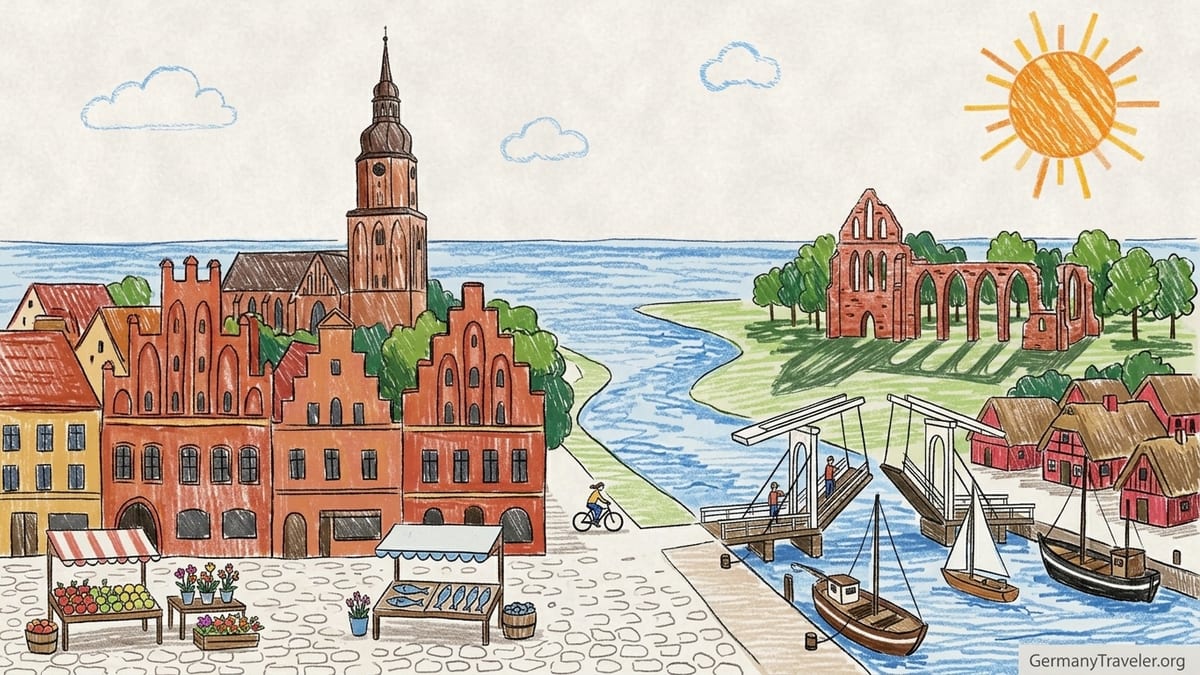
My day began, as Greifswald days usually do, on the market square. Even before nine in the morning, the ochre-red town hall already stood out against a sky that was still warming from a pale gray to Baltic blue. Around it, the stepped gables of the merchants’ houses at Markt 11 and 13 immediately told the story of a Hanseatic city: high, brick-fronted facades, ornate edges and narrow footprints that stretched deep behind the street. These are classic examples of north German Brick Gothic, once owned by wealthy traders who dealt in salt, grain and fish, and they still anchor the square with a sense of sturdy prosperity.
The square itself felt lived-in rather than preserved. A weekly market was being set up, with stalls rolling in crates of local apples and potatoes, smoked fish, cheeses from the surrounding countryside and the occasional stand selling honey or handmade soap. By the time I had crossed from one side of the cobblestones to the other, a flower seller was lining up buckets of sunflowers and dahlias in front of one of the gabled houses. It was easy to imagine this as a trading floor in the Middle Ages, only now the goods fit neatly into a modern jute bag.
Turning away from the chatter of the market, I followed the sightline that dominates the old town: the tall tower of St. Nikolai, affectionately known as “Langer Nikolaus,” the long Nicholas. At around 98 meters high, its brick tower is visible from almost anywhere in central Greifswald. St. Nikolai, dedicated to the patron saint of seafarers and merchants, is the most imposing of the three main churches that define the skyline. Inside, a modest fee of a few euros allows visitors to climb more than 250 narrow steps to a viewing platform. I made the climb early, and from the top I could look down to the market, trace the line of the Ryck out toward the Bodden and already spot, in the distance, the thin strip of trees that hides Eldena Abbey.
Back at street level, I walked the short distance to St. Marien and St. Jacobi, the other two Brick Gothic churches that complete Greifswald’s famous trio. St. Marien, sometimes called “Fat Marie” because of its broad hall church proportions, stands just a few minutes’ walk from the market and has a more intimate, neighborhood feel despite its size. St. Jacobi, known locally as “Kleiner Jacob,” is smaller and associated historically with fishermen. Together with the town hall and the gabled houses on the square, these churches form the backsteinrotes Herz, the brick-red heart of the city, and they are the best reminder that Greifswald began as a place of trade, religion and learning long before it became a university town.
Leaving the Square for the Ryck and Museum Harbor
Many visitors linger in the old town and never quite make it to the water. I decided early that I wanted to see how Greifswald’s Hanseatic core connects physically to the Baltic, so I left the market and followed small streets north and east toward the Ryck. It is barely a ten-minute walk from the square to the water, and the transitions are gentle: brick houses give way to a mix of residential blocks, university buildings and finally the open, slightly salty air of the museum harbor.
The Museumshafen, or museum harbor, lines both sides of the Ryck close to the city center. Here, instead of modern marinas, historic sailing vessels, tugs and small barges are moored side by side. Many date back to the 19th and early 20th centuries and recall a time when the Ryck was Greifswald’s main commercial artery. Interpretive boards on the quayside explain in German and English that, at its peak in the mid-1800s, the river bustled with schooners and coastal traders bringing in timber and exporting grain, bricks and salt fish. Today, the ships are lovingly maintained by associations and volunteers, and some are still sailed on special occasions.
Walking along the quay, I could see how low and narrow the Ryck is by global standards. It looks almost modest, especially at low tide, but this short river has always been Greifswald’s lifeline to the Baltic. It flows out into the Dänische Wiek, a bay that forms part of the Greifswalder Bodden, itself an indentation of the wider Baltic Sea. That connection explains why a city that now feels pleasantly inland in its historic core still has a decidedly maritime culture. Locals talked about wind forecasts, regattas and sailing conditions as naturally as people in landlocked towns talk about rush-hour traffic.
On the northern bank, a few cafes and a simple kiosk were already open by late morning, serving filter coffee, soft drinks and Fischbrötchen, the classic northern German fish roll. Prices were refreshingly down to earth: a herring Fischbrötchen with onions, crisp lettuce and a dollop of remoulade cost around 3.50 to 4.00 euros, and a cappuccino or latte around 3 euros. I took my breakfast on a wooden bench looking over to the tall masts of an old schooner, while a couple of joggers passed along the riverside path and a small rowing boat slid silently upriver.
Choosing How to Reach Wieck: On Two Wheels Along the Ryck
From the harbor, the question becomes practical: how to cover the roughly five kilometers to the fishing village of Wieck without losing the day in transit. The tourist information material and the city’s own guidance are clear that cycling along the Ryck is one of the best ways to make the trip. The riverside path is mostly flat, well surfaced and popular with locals heading to the water or to the beach at Eldena. City bikes can be rented from several outlets in the center; daily rental for a simple, three-gear city bike tends to fall in the range of 10 to 15 euros for a full day, depending on the shop and any seasonal promotions. E-bikes are also available at higher prices, often between 25 and 35 euros per day.
I opted for a classic city bike rented from a small local shop just off the market square, for 14 euros for the day including a basic lock. The owner gave me a simple paper map that traced the river from the museum harbor all the way to Wieck and Eldena, with a friendly warning that, on sunny weekends in July and August, the path can be busy with families and students. From the harbor, it took less than five minutes to cross to the north bank, join the designated riverside route and feel the streets slip away behind me.
The ride itself felt almost meditative. The Ryck lay consistently on my right, sometimes only a few meters away, sometimes separated by reeds and occasional moorings. A line of allotment gardens, small boathouses and modest sailing clubs stretched along the water. Every so often I passed a wooden jetty with a couple of motorboats or small yachts tied up, their owners tinkering with lines or sitting on deck chairs under striped awnings. The closer I came to the outskirts of Greifswald, the more the city thinned into patches of meadow and clusters of trees.
Covering the distance from the museum harbor to Wieck by bicycle took me about 20 to 25 minutes at an unhurried pace, including short pauses to take photos of the river and the distant steeples of St. Nikolai and St. Marien receding behind me. For travelers who prefer not to cycle, local buses also link the city center with Wieck and Eldena, generally in under 20 minutes, using regional bus lines that are integrated into the Vorpommern-Greifswald transport network. A standard single ticket within Greifswald costs only a few euros, and holders of regional season tickets or the Germany-wide ticket can often use the city buses at no extra cost. Taxis are another option, though at a significantly higher price for such a short distance. For me, the slow pace of the bike was worth it because it made clear, in a physical way, how the river truly connects the old town to the Baltic edge.
Arriving in Wieck: A Working Fishing Village on the Baltic Fringe
As I rolled down the last gentle slope into Wieck, the atmosphere shifted noticeably. Although Wieck is officially a district of Greifswald, it has the feel of a distinct fishing village clustered around the point where the Ryck meets the Dänische Wiek. Low, often thatched houses sit close to the water, and narrow lanes run perpendicular to the river toward reedy banks and moored boats. Fishing nets, buoys and stacks of crab pots lie piled near sheds and small wharves, and the smell of smoked fish hangs lightly in the air even on a breezy day.
The harbor basin itself is compact, lined with traditional fishing boats, small pleasure craft and an increasing number of visiting yachts. Here, Greifswald feels much closer to the open sea. Gulls wheel overhead, and on the far side of the water you can see the contours of newer flood protection works and, beyond that, the flat line of the Greifswalder Bodden. A sign announces the village name, but the real welcome came from the bustle around the waterside restaurants and snack stands that start serving lunch well before noon on sunny days.
One of the pleasures of Wieck is eating directly beside the water. Several simple restaurants and Imbiss stands specialize in local fish, with menus full of fried herring, smoked mackerel, fish soup and Fischbrötchen variations. At a small terrace overlooking the harbor, I ordered a plate of fried cod with potatoes and a side salad for around 16 euros, and a non-alcoholic beer for just over 3 euros. Nearby, families shared trays of calamari and chips, while older regulars, clearly locals, lingered over coffee and cake. Prices overall felt fair for a waterside setting, particularly when compared with better-known Baltic resorts.
Even on a weekday, Wieck felt like a place where work and leisure overlap. I watched a fisherman hose down the deck of his boat while a group of cyclists in bright jerseys consulted an outdoor map of the region. Delivery vans backed up to restaurant kitchens, while a sailing school prepared dinghies for an afternoon class. For all the visitors, there was still the sense that this is a living working harbor, not just a staged maritime backdrop.
The Wooden Bascule Bridge: Watching a Historic Structure Move by Hand
At the center of Wieck stands its best-known landmark: the wooden bascule bridge over the Ryck, often called the Wiecker Brücke or Holzklappbrücke. Built in 1887 in a style inspired by Dutch double-leaf drawbridges, it connects the districts of Wieck and Eldena and is one of the few remaining manually operated wooden bascule bridges still in regular use. From the harbor, it is only a minute’s walk. The white-painted structure, with its timber beams and iron fittings, looks both delicate and robust, a piece of late 19th-century engineering preserved as a technical monument.
The bridge is reserved primarily for pedestrians and cyclists, with only limited car access under special permit, and even then for a small fee of around 50 cents per crossing. What makes it truly compelling for visitors is the fact that its two leaves, each about 13 meters long, are still opened by hand. Greifswald’s harbor authorities maintain a regular schedule of openings during the boating season, especially between late April and early autumn. In 2026, for example, the bridge opened roughly at the top of the hour from morning until evening during the main summer period, skipping only the midday slot around noon, and switching to reduced or on-demand openings in late autumn and winter.
I timed my visit to coincide with a scheduled opening at 3 p.m. Around ten minutes beforehand, a couple of sailboats idled near the bridge, hovering in place as they waited for the signal. On the bridge itself, a small crowd of onlookers began to form: parents with children, cyclists resting on their handlebars, older residents greeting each other and pointing out the details of the mechanism. At the appointed time, a bridge operator appeared, closed off pedestrian access with simple barriers and activated the signal system that controls boat traffic. Then, slowly and with visible physical effort, the operators worked the mechanism that lifted the counterweighted leaves. The entire process took around ten minutes, and there was something quietly impressive about watching such a large structure move without motors, driven instead by a system of weights, chains and human muscle.
For pedestrians and cyclists, the bridge opening becomes a built-in pause. You wait, watch the boats glide beneath the raised spans, listen to the creak of wood and the slap of halyards against masts, and perhaps chat with other people in line. The delay is short enough to be only mildly inconvenient, but long enough to feel like a ritual that punctuates the rhythm of life in Wieck. For boat crews, timing is more critical. Notices advise skippers to arrive about ten minutes before the scheduled opening and to remember that the bridge will not operate in very high winds or outside set times without prior arrangement. On that afternoon, the operation passed uneventfully, and within a few minutes of the last yacht clearing the span, walkers and cyclists were flowing back and forth again between Wieck and Eldena.
On to Eldena: Ruins, Romanticism and the Edge of the City
From the far side of the bridge, a short walk of less than ten minutes leads along tree-lined paths to the ruins of Eldena Abbey. Technically, Eldena is another district of Greifswald, but the combination of open lawns, tall trees and the skeletal brick remains of the Cistercian monastery creates a self-contained world that feels far from any market square. The abbey, founded in the 13th century, is one of the oldest surviving Brick Gothic sites in the region and a key part of Greifswald’s origin story, since the town developed partly in connection with its trade and harbor rights.
Today, the Eldena ruins are best known from the paintings of Caspar David Friedrich, Greifswald’s most famous son and a major figure of early German Romanticism. Friedrich sketched and painted the abbey repeatedly over decades, under different lighting conditions and at different times of day, transforming the real ruins into powerful symbols of decay, memory and nature reclaiming human structures. Art historians have documented how he altered the actual setting in his works, adding more trees or shifting viewpoints, but standing among the surviving walls, it is easy to see why the place fascinated him. Framed by tall, mature trees and open grass, the brick arches cast long shadows in late afternoon light, and the sky above feels vast despite the modest footprint of the site.
Entrance to the grounds is usually either free or charged at a small fee for special events such as concerts or festivals. On the day I visited, I could simply walk in through a gate in the low fence that surrounds the site. A few information panels in German and sometimes English explained the abbey’s history and its connection to Friedrich’s work. A group of students sat on blankets sketching parts of the ruins for an art class, while nearby a family played hide-and-seek among the arches. It felt at once like a local park and a quiet outdoor museum.
From Eldena, the Baltic is only a short additional walk. The small Eldena beach is reachable in around 15 to 20 minutes on foot from the ruins or even faster by bike, along the same general corridor that traces the Ryck toward the Bodden. The beach itself, with shallow water and a modest strip of sand, is a popular summer spot for locals, and according to city information it can be reached from the old town by bike in roughly 20 minutes along the towpath. I did not linger there long, because the focus of my day was the city’s cultural and historic spine, but it was comforting to know that open water was so close, a natural end point to a journey that started on a cobbled square.
One City or Many? How the Journey Feels on the Ground
By late afternoon, sitting on a bench in the shade at Eldena and looking back in the direction of the unseen city center, I tried to decide whether the day’s route felt like a single urban experience or several distinct environments stitched together. The answer, for me, lay somewhere in between. The old town around the market square, with its dense fabric of Brick Gothic churches, merchants’ houses, university buildings and narrow streets, clearly forms one cohesive world. It is academic, urban in scale, and oriented around squares and civic institutions.
The museum harbor is a kind of threshold, neither fully city nor village. It retains a strong sense of history, with its vintage vessels and industrial remnants, but it is also an open space where people jog, picnic and sit on the grass. This is where Greifswald’s identity as a Hanseatic trading town most clearly overlaps with its modern maritime leisure culture. Walking or cycling away from the square and seeing how little time it takes to reach this harbor zone makes it feel very much part of the same city.
Wieck, however, genuinely feels like a different place. The scale drops, the architecture shifts to thatched fishermen’s cottages and modest brick houses, and the daily rhythms change. Here, the focal points are the small harbor, the smell of frying fish, the clatter of cutlery on outdoor tables and the periodic interruption of the bridge opening. While administrative boundaries classify Wieck as a district of Greifswald, the village atmosphere is strong enough that, standing on the quay, I had to remind myself that I had arrived here on a straightforward city bike ride rather than a separate regional excursion.
Eldena adds another layer, almost pastoral and contemplative. The abbey ruins and the surrounding greenery carve out a space that is neither fully urban nor strictly rural. Thanks to Caspar David Friedrich’s paintings, the site also exists simultaneously in physical reality and in the collective imagination of anyone familiar with Romantic art. In that sense, the journey from the market square to Eldena felt less like traveling through a single city and more like passing through the chapters of Greifswald’s history and identity: mercantile, maritime, fishing village and Romantic landscape.
Practicalities: Costs, Seasons and Transport Back
On a practical level, the route from old town to harbor, Wieck and Eldena can be done as a relaxed full day for travelers on a moderate budget. My main fixed costs were the day’s bicycle rental and meals. As of 2026, standard city bike rental in Greifswald commonly ranges around 10 to 15 euros per day, and more comfortable trekking bikes or e-bikes cost more. A simple lunch of fish in Wieck with a drink runs in the region of 15 to 20 euros per person, while a lighter snack such as a Fischbrötchen and a coffee can easily stay under 8 euros. Back in the old town, coffee and cake near the market generally cost between 6 and 8 euros, depending on the venue.
Public transport within Greifswald is affordable. A regular single bus ticket across the city costs only a few euros, and various day or week tickets bring down the per-ride price for those staying longer. Holders of broader regional or national passes such as the Germany-wide ticket frequently have city bus travel included. This means that travelers who prefer to walk one way and ride back can easily catch a bus from stops in Wieck or Eldena to return to the main station or the city center, often in under 20 minutes. Buses run more frequently on weekdays and in daytime hours, with reduced services in the late evening, so it is wise to check the latest timetable locally or via the regional transport apps.
Seasonality matters for this route. From late April to early October, the riverside paths are pleasant, days are long, and the bridge in Wieck follows a regular opening schedule that ensures plenty of opportunities to see it in operation. Restaurant terraces in Wieck are fully active, and the museum harbor buzzes with activity, especially on weekends and during local festivities. In the shoulder seasons of early spring and late autumn, many of these experiences are still accessible, but opening hours can be shorter, and the bridge operates less frequently, sometimes only on demand outside the main boating period. In winter, winds can be sharp along the Ryck, the daylight hours short and some seasonal eateries closed, although the route remains passable for hardy walkers and cyclists equipped with warm clothing.
For the return to the city center at the end of the day, I chose to cycle back along the opposite bank for a slight change of perspective. The ride from Eldena through Wieck and back to the museum harbor took barely 25 minutes in the soft light of early evening. From there, it was another gentle ten-minute pedal into the heart of the old town, where I returned my bike and finished the day with a last slow walk across the market square, now quieter and framed by softly lit facades.
A Reusable Full-Day Route Linking Market, Harbor, Wieck and Eldena
For travelers wanting to replicate this journey without rushing, a full day of around eight to ten hours offers enough time to move at an unhurried pace and absorb the different faces of Greifswald. I would begin between 9 and 10 a.m. on the market square, with a short stroll among the stalls and a look at the merchants’ houses and the town hall. From there, I recommend visiting at least one of the major churches in more depth, preferably St. Nikolai for the tower climb and panoramic view. Allow about 90 minutes for the market and churches together, including time to sit for a coffee at one of the cafes that ring the square.
Late morning, walk down to the museum harbor, taking 15 to 20 minutes to explore the historic ships and absorb the river’s role in the city’s story. Around midday, pick up a rental bike near the center and ride out along the Ryck toward Wieck. Plan for about 30 minutes of gentle cycling, including brief photo stops. Arriving in Wieck just before a scheduled bridge opening time, ideally early afternoon, lets you find a seat at a waterside restaurant, order lunch, and then step out to watch the manual operation of the bascule bridge at the top of the hour. With lunch and bridge watching combined, expect to spend at least two leisurely hours here.
In mid afternoon, cross the bridge on foot or by bike and make the short journey to Eldena Abbey. Spend 45 to 60 minutes among the ruins and trees, reading the information panels and, if you are inclined, comparing the real place to reproductions of Caspar David Friedrich’s paintings in guidebooks or on your phone. If the weather is warm and the day long, you can add a side trip to the nearby beach, perhaps for a quick dip or simply a rest on the sand before turning back. From Eldena, either cycle or walk back to Wieck and then to the city, or, if your legs are tired, roll or walk to the nearest bus stop and ride back into town.
Back in the old town by early evening, there is still time for a simple dinner close to the market, perhaps in one of the restaurants tucked into side streets that serve regional dishes such as fish, pork or vegetarian plates accompanied by local beer. By then, the loop will have made sense as a coherent day: a progression from Hanseatic square to harbor, river to fishing village, bridge to abbey and back again. It is a route that fits easily into a Greifswald city break and, with minor adjustments for weather or personal pace, can be repeated by others almost step for step.
The Takeaway
Traveling from Greifswald’s market square to its Baltic edge in a single day revealed to me how layered this compact city really is. What begins as a study in Brick Gothic architecture and Hanseatic history soon becomes a gentle riverside journey, a glimpse into an active fishing village and a quiet encounter with the ruins that helped shape Romantic art. The River Ryck is not just a geographical link but an organizing thread; following it from the museum harbor through Wieck to Eldena gives shape to a route that is more than the sum of its individual sights.
What stood out most was how accessible these different environments are. Distances are short enough to cover on foot or by bicycle, prices are moderate, and public transport provides an easy safety net. The experience shifts naturally with the seasons, offering bright, busy harbors and long evenings in summer, or quieter, contemplative walks in colder months. For travelers who like cities that can be read as stories rather than checklists, Greifswald’s sequence of square, harbor, bridge and ruins offers a satisfying narrative arc that begins and ends in the same city yet never feels repetitive along the way.
FAQ
Q1. How long does it take to cycle from Greifswald’s old town to Wieck?
At an easy pace with a few short stops, the roughly five-kilometer route along the River Ryck usually takes about 20 to 30 minutes one way.
Q2. Can I walk the entire route from the market square to Eldena Abbey?
Yes. Walking from the market square to the museum harbor, then on to Wieck and Eldena, and back again, makes for a long but manageable full day of around 15 to 18 kilometers.
Q3. How much should I budget for a one-day trip including bike rental and meals?
If you rent a basic city bike, buy a fish lunch in Wieck and have coffee or cake in the old town, a realistic budget is around 40 to 60 euros per person.
Q4. When does the wooden bascule bridge in Wieck usually open?
In the main boating season from late April to early autumn, the bridge typically opens at set times during the day, often on the hour, with reduced or on-demand service outside that period.
Q5. Is Wieck still an active fishing village or mainly a tourist spot?
Wieck remains a working harbor with local fishing boats and maritime services, but it also has a growing role as a leisure destination with popular fish restaurants and cafes.
Q6. Do I need to pay to visit Eldena Abbey ruins?
Access to the abbey grounds is often free, though small admission fees or tickets may apply during special events, concerts or festivals held on the site.
Q7. What is the best season to follow this route from Greifswald to Wieck and Eldena?
Late spring to early autumn offers the most pleasant weather, long daylight hours, regular bridge openings and full operation of waterside restaurants and cafes.
Q8. Can I reach Wieck and Eldena by public transport instead of cycling?
Yes. Local buses run from Greifswald’s center to stops in Wieck and Eldena, generally taking under 20 minutes, with tickets costing only a few euros per journey.
Q9. How is Eldena connected to Caspar David Friedrich’s paintings?
The ruins of Eldena Abbey were a recurring subject in Caspar David Friedrich’s work, and he used the site as a motif to explore themes of memory, decay and nature in his Romantic landscapes.
Q10. Is this full-day route suitable for families with children?
Families with school-age children who are comfortable walking or cycling moderate distances can enjoy the route, especially in summer, with breaks at the harbor, bridge and abbey to keep the day varied.