


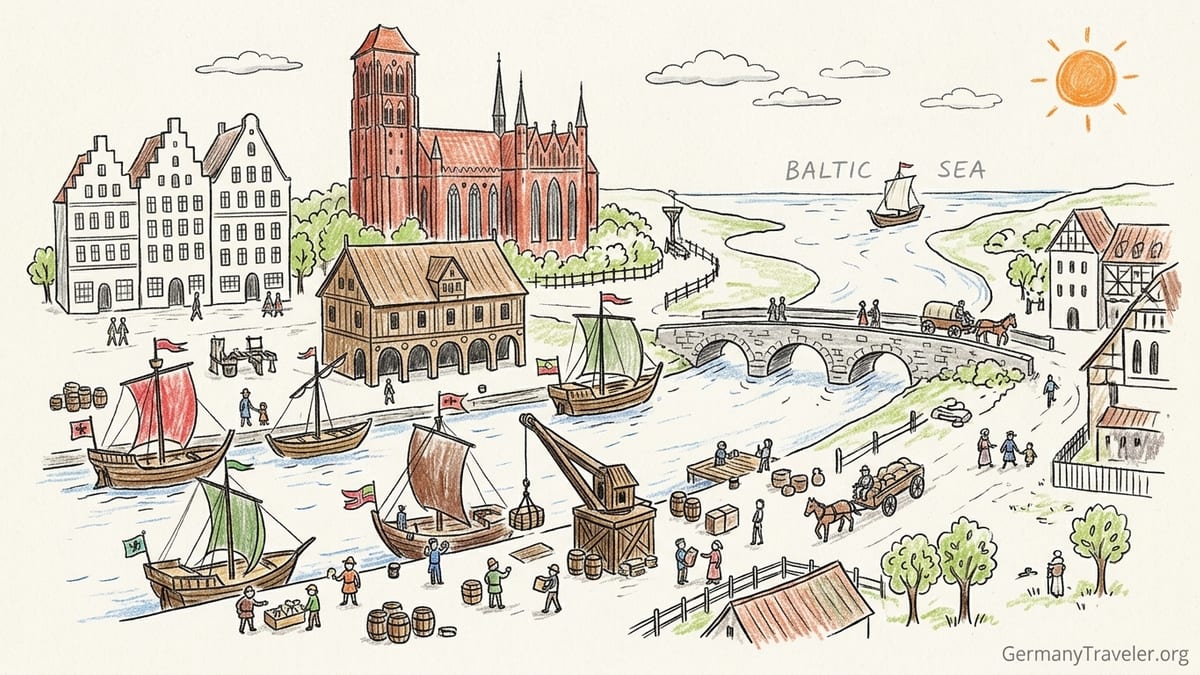
Germany’s Hanseatic cities line the North and Baltic Sea coasts with red-brick gables, old harbors and proud town halls that once ruled trade in northern Europe. Yet not every place that calls itself Hansestadt offers the same depth of medieval fabric or visitor experience. This guide compares the key German Hanseatic cities that most travelers consider today, focusing on what you can actually see and do rather than on historic prestige alone.
What Made a City Hanseatic, Then and Now
To understand Germany’s Hanseatic cities, it helps to separate three related but distinct ideas: the medieval Hanseatic League, today’s cultural association called DIE HANSE, and the modern use of “Hansestadt” in official city titles. In the Middle Ages, a Hanseatic city was a trading center that joined the Hanseatic League, a loose alliance of merchant towns around the North and Baltic seas. Membership was based on economic clout and mutual protection, not on geography alone. Lübeck, Hamburg and Bremen emerged as especially powerful players, controlling routes for grain, salt, timber and other bulk goods that flowed between the Baltic and the North Sea.
Modern visitors will still see traces of this league in brick-gothic churches, gabled warehouses and market squares, but the medieval alliance itself dissolved centuries ago as new nation-states and trade routes emerged. In its place, a cultural network simply called DIE HANSE connects more than 190 towns in 16 countries as a voluntary association that promotes shared heritage, tourism and events such as the annual Hanseatic Days. Many German cities on this list are members, but membership today is symbolic and has no political power. It is a way to preserve and market a shared trading past rather than a functioning trade cartel.
The term “Hansestadt” in city names is yet another layer. Hamburg, Bremen and Lübeck still officially style themselves “Freie und Hansestadt” (Free and Hanseatic City) on documents, car license plates and public signage, underlining their historic autonomy inside the Holy Roman Empire and later Germany. Other places like Wismar, Rostock, Stralsund, Greifswald, Lüneburg, Stade and Buxtehude use “Hansestadt” in branding, on station signs or town halls, even if their political status is now that of a normal municipality. For the traveler this means that an official title, UNESCO status or modern membership in DIE HANSE do not automatically indicate how much medieval fabric actually survives on the ground.
This guide therefore evaluates ten German Hanseatic cities primarily by their current visitor value. It considers how much medieval or early modern architecture remains, how strong the maritime atmosphere feels, the quality of museums and how easy and affordable they are to visit by train. Lübeck is treated as the clearest single introduction to medieval Hanseatic power, with Wismar and Stralsund as complementary UNESCO old towns, Bremen for its marketplace and civic independence, Hamburg for later maritime-commercial heritage, Lüneburg for salt wealth, Rostock for its working-port identity, Stade and Buxtehude for small-town charm, and Greifswald as a quiet university harbor city with authentic Baltic flavor.
Lübeck: Classic Hanseatic Powerhouse on the Baltic
For most travelers, Lübeck is the best starting point for understanding the Hanseatic world. Founded in the 12th century and quickly rising to become the leading city of the Hanseatic League, it once coordinated trade from London to Novgorod. Today its compact medieval core, ringed by water and packed with brick-gothic monuments, is recognized as a UNESCO World Heritage Site that illustrates the political and economic reach of the Hanse. Visitors see this history not in isolated buildings but in an entire urban landscape of gabled merchants’ houses, churches and civic institutions within walking distance of each other.
Several landmarks bring this former power to life. The Holstentor city gate with its two round towers and slightly leaning walls once guarded merchants arriving from the west and now houses a city history museum that explains Lübeck’s rise through trade and law. Inside the old town, the vast Marienkirche church with its twin towers dominates the skyline and signals the wealth of merchant families who funded its construction. The town hall combines earlier gothic sections with a later renaissance façade and overlooks a marketplace that still hosts weekly food stalls. Travelers who want context on trade in the Baltic often choose the European Hansemuseum on the northern edge of the old town, a modern exhibition complex that uses original artifacts, reconstructions and multimedia to explore the league’s network, trading posts and legal systems.
Lübeck is easy to visit on foot and works well as a full-day excursion from Hamburg, since regional trains link the cities in roughly 45 to 60 minutes several times per hour. Many visitors allow at least one day for the old town itself and another half-day or more if they also visit the seaside suburb of Travemünde, which has a beach promenade and ferry connections that highlight Lübeck’s maritime side. The city suits travelers who enjoy walking historic streets, visiting churches and museums, and pausing at cafes or marzipan shops such as the famous marzipan producer headquartered on the main shopping street. Drawbacks include relatively high accommodation prices on popular summer weekends and limited evening buzz in the old town once day-trippers leave.
In terms of Hanseatic atmosphere, Lübeck delivers the clearest “textbook” experience: a near-complete medieval townscape that illustrates how wealth from long-distance trade reshaped a Baltic city. It is ideal for first-time visitors who want one base that combines iconic sights with clear interpretation. Those mainly interested in nightlife or very modern urban culture may find more variety in Hamburg, but as a pure historic Hanseatic city, Lübeck remains unmatched in Germany.
Wismar and Stralsund: Twin UNESCO Old Towns on the Baltic Coast
Wismar and Stralsund are smaller than Lübeck, but together they offer one of the most impressive collections of Hanseatic urban fabric in northern Germany. Both cities’ historic centers are jointly listed as a single UNESCO World Heritage Site because of their exceptionally intact medieval street patterns, brick-gothic town halls and parish churches, and their later role as fortified Swedish outposts on the Baltic. Visitors walking through the old towns encounter not only individual buildings but also large ensembles of gabled houses that show how Hanseatic building styles spread around the Baltic rim.
In Wismar, travelers arrive at a cobbled marketplace framed by the town hall, waterworks pavilion and merchants’ houses with stepped gables. The harbor is only a short walk away, with a mix of old warehouses and modern leisure boats. Several large brick churches, some heavily damaged in the 20th century, have been stabilized and partially restored. They serve as both places of worship and exhibition spaces where visitors can climb towers or explore archaeological remains, making the process of restoration itself part of the experience. The World Heritage House in Wismar provides background about the city’s trading history and the UNESCO listing with models and displays, which is useful if you want context before exploring on your own.
Stralsund, further north on the Strelasund strait, offers a different vantage point. Its town hall with ornate brick tracery and arcades fronts a lively old market square, and several brick parish churches punctuate the skyline. The city’s maritime character is especially visible on the harborfront, where museum ships and a modern oceanographic museum share space with ferries heading for the island of Rügen. The combination of a medieval street grid, Swedish-era fortifications and harbor gives Stralsund a layered feel that appeals both to history-minded travelers and families heading onward to the Baltic islands.
Both Wismar and Stralsund are reachable by regional train connections from Rostock and other regional hubs, though direct journeys from Berlin or Hamburg often involve at least one change. Each city rewards at least a full day for unhurried exploration of the old town, with an overnight stay allowing you to enjoy quieter evening streets after day visitors depart. These cities suit travelers who care about architecture, photography and the feel of an intact historic town more than nightlife or shopping. One limitation is that some church interiors and towers can be closed in the off-season or for restoration work, so checking local opening times once you are in Germany is sensible. Compared with larger cities, dining options are more concentrated around the main squares and harbor, which some visitors may find limited for longer stays.
Hamburg: Free Port Giant with Limited Medieval Remains
Hamburg today is Germany’s second-largest city and one of Europe’s busiest ports. Its full official name still includes “Freie und Hansestadt,” reflecting centuries as a self-governing city-state tied to maritime trade. However, visitors hoping for a medieval old town like Lübeck’s are often surprised at how little pre-modern urban fabric survives in the city center. Fires, including a major fire in 1842, and heavy wartime damage, along with repeated urban renewal, mean that most visible Hanseatic heritage here dates from the 19th and early 20th centuries rather than the league’s medieval peak.
The most distinctive historic ensemble for travelers is the Speicherstadt, a late 19th century warehouse district built on a network of canals along the Elbe. Its long rows of red-brick warehouses, iron bridges and quaysides formed a vast free-port storage zone when Hamburg entered the German customs union and still represent one of the world’s largest historic warehouse complexes. Since 2015 the Speicherstadt, together with the adjacent Kontorhaus office district, has been recognized as a UNESCO World Heritage Site for illustrating the expansion of global maritime trade. Visitors can wander the canals on foot or by boat and explore attractions housed in the warehouses, including the International Maritime Museum and smaller private museums that discuss shipping, trade goods and Hamburg’s port history.
Modern maritime life centers around the Landungsbrücken piers in St Pauli and the working container terminals downstream, which you can see on harbor cruises that run both during the day and in the evening. These trips bring home the scale of Hamburg’s current port operations: container cranes, shipyards, cruise terminals and tugboats moving vessels on the Elbe. The city’s maritime museums and memorials tie this modern activity back to Hanseatic roots by highlighting trade with Scandinavia, Britain and beyond. For travelers, this means Hamburg is best understood as a living port city that evolved from Hanseatic trading traditions rather than as a preserved medieval showcase.
Hamburg is exceptionally easy to visit by rail, with frequent high-speed trains from Berlin, Cologne, Frankfurt and other German hubs, as well as international connections from Denmark and the Netherlands. Urban transport is efficient, and most first-time visitors can cover central sights such as the Rathaus, Speicherstadt, Elbphilharmonie concert hall and main shopping streets in one long day, though two or three days allow time for neighborhood exploration. The city is ideal for travelers who want a blend of history, big-city culture, nightlife and harbor atmosphere. Drawbacks for Hanse purists include the scarcity of original medieval streetscapes and the higher prices for accommodation and dining compared with smaller Hanseatic towns.
Bremen: Civic Independence and a Perfect Market Square
Bremen is another city-state that still proudly calls itself the “Freie Hansestadt.” Unlike Hamburg, its compact old town preserves a remarkably intact market square that encapsulates the ideals of civic independence that defined many Hanseatic cities. The ensemble of the town hall and Roland statue on the Marktplatz carries UNESCO World Heritage status, recognized as an outstanding representation of the rise of bourgeois self-government within the Holy Roman Empire. Standing on the square, visitors see in one glance the decorated renaissance façade of the Rathaus, the stone Roland as a symbol of city rights and liberty, and the nearby cathedral, with tram tracks and cafe chairs weaving this heritage into daily life.
The town hall offers guided tours that lead through historic council chambers where merchant elites negotiated trade privileges and city policies, while the vaulted wine cellar in the basement showcases centuries of wine trading. The Roland statue, erected in the early 15th century, faces the cathedral and emphasizes that the city’s freedoms derive from imperial authority rather than from local bishops. For travelers interested in Hanseatic self-rule and municipal autonomy, few places in Germany present the theme as clearly as this square. The adjacent Böttcherstraße, rebuilt in the early 20th century, adds a controversial but architecturally striking alley of expressionist brick buildings funded by coffee merchants, linking Hanseatic trading wealth to modern-era patronage.
Bremen’s Schnoor quarter, a tangle of narrow lanes and small houses near the river, hints at older urban fabric, though much of the city around it reflects later rebuilding. Along the Weser promenade, visitors can see riverboats repurposed as restaurants and bars, reinforcing Bremen’s role as a river port connected to the North Sea. While not a deep-water seaport like Hamburg, Bremen and its downstream twin city Bremerhaven operate as a combined port region with container terminals and shipyards, which underlines their continued identity as trading centers.
Bremen is easy to reach by intercity trains and can work as a stand-alone city break or as a day trip from Hamburg, with journey times around one hour on faster services. Most visitors can see the core sights of the market square, Böttcherstraße, Schnoor and riverside promenade in a day, though an overnight stay makes the city feel more relaxed. Bremen suits travelers who value civic and political history, enjoy high-quality guided tours and like the feel of a mid-sized city that is less hectic than Hamburg yet more urban than Wismar or Stralsund. On the downside, some neighborhoods beyond the historic core feel quite modern, so those seeking only medieval streets may find their focus largely limited to the central square and a few adjoining streets.
Rostock and Greifswald: Working Ports and University Heritage
Rostock and Greifswald offer a different slice of Hanseatic heritage. Both were important trading and university towns on the Baltic, and both retain brick-gothic elements, but their modern identities are strongly shaped by shipbuilding, ferry traffic and student life. This mix appeals to travelers who like to see how historic Hanseatic towns function today, rather than visiting them purely as preserved open-air museums.
Rostock is the largest city in the state of Mecklenburg-Vorpommern and still feels like a working port. Its center features remnants of medieval city walls and gates, several large brick churches and a historic town hall with a baroque façade masking older structures. The Kröpeliner Tor gate marks the western edge of the old town, and nearby pedestrian streets are lined with shops and cafes. A short suburban rail ride connects the center to Warnemünde at the river mouth, where cruise ships dock alongside fishing boats and a sandy beach. Watching ferries and cargo ships enter and leave the river brings the Hanseatic idea of a trading harbor up to date, showing how sea traffic continues to anchor the local economy.
Greifswald, smaller and quieter, is known for its university founded in the 15th century, which was partly financed by trading wealth from the Hanseatic period. The old town includes a traditional market square with a town hall and gabled houses, as well as several brick churches. Close to the city, the fishing village of Wieck and the monastery ruins of Eldena sit along a small estuary, combining maritime scenery with romantic ruins that inspired the painter Caspar David Friedrich. For visitors, Greifswald offers an authentic Baltic atmosphere without large crowds, especially outside the main summer vacation weeks.
Both cities are linked by regional trains that run along the Baltic coast, and connections from Berlin usually require one change in either Stralsund or Pasewalk. Rostock’s main sights can be seen in a single full day, especially if you include a side trip to Warnemünde, while Greifswald works well as a relaxed day trip with time for the nearby coast. These destinations suit travelers already exploring Mecklenburg-Vorpommern or heading to the islands of Rügen and Usedom. Drawbacks include fewer English-language tours and less polished tourist infrastructure than in Lübeck or Hamburg, which some visitors will experience as refreshing authenticity and others as a lack of convenience.
Lüneburg, Stade and Buxtehude: Salt Wealth and Small-Town Hanseatic Charm
South of the main Baltic coast route, Lüneburg, Stade and Buxtehude show how Hanseatic trade also reshaped inland towns connected to the sea by rivers and overland routes. They are especially appealing for travelers who prefer walkable historic centers with fewer crowds, and who are comfortable with a more modest selection of museums and big-name sights.
Lüneburg grew rich on salt, which was extracted from local brine springs and shipped via the Ilmenau and Elbe rivers toward Lübeck and the Baltic. The town’s prosperity still shows in its dense concentration of brick-gothic and renaissance merchant houses, some of which lean and warp from centuries of ground subsidence caused by salt mining. The old harbor on the Ilmenau, with its preserved wooden crane, evokes images of barges being loaded for shipment to Hanseatic ports. Visitors can tour a historic saltworks museum that explains how salt production shaped the town’s layout, labor systems and fortunes. The main market square, town hall with its multi-period façade and numerous churches provide additional layers of visual interest.
Stade, located on the lower Elbe west of Hamburg, once competed with Hamburg itself for regional trading dominance, especially in the Elbe-Weser area. Its historic center is wrapped by moats and features a picturesque harbor basin lined with gabled houses and restaurants. Many visitors wander along the cobbled streets around the fish market square, where former warehouses and townhouses now host cafes and small shops. The local history museum addresses Stade’s role in river trade, Swedish occupation and membership in the Hanseatic League. Compared with Lübeck or Bremen, the scale is intimate, but the preservation of streets and buildings makes the Hanseatic story feel very tangible.
Buxtehude, further upstream on the Este river, is smaller again but markets itself strongly as a Hanseatic town. Its appeal lies in quiet streets with half-timbered and brick houses, a small harbor basin and remnants of fortifications. The compact center can be explored in a few hours, and its calm atmosphere makes it a pleasant half-day excursion from Hamburg, particularly for travelers who have already seen Lübeck or Stade and want a less trafficked place for a stroll and coffee. Signage and small exhibits around town refer to its Hanseatic history, though the remaining architecture is a mix of periods rather than a single intact medieval ensemble.
All three towns connect conveniently to Hamburg by regional trains, with journey times usually under an hour for Lüneburg and Stade and not much longer for Buxtehude when using commuter rail lines. Lüneburg deserves at least a full day for its museums, churches and riverfront, and many travelers enjoy staying overnight to experience its lively student-driven bar and cafe scene. Stade can be comfortably visited in a half to full day, while Buxtehude is well suited to a half-day. These towns are ideal for visitors who enjoy walking, photography and discovering smaller, lived-in historic centers. Potential drawbacks include fewer major museums compared with Lübeck or Hamburg and more limited opening hours on Sundays or in winter.
Why Some Hanseatic Cities Preserve Little Medieval Fabric
Many travelers arriving in Hamburg or Rostock with images of Lübeck’s old town in mind feel surprised that some large Hanseatic cities preserve relatively little from the league’s medieval heyday. Several factors explain this. Extensive urban fires destroyed large sections of timber and half-timbered housing long before modern heritage protection laws were introduced. In Hamburg, for instance, the great fire of the 19th century led city planners to redesign the center with broader streets and new building regulations, which drastically changed the medieval layout.
Wartime destruction during the 20th century also reshaped many port cities. Strategic bombing raids targeted harbor installations, warehouses and adjacent working-class districts, and the rebuilding that followed often prioritized modern transport and housing needs over reconstructing old quarters. Where reconstruction of major churches and town halls did take place, it was often selective, focusing on landmark monuments rather than entire historic street networks. This is why a city like Bremen has a beautifully preserved market square and town hall but comparatively modern surroundings once you move a few blocks away.
Another factor is that some prosperous Hanseatic cities were keen to modernize their image in the 19th and early 20th centuries. They demolished older quarters considered unhealthy or outdated and replaced them with wider boulevards, dock basins and new commercial districts. In Hamburg, the creation of the Speicherstadt warehouse district required clearing entire neighborhoods and raising new uniform rows of warehouses on artificial islands, which today themselves form a historic monument but date from a later trading era.
For visitors, this history means that official Hanseatic status or membership in a modern Hanse organization does not automatically guarantee a medieval-looking city center. Conversely, smaller towns that were less important politically sometimes preserved more of their older fabric simply because there was less pressure for massive redevelopment. This is part of the reason why places like Wismar, Stralsund, Stade and Lüneburg feel more consistently historic than some of the larger port cities that overshadowed them economically in later centuries.
How the Hanseatic Cities Compare for Today’s Traveler
When comparing Lübeck, Hamburg, Bremen, Wismar, Stralsund, Rostock, Lüneburg, Stade, Buxtehude and Greifswald for actual visitor value, it is helpful to think in terms of several broad criteria: medieval architecture, maritime atmosphere, museums and interpretation, affordability and ease of visiting by train. Each city offers its own mix rather than a simple ranking, but certain patterns emerge that can guide itinerary planning.
For medieval architecture, Lübeck, Wismar, Stralsund and Lüneburg stand out with extensive brick-gothic or early modern cores. Their skylines are marked by multiple large churches, town halls and rows of merchants’ houses that still line medieval street grids. Stade and Greifswald follow with smaller but atmospheric centers, while Bremen’s medieval feel is concentrated around the Marktplatz and Schnoor. Hamburg and Rostock offer isolated monuments and street sections, but their overall impression is more modern because large areas were rebuilt.
Maritime atmosphere is strongest in Hamburg, Rostock (especially with Warnemünde), Wismar, Stralsund and Greifswald, where harbors and waterfront promenades remain integral to daily life. Lübeck’s maritime side is best experienced by including nearby Travemünde, while Lüneburg, Stade and Buxtehude rely on river harbors that now function mostly as scenic backdrops rather than active cargo hubs. For visitors who want to see big ships, cranes and ferry traffic, Hamburg and Rostock are the clearest choices, whereas those seeking tranquil harbors and historic sailing vessels may prefer Wismar, Stralsund or Greifswald.
Museum quality and interpretation of Hanseatic history are particularly strong in Lübeck, with its dedicated Hanse museum and detailed exhibits in the Holstentor, and in Hamburg and Bremen, where maritime and city history museums place Hanseatic themes within larger narratives of trade and urban development. Wismar, Stralsund, Lüneburg and Stade provide smaller but focused local history museums, often set in historic houses or warehouses, which can feel more intimate but require a bit more effort to piece together the bigger picture. Greifswald and Buxtehude lean more on outdoor interpretation panels and smaller collections, which suits independent travelers who enjoy exploring at their own pace.
Affordability and ease of visiting depend in part on where you start. Hamburg is usually more expensive for accommodation and dining than the smaller Baltic towns, but it offers the best long-distance rail connections. From Hamburg, Lübeck, Lüneburg, Stade and Buxtehude are straightforward rail trips, making them easy day or overnight excursions. Bremen is only about an hour away by fast train and serves as a practical base for exploring the Weser region. Wismar, Rostock, Stralsund and Greifswald require slightly longer regional journeys from major hubs or a stop in Berlin or Hamburg, but once there, local prices for guesthouses, cafes and public transport can be more moderate. Travelers willing to stay in smaller towns generally find better value for money than in the bigger city-states.
The Takeaway
Germany’s Hanseatic cities are not a single uniform category but a set of very different destinations linked by a shared trading past. For first-time visitors with limited time who want one place that captures the essence of medieval Hanseatic power, Lübeck is the strongest single choice. Its UNESCO-listed old town, iconic Holstentor gate, major churches and dedicated Hanse museum give a clear, walkable introduction to the league’s architecture, politics and trade networks. An overnight stay lets you experience quieter evening streets and sample regional food in historic surroundings.
For a short break of three to four days from a major arrival city, a practical combination is Hamburg as a base with day trips to Lübeck and either Lüneburg or Stade. This mix delivers big-city harbor energy, a textbook medieval Hanseatic town and at least one smaller, more intimate historic center. Travelers who prioritize nightlife, live music and varied dining will appreciate Hamburg’s size, while train access makes it simple to step back into earlier centuries in nearby towns without renting a car.
Serious history enthusiasts willing to range more widely could design a week or longer entirely around Hanseatic themes. A Baltic corridor itinerary might link Lübeck, Wismar, Rostock with Warnemünde, Stralsund and Greifswald, focusing on brick-gothic churches, town halls, harbors and local museums. Another route might pair Bremen’s market square and civic heritage with Stade and Buxtehude for a deep dive into Elbe and Weser river trade. In either case, allowing at least one full day per city, plus travel time between them, creates space for guided tours, museum visits and unhurried exploration of backstreets.
Ultimately, the best Hanseatic city for you depends on whether you value intact medieval streetscapes, working ports, museum depth, urban buzz or small-town charm. By separating historic membership in the medieval Hanseatic League from modern branding and UNESCO labels, travelers can choose destinations that match their interests more closely and experience the many different ways in which Hanseatic heritage still shapes northern Germany today.
FAQ
Q1: If I can visit only one Hanseatic city in Germany, which should it be?
Lübeck is usually the best single choice because its old town, museums and waterfront together give the clearest introduction to medieval Hanseatic power.
Q2: How many days do I need in Lübeck, Hamburg and Bremen?
Lübeck and Bremen each deserve at least one full day, while Hamburg rewards two or more days if you want to combine harbor tours, museums and neighborhoods.
Q3: Are Hamburg and Bremen still independent city-states?
Yes, both Hamburg and Bremen are federal states within Germany, but their “Free and Hanseatic” titles are historic and do not imply separate foreign policy or currency today.
Q4: Do I need a car to visit the main Hanseatic cities?
No, all the cities in this article are reachable by regional or intercity trains, and their historic centers are compact enough to explore on foot or with local trams and buses.
Q5: Which Hanseatic cities are best for seeing large ships and active ports?
Hamburg and Rostock, particularly with a visit to Warnemünde, offer the clearest view of modern commercial shipping, ferries and cruise ships alongside historic waterfronts.
Q6: Where can I find the most intact medieval old towns?
Lübeck, Wismar, Stralsund and Lüneburg have the most extensive preserved historic cores, with brick-gothic churches, merchants’ houses and town halls concentrated in walkable centers.
Q7: Are the Hanseatic cities expensive to visit?
Hamburg is relatively expensive for accommodation and dining, while smaller cities like Wismar, Stralsund, Greifswald and Stade often offer more moderate prices, especially outside peak summer.
Q8: Is English widely spoken in museums and on tours?
Major museums and visitor centers in Lübeck, Hamburg, Bremen and the larger Baltic towns usually offer at least some English signage, though guided tours in English may be limited outside peak season.
Q9: What is the best time of year to explore Hanseatic cities?
Late spring and early autumn combine mild weather with fewer crowds, while summer offers long evenings and coastal life but can be busy in popular Baltic resorts and harbor districts.
Q10: How can I experience Hanseatic heritage without focusing only on museums?
You can walk harborfronts, join harbor or river cruises, climb church towers, stay overnight in historic centers and spend time in marketplaces and old streets where trade once shaped daily life.