


I arrived in Lübeck with the sort of reverence usually reserved for capitals. Guidebooks call it the Queen of the Hanseatic League, the greatest brick Gothic city on the Baltic, a place whose very street plan supposedly breathes medieval trade and power. After a day and a half on the ground as an ordinary, self-guided visitor, I found myself wondering whether that royal title has set expectations Lübeck can no longer meet. The city is not without beauty, but the gap between its grand reputation and the reality on the streets felt surprisingly wide.
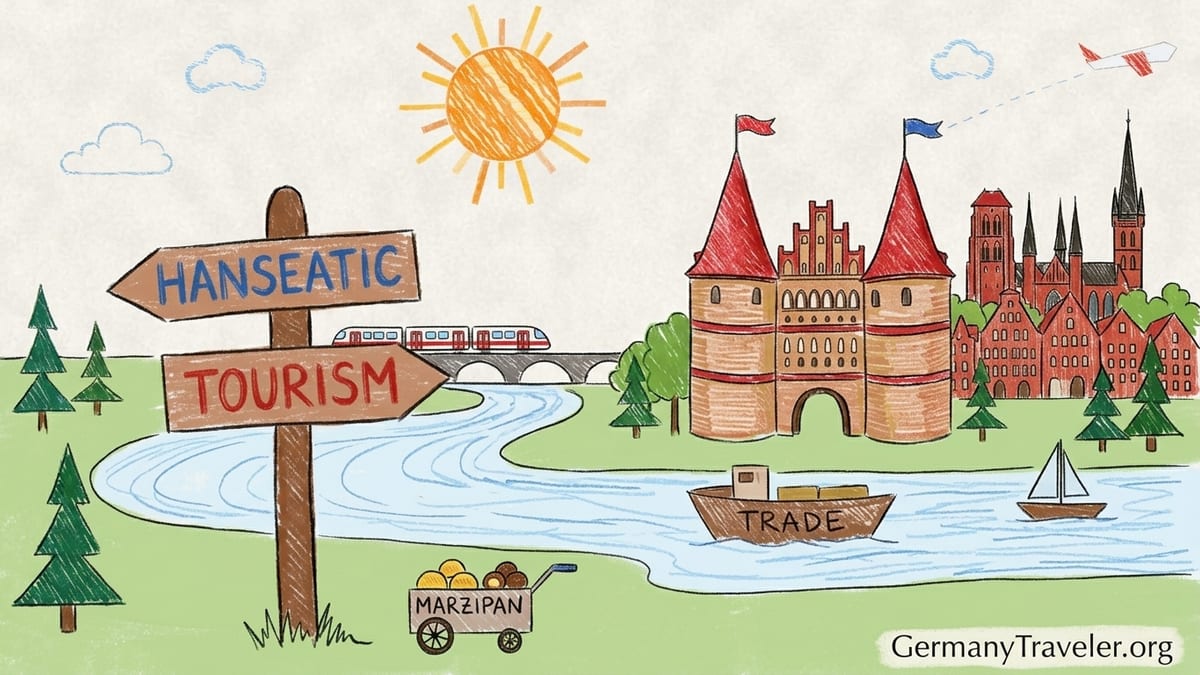
From Hanseatic Dream to Uneasy Reality
My expectations for Lübeck were shaped long before I stepped out of the train station. The tourism photos are everywhere: the Holstentor rising over the river like a brick-red crown, church spires puncturing the sky, and narrow alleys promising whispers of medieval merchants. UNESCO World Heritage status since 1987 reinforces the impression that almost every stone in the old town is sacred fabric of the Hanseatic League. I came in imagining a sort of northern Bruges where every corner rewards slow wandering with another layer of history.
The walk from the station to the old town is supposed to be the grand approach. In reality, it funnels you straight into a traffic-clogged intersection and the front of the Holstentor, already ringed with selfie sticks and coaches by mid-morning. The famous gate is indeed photogenic, but it also feels oddly stranded between modern roads and car parks. For a city that trades so heavily on its medieval aura, the entry sequence sets a slightly jarring tone: the past is right there in front of you, but the atmosphere is diluted by buses, signage and a constant churn of day-trippers piling out, taking the photo, and moving on.
By the time I reached the central squares around St. Mary’s Church and the Town Hall, the disconnect sharpened. The skyline is rightly admired, yet at street level the experience leans heavily on modern retail, chain bakeries and tourist-oriented shops. It felt less like entering the preserved capital of a medieval trading empire and more like walking into a pleasant but fairly standard German town that happens to have outstanding church roofs. Without context, Lübeck’s big story of Hanseatic power and wartime survival remains frustratingly hard to grasp.
Some of that is Lübeck’s own complicated history. The city was the first major German target of a large Royal Air Force raid in March 1942. Around a fifth of the town centre was destroyed, particularly around St. Mary’s and the market area, and many timber houses burned. Postwar reconstruction and later restorations preserved the street grid and much of the brick shell, but a significant part of what a visitor sees today is careful rebuilding rather than untouched medieval fabric. UNESCO acknowledges this directly, praising Lübeck as a largely intact medieval urban structure while noting the heavy bombing and reconstruction around its main squares. That nuance rarely appears in tourism slogans, and I felt the absence of honest interpretation on the ground.
Holstentor: The Icon That Eats Your Time
Lübeck’s Holstentor is unavoidable, literally and metaphorically. Its towers appear on postcards, chocolate boxes and banknotes, and it dominates not just the skyline but the way many visitors experience the city. You cross the bridge, join the loose queue of people arranging themselves in front of the lawn, and almost inevitably end up repeating the same photograph that lured you here. Even before entering, I had the sense that the city’s branding rests so heavily on this one structure that it risks overshadowing everything else.
The museum inside the Holstentor, currently around 8 euros for adults according to recent visitor reports, promises a compact history of Lübeck and the Hanseatic League. In practice, it delivers a curious mix. There are some engaging models of ships and fortifications and a few atmospheric rooms, but the interpretation feels dated and text-heavy. English translations cover the basics but do not dig deeply into the politics or economic networks that made Lübeck powerful. In less than an hour I had seen the exhibits, read as much as felt necessary, and was back outside dodging tripods on the lawn. For a flagship monument in a world heritage city, the substance inside does not really match the iconography on the outside.
Holstentor’s biggest impact may actually be how it structures time. Many day-trippers apparently devote a generous slice of a short visit to photographing the gate from every angle, waiting for gaps in the crowds, and perhaps visiting the interior. All of that attention narrows the visit around a single image. Standing there, squeezed between coach groups, I found myself questioning whether Lübeck has allowed its global symbol to become a distraction from the richer and more complicated Hanseatic story that lies scattered across the rest of the island.
Worse, the plaza around the Holstentor offers almost no help for visitors trying to move beyond the icon. There is little on-site explanation in multiple languages that genuinely links the gate to trade routes, to the Baltic, or to the later decline of the League. Instead, Holstentor functions as a giant backdrop: impressive on a screen, slightly hollow in person without extra effort. If you arrive expecting your understanding of Lübeck to begin here, you may leave with nothing more than a few well-composed shots and a vague sense that “Hanseatic” meant old bricks and canonballs.
Marzipan, Shopping Streets and the Tourist Skin of the City
Walk away from the Holstentor along Holstenstrasse and Breite Strasse, and Lübeck’s Hanseatic mystique quickly dissolves into a perfectly ordinary northern German shopping zone. Chain fashion stores, drugstores and electronics shops fill most ground floors. The high, narrow brick facades above are genuinely striking, but at pavement level you could be in many mid-sized cities. On a grey afternoon, I felt I was drifting in and out of a heritage film set whose interiors had been replaced by standard retail units. The cognitive dissonance is real: your eyes tell you this is a medieval powerhouse, your wallet tells you it is just another place to buy sneakers.
The one exception is marzipan. Lübeck’s almond confectionery is renowned, and several shops lean hard into that reputation. The most famous brand decorates its premises with historic photos and intricate marzipan models of the city. Inside, however, the experience shifts from storytelling to sales very quickly. Trays of pralines sit beside branded coffee mugs and marzipan gift tins marketed to coach groups. For a visitor looking to understand Lübeck’s trading past, this sugary focus can feel oddly shallow. Marzipan became a symbol of local craftsmanship and merchant wealth, yet the contemporary treatment rarely explains that economic and cultural background. You are invited to taste, not to learn.
In peak season, queues for café tables and counters stretch into the street. A cappuccino and two slices of marzipan cake on the main pedestrian route can easily eat more than 10 or 12 euros of your budget, yet contribute little to your understanding of the city other than reinforcing that it now sells its heritage in bite-sized pieces. After half an hour watching tourist groups file through the same branded shop, snapping a photo of the counter and leaving with the same box of chocolates, I could not escape the feeling that the Hanseatic capital had rebranded itself as a marzipan mall with gothic bell towers.
None of this is to say you should avoid Lübeck’s sweet side entirely. However, the ratio between consumption and comprehension feels unbalanced. For every plaque that explains how Baltic trade networks brought spices and almonds into the city centuries ago, there are dozens of price tags. If you arrive expecting the shopping streets to tell you much about the merchants who once ruled this place, you may find yourself disappointed and a little over-sugared.
Wartime Damage, Reconstruction and the Filtered Past
Part of Lübeck’s puzzle lies in how it presents its scars. The city suffered a heavy bombing raid on the night of 28 to 29 March 1942, when British bombers targeted its vulnerable timber-framed core with incendiaries. Contemporary research suggests roughly 15 percent of the building fabric was destroyed, with particular devastation around St. Mary’s Church, the Town Hall and adjacent streets. Several major churches, including the cathedral and St. Mary’s, lost roofs and interiors. Yet as you wander today, those events are remarkably easy to miss.
UNESCO’s own description of Lübeck points out that despite significant wartime damage, the basic medieval structure of the old town island survived. The street grid, many 15th and 16th century patrician houses, salt warehouses and public monuments remain in place. At the same time, UNESCO explicitly notes that the zone around St. Mary’s and the Market Square bears “tragic scars” of bombing, and that entirely reconstructed areas lie within and beside the protected core. On the ground, however, those distinctions are not always clearly signposted. You can stand in the main square, admire the apparently ancient facades and have little sense of which walls endured the firestorm and which are careful postwar recreations.
As a visitor interested in authenticity, I found this lack of explanation frustrating. It does not diminish Lübeck’s value to admit the extent of destruction and rebuilding. If anything, the city’s decision to repair its brick Gothic skyline and to continue using historic building forms for new construction is a story worth telling. Yet outside the major museums, information boards about the 1942 raid are relatively sparse, and there is little in English that helps newcomers read the patched history embedded in the streets. In practice, Lübeck’s past is curated so that the medieval narrative dominates and the shattered 20th century one fades quietly into the background.
The result is a strange uncertainty. You come looking for the Queen of the Hanseatic League and instead find something more like a theatre set loyal to the old plot but not always honest about the props. That does not make Lübeck less attractive, but it does challenge the high expectations set by brochures that suggest an almost untouched medieval city. If you care deeply about historical authenticity, you will need to work harder than expected to understand which parts of what you see are original, which are scarred, and which are postwar approximations of a lost skyline.
The European Hansemuseum: Impressive, Exhausting and Not for Everyone
For anyone who wants real depth on the Hanseatic League, Lübeck’s European Hansemuseum is the obvious stop. The institution, opened in 2015 on the north edge of the old town near the Burgtor, advertises itself as the largest museum in Europe devoted to Hanseatic history. In 2026, the museum lists an adult ticket for the permanent exhibition at 16 euros, with free admission for visitors under 18 and some reductions for students and others. Tickets include access to the associated former monastery complex and audio material in multiple languages.
On paper, that sounds like excellent value: a multi-hour deep dive into medieval trade, politics and urban life in the very city that once led the League. In practice, the museum is dense, heavily curated and at times overwhelming. The permanent exhibition threads visitors through a sequence of thematic rooms using a chip card that personalizes some content. Each space is loaded with media stations, reconstructions and detailed wall texts. If you are a specialist, a serious history enthusiast or someone willing to spend three or four hours absorbing information about shipping routes, legal codes and trading privileges, the 16 euros feels reasonable. You will leave with a nuanced understanding that Lübeck’s tourism marketing barely hints at.
As an ordinary visitor with a finite attention span, I found the experience more mixed. After about 90 minutes, my ability to meaningfully absorb more data on grain prices in Novgorod or legal disputes in Bruges started to fade. I watched other visitors drifting past interactive displays without engaging, simply because the information load was too high. Families with children seemed particularly challenged; even with child-oriented stations, the sheer volume of text and the solemn tone are not easy to digest on a short city break. It is hard to shake the impression that the museum is designed partly for academic confidence and only secondarily for non-specialists.
From a value perspective, you also need to consider opportunity cost. A focused visit can easily consume half a day once you factor in walking there, queuing in busy periods, and spending at least two concentrated hours inside to feel the ticket worth the price. That is a large portion of a one-day or even overnight stay in Lübeck devoted to a single, highly specialized topic. If you already have a general background in medieval Europe and are more interested in atmosphere than granular trade history, you may come away feeling that much of the content simply confirmed what you roughly knew already, but at considerable expense of time and money.
The underlying issue is not that the European Hansemuseum is a bad museum. It is thorough, well funded and takes the Hanseatic story seriously, which many cities do not. The question is whether this level of depth is what most visitors to Lübeck actually want. The city markets itself heavily through evocative imagery and romantic language. That suggests a desire for mood and narrative rather than a quasi-academic course in medieval commerce. For many non-specialists, a shorter, cheaper, more accessible introduction might have been enough. As it stands, the Hansemuseum can feel like you are paying premium price to work quite hard.
Gänge und Höfe: Not Quite the Open-Air Museum You Expect
Another of Lübeck’s signature selling points is its network of Gänge und Höfe, the narrow passageways and inner courtyards that once housed poorer residents and small workshops behind the grand merchant houses. Tourist brochures evoke them as hidden worlds, romantic backdrops of ivy-covered brick and tiny staircases. Some even suggest they are an informal open-air museum, a labyrinth anyone can wander through freely to discover “secret Lübeck.” That impression is only half-true, and arriving with the wrong expectations can be a recipe for disappointment.
The city’s own information notes that most of the Gänge and Höfe are freely accessible. In practice, they are also living residential spaces. Behind ornate archways you will find bicycles, dustbins, garden chairs and the sound of televisions. Some entrances are signed with clear visiting hours or requests for quiet; others are so obviously private that stepping in feels intrusive, even if technically allowed. A few courtyards are gated or closed off entirely. Walking these alleys as if they were museum exhibits is neither accurate nor respectful to the people who now live in what were once cramped working-class quarters.
On my visit, I joined one of the dedicated Gänge und Höfe walking tours offered by local guides, paying just under 15 euros for a scheduled public tour. This proved to be a more effective way to experience them than trying to explore alone with a printed map. The guide knew which passageways currently welcome visitors and which residents prefer to keep to themselves, and she provided the social history that is largely absent from the signage. Even so, the group moved quickly and often had to huddle against one wall to let residents pass with groceries. The whole experience felt less like wandering through a preserved medieval maze and more like peeking into other people’s courtyards under supervised conditions.
If you come to Lübeck imagining unrestricted access to dozens of picturesque alleys, you may find this reality uncomfortable. The city’s promotional language does not always stress clearly enough that the Gänge and Höfe are, first and foremost, homes. Their survival is a testament to preservation policies that prioritized housing as much as tourism, which is admirable. But it also means that they cannot function like a theme park. Visitors who respect that will still find them atmospheric. Those who arrive expecting Instagram-ready corridors at every turn are likely to feel constrained, rushed or awkwardly out of place.
Comparing Lübeck with Wismar and Lüneburg
To understand why Lübeck might feel overrated to some travelers, it helps to compare it with other north German towns that share parts of its story. Wismar, on the Baltic coast further east, is also a UNESCO-listed Hanseatic city, but its historic core is more compact. The market square, harbour edge and main churches lie within a few minutes’ walk of each other, and there is less sense of the old town dissolving into generic shopping zones. You can stand on Wismar’s cobblestones and easily read the relationship between market, port and parish churches without needing a museum ticket. For visitors who value immediate atmosphere and legible urban form, Wismar can feel more coherent than sprawling Lübeck.
Lüneburg, south of Hamburg, offers a different comparison again. It was a major salt-trading town connected to the Hanseatic network but never branded as its queen. Today, the compact old town has an almost theatrical sequence of gabled houses, crooked alleys and a surprisingly intact ensemble of brick and half-timbered buildings. Crucially, Lüneburg’s modern commercial life intertwines a little more gently with its historic fabric. Independent cafes, bookstores and bars occupy older structures without overwhelming them, and the student presence gives the streets a different energy. The mood there is less museum, more lived-in medieval backdrop.
Spending time in these places after Lübeck throws some of the latter’s weaknesses into relief. Lübeck’s old town island is larger, its churches are arguably more monumental, and its Hanseatic credentials beyond dispute. Yet the visitor experience sometimes feels disjointed. Key sights lie further apart, separated by stretches of traffic or fairly bland shopping streets. The European Hansemuseum and Holstentor each demand concentrated time but are not obviously linked in a narrative route for first-timers. In Wismar and Lüneburg, you can accomplish more coherent exploration in a single afternoon, with fewer paid gates and less museum fatigue.
This is not to declare Lübeck unworthy. Rather, it is to emphasize that its reputation as the preeminent Hanseatic city can mislead travelers into expecting the most satisfying urban experience as well. If your trip through northern Germany is short and you crave immediate charm over intellectual depth, you might genuinely find that Wismar’s waterfront or Lüneburg’s sloping streets deliver more of what you imagined when you first heard the word “Hanseatic.”
Who Is Likely to Leave Lübeck Disappointed?
After walking the city, visiting several main sights and comparing notes with other travelers, a pattern emerged. The visitors most at risk of disappointment are those who come to Lübeck as a quick day trip from Hamburg with only a few hours and a handful of famous images in mind. They reach the Holstentor, perhaps climb a church tower, eat marzipan, glance at an alley or two and then wonder where the rest of the story is hiding. Without either a guide or the time and budget to invest in the Hansemuseum, the city can feel oddly thin once the first wave of visual impressions wears off.
Budget-conscious travelers may also find Lübeck underwhelming. Admission to major museums, coffee and cake on the main streets, and guided tours all add up quickly. The European Hansemuseum alone is 16 euros per adult. Add the Holstentor interior, a church tower viewpoint, and a walking tour of the Gänge und Höfe, and a single day can easily require 40 to 50 euros per person in entry fees and experiences if you try to “do it properly.” For visitors who value simple wandering and street-level atmosphere, that outlay may not feel justified, especially when nearby towns offer more immediate charm for less structured spending.
Finally, travelers who equate UNESCO status with a largely untouched medieval cityscape may be disillusioned. Lübeck’s wartime destruction and postwar reconstruction were real and significant. The medieval street plan survives and large numbers of historic buildings remain, but the illusion of total continuity is just that, an illusion. If you have seen promotional material implying an almost perfectly preserved Hanseatic capital, the presence of modern infill, reconstructed facades and fairly generic commercial stretches will come as an unwelcome surprise.
By contrast, travelers who tend to enjoy Lübeck most seem to be those with a specific curiosity about the Hanseatic League, those who appreciate large brick churches as objects of architecture, and those who have allowed enough time. An overnight stay, with a long morning or afternoon reserved for the Hansemuseum and a quieter evening wander once day-trippers leave, suits the city better than a rushed half-day dash.
The Takeaway
Lübeck is not a fraud, but it is a city whose reputation currently exceeds the average visitor experience it offers without extra effort. It remains historically important, architecturally striking from many angles and home to one of Europe’s most ambitious museums on medieval trade. Yet its old town is not the seamless medieval dream that “Queen of the Hanseatic League” implies. Wartime damage, reconstruction, heavy tourism branding around a single gate and a commercial core focused on mainstream retail and marzipan all chip away at the romance.
If I were planning a return visit, I would make selective, even ruthless, choices. I would still walk past the Holstentor and take a few photos, but I would probably skip paying to go inside unless I was traveling with someone particularly fascinated by fortifications or early modern weaponry. I would avoid lingering on the main shopping streets except to cut through them. Instead, I would spend limited museum money either on a focused visit to the European Hansemuseum, if in the right mood for serious learning, or on a guided walking tour that ties together the churches, alleys and main squares with stories about trade, war and everyday life.
To experience Lübeck’s strongest history without unnecessary spending, consider three strategies. First, pick up or download a good self-guided walking route that explains wartime damage and reconstruction so you can read the city’s scars in context while simply walking. Second, join just one well-reviewed guided tour, such as a Gänge und Höfe route, instead of multiple shorter experiences; a single 90-minute tour can illuminate corners you would otherwise misinterpret as mere backyards. Third, accept the limits of access: some alleys are private, some stories are behind museum doors, and some of the Hanseatic League’s complexity will not reveal itself in a couple of hours. With those expectations reset, Lübeck becomes less a disappointing queen and more a demanding teacher.
For travelers who crave instant charm, compact scale and a more intuitive historic atmosphere, Wismar or Lüneburg may indeed leave a stronger impression than Lübeck, despite having neither its title nor its scale. But for those willing to work a little, to look past the marzipan boxes and the Holstentor selfies, Lübeck still has a deep and complicated story to tell. It just no longer gives that story away for free.
FAQ
Q1. Is Lübeck worth visiting for a day trip from Hamburg?
For a quick day trip, Lübeck can feel underwhelming if you only have time for the Holstentor, a church and the main shopping streets. You will see famous views but only scratch the surface of its Hanseatic history. If you are short on time and mostly want atmosphere, you might find smaller towns like Lüneburg more satisfying for a single afternoon.
Q2. Does the European Hansemuseum justify the 16 euro ticket for casual visitors?
The European Hansemuseum offers exceptional depth on the Hanseatic League and is fairly priced for its size, but it is intense and time-consuming. Casual visitors who are not especially interested in medieval trade may find that, after 90 minutes, the information feels overwhelming and the ticket less rewarding than expected.
Q3. How much time should I plan for Lübeck to avoid feeling rushed?
To move beyond the standard photo stops and engage with the city’s history, an overnight stay works better than a rushed half-day. One full day allows time for either the Hansemuseum or a detailed walking tour plus unhurried exploration of the churches and alleys once day-trippers leave.
Q4. Are the Gänge und Höfe really open to everyone?
Many of Lübeck’s Gänge und Höfe are physically accessible, but they are primarily residential courtyards, not a formal open-air museum. Some have signs requesting quiet or limiting entry, and a few are gated. A guided tour can help you visit respectfully and understand the social history without intruding on residents.
Q5. Is the Holstentor museum worth going inside, or is a photo from outside enough?
The Holstentor’s exterior is the main attraction for most visitors. The small museum inside offers a basic overview of city history but feels dated and can be fully seen in under an hour. Unless you have a special interest in fortifications or Hanseatic models, the value of the interior may not match your expectations.
Q6. How visible are Lübeck’s wartime scars to a first-time visitor?
Without background information, Lübeck’s wartime damage is not easy to see. Many bombed areas around St. Mary’s and the market were rebuilt in traditional styles. To understand what is original and what is reconstructed, you need either good interpretive materials or a guide, as signage on the streets is limited.
Q7. Is Lübeck very expensive compared with other Hanseatic towns?
Entry fees for major attractions such as the European Hansemuseum, some church towers and guided tours can make Lübeck feel costly for a short visit. While general prices are comparable to other German cities, the concentration of must-see paid sights means your sightseeing budget can disappear quickly.
Q8. How does Lübeck compare to Wismar for a short visit?
Wismar’s historic core is more compact, and the relationship between harbour, market square and churches is easier to grasp in a few hours. Lübeck has grander monuments and a larger old town, but it demands more time and context. For travelers seeking immediate charm in a limited timeframe, Wismar often feels more manageable.
Q9. Should I prioritize Lübeck or Lüneburg if I only have time for one?
If your priority is deep Hanseatic history and major brick Gothic churches, Lübeck is the more significant city. If you prefer an intimate old town with a strong sense of place, independent shops and a lively student atmosphere, Lüneburg may provide a more enjoyable overall experience in a single day.
Q10. How can I experience Lübeck’s history without spending a lot on tickets?
Focus on free or low-cost experiences: walk the old town island with a self-guided route that explains wartime damage, explore a few of the accessible alleys respectfully, step into churches that do not charge high entry fees, and consider just one paid experience, such as a single walking tour. Skipping some interiors allows you to appreciate the historic street plan and skyline without a heavy financial commitment.