


I arrived in Bremen with the sort of reverence you reserve for historically important names on a map. Hamburg, Lübeck, Bremen: the trio that powered centuries of Hanseatic trade and still loom large in guidebooks and tourism campaigns. If any city was going to ooze maritime history from every brick, I thought, surely it would be Bremen. After a full day on the ground, carefully walking the UNESCO marketplace, the Schnoor quarter, Böttcherstraße and the Schlachte waterfront, I found myself asking a very different question: how much substantial Hanseatic history does Bremen actually deliver once you look past the famous postcard sights?
Expecting a Hanseatic Heavyweight, Finding a Compact Stage Set
On paper, Bremen looks like a dream for history travelers. This was a fully fledged Hanseatic city, a key port in the trading network that linked the Baltic and North Sea worlds and helped shape northern Europe. Modern promotional material leans heavily into that heritage, and from afar it is easy to imagine a sprawling old town, atmospheric docks and streets that still feel tied to the medieval trading world. Stepping out of Bremen Hauptbahnhof on a crisp morning, that was the mental image I carried with me.
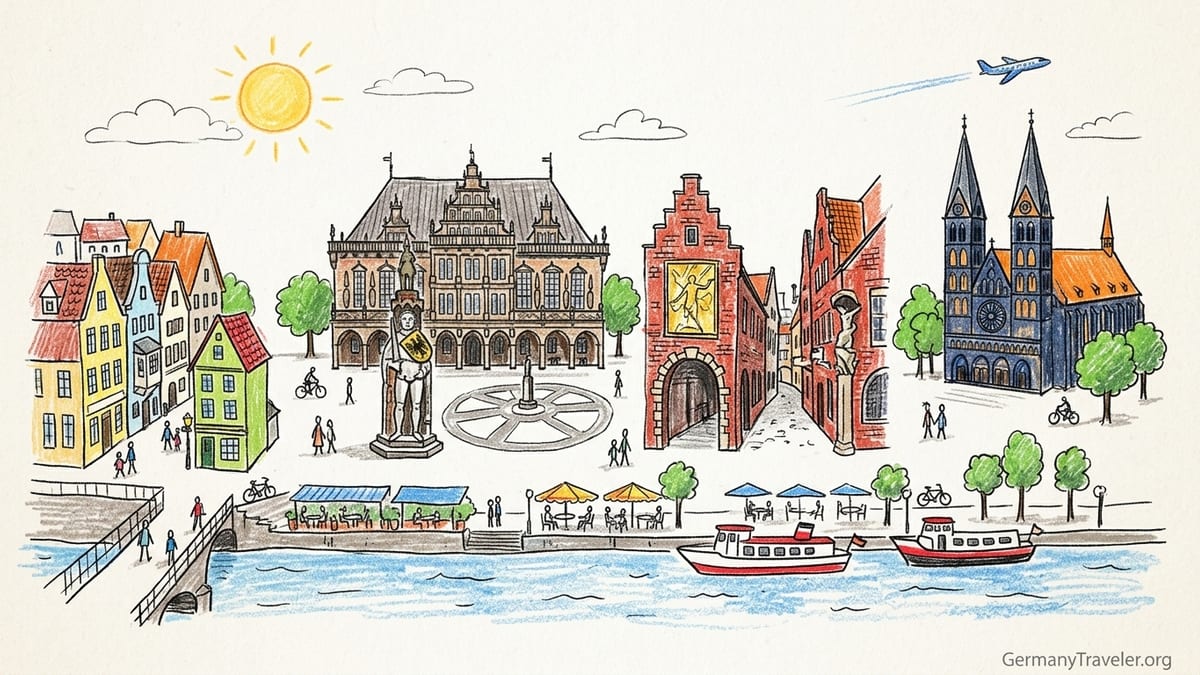
The reality, once I started walking, was how small and concentrated the historic core feels. Within a few minutes I had crossed the Wallanlagen park and reached the Marktplatz, Bremen’s showpiece square. From there, almost every famous sight that fills the brochures sits within a compact triangle: Town Hall, Roland, the cathedral, Böttcherstraße, the Schnoor and the Schlachte river promenade. You can move between them in five to ten minutes. For some travelers this efficiency is ideal. For me, coming specifically in search of depth and discovery, it already hinted at a problem: Bremen’s “old town” experience is essentially a single, carefully framed set piece.
In practice that means you can tick off a lot very quickly. I spent the first hour doing what every first-time visitor does. I circled the Town Hall, read the plaque at the Roland statue, waited for the obligatory photo with the Bremen Town Musicians, ducked into Böttcherstraße, then followed the stream of people toward the Schnoor. It is impressive how much visual impact is packed in. Yet by late morning I had an uneasy sense that I was looping around the same handful of facades rather than exploring a historic city that unfolds block by block the way Lübeck or Hamburg do.
That compactness feeds directly into the touristy feel. Because almost everyone is funneled through the same short routes, the streets take on the atmosphere of a designated visitor zone rather than a living historic quarter with different layers and uses. Souvenir shops, themed cafés and branded chocolate stores cluster around the key corners, particularly near the Town Musicians monument and along Böttcherstraße and in the Schnoor. I am no stranger to tourism infrastructure, but in Bremen the ratio of “staged” to “lived-in” felt unusually skewed for a city with such a mighty name.
The UNESCO Marketplace: Genuine Gravitas, Limited Reach
Where Bremen absolutely does earn its reputation is the Marktplatz ensemble itself. The Town Hall and the Roland statue, jointly inscribed on the UNESCO World Heritage List in 2004, are genuinely significant. The late Gothic Town Hall, built in the early 15th century and remodeled in Weser Renaissance style in the early 1600s, is one of the finest examples of a civic hall from the period. UNESCO recognizes it, together with the 1404 Roland, as an outstanding representation of civic autonomy and freedoms in the Holy Roman Empire, protected today by Bremen’s monument law. Inside, the upper hall and the famed Ratskeller with its wine casks dating back centuries make the building feel weighty, serious and authentically old.
Standing in front of the Town Hall, there is a real sense of continuity. The façades are richly sculpted, and the Roland, sword drawn and shield emblazoned with the imperial eagle, is more than a photogenic knight. He represents the market rights and privileges that once underpinned Bremen’s wealth. Spend time reading the explanatory panels in the square, and you get a concise lesson in how urban self-government and trade were linked in northern Germany. This is not packaging. It is core history, and it deserves the attention it receives.
The problem, for me, was how abruptly that depth drops away once you leave the immediate orbit of the square. The UNESCO listing is tightly drawn around the Town Hall and Roland, with a defined buffer zone in the surrounding streets. That makes sense from a conservation perspective. But as a visitor it underlines a truth that brochures often blur: in Bremen the genuinely first-rank heritage is focused in a very specific place. You can walk to the Weser in minutes, but you do not pass former hanseatic counting houses, long rows of medieval brick warehouses or a preserved harbor district reminiscent of Lübeck’s old-town island or Hamburg’s Speicherstadt. Instead, you encounter mostly 19th and 20th century buildings, gaps from wartime destruction and modern retail corridors.
Guided walking tours are the obvious way to dig below the surface, and operators clustered around the tourist information office on the square offer regular 90-minute introductions in German and, on some days, in English. When I joined one, the guide did a competent job of explaining the Town Hall’s façades, pointing out the statue of Ode to the Seafarer and mentioning the city’s trading past. Yet even the tour route made the limits clear: Marktplatz, a quick detour into Böttcherstraße, a short walk to the cathedral and the Schnoor, and we were done. For a city whose name once stood alongside Lübeck and Hamburg in diplomatic correspondence, the on-the-ground narrative felt strangely thin.
Böttcherstraße: Picturesque Passage with Modern Origins
Böttcherstraße is a perfect example of the gap between appearance and historical depth in Bremen’s old town. On a busy day you enter the lane through an ornate brick arch crowned by the gilded “Lichtbringer” relief. Tour groups bunch up under it; phones tilt skyward. The narrow canyon of red-brick gables, expressive sculptures and inner courtyards feels like a fantasy version of a medieval artisan street. At first glance it would be easy to assume these are lovingly preserved Hanseatic houses that somehow survived bombing intact.
Spend a little time reading about the street and a very different picture emerges. While the route itself dates back to the Middle Ages and its name recalls the coopers who once worked here, the architectural ensemble visitors admire today is largely a creation of the early 20th century. Coffee magnate Ludwig Roselius began buying up the dilapidated buildings in the early 1900s and, between roughly 1922 and 1931, had the entire street transformed. Architects Alfred Runge and Eduard Scotland and sculptor Bernhard Hoetger rebuilt or heavily remodeled most of the houses during that decade. At the south end, original two-storey warehouse buildings were demolished around 1921 to make way for new structures, including the Robinson Crusoe House completed in 1931.
The result is deliberately theatrical. Roselius conceived Böttcherstraße as a “small city within the city,” complete with museums, offices, upscale shops and places to drink his decaffeinated Kaffee HAG. Later, in the 1930s, the Nazi regime both criticized and then, paradoxically, protected parts of the street as an example of so-called “degenerate art” while also integrating it into its own cultural narratives. Many buildings were damaged in the Second World War and then restored or reconstructed in the late 20th century. Today, information panels and the official heritage listings emphasize that Böttcherstraße is a listed monument of 1920s and 1930s architecture, not a surviving medieval trade street.
Walking through with that knowledge changed my experience. Where earlier I might have been enchanted by the apparent timelessness, I instead felt as if I was strolling through an early example of immersive themed urban design. Shops selling regional chocolates, design objects and souvenirs fit neatly into that framework. They are enjoyable in a light, commercial way, similar to wandering a historic shopping arcade elsewhere in Europe. What I did not feel was a meaningful connection to Bremen’s Hanseatic trading heyday. If you come aware that you are admiring a 20th century reinterpretation of older forms, Böttcherstraße becomes an interesting architectural curiosity. If you expect untouched medieval authenticity, it risks feeling like a beautiful but misleading backdrop.
Schnoor Quarter: Pretty, Packed and Surprisingly Shallow
The Schnoor quarter is perhaps the most divisive part of Bremen’s old town. In photographs it looks irresistible. Narrow alleys, crooked houses, pastel façades leaning toward each other like gossiping neighbors. Historic photos and city records show that this area genuinely preserves the layout and scale of an old fishing and crafts district, and some building fabric goes back several centuries. On arrival, I ducked beneath the hanging signs and prepared to fall in love.
Within minutes, my enthusiasm dimmed. The Schnoor is tiny. You can walk from one end to the other in a few minutes, and almost every ground floor has been converted into something designed explicitly for visitors: jewelry stores, Christmas ornament shops, atmospheric but pricey cafés, galleries selling decorative prints and glassware. It is not that these businesses are illegitimate. They keep the quarter active and maintained. The problem is that very little in the contemporary use of the Schnoor helps you grapple with Bremen’s hanseatic story or with the social history of the neighborhood itself. It feels more like a curated shopping experience than a historic district where daily life and heritage coexist.
At one café, I paid a premium for a slice of cake and coffee enjoyed at a table that barely fit into the cramped interior. The staff were friendly, but the atmosphere was unambiguously that of a high-turnover tourist stop. A small local museum space in the area touches on the quarter’s past, but the displays I encountered were modest and felt overshadowed by the retail push around them. Even the signage sometimes leaned more into fairy-tale branding than into solid interpretation of urban history. I have no objection to a city monetizing its charm, but in a place that trades so heavily on the notion of authenticity, the dominance of souvenirs over substance left me underwhelmed.
What struck me most was how quickly the illusion broke when I stepped outside the tight cluster of photogenic lanes. A block or two away, the urban fabric becomes abruptly more ordinary: postwar buildings, standard shops, streets you could find in almost any medium-sized German city. That contrast is, in some ways, understandable given wartime destruction. But from a traveler’s perspective it reinforces the sense that Bremen’s “old town” is made up of a few heavily protected islands in a sea of modernity, rather than a large, contiguous historic center that lets you sink into the past for hours.
The Schlachte Waterfront: Pleasant Promenade, Thin on History
If you are looking for a tangible connection between Bremen and the river that made it rich, the Schlachte waterfront is the obvious destination. It runs along the Weser, a few steps below the main shopping streets, and in good weather the beer gardens and outdoor restaurant terraces are a magnet for locals and visitors. Boat tours depart from here, there are moored ships converted into bars and hostels, and during festivals the promenade can feel lively and atmospheric.
As a purely recreational space, the Schlachte works. I stopped for a drink at one of the riverside beer gardens and watched cyclists and families drift by. Prices were in line with central German cities, roughly what you would expect to pay for a glass of beer or a simple meal in a tourist-facing area. In late afternoon light, with the reflections of the bridges and boats on the Weser, it is easy to relax. The mood is sociable, and if you have already done your sightseeing, spending a few hours here is pleasant.
As a place to understand Bremen’s Hanseatic maritime history, however, the Schlachte is surprisingly thin. Modern embankments, postwar buildings and the lack of extensive surviving port infrastructure mean you do not get the immersive sense of sailing ships, warehouses and long-distance trade that older images of Bremen might suggest. Interpretation panels along the promenade offer some basic historical context, but the overall presentation is that of a contemporary leisure zone with a few historical references, not a preserved or reconstructed harbor district.
For travelers who want hands-on maritime museums or extensive dockside heritage, this will be a disappointment. Those experiences have, to a significant extent, migrated downriver to Bremerhaven, where institutions like the German Emigration Center and the Klimahaus present large-scale, modern exhibitions in purpose-built spaces. Bremen’s own Maritime Museum presence in the central city is modest. If your time is limited and your interest is firmly in ports and seafaring, you may find that Bremen’s core offers only a light tasting plate, not the full meal.
Comparing Bremen with Lübeck and Hamburg: One Spare Day, Where to Go?
Because Bremen is so easy to reach by train, it often ends up in direct competition with Lübeck and Hamburg for the traveler who has one extra day to devote to a Hanseatic city. Having spent time in all three, my feeling is clear: if you are primarily motivated by historical depth, Lübeck and Hamburg offer stronger experiences.
Lübeck, as the former “Queen of the Hanse,” has an old town that feels like an integrated historical organism. The brick Gothic churches, merchants’ houses and surviving city gates stand within a tight island encircled by water. Streets like Königstraße and Glockengießerstraße unwind with a continuity of historic facades that Bremen simply cannot match. Crucially, Lübeck has invested in interpretation. The European Hansemuseum combines archaeological remains with multimedia exhibitions that walk you through the League’s politics, trade routes and daily life. When you leave, you not only have pretty photographs; you have a coherent understanding of what the Hanse was and how it functioned.
Hamburg, while much larger and more heavily modernized, gives you scale and variety. The Speicherstadt warehouse district, another UNESCO World Heritage site, is one of the most impressive ensembles of late 19th and early 20th century port architecture anywhere. Even if its period is later than the medieval Hanse, the sheer physicality of brick warehouses, canals and bridges brings the trading city concept to life. Add the Elbphilharmonie, the busy harbor boat traffic and sturdy brick quarters like the Kontorhaus district, and you have a day’s worth of exploration that constantly returns you to the theme of commerce and the sea.
Against that backdrop, Bremen feels like the most compact and curated of the three. Its strengths are the UNESCO marketplace, a few very photogenic streets and the ease with which you can cover the center on foot in half a day. Its weaknesses are the limited extent of contiguous historic urban fabric, the tourist-heavy focus of the key quarters and the relative scarcity of heavyweight museums devoted specifically to the Hanseatic period. If you want a gentle, low-effort outing with nice postcards and café stops, Bremen will suit. If you are looking to really sink your teeth into northern European trading history, Lübeck and Hamburg do more of the heavy lifting.
Beyond the Postcard: Where Bremen Still Rewards Curious Visitors
All of this might sound as if I am arguing against visiting Bremen at all, and I am not. What I am arguing against is the mismatch between the city’s marketing as a grand Hanseatic destination and the more limited, tourism-centered reality of its old town. Once you adjust your expectations and stop demanding a full medieval harbor city, Bremen becomes easier to appreciate on its own terms.
One way to recalibrate is to focus less on the photogenic corridors and more on specific cultural or historical experiences. A guided tour of the Town Hall interior, for example, takes you beyond the façades and into the great hall where Bremen’s patricians once debated. The carved ship models hanging from the ceiling, the painted panels and the long wooden tables communicate a sense of civic ritual that no exterior snapshot can convey. In the vaulted Ratskeller below, a knowledgeable staff member can point out some of the older wine casks and explain how wine trading intertwined with Bremen’s mercantile class over centuries.
Elsewhere in the city, small museums and churches offer quieter, more local insights. The cathedral, with its mix of Romanesque and Gothic elements, allows you to climb towers or visit the crypt, where the atmosphere shifts from tourist bustle to something more contemplative. Neighborhoods outside the center, such as the Viertel with its 19th century streets and independent cafés, show a version of Bremen that is lived-in and creative rather than curated for day trippers. None of these experiences scream “Hanseatic League,” but together they can make a day in Bremen feel more like a visit to a multi-layered city and less like a walk through a historical showroom.
It is also worth paying attention to seasonal and event-based offerings. During the Freimarkt or Christmas market periods, parts of the city fill with stalls and temporary rides that many locals and visitors enjoy for their festive atmosphere. From a strictly historical point of view, they add little. From a cultural one, they show how Bremen uses its central spaces today. If you arrive expecting a solemn history lesson, you may be irritated by the carnival feel. If you come ready to experience a contemporary northern German city with a strong sense of civic space, you may enjoy the mix more.
The Takeaway
So, is Bremen worth visiting for travelers interested in Hanseatic history, and what should you realistically expect? For me, the answer is nuanced. Bremen delivers one world-class historic ensemble in the UNESCO-listed Town Hall and Roland, along with a handful of visually striking streets and squares. It does not, however, offer the kind of extensive, immersive old town or museum infrastructure that would make it a primary destination for serious exploration of the Hanseatic world. Much of what looks ancient at first glance, particularly in Böttcherstraße, turns out to be a carefully designed 20th century reinterpretation, beautiful but far removed from untouched medieval trade architecture.
If you have one spare day in northern Germany and your main goal is to understand the Hanseatic League in depth, I would still send you to Lübeck first, and to Hamburg if you want to combine history with big-city buzz and dramatic port scenery. Bremen, in that comparison, is best suited to travelers who value compactness, straightforward sightseeing and a gentle pace over depth. It is easy to navigate, photogenic in its core, and offers enough cafés and restaurants to punctuate a relaxed stroll. You will leave with attractive images and a thumbnail understanding of civic autonomy symbolized by the Roland and the Town Hall.
Who is most likely to find Bremen underwhelming? Travelers who build their itineraries around substantial historical districts, who delight in losing themselves for hours in streets where nearly every building predates industrialization, and who expect a city of Bremen’s name to confront them with the full drama of Hanseatic trade. Those visitors may feel, as I did, that once the camera is full and the standard sights are ticked off, there is surprisingly little left in the old town that deepens or complicates the story.
Yet there are still reasons to come, provided you calibrate your expectations. Take the time to go inside the Town Hall, sample the wine culture of the Ratskeller, seek out smaller church interiors, and, if possible, venture beyond the postcard streets into residential quarters where contemporary Bremen life unfolds. Accept Böttcherstraße for what it is, a remarkable exercise in early 20th century urban design on a medieval footprint, rather than a preserved guild street. Approach the Schnoor as a charming, commercialized cluster of lanes rather than a portal into untouched history. Seen in this light, Bremen does not quite live up to its Hanseatic hype, but it can still be a worthwhile, if modest, stop on a broader northern German journey.
FAQ
Q1. Is Bremen worth visiting if I only care about Hanseatic history?
Bremen offers an outstanding UNESCO-listed Town Hall and Roland statue that reflect civic autonomy in the Hanseatic era, but its surviving historic fabric is limited and heavily concentrated. If your main goal is deep immersion in Hanseatic urban history, Lübeck provides a more extensive old town and a dedicated Hanse museum, while Hamburg adds large-scale port districts with strong historical resonance.
Q2. How much time do I really need in Bremen’s old town?
For the main sights around the Marktplatz, Böttcherstraße, the Schnoor and the Schlachte waterfront, a focused visitor can see everything in half a day. Adding a guided Town Hall tour, a cathedral visit and relaxed café stops turns it into a full but still compact day. If you stay longer, you will likely spend more time in modern neighborhoods or on excursions than in the old town itself.
Q3. Is Böttcherstraße actually medieval?
The route of Böttcherstraße is historic and the name recalls the coopers who once worked there, but the architectural ensemble that visitors admire today was largely created between about 1922 and 1931 by coffee magnate Ludwig Roselius and his chosen architects and artists. Many earlier buildings were demolished or radically transformed, and later repairs after wartime damage mean that the street is best understood as a 20th century reinterpretation of older urban forms.
Q4. How authentic is the Schnoor quarter?
The Schnoor preserves the tight street pattern and small-scale plots of an old riverside neighborhood, and some building fabric is genuinely historic. However, most ground floors now house cafés, galleries and souvenir shops aimed at visitors. You will experience a very picturesque environment, but day-to-day life and detailed historical interpretation take a back seat to commercial use.
Q5. Are guided tours in Bremen worth joining?
Short walking tours that start near the Marktplatz are useful for orientation and for context around the Town Hall, Roland and nearby churches. They generally last around 90 minutes and follow a compact loop through the main sights. They are worth joining if you like structured introductions, but they will not transform Bremen into a much more extensive historical experience, simply because the physical area of interest is small.
Q6. How does Bremen compare with Lübeck for a one-day trip?
Lübeck offers a larger, more cohesive historic center, with brick Gothic churches, city gates and long streets of merchants’ houses that together create a stronger sense of Hanseatic scale. The city also has a substantial museum dedicated to the League’s history. Bremen, by contrast, delivers a single superb civic square, a couple of very photogenic lanes and a pleasant riverside, but it does not match Lübeck’s depth or variety for history-focused travelers.
Q7. Is Hamburg a better choice than Bremen for port and trading history?
Hamburg’s appeal lies in its size and surviving port architecture. The warehouse district and surrounding quarters present a dense landscape of brick buildings, docks and canals that make the city’s trading role very tangible, even if much of it dates to the late 19th and early 20th centuries. If you want to experience an active port city with layered commercial history, Hamburg is a stronger and more varied choice than Bremen.
Q8. Will I find many museums about the Hanseatic League in Bremen?
Bremen has museums and church spaces that touch on its wider past, but it does not have a flagship, large-scale institution to match Lübeck’s Hanse museum. If a deep dive into the League’s politics, trade routes and urban networks is your priority, you will get more comprehensive coverage in Lübeck and, to some extent, through exhibits in Hamburg’s historical museums.
Q9. Is the Schlachte waterfront historically significant or mainly a leisure area?
The Schlachte marks Bremen’s historic riverfront, but wartime damage and later redevelopment mean that little original port infrastructure remains. Today the promenade is primarily a leisure zone filled with terraces, beer gardens and moored ships used as venues. It is pleasant for a drink and a walk, but you should not expect a preserved historic harbor district.
Q10. Who is most likely to enjoy Bremen despite its limitations?
Travelers who appreciate compact historic cores, prefer easy, low-effort sightseeing and are happy with a handful of standout sights, cafés and riverside time will find Bremen agreeable. Those less fixated on exhaustive Hanseatic history and more interested in a relaxed city break with some striking architecture and a manageable scale may leave satisfied, especially if they combine Bremen with other northern German destinations.