


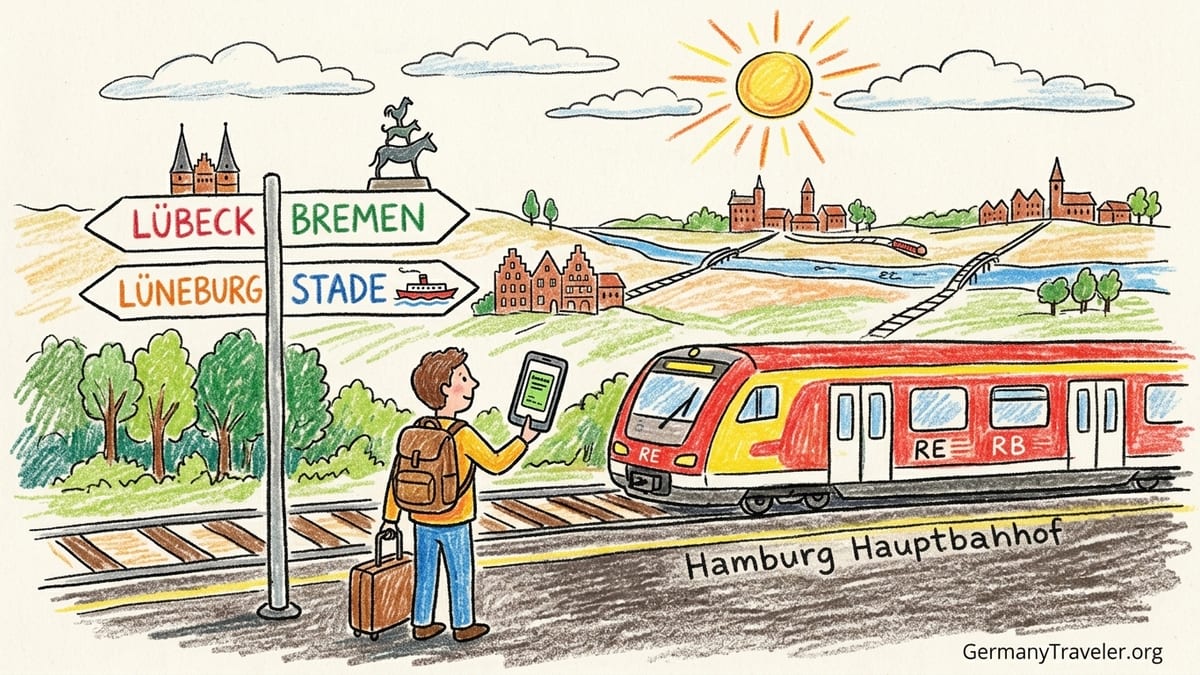
Hamburg is a perfect base for car free day trips into the historic world of the Hanseatic League. Within one to ninety minutes by train you can reach a ring of medieval trading towns with brick gables, cobbled alleys and working harbors. This guide compares the most rewarding Hanseatic excursions from Hamburg by rail, explains current train services and tickets, and gives concrete walking routes so you can step off the platform and straight into history.
How to Use Hamburg as a Car Free Hanseatic Base
Staying in Hamburg without a car is practical because the city is a major rail hub with frequent regional services in all directions. The main departure point is Hamburg Hauptbahnhof, the central station where regional express trains to Lübeck, Lüneburg, Bremen and Uelzen depart, and where the S Bahn lines, including the new S5 toward Stade and Buxtehude, intersect with long distance services. Many travelers stay within easy U or S Bahn reach of Hauptbahnhof so that early departures and late returns are simple even after dinner in another city.
For most visitors the key ticket is the nationwide Deutschlandticket, currently a monthly subscription product valid only on local and regional public transport, not on long distance ICE, IC or EC trains. As of late 2026 it costs 49 euros per calendar month and must be bought in advance as a personal, non transferable pass in an app or as a chip card. It is valid on S Bahn, U Bahn, trams, most buses and all regional trains labeled RE, RB or S that serve the routes in this guide. It is not accepted on fast ICE or IC trains even if those trains run on the same tracks between the same cities.
From Hamburg, the Deutschlandticket covers the RE 8 and RE 80 to Lübeck, the Metronom operated RE 3 and RB 31 to Lüneburg and Uelzen, and the Metronom RE 4 to Bremen. It is also valid on Hamburg S Bahn lines including the S5 that now runs from Elbgaustraße through Hamburg Hauptbahnhof and Harburg to Buxtehude and Stade. That means most of the classic Hanseatic day trips from Hamburg can be done without buying extra tickets, although you should still budget time to activate or show the digital pass and carry photo ID because staff on Metronom and S Bahn services do spot checks.
Weekend engineering works are common on the busy rail corridors radiating from Hamburg. Track closures can lengthen journey times by 15 to 30 minutes, add a change of train in the suburbs, or replace part of the journey with a rail replacement bus. Before you leave, check the Deutsche Bahn Navigator app or station departure boards and look for construction warning icons on your route. If you have dinner plans back in Hamburg, choose a connection that is not the very last train of the evening so that you have a buffer if your planned train is cancelled.
Lübeck: UNESCO Old Town Island in Under an Hour
Lübeck is the classic Hanseatic day trip and the quickest way to feel immersed in red brick Gothic architecture. Trains to Lübeck depart from Hamburg Hauptbahnhof and arrive at Lübeck Hauptbahnhof, usually in about 45 to 50 minutes on the regional express services RE 8 and RE 80 that are operated by DB Regio. At busy times there are generally two trains per hour, and current sample timetables show departures such as 06:06 from Hamburg Hauptbahnhof with arrival 06:52 in Lübeck. These are all regional trains, so the Deutschlandticket is valid and you do not need a reservation.
From Lübeck Hauptbahnhof it is an easy ten to fifteen minute, mostly level walk to the UNESCO listed old town island. Simply exit the station, follow the signs toward the city center and cross the Puppenbrücke bridge over the Trave river. Within a few hundred meters you will see the twin towers of the Holstentor city gate, one of Germany’s most recognizable medieval silhouettes, and beyond them the spires of St. Petri and St. Marien churches. The route is suitable for travelers with wheeled luggage or strollers; however, the old town itself has cobblestones, so wheelchair users may want to allow more time.
A simple walking route starts at the Holstentor, continues along Holstenstrasse into the old town, then turns left up Breite Straße for shopping and right toward the Markt square. From here you can visit the town hall courtyard, step inside St. Marienkirche to see its brick vaults, then walk along Königstrasse to the Heiligen Geist Hospital. Finish with a stroll along the riverfront promenade on the north side of the island and then cut back through small lanes to return toward the station. To do this circuit at a relaxed pace with coffee and one or two interior visits, plan at least four to five hours on the ground in Lübeck.
Return trains to Hamburg run into the late evening, often at least hourly, so you can comfortably have dinner in Lübeck before traveling back. On weekends, engineering works on the Hamburg–Lübeck line occasionally reroute trains or extend journey times but rarely suspend service completely. If a closure does appear in the app, it may involve a replacement bus for one section of track, which still keeps total travel time under ninety minutes each way in most cases.
Lüneburg: Salt Trade Wealth and Brick Gables
Lüneburg sits south of Hamburg on the main regional line toward Uelzen and Hanover, part of the Hanse Netz operated by Metronom. Regional trains RE 3 and RB 31 run at least every hour, with additional services in peak periods, and take roughly 30 to 50 minutes from Hamburg Hauptbahnhof to Lüneburg station depending on the stopping pattern. Current journey examples list around 48 minutes on the faster RE 3. All of these trains are regional, so they are included in the Deutschlandticket. They can be busy with commuters, so try for an earlier start if you want a quieter carriage.
Lüneburg station is about a ten to twelve minute walk from the medieval center. When you leave the station, follow the well signposted route toward the Altstadt and climb gently along Bleckeder Landstraße and Grapengießerstraße until you reach Am Sande, the wide, cobbled square lined with richly ornamented gabled houses. This is where the town’s past as a salt trading center is most visible. Many facades display the stepped or rounded brick gables typical of the North German Renaissance, built with money from the salt that once shipped from here to the Baltic world.
A good walking tour begins at Am Sande and heads toward the St. Johanniskirche to see its slightly tilting tower, then crosses the Ilmenau river to the former harbor with its large wooden crane, a relic of Lüneburg’s river trade. From here you can wander through the Wasserviertel, where narrow lanes dip toward the water and cafés occupy former warehouses, then loop back up through the older quarter around the town hall and Markt. The distances are short, but the atmosphere rewards slow exploration, so a half day of three to five hours on site works well, with more time if you want to include a guided salt museum visit.
Lüneburg is an easy destination for travelers with limited mobility because the walk from station to center is short and mostly paved without steep hills, although some streets in the core are uneven. If you only have a few hours, you could realistically do an early afternoon out and be back in Hamburg by evening, using a 30 to 40 minute train each way. Metronom trains generally run late into the night, and the Deutschlandticket covers the full journey, but do factor in occasional weekend track works that can add a short detour via Harburg or lengthen travel time.
Stade: A Hanseatic Inner Harbor on the S5
Stade lies northwest of Hamburg along the lower Elbe and has a compact historic core wrapped around a preserved inner harbor. Getting there is straightforward using Hamburg’s S Bahn network. The S5 line runs from Elbgaustraße through the city center and Hamburg Hauptbahnhof, then across the Elbe via Veddel and Harburg, continuing through Neugraben, Neu Wulmstorf and Buxtehude to Stade. The journey from Hamburg Hauptbahnhof to Stade typically takes around 60 to 75 minutes according to recent S Bahn information, with trains running at least every 20 minutes in busy periods and every 20 to 40 minutes at quieter times.
The S5 is classified as a suburban S Bahn service, so it accepts the Deutschlandticket and also local HVV tickets. Trains are designed for frequent boarding, with level access at many stations, although some smaller stops still rely on steps. From Stade station it is a flat walk of roughly ten minutes along Bahnhofstrasse into the old town. Within a few blocks the street joins the edge of the old harbor basin, known as the Hansehafen, with moored historic ships and brick warehouses converted into restaurants and small museums.
A satisfying walking loop starts at the Hansehafen, follows the water past the old crane and half timbered merchants’ houses, then continues up through the Fischmarkt square toward St. Cosmae church. From there, you can weave through pedestrian lanes to the Pferdemarkt and the Swedish ship earthworks before descending back toward the harbor. This compact circuit, with time for a coffee on the waterfront, can be done in two to three hours, making Stade ideal for a shorter day or a relaxed afternoon. Travelers arriving from Hamburg can comfortably plan a late morning departure, spend four or five hours on site including lunch, and still catch an early evening S Bahn back.
The Schwedenspeicher Museum, a prominent museum housed in a former Swedish storehouse at the harbor, has been undergoing renovation and has reopened after refurbishment with updated exhibitions. Because galleries and floor access can still be affected by ongoing work or new installations, travelers should check the latest opening details with local tourism information or at the museum itself before planning a visit around specific exhibits. If it is fully open, you can easily incorporate an hour there as part of your harbor walk; if not, the outdoor architecture and harbor views still offer strong reasons to come.
Buxtehude: Fleth Canal and Half Timbered Streets
Buxtehude lies on the same S5 corridor as Stade and makes an even shorter trip, which is helpful for travelers who want a quick outing without a long commuting tail. From Hamburg Hauptbahnhof to Buxtehude, S5 journey times are usually around 35 to 45 minutes, with trains continuing onward toward Stade. S Bahn timetables show a dense pattern of departures in peak periods, often every 10 minutes between Hamburg and Buxtehude, and at least every 20 minutes most of the day.
The station at Buxtehude is currently undergoing accessibility improvements, and official notices indicate that both elevators are being renewed until at least late October 2026. During this period step free access between platforms may be limited, so travelers with wheelchairs or heavy luggage should allow more time and, if necessary, use staff assistance or plan for alternative ramps at the edges of the station. Once at street level, the historic center is a short, mostly level walk of about five to ten minutes.
The highlight of Buxtehude is the Fleth, a narrow canal lined with half timbered houses and small pedestrian bridges. For a simple walking route, leave the station heading toward the Altstadt, follow Bahnhofstrasse and then turn into Lange Straße toward the main shopping area. From there, cut across to the Fleth, walk its length along both banks, then circle around the St. Petri church and the old harbor area where small boats are still moored. The distances are small; you can cover the core in about 90 minutes, but two to three hours allow time to enjoy cafés and photograph the reflections of gabled houses in the canal.
Buxtehude combines well with Stade for a two stop Hanseatic outing because both lie on the same S5 line. For example, you could board a mid morning S5 at Hamburg Hauptbahnhof, get off in Buxtehude for two hours, then continue on a later S Bahn to Stade for the afternoon, returning to Hamburg in the evening. With the Deutschlandticket the additional hops do not add cost, only time. On weekends, watch for planned engineering disruptions on the S5 corridor that might introduce temporary bus segments between Buxtehude and Stade or extend journey times. If buses are running, factor in a slightly longer walk from bus stops back to the railway stations.
Bremen: Grand Marketplace and the Schnoor Quarter
Bremen is farther from Hamburg than Lübeck or Lüneburg but still makes a realistic full day outing by regional train. Metronom operates the RE 4 line from Hamburg Hauptbahnhof via Harburg and Rotenburg (Wümme) to Bremen Hauptbahnhof, with trains typically once per hour. Journey times are around 1 hour 15 minutes to 1 hour 25 minutes depending on intermediate stops. Since RE 4 is a regional express service, it is covered by the Deutschlandticket; you do not need a supplemental fare unless you choose to use a long distance ICE, which is faster but not included.
From Bremen Hauptbahnhof the UNESCO listed market square is about a 15 minute walk on level, paved streets. Exit the station toward the city center and follow Bahnhofsplatz into Herdentor, then continue straight down Obernstrasse toward the Dom and town hall. The Marktplatz reveals Bremen’s famous ensemble of Gothic and Renaissance architecture, including the richly decorated town hall and the Roland statue, which together carry UNESCO World Heritage status. Nearby stands the bronze Bremen Town Musicians sculpture, a magnet for photos and a reminder of how deeply the city is tied to North German folklore.
A classic walking route starts on the Marktplatz, loops through the narrow lanes of the Schnoor quarter with its small, sometimes leaning houses, then continues along the Weser river promenade known as the Schlachte. From there you can circle back into the city center through Böttcherstrasse, an early twentieth century brick expressionist alley packed with reliefs and courtyards. Walking between these points does not take long, but the density of sights, cafés and museums means Bremen rewards a full day of six to eight hours on the ground. It is realistic to leave Hamburg on a morning RE 4, spend the day exploring, have an early dinner in Bremen, and return on an evening regional train.
Because the Hamburg–Bremen corridor carries both regional and freight traffic, weekend track maintenance is relatively common. Construction work may increase journey times or require a change of trains at Rotenburg (Wümme) but usually keeps at least an hourly regional connection open. If your trip to Bremen coincides with a major festival such as the Freimarkt, expect fuller trains and consider boarding at Hamburg Hauptbahnhof a little earlier to secure a seat. With the Deutschlandticket you can use any RE 4 or RB 41 trains shown as regional in the app, but always double check that your chosen departure is not an ICE before boarding.
Optional Excursion: Uelzen and the Hundertwasser Station
For travelers who have more time in northern Germany, Uelzen offers a quirky architectural excursion rather than a classic Hanseatic streetscape. It lies further along the same Metronom operated corridor as Lüneburg. Regional trains RE 3 and RB 31 run from Hamburg Hauptbahnhof through Harburg, Winsen and Lüneburg to Uelzen roughly once an hour. Depending on the stopping pattern you should allow about 1 hour 15 minutes to 1 hour 30 minutes for the journey from Hamburg. All these services are regional and therefore valid with the Deutschlandticket.
Uelzen is best known for its redesigned station building, the Hundertwasser Bahnhof, which Austrian artist Friedensreich Hundertwasser transformed with colorful tiles, uneven floors and playful columns. Since this attraction is directly integrated into the functioning station, it is logistically simple to visit. You can spend an hour exploring the building, its small exhibitions and station café, then either return directly to Hamburg or continue onward to another destination on the same line. For example, some travelers break up the longer Hamburg–Hanover regional journey here.
If you want to see more than just the station, Uelzen’s center is a short walk of approximately ten minutes from the platforms, with a modest collection of shops and squares. It lacks the extensive historic cores of Lübeck or Lüneburg but offers a quieter small town atmosphere. This makes Uelzen better suited as an add on or a curiosity stop on a longer regional trip rather than a primary day trip target for first time visitors to Hamburg.
Tickets, Accessibility and Weekend Changes
The Deutschlandticket simplifies most of these Hanseatic excursions because it covers all regional and S Bahn services listed in this guide. You subscribe for a calendar month, currently at 49 euros, usually via a transport authority app such as HVV in Hamburg or directly through Deutsche Bahn. The pass is personal, displays your name and often a photo or QR code, and you must carry government issued ID that matches the ticket name. It is accepted on trains labeled RE, RB and S, and on U Bahn, trams and most local buses, but not on fast ICE or IC trains even if they run between the same cities at more convenient times.
Travelers visiting for only a few days sometimes hesitate at a monthly subscription. In that case you can evaluate whether single regional journeys plus local day passes might be cheaper than a full month pass, especially if you plan only one or two day trips. However, for itineraries that include several regional outings, like Lübeck, Lüneburg and Bremen in the same week, the Deutschlandticket often becomes cost effective quickly. You can start the subscription for the month that includes your stay and cancel before the next month begins, following the conditions in the app. Always confirm cancellation deadlines, which are usually toward the end of the current month.
Accessibility varies by station and line. Hamburg Hauptbahnhof, Bremen Hauptbahnhof, Lübeck Hauptbahnhof and Lüneburg all have lifts and ramps, though occasional maintenance can temporarily close one or more elevators. Hamburg S Bahn has been progressively upgrading stations along the S5 route toward Stade, but some smaller stops remain partially step only. As mentioned earlier, Buxtehude station is undergoing elevator replacement during 2026, limiting step free platform access there at times. If you rely on step free access, use the DB Navigator app or station information boards, which mark lifts and indicate current outages.
Weekend and evening engineering works are a fact of life on German railways. On the Hamburg–Lübeck, Hamburg–Lüneburg–Uelzen and Hamburg–Bremen lines, works can mean diverted trains, additional changes or replacement buses, sometimes for several months at a time in specific segments. On the S5 toward Buxtehude and Stade, works may shorten the S Bahn route or insert bus links between outlying stations. Before committing to a day trip, check the route in the DB Navigator app for your travel date and time window. If you see warnings about construction, tap through to read whether your train is cancelled, rerouted or just a few minutes slower, and build in extra time for connections and dinner reservations back in Hamburg.
Choosing Your Hanseatic Day Trip: A Time Based Matrix
When time is limited, it helps to match each destination to the hours you have available. For roughly three hours total, including travel, the most realistic options from central Hamburg are very close in. Buxtehude works well as a short excursion, with a 35 to 45 minute S5 ride each way and a compact core that can be appreciated in about 90 minutes on foot. You could leave Hamburg at lunchtime, stroll the Fleth canal and half timbered streets, grab a coffee and be back in the city by late afternoon.
With about half a day, meaning four to six hours from departure to return, Lüneburg and Stade become attractive. From Hamburg Hauptbahnhof it is realistic to ride a regional train to Lüneburg in under an hour, walk from the station to Am Sande, explore the salt trade era streets and riverside quarter for two or three hours, and still be back for dinner. Similarly, the S5 to Stade allows enough time to circle the harbor, climb to the churches and linger on a café terrace without watching the clock too anxiously. Either destination delivers a strong sense of Hanseatic history with manageable walking.
For a full day, Lübeck and Bremen stand out. Lübeck’s UNESCO old town island, churches and riverside are dense enough to fill six to eight hours of sightseeing without rushing, especially if you include interior museum visits or a leisurely lunch. Bremen, with its grand marketplace and the Schnoor quarter, also merits a full day given the longer train journey. You will appreciate the flexibility to linger on the Schlachte promenade or duck into additional museums like the art gallery without having to chase an early train back.
Uelzen fits best for travelers who have multiple days in the region, perhaps already using the Lüneburg or Hanover corridor, and want a unique station visit rather than a traditional old town walk. It is not the top choice for first time visitors with only one or two spare days, but it can be a memorable stopover combined with another city because the Hundertwasser station experience starts the moment you step off the train.
The Takeaway
Using Hamburg as a base, you can reach an impressive range of Hanseatic history without setting foot in a car. The Deutschlandticket unlocks regional trains and S Bahn services that weave through the brick built trading towns of Lübeck, Lüneburg, Stade, Buxtehude and Bremen, with Uelzen as an optional architectural detour. Each city offers a distinct flavor, from Lübeck’s island of Gothic towers to Bremen’s formal market square and fairy tale alleys.
Planning a successful car free day out comes down to three practical steps: choosing the town that fits the time you have, confirming that your train is a regional service included in your ticket, and checking for weekend engineering works. Once those pieces are in place, you can treat Hamburg Hauptbahnhof as the front door to an entire Hanseatic landscape, confident that within an hour or two of departure you will be walking cobbled streets, tracing the outlines of medieval trade and returning the same evening to the bright lights of the modern port city.
FAQ
Q1. Can I visit all these Hanseatic towns using only the Deutschlandticket?
Yes, if you stick to regional trains and S Bahn services labeled RE, RB or S. The routes from Hamburg to Lübeck, Lüneburg, Bremen, Stade, Buxtehude and Uelzen described here are all covered, but fast ICE or IC trains are not included.
Q2. Which day trip is best if I only have about three hours free?
Buxtehude is the most realistic choice. The S5 ride from Hamburg Hauptbahnhof takes around 35 to 45 minutes each way, and the historic Fleth canal area can be explored in roughly 90 minutes on foot.
Q3. How much time should I plan for Lübeck?
For Lübeck’s UNESCO old town island, plan a full day of six to eight hours on site. That allows for the 45 to 50 minute train each way, a walking circuit from the Holstentor through the main churches and streets, and at least one or two interior visits.
Q4. Is Lüneburg suitable for travelers with limited mobility?
Yes, relatively. The walk from the station to the center is about ten minutes on mostly level, paved streets, though some old town lanes are cobbled. Elevators at Lüneburg and Hamburg Hauptbahnhof provide step free access to the platforms when they are in service.
Q5. How often does the S5 run to Stade and Buxtehude?
The S5 generally runs at least every 20 minutes on the outer section toward Stade and even more frequently between Hamburg and Buxtehude in peak times. Journey times are roughly 35 to 45 minutes to Buxtehude and around 60 to 75 minutes to Stade.
Q6. Is the Schwedenspeicher Museum in Stade open again?
The Schwedenspeicher Museum has reopened after renovation, but exhibits and access can still change. Before planning a visit around it, check the latest information from local tourism offices or the museum to confirm current opening hours and any remaining restrictions.
Q7. Do I need to reserve seats on regional trains from Hamburg?
No, seat reservations are not required and are often not available on the regional trains used for these trips. At busy times, such as Friday afternoons or festival weekends, it is wise to arrive on the platform early to increase your chances of finding seats together.
Q8. What happens if there are engineering works on my route?
Engineering works can add changes of train, short rail replacement bus segments or slightly longer journey times. The DB Navigator app and station displays show affected departures, so check shortly before you travel and if possible avoid relying on the very last train home at night.
Q9. Which destination is best for a family with children?
Lübeck and Stade are both good choices. Lübeck offers big, dramatic sights like the Holstentor and large churches, while Stade’s compact harbor area, wooden crane and historic ships give children clear visual anchors without long walks.
Q10. Can I combine more than one town in a single day?
Yes. A practical combination is Buxtehude and Stade on the S5 line, visiting Buxtehude for a short canal walk before continuing to Stade. With an early start you could also combine Lüneburg with a brief stop in Uelzen, as both sit on the same regional line south of Hamburg.