


Hanse Sail in Rostock sells a powerful idea: a free maritime festival where anyone can wander the quaysides and soak up tall ships and Baltic light without spending a cent. When I finally went, lured by photos of masts crowding the skyline and “no entry fee” marketing, I discovered a more sobering reality. The ships are real and spectacular, but so are the hidden costs that quietly attach themselves to every supposedly spontaneous beer, bratwurst and boat trip.
Free To Enter, Costly To Experience
Hanse Sail markets itself as a free festival, and in a narrow sense that is correct. There are no turnstiles at Rostock’s Stadthafen, no wristbands to enter Warnemünde’s quays, and for 2027 the official dates from 5 to 8 August are again advertised as an open, public celebration rather than a ticketed event. You can walk the harbor, watch the tall ships and listen to distant live music without paying an admission fee. That promise, however, only covers the right to stand on the pavement among hundreds of thousands of other people. Almost everything that turns the weekend into a meaningful trip has a price tag.
During my own visit to Hanse Sail, I arrived feeling clever for choosing a “free” summer highlight in northern Germany. Within an hour I had paid for parking, queued for an overpriced fish roll simply because it was closest to the water, and bought a drink just to secure a small space at a crowded standing table. I did not hand over money at a gate, but the festival structure gently but relentlessly funneled me toward spending if I wanted to sit down, use cleaner restrooms, or get closer to the maritime action than the outer ring of smartphone cameras.
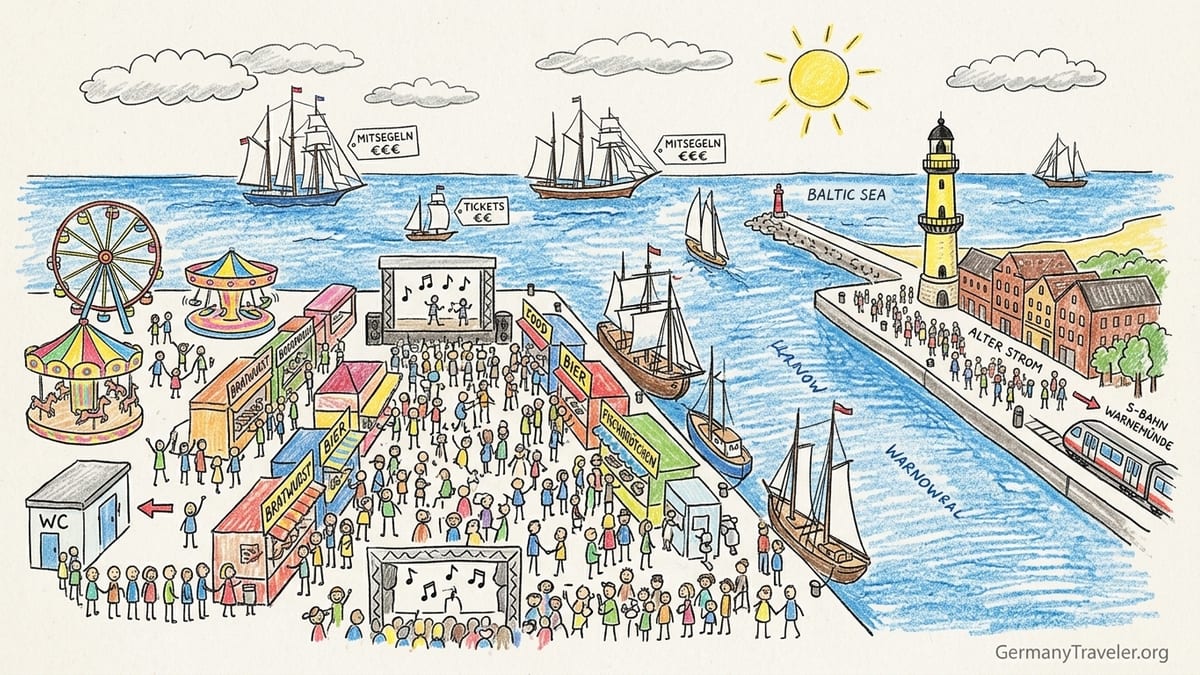
Looking ahead to Hanse Sail 2027, the overall framework remains the same. Stadthafen in central Rostock and the seaside district of Warnemünde will host open promenades, stages, rides and food stands. The real costs will show up in the accommodation premiums that weekend, the markups at waterfront stalls, and the hefty but tempting prices for day sails on historic vessels that are marketed as the ultimate way to “really experience” Hanse Sail. Free admission, in practice, becomes the starting point for a very expensive weekend if you do not plan carefully.
Understanding that contrast between open access and practical expense is the key to deciding whether Hanse Sail is actually a bargain break or a budget trap. To make that clear, it helps to look separately at what I actually encountered on the ground and what current information suggests for the 2027 edition.
My Hanse Sail Reality: Crowds, Queues And A Thin Maritime Core
My own Hanse Sail visit took place on a warm August Saturday, the festival’s peak. I arrived mid-morning at Rostock Stadthafen, convinced that a reasonably early start would let me stroll the quays before things became crowded. By midday, that illusion had evaporated. The main promenade by the water had become a slow-moving corridor where every second person stopped for photos, and it took several minutes just to cross from one side to the other through dense foot traffic.
Crowding shaped almost every basic experience. Queues at the better-known food stalls regularly stretched to 20 or 30 people, and even the more anonymous bratwurst stands often meant a 10 to 15 minute wait. The public toilets closest to the center of activity had lines out the door. Temporary festival toilets further back from the water were less overwhelmed, but they were heavily used and not pleasant after a few hours of continuous footfall in summer heat. I saw families giving up on a particular stall simply because managing restless children in a tightly packed queue took too much energy.
Noise was relentless rather than festive. Multiple stages at Stadthafen pumped out overlapping music, with bass lines colliding in the middle zones. Announcements from fairground rides cut across sea shanties from smaller maritime stages. It was difficult to find a genuinely quiet place to pause and look at the ships unless you retreated well away from the heart of the festival, at which point you also left behind most of the tall masts and historic hulls that had brought you there in the first place.
The maritime content in the core areas was also more diluted than the marketing implied. Yes, several tall ships and traditional vessels were moored along the quays and occasionally opened for short deck visits or ticketed sails. But large stretches of the waterfront were lined with beer tents, generic snack stands and fairground attractions that could have been transplanted from almost any German city festival. For every information board on shipbuilding or navigation, there seemed to be dozens of stalls selling sweets, cocktails or plastic toys. Hanse Sail felt, in those moments, more like a giant fair that happened to have ships in the background than a maritime heritage event shaping the entire experience.
Stadthafen Versus Warnemünde: One Festival, Two Difficult Worlds
Rostock’s Hanse Sail is officially a single event, but in practice it is split between two distinct zones: the Innenstadt Stadthafen along the Warnow river and the seaside district of Warnemünde at the river mouth and Baltic shore. On paper they are only several kilometers apart. On the ground during Hanse Sail, bridging the two can be logistically painful, especially for first-time visitors who expect to drift easily between both.
In my case, I began the day at Stadthafen and planned to head to Warnemünde late afternoon to watch ships entering and leaving the harbor between the piers. That simple plan collided with reality as soon as I tried to move. Road traffic around the harbor was already sluggish, and parking near Stadthafen felt fragile, so fetching the car to drive to Warnemünde meant risking losing my hard-won spot. I chose public transport instead, joining a stream of people walking to tram and S-Bahn connections.
The tram into the city center was already full. Transferring to the local train toward Warnemünde meant standing in a carriage packed with festival visitors, teenagers on a summer day out and beachgoers loaded with towels and inflatable toys. The journey is not long on paper, but the combination of crowding, heat and frequent stops made it feel far from relaxed. By the time I reached Warnemünde, I had already spent an hour just getting from one festival zone to the other, and I was not alone in stepping onto a platform that felt like a stadium concourse after a football match.
Once at Warnemünde, the contrast in atmosphere was striking. The Alter Strom promenade and the area near the lighthouse were again lined with food stands and stalls, but the spatial layout felt more spread out along the waterfront and beach. It was easier to step back, face the sea, and simply watch ships and ferries move past the piers. Crowding was still intense at peak times, but the availability of open sand and wider promenades made it marginally more breathable than the narrowest passages at Stadthafen. The practical trade-off, however, was clear. Unless you were based overnight in Warnemünde, attending headline events in both areas on the same day involved long, crowded transfers that ate into your festival time and patience.
The Real Numbers For 2027: Accommodation, Transport And Parking
For 2027, Hanse Sail is scheduled from Thursday 5 August to Sunday 8 August, again on the second weekend of the month. Official information continues to emphasize that entry remains free and that more than half a million visitors typically descend on Rostock and Warnemünde across the four days. That scale has direct consequences for accommodation and local transport that anyone budgeting a supposedly cheap trip needs to face early.
Checking hotel and guesthouse prices for recent August Sail weekends reveals a clear pattern. Simple two or three star hotels in central Rostock or near Stadthafen often rise into the range of around 140 to 200 euros per room per night when booked close to the event. In Warnemünde, waterfront hotels and guesthouses can easily list rooms above 200 euros per night for the festival period, even for fairly standard double rooms without sea view. Cheaper options exist further inland or in suburban districts like Lütten Klein, but these too often see increases compared with quieter weeks in June or late September.
Budget travelers sometimes turn to hostels and short-term rentals. Places such as simple hostels near the city or student guesthouses can list beds in dormitories from roughly 35 to 50 euros per night during high season, though availability during Sail weekend is limited and tends to disappear months in advance. Short-term apartments in Rostock’s inner districts and in Warnemünde are frequently advertised well over 100 euros per night once cleaning and service fees are included, especially when located within easy walking distance of the harbor or beach.
Transport costs also add up. Driving into Rostock during Hanse Sail means contending with temporary traffic management and highly sought after parking spaces near Stadthafen. Official advice in recent years has repeatedly pushed visitors toward park and ride options on the edge of the city, often costing a modest fee per day plus local public transport tickets to the center. Those determined to park close to the harbor often end up using commercial garages or private parking lots where day rates can approach the cost of a budget hotel night if you stay from morning to late evening. Public transport itself is not expensive by western European standards, but a couple, or a family adding day tickets for trams, S-Bahn and regional trains between Rostock and Warnemünde over several days, will quickly spend a noticeable sum before any food or paid sailing activity enters the picture.
Food, Drinks And The Price Of Simply Being There
The most immediate hidden cost at Hanse Sail during my own visit was food and drink. The concentration of visitors and the prime location along promenades created an environment where sellers did not need to compete for every customer. A simple Fischbrötchen, the classic Baltic fish roll, often sold for several euros, with higher prices at stands facing the water or at especially popular locations. Bratwurst, crepes, spiral potatoes and other fairground staples clustered in a narrow typical range above what you would pay at a supermarket grill.
The real escalation came from drinks. Soft drinks and bottled water from festival stands carried noticeable markups, and draft beer in plastic cups felt expensive once you translated the unit price into what you would pay for the same amount in a supermarket. For many visitors, a beer by the harbor is part of the charm. But repeat that ritual several times a day, add coffee stops and perhaps an evening cocktail, and food and beverage spending alone can exceed the cost of a mid-range hotel room across a long weekend.
Seating is a key pressure point that quietly drives consumption. Free benches with reasonable views of the ships are few and in constant demand. When I found one, it often filled immediately with people who clearly intended to stay. Covered seating is almost entirely tied to commercial stands or beer gardens, where it is awkward to occupy a table without ordering. On the day I visited, I repeatedly faced the choice between leaning against a railing in full sun or buying yet another drink to justify holding onto a small sliver of shade and a chair. For older visitors and families with children, the lack of truly public seating with backrests and shelter becomes more than a comfort issue and borders on exclusion.
For 2027, no radical shift in this pattern is signaled. The published festival concepts still emphasize long “Bummelmeilen” of stalls at Stadthafen and along Warnemünde’s waterfront. Free concerts on large stages remain part of the program, but they are surrounded by food and drink stands that form the practical infrastructure of watching. As long as you can stand for long stretches and are happy to picnic on the ground with provisions brought from a supermarket somewhere inland, you can control food costs. If you want anything resembling comfort within the festival footprint, you will end up paying repeatedly just to occupy space.
Paying To Sail: Priceless Experience Or Overpriced Add-On
Much of Hanse Sail’s marketing energy is directed at “Mitsegeln,” the chance to sail on board a traditional tall ship or heritage vessel. During my own visit, these offers were everywhere. Temporary ticket booths advertised short harbor cruises, afternoon trips along the coast and evening sails timed to fireworks. Prices varied widely depending on the ship and route, but the cheaper short harbor circuits were described by crews themselves as giving more of a “boat ride” than a real sailing experience.
Current booking portals and official Hanse Sail information for 2027 show that places on larger traditional sailing vessels typically cost in the rough region of several dozen euros per person for short trips of a few hours, rising to significantly more for half-day or evening fireworks cruises that include catering or open bar options. A family of four who decides spontaneously to take an evening sail on a well-known tall ship can easily spend a three-figure sum before even considering food on land that day. For many visitors this is a once in a lifetime expense, but it is a serious line in any realistic festival budget.
From a value perspective, there is no question that being on board a tall ship under sail in the Baltic at sunset is emotionally powerful. Feeling the deck move, watching the crew haul lines, and seeing other historic vessels cross your path at close range delivers a depth of maritime experience that standing on a crowded quay with a plastic beer cup simply cannot match. My own regret from my visit is that I tried to save money and ended up only watching from shore, most of the time through a forest of raised smartphones, with only brief glimpses of canvas and rigging between heads.
Yet comparison matters. Much of the spectacle of Hanse Sail takes place in relatively confined waters between Rostock and the Baltic, where tall ships must line up to enter, exit and maneuver past the Warnemünde lighthouse and harbor entrance. That choreography is spectacular even from land. If your budget is limited, positioning yourself early on the piers at Warnemünde or along less crowded stretches of Stadthafen to watch ships at a distance can still deliver a strong sense of scale and variety at essentially no extra cost beyond transport. The paid sailing experiences sharpen and deepen that encounter but are undeniably a premium layer rather than a necessary condition for enjoying maritime heritage.
What Really Feels Like Maritime Heritage, And What Feels Like A Fair
Hanse Sail promises contact with maritime history on land and at sea, but in practice only certain pockets of the festival truly deliver that. During my walk through Stadthafen, the most meaningful moments involved overhearing crew briefings on deck, listening to retired sailors explain details of rigging to curious children, and stepping into small exhibitions that traced Rostock’s development as a port city. These experiences were scattered, sometimes hidden behind rows of commercial stalls, but they grounded the event in something deeper than a seasonal party.
By contrast, much of what dominates the eye and ear at Stadthafen would not be out of place at any large European funfair. There are Ferris wheels and rides, generic pop and rock cover bands on busy stages, brand-name beer tents and loud sponsors’ areas that talk more about mobile phone tariffs or cruise lines than about navigation or shipbuilding. At times, walking through the densest parts of the harbor festival felt like passing through a commercial corridor where maritime heritage appeared mostly as a decorative backdrop on branded banners.
Warnemünde offered a slightly different balance. Watching ferries, cruise ships and tall ships moving in and out between the moles automatically anchored the experience in the here and now of seafaring. Even without formal interpretive boards, simply seeing how pilots transferred, how modern cruise ships dwarfed older hulls, and how the sea state changed during the day communicated something real about a working harbor and open water. Stalls selling smoked fish, maritime souvenirs and regional products felt more connected to that setting than many of the generic stands at Stadthafen, though the fairground element was still present.
For 2027, program materials again highlight tall ships, traditional seamanship displays and specific regattas as the heart of Hanse Sail. The challenge remains that these maritime elements compete for attention and space with commercial entertainment that is easier to monetize and easier to scale. Travelers hoping for an immersive educational festival of maritime culture need to be selective and prepared to walk past many stalls that add noise and expense but little heritage value.
Cost Scenarios: Day Visitor Versus Overnight Guest
To make the hidden costs concrete, it helps to sketch two rough scenarios based on current price ranges and my own spending patterns. These are not precise budgets but realistic orders of magnitude for Hanse Sail 2027 if you travel from within Germany or neighboring countries.
A day visitor driving in from within roughly 150 kilometers might set off early on a Saturday. Fuel for a round trip could easily run to around 40 to 60 euros at current prices, depending on vehicle and distance. Using a park and ride facility with public transport into the center might add 10 to 20 euros for parking and tickets for two adults. On site, buying snacks, a decent lunch and several drinks across the day for two people might comfortably reach 60 to 80 euros if most items come from waterfront stalls. Add a spontaneous short harbor cruise or one of the cheaper traditional ship trips at perhaps 30 to 40 euros per person, and the couple’s total spend for a single long day can end up around 180 to 250 euros without counting shopping or extra evening entertainment.
An overnight guest staying from Friday to Sunday faces a very different total. Two nights in a mid-range hotel in central Rostock may already consume 300 to 400 euros for a double room during Sail weekend, more if located in Warnemünde. Public transport or parking costs for local movement between Stadthafen and Warnemünde can add another 30 to 50 euros across the stay. Food and drink for two people at festival prices, even with one supermarket run or hotel breakfast included, is unlikely to fall below roughly 150 to 200 euros for the weekend if most main meals are eaten on site.
If that same couple also books one substantial paid sailing experience on a tall ship, perhaps a three to four hour afternoon or evening trip for two, they might easily add 150 to 250 euros depending on the vessel and included services. Souvenirs, occasional coffees and emergency purchases like sunscreen or rain ponchos push the total further upward. By the time they head home on Sunday, their “free” festival weekend may have cost in the region of 700 to well over 900 euros, comparable to a week of off-season travel in less hyped coastal regions.
These scenarios underline the fundamental point. Hanse Sail can be sampled cheaply if you live locally, bring your own food, use bicycles or regular public transport passes, and skip all paid trips. The moment you add distance, accommodation and the temptation to sail on the very ships you came to see, the budget escalates into the territory of a major holiday rather than a spontaneous free festival.
The Takeaway
Hanse Sail remains an extraordinary spectacle. There are few places in northern Europe where so many tall ships, traditional vessels and modern cruise ships converge against the backdrop of a historic Hanseatic city and a working Baltic harbor. My own visit delivered unforgettable visual moments, especially when masts cut across a late summer sky or a line of ships threaded through the narrow entrance at Warnemünde. But it also exposed a persistent gap between the image of a free, open maritime festival and the reality of a tightly commercialized event that depends heavily on your willingness to spend.
For travelers considering Hanse Sail 2027, the most effective cost reduction strategy begins with accommodation and timing. Booking an affordable room several months in advance, preferably outside Warnemünde’s premium waterfront but within easy reach of reliable tram or S-Bahn lines, can save hundreds of euros. Staying in districts slightly away from the core, such as residential neighborhoods north or west of Rostock’s center or well-connected suburbs, often provides cheaper rates while still allowing direct public transport to Stadthafen and the train to Warnemünde.
Using regional train or long-distance bus connections to reach Rostock and then relying on local public transport during the festival avoids the headaches and expenses of hunting for parking in congested harbor zones. Buying day tickets or small group tickets can reduce per person costs, especially for families moving between Stadthafen and Warnemünde more than once per day. Packing reusable water bottles, buying snacks and basic supplies from supermarkets away from the festival footprint, and treating on-site food stalls as occasional treats rather than default meals also delivers substantial savings without diminishing the maritime experience.
Finally, it is worth asking whether you need the full intensity of the peak Hanse Sail weekend at all. Smaller maritime events along the Baltic coast, and even the days immediately before or after the main Sail dates in Rostock, often provide quieter opportunities to see individual tall ships, visit maritime museums or join less crowded harbor tours. For some travelers, especially families with young children or visitors who prefer to actually hear the creak of rigging, these less hyped alternatives may deliver a richer connection to maritime culture than fighting through dense crowds during the festival’s loudest hours. Free admission is an attractive slogan, but the real value of a trip lies in how you shape your time and spending, not in the absence of a ticket at the gate.
FAQ
Q1: Is Hanse Sail 2027 really free to attend?
Yes, there is no entrance ticket or gate fee for the festival areas in Rostock Stadthafen and Warnemünde. However, you pay separately for accommodation, transport, parking, food, drinks and any sailing trips, which together make the overall visit far from free.
Q2: How crowded should I expect Hanse Sail to be?
Hanse Sail typically attracts several hundred thousand visitors over four days, with Saturday afternoon and evening the busiest. Expect very dense crowds along the main promenades, queues for food and toilets, and packed public transport between Rostock and Warnemünde during peak hours.
Q3: Is it worth staying in Warnemünde instead of central Rostock?
Staying in Warnemünde puts you close to the beach and harbor entrance where many ships pass, but accommodation prices are often significantly higher during Hanse Sail. Central Rostock offers slightly broader price options and faster access to Stadthafen, at the cost of a longer, sometimes crowded train ride to the seaside events.
Q4: How expensive are food and drinks at the festival?
Waterfront stalls usually charge noticeably more than supermarkets or inland snack bars. Simple meals, snacks and drinks across a full day can add up to a substantial amount, especially if you rely entirely on festival vendors. Bringing some food and using off-site bakeries or supermarkets can keep costs under control.
Q5: Do I need to book tall ship sailing trips in advance?
For popular ships and weekend afternoon or evening cruises, advance booking is strongly recommended. Some last minute tickets may be available on site, but choice and departure times are limited. Prices for these trips are high enough that they should be treated as a planned budget item rather than a casual impulse.
Q6: Can I enjoy Hanse Sail without paying for a boat trip?
Yes, many visitors simply watch the ships from the shore, especially along Rostock Stadthafen and at the piers in Warnemünde. You still experience the scale and atmosphere without the cost of a ticket, though sailing on board offers a deeper and more immersive encounter with maritime life.
Q7: What is the best way to move between Stadthafen and Warnemünde?
Using public transport is usually the most practical option, especially during peak times. Trams and trains are crowded but frequent, and they spare you the stress of searching for parking in both locations. Allow extra time for transfers, as trains can feel as busy as stadium shuttles during the festival.
Q8: Are there quieter times during Hanse Sail?
Mornings on weekdays and early on the Thursday often feel less crowded than Friday evenings and Saturdays. Visiting Stadthafen early, then heading to Warnemünde later in the afternoon, can sometimes balance crowds, though weather and specific program highlights also influence where people gather.
Q9: How can I reduce accommodation costs during Hanse Sail?
Book as early as possible, look at districts outside Warnemünde and the immediate harbor area, and consider basic guesthouses or hostels with direct tram or train connections. Staying a few kilometers inland often provides better rates while keeping reasonable access to both festival zones.
Q10: Would a smaller maritime event be a better choice for a relaxed trip?
For travelers who prioritize calm over spectacle, smaller harbor festivals or maritime weekends along the Baltic coast, or visits to Rostock and Warnemünde outside the main Hanse Sail dates, may offer more space, lower prices and easier access to ships without the intense crowds and commercial pressure of the peak festival days.