


Berlin does not have one “big” Christmas market. It has dozens, spread across palaces, neighborhood squares and even the Botanical Garden. For a first visit in 2026, the hardest part is not finding a market, but choosing just a few that feel different enough to justify your time. This guide treats Berlin’s Christmas markets as a standalone seasonal trip, helping you navigate dates, prices and transport so you can build a small but memorable line up rather than trying to collect ten nearly identical markets.
How the 2026 Berlin Christmas season works
VisitBerlin’s official overview confirms that the city’s main Christmas market season in 2026 begins around 22 November, with many of the classic markets starting between 23 and 24 November and running until just before or just after Christmas. Some winter events open earlier as pure winter attractions, such as the Winterwelt at Potsdamer Platz with its long snow slide, which usually starts at the end of October, so you can already get a taste of the season before the official market calendar begins.
The city’s tourism board maintains an updated Christmas markets page with a map and filters for dates and districts. In 2026 it lists key markets such as WeihnachtsZauber at Gendarmenmarkt (23 November to 31 December 2026) and the Spandau Old Town market (23 November to 22 December 2026), plus neighborhood events in almost every borough. The separate Berlin city portal also runs a detailed Christmas market directory and map for 2026 that is useful when you want to see what is open on a specific date instead of just a general list.
For palace and garden events, 2026 is also clearly defined. The Christmas market at Charlottenburg Palace is announced for late November to 27 December 2026, closing on Christmas Eve, while the illuminated Christmas Garden at the Berlin Botanical Garden runs even longer, from 18 November 2026 to 10 January 2027, on separately timed tickets. That makes Berlin one of the few German cities where a visitor between Christmas and New Year can still experience a substantial festive atmosphere without having to leave town.
Because dates, opening hours and entry rules can change, it is worth double checking each market’s official listing and, where relevant, the operator’s own website every year before you finalize an itinerary. Use this article as a framework for which kinds of markets to combine, then confirm the exact days and times for your 2026 travel window using VisitBerlin and the Berlin city portal.
The classic grand markets: Gendarmenmarkt and Spandau Old Town
If you want the archetypal big German Christmas market experience in Berlin, two names belong on your shortlist: WeihnachtsZauber at Gendarmenmarkt and the Spandau Old Town market. Both are confirmed for 2026, both feel substantial, and both are easy to combine with broader sightseeing.
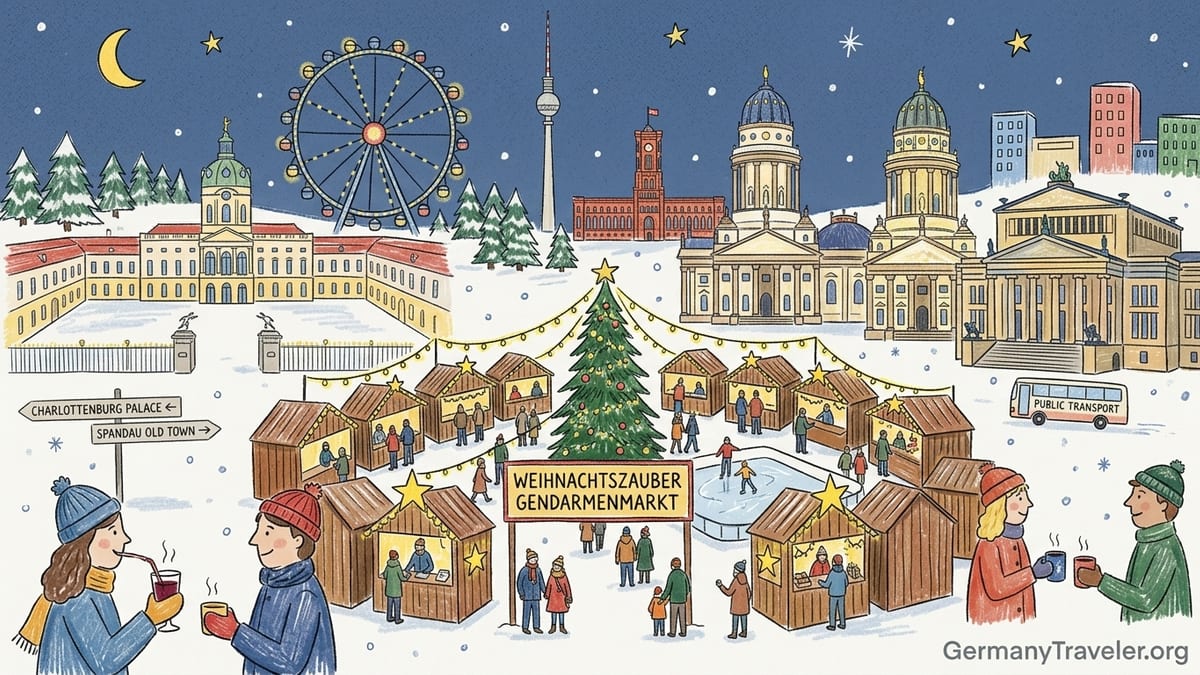
WeihnachtsZauber at Gendarmenmarkt calls itself the luxurious option among Berlin’s Christmas markets, set between the French Cathedral, German Cathedral and the Konzerthaus in one of the city’s most beautiful squares. The 2026 season at its current location near Gendarmenmarkt is scheduled from 23 November to 31 December. There is typically a small admission fee in the low single digits per adult in the late afternoon and evening, with free or cheaper entry at off peak times; families should budget a few euros per person and check the latest pricing shortly before their visit. On the market grounds you will find gourmet food tents alongside classic sausage stands, gloved glassblowers working on site and a stage program with choirs and small bands.
The Spandau Christmas market, officially listed for 23 November to 22 December 2026, transforms the pedestrian old town west of central Berlin into what VisitBerlin describes as one of the largest markets in the city. Narrow streets fill with traditional wooden stalls, and the main church square hosts a large Christmas tree and stage. There is no gate and no general admission fee to enter the streets, which can make it feel less curated than Gendarmenmarkt but also more relaxed and local, especially earlier in the day. The flip side is that it gets extremely busy on December weekends once darkness falls.
In both of these grand markets, food and drink prices in recent seasons have typically ranged around 4.50 to 6.50 euros for a standard mug of Glühwein and roughly 4 to 7 euros for a Bratwurst, depending on toppings and bread. A reusable mug deposit of 3 to 5 euros per mug is standard. Expect to pay by cash at many smaller stalls, although card acceptance is slowly improving. Weekday evenings from about 6 pm to 8 pm are the most crowded, especially from early December onwards. If you prefer more breathing room, aim for late afternoon on a Monday or Tuesday.
Logistically, the two markets sit at opposite ends of the S Bahn network. Gendarmenmarkt is walkable from Friedrichstrasse or Stadtmitte stations, right in the central Mitte district, and combines naturally with sightseeing at Museum Island or a shopping run along Friedrichstrasse. Spandau, by contrast, lies at the western edge of the city, reached by S Bahn and regional trains to Rathaus Spandau followed by a short walk into the old town. If you are in Berlin for three or four nights and want to experience two of the biggest markets, plan one evening around Gendarmenmarkt plus central Berlin, and another half day dedicated to Spandau, including the train ride.
Palace and historic settings: Charlottenburg and Rotes Rathaus
Berlin’s palace and historic markets provide a very different backdrop from the dense urban feel of central squares. The most striking is the Christmas market at Charlottenburg Palace, where the baroque facade of Berlin’s largest palace is lit with color washes and projections while wooden huts line the forecourt. The official listings show the market operating from the late afternoon of 24 November to 27 December 2026, with a break on 24 December. That means you can still visit between Christmas and New Year, a period when many other German markets are already dismantled.
At Charlottenburg, the emphasis is on atmosphere rather than sheer size. There are carousels and a small Ferris wheel for children, stalls selling carved wooden ornaments and wool products, and several heated tents where you can sit with a plate of roasted duck or käsespätzle away from the cold. Admission to the market area itself is generally free, though there is a separate ticket if you decide to tour the palace interiors during daytime visiting hours. Food and drink prices are in line with the larger central markets, but the combination of palace visit and market can make this a good value half day, especially if you use the time before sunset to explore the palace park and then enjoy the lights after dark.
In contrast, the long running Berliner Weihnachtszeit at the Rotes Rathaus, the red brick city hall near Alexanderplatz, offers a nostalgic funfair flavor. The 2026 edition, listed from late November into early January, wraps around the Neptune Fountain and city hall, with a large Ferris wheel that gives sweeping views over the TV Tower and historic core. A traditional style ice rink usually circles the fountain, and wooden stalls focus on hearty classics and sweets. There is no overall entrance fee, but you pay for attractions like the Ferris wheel and skate hire separately. The location just off Alexanderplatz station makes this one of the easiest markets to reach on the U Bahn and S Bahn, and it combines naturally with shopping in the surrounding malls.
If you want a palace or historic setting without spending all evening on transport, Charlottenburg and Rotes Rathaus pair well in a single trip of two or three nights. Charlottenburg works best as an afternoon and early evening outing, since the palace park closes later and the illuminations show up strongest once it is dark. Rotes Rathaus can then slot into a different evening when you want more rides and a stronger city feel. Both are suitable for families, though the Ferris wheel and ice rink at Rotes Rathaus make it especially appealing for children and teenagers.
Local neighborhood and medieval style markets
Beyond the showpiece markets, Berlin’s neighborhoods stage their own smaller Advent events that can feel much more local. These typically run only on Advent weekends in 2026 rather than daily across the season, and dates can shift each year, so it is important to use VisitBerlin’s calendar and the Berlin city portal to check the exact weekend you are in town. Examples include markets in Prenzlauer Berg, Neukölln and around churches in Wilmersdorf or Zehlendorf, often with school choirs performing and charity groups running food stalls.
These neighborhood markets tend to have modest stall numbers compared with the grand ones, but the atmosphere can be warmer and far less commercial. You are more likely to encounter homemade cakes, local honey and small ceramics sold directly by the maker. Prices can be slightly lower, with Glühwein sometimes closer to 3.50 or 4 euros and food portions priced with locals rather than tourists in mind, though inflation has pushed most offers toward similar ranges citywide. The main reason to include one of these markets in a short trip is to balance out the big, busy city center nights with something more low key, especially if you already plan to be in that part of town for other reasons.
Medieval style markets add another layer. Berlin often hosts at least one market with a deliberate Mittelalter theme, featuring costumed performers, open fire pits for grilling meat and mead served in clay mugs. These sometimes appear at the Zitadelle Spandau fortress or as pop up events on specific Advent weekends. In 2026, the exact host locations and dates are confirmed closer to the season, but the city’s Christmas market directories already indicate several medieval themed entries. Admission to these specialty markets may involve a small fee at the gate, particularly in fortress or cloister settings, though children often enter free or at a reduced rate.
If you are traveling with someone who is less interested in shopping and more in atmosphere, slotting in a medieval or neighborhood market can provide a welcome change of pace. Just remember that they run on tighter schedules than the daily grand markets. Build them into your Berlin plans only after you have checked the specific Advent weekend dates for 2026, and be ready with a backup plan like a central market in case of last minute changes or bad weather.
Design, craft and “alternative” markets
Berlin’s reputation for creativity shows up in a cluster of design and craft markets that orbit, rather than imitate, the traditional Christmas market formula. Some focus on local designers and sustainable gifts, others on street food and live music in repurposed industrial spaces. Instead of long rows of identical wooden huts, you might find curated stalls in a former factory hall or a pop up inside a cultural center, with DJs replacing brass bands.
One long running example is the Holy Shit Shopping design market, which in recent years has used event spaces in neighborhoods such as Neukölln. It typically appears on selected December weekends with an entrance fee per adult that is comparable to a small concert ticket, and then gives access to dozens of stands selling prints, jewelry, clothing and homeware from independent creators. Food and drink here are closer to standard Berlin street food pricing than to the heavy sausage and mulled wine focus of traditional markets, though you can usually still find a winter drink or two.
Other creative markets appear in cultural complexes and art centers in Friedrichshain, Kreuzberg or Mitte, usually branded as design, vegan or sustainability focused Christmas markets. The official city listings for 2026 highlight several of these, but dates are sometimes only announced a couple of months in advance. Expect opening hours concentrated around afternoons and early evenings on Saturdays and Sundays, with limited or no weekday operation. Inside, many stalls accept cards and contactless payments, and you are as likely to see specialty coffee and natural wine as Glühwein ladled from a traditional cauldron.
For a first time visitor, one design oriented event is enough. These markets are best if you are interested in Berlin’s creative scene anyway and want your Christmas market time to double as a shopping opportunity for gifts that feel more individual. They also pair logically with exploring their surrounding neighborhoods, whether that is a stroll along the Landwehr Canal or browsing independent shops in side streets that you would not otherwise visit.
Family friendly and modern winter attractions
Families with children or visitors who care more about lights and rides than about Christmas ornaments should treat Berlin’s winter attractions as a separate category from the traditional markets. The standout here is Christmas Garden Berlin, a ticketed light trail through the Berlin Botanical Garden in Dahlem that returns for its tenth anniversary season from 18 November 2026 to 10 January 2027. Visitors follow a signposted route through the grounds after dark, with millions of lights, music installations and occasional food and drink stops along the way.
Christmas Garden operates on timed entry slots, typically from late afternoon into the evening, and tickets must be bought in advance for a specific date and time. Current sales channels show a tiered pricing structure depending on weekday or weekend and on whether you book early or closer to the date. Adults can expect to pay in the low to mid twenties in euros for standard tickets, with discounted rates for children and families. Once inside, food and drinks are priced somewhat above everyday Berlin street prices, reflecting the event’s production costs, and many stalls accept cashless payments. There is no reusable mug system in the same sense as at city markets, since cups are often paper or compostable, but you should still expect environmental rules about waste and recycling.
Within the city, several winter events reinforce the family focus. The Berliner Weihnachtszeit at Rotes Rathaus includes a sizable ice rink around the Neptune Fountain and a mix of traditional rides that can keep children entertained for hours, all in one contained area. Admission to the grounds is free, while rides and skate rental are charged individually, so families can adjust spending by limiting the number of attractions. The Winterwelt at Potsdamer Platz, running from late October through much of the Advent period, adds another layer with a long snow slide and curling lanes. It is not a Christmas market in the strict sense, but it complements them by offering winter sport style activities in the heart of the city.
When you plan a child friendly Berlin Christmas itinerary, the main question is stamina rather than quantity. One major market or light event per day is usually enough for younger travelers, especially in cold or wet weather. A day might combine a museum or indoor attraction in the morning, a warm lunch, then an afternoon and early evening at Rotes Rathaus or Christmas Garden, with plenty of breaks for hot chocolate along the way. If you are staying near central stations like Zoologischer Garten or Alexanderplatz, this structure also keeps journeys short and predictable.
Prices, deposits, crowds and public transport
Across Berlin’s Christmas markets in recent seasons, visitors have noticed significant price increases in food and drink, driven in part by energy and staffing costs. As of late 2025, reports from locals at medium priced markets such as the Lucia market in Prenzlauer Berg reference Glühwein starting around 4.50 to 5 euros and moving higher at premium venues, with Bratwurst and other hot snacks in a comparable band. For 2026, it is reasonable to expect most central Berlin markets to charge roughly 5 to 6.50 euros for a standard mulled wine and similar for a sausage or portion of fries, with higher prices for specialty drinks like Feuerzangenbowle.
Reusable mug deposits are standard at traditional markets, both for environmental reasons and to reduce litter. The deposit, which you get back when you return the mug, usually ranges from 3 to 5 euros per mug and may be higher at more upmarket markets to encourage returns. Some mugs are designed as souvenirs with the year and market name printed on them, and many visitors simply keep one and forfeit the deposit as a cheap and practical keepsake. At light events such as Christmas Garden, where drinkware may be disposable, you will instead see separate waste and recycling systems and possibly higher base prices that bundle in those costs.
Berlin’s markets are busiest once locals finish work. On weekdays, crowd levels spike between about 6 pm and 8 pm, especially on Thursdays and Fridays in early and mid December. Saturdays from mid afternoon into the evening are the most intense, with some markets operating one in, one out systems at peak times to avoid dangerous overcrowding. If you dislike dense crowds, prioritize visits from opening time in the late morning or early afternoon on Monday to Wednesday. Markets like Charlottenburg and Gendarmenmarkt feel very different at 3 pm on a Tuesday compared with 7 pm on a Saturday.
The city’s public transport is one of the main advantages of a Christmas trip to Berlin. S Bahn and U Bahn lines knit together most of the key markets without the need for cars. Charlottenburg Palace lies a short bus or walk from Westend and Jungfernheide area stations, Gendarmenmarkt sits near Stadtmitte and Hausvogteiplatz, and Rotes Rathaus is steps from Alexanderplatz. Trams help link neighborhoods in the east for local markets. You can use a day ticket or multi day ticket for unlimited travel within the central zones, which makes it easy to visit one market in the afternoon and another in the evening without thinking about individual fares.
Whether weekends are worth the crowds depends on your priorities. If you care most about ambiance, choir performances and the feeling of being in the middle of a festive city, then a Saturday evening at Gendarmenmarkt or Spandau can be unforgettable, provided you are prepared for tight spaces and lines for food and toilets. If you are more interested in tasting specific foods, browsing craft stalls or photographing the lights, a calmer weekday visit might actually fit your goals better. Many first time visitors do one weekend evening to experience the full buzz, then schedule their other market visits for quieter times.
How many markets are “enough” and smart combinations
With over a hundred markets listed citywide in 2026, it is easy to overprogram a trip and end up shuffling between stalls that all blend together. For a first time visit of three to four nights, a realistic sweet spot is two or three main markets plus, optionally, one winter attraction like Christmas Garden. That gives you enough variety in setting and atmosphere without turning your stay into a checklist exercise.
Think in terms of experiences rather than numbers. One classic grand market, one special setting, and one modern or alternative event will already cover a lot of ground. For example, a strong three part combination for many travelers would be WeihnachtsZauber at Gendarmenmarkt for the archetypal city square feel, Charlottenburg Palace for the palace backdrop, and either Christmas Garden at the Botanical Garden or Berliner Weihnachtszeit at Rotes Rathaus for lights and rides. This line up balances food, crafts, rides and pure atmosphere, and it spreads your evenings across different corners of the city.
Geography matters when your days are short and the weather is cold. Pair central markets that you can walk between in one evening: Gendarmenmarkt, Rotes Rathaus and the smaller market near the Kaiser Wilhelm Memorial Church can be threaded together over three or four hours without excessive transit, with warming stops in cafés or shopping centers in between. On another day, dedicate your late afternoon and evening to Charlottenburg, combining a museum visit or walk in the palace park before dusk with market time after dark. Christmas Garden, located in Dahlem, is best treated as a stand alone evening because of its scheduled entry slots and the time required to complete the loop.
If you are in Berlin for only two nights, choose quality over quantity. A compact but diverse plan might be Gendarmenmarkt on your first evening, then Charlottenburg Palace the next, with a quick stop at Rotes Rathaus or Alexanderplatz market if you have an hour to spare before or after. Even in a week long Berlin stay, you will likely find that three or four substantial markets feel sufficient, leaving space for museums, cafés, neighborhoods and indoor time to thaw out between outdoor sessions.
The Takeaway
Berlin’s Christmas markets in 2026 are less a single attraction and more a season long tapestry of events. The official calendar shows markets starting around 22 November, with showpiece venues like Gendarmenmarkt, Spandau and Charlottenburg Palace offering daily or near daily openings through much of Advent, and light events such as Christmas Garden stretching well into January. That breadth means you can shape your own version of a Berlin Christmas break instead of following a fixed template.
To make the most of it, start by identifying the experiences that matter most to you. If you want one classic, one historic and one modern or alternative market, Berlin can provide that within a compact radius using only public transport. A tight, considered itinerary of two or three different markets will feel richer than a breathless dash through every cluster of wooden huts you see. Factor in realistic budgets for food and drink, plan at least some visits for quieter weekdays, and be willing to adjust if the weather turns.
Above all, remember that the markets are only one part of Berlin in winter. Galleries, museums, cafés and music venues remain open when the stalls close for the night. Use the markets as a festive thread that runs through your days in the city rather than as the entire fabric of the trip, and you will come away with a clearer, warmer memory of Berlin at Christmas than any checklist of ten nearly identical markets could provide.
FAQ
Q1. When do the main Berlin Christmas markets run in 2026?
Most major markets open around 23 or 24 November 2026 and run until just before or just after Christmas, with some, such as WeihnachtsZauber at Gendarmenmarkt and the Charlottenburg Palace market, scheduled through late December, and Christmas Garden at the Botanical Garden continuing until 10 January 2027.
Q2. How many Christmas markets should I plan to visit on a short trip?
For a first visit of two to four nights, plan on two or three substantial markets plus, optionally, one winter attraction like Christmas Garden, rather than trying to visit every market in the city.
Q3. Which Berlin Christmas markets are best for a classic “grand” market experience?
WeihnachtsZauber at Gendarmenmarkt and the Spandau Old Town Christmas market both offer large scale settings with extensive food, drink and craft options, strong lighting and daily operation through most of Advent.
Q4. Is the Charlottenburg Palace Christmas market worth the trip from central Berlin?
Yes. The illuminated baroque palace backdrop, combination of traditional stalls and heated tents, and the chance to combine a palace visit with the market make Charlottenburg a standout, even though it requires a short S Bahn and bus journey from the city center.
Q5. How expensive are food and drinks at Berlin Christmas markets in 2026?
Based on recent seasons and current price trends, expect to pay roughly 5 to 6.50 euros for a standard mug of Glühwein and a similar range for a Bratwurst or comparable snack at central markets, with a separate reusable mug deposit of around 3 to 5 euros.
Q6. Are weekends too crowded to enjoy the markets?
Saturday evenings in December are very busy and can feel overwhelming at the most popular markets, but many visitors still enjoy the lively atmosphere. If you prefer space and shorter lines, visit on weekday afternoons or early evenings and save only one weekend night for the full crowd experience.
Q7. Which markets are best for families with children?
Berliner Weihnachtszeit at Rotes Rathaus, with its Ferris wheel and ice rink, the Winterwelt at Potsdamer Platz with its slide and activities, and the Charlottenburg Palace market with its carousels all work well for families, while Christmas Garden offers an atmospheric light walk suitable for older children.
Q8. Do I need cash, or can I pay by card at Berlin’s Christmas markets?
Many larger and more modern stalls now accept cards and contactless payments, but a significant number of smaller food and craft stands remain cash only, so it is sensible to carry enough euros for an evening’s worth of snacks, drinks and deposits.
Q9. How should I use public transport to get between markets?
Buy a day or multiday travel ticket covering the central zones and use the S Bahn and U Bahn to link areas such as Alexanderplatz, Gendarmenmarkt and Charlottenburg, adding trams or buses where needed. Most major markets sit within a few minutes’ walk of a station, so there is rarely any need for taxis.
Q10. What happens if the weather is bad during my planned market visit?
If heavy rain or snow makes an outdoor evening less appealing, shift your focus to indoor attractions during the worst of the weather, then visit a nearby central market for a shorter session once conditions improve, or prioritize markets with heated tents such as Gendarmenmarkt and Charlottenburg.