


The Berlin Wall no longer exists as a single continuous structure, and there is no one "Berlin Wall attraction" you can visit. Instead, fragments, memorials, museums and open-air galleries are scattered across the city. That makes Berlin fascinating, but it also means first-time visitors often confuse very different sites. This guide explains what each major Berlin Wall location actually offers today and helps you choose the right combination for your time, interests and energy.
Understanding Today’s Berlin Wall Landscape
The physical Berlin Wall stood from 1961 until most of it was demolished after 1989. What survives is a patchwork. In some places you see original inner and outer walls with the former death strip between them. In others there is only a single wall, a line of cobblestones in the pavement, or a modern art mural painted on the remaining concrete. A few checkpoints have been carefully interpreted as memorial sites, while others are dominated by souvenir shops and fast-food outlets.
This scattered legacy is deliberate. Berlin’s authorities developed a “overall concept” for remembering the Wall that keeps different types of sites distinct. Bernauer Straße is the main historical memorial with preserved border architecture. The East Side Gallery is an art monument on a long surviving stretch of wall. Around Checkpoint Charlie the emphasis has largely shifted to commercial tourism, while nearby institutions such as the Topography of Terror and the Tränenpalast explain dictatorship, surveillance, and everyday border crossings.
As a result, no single location can tell you everything. A visitor who spends an hour among the murals of the East Side Gallery but never sees Bernauer Straße will come away with a distorted idea of what the border actually looked like. Someone who only visits Checkpoint Charlie and its souvenir stands may leave thinking the Wall has been reduced to costumes and coffee mugs. The key is to match specific sites to what you most want to understand: how the border system functioned, how it looked, how it felt, or how it has been remembered and commercialized.
In practice, this means planning your Berlin Wall time across at least two sites, and understanding that it is impossible to “do the Wall” in a single stop. The following sections break down the main locations by the kind of experience they offer and give concrete suggestions for routes that make sense on the ground.
Best Place to Understand How the Wall Worked: Berlin Wall Memorial, Bernauer Straße
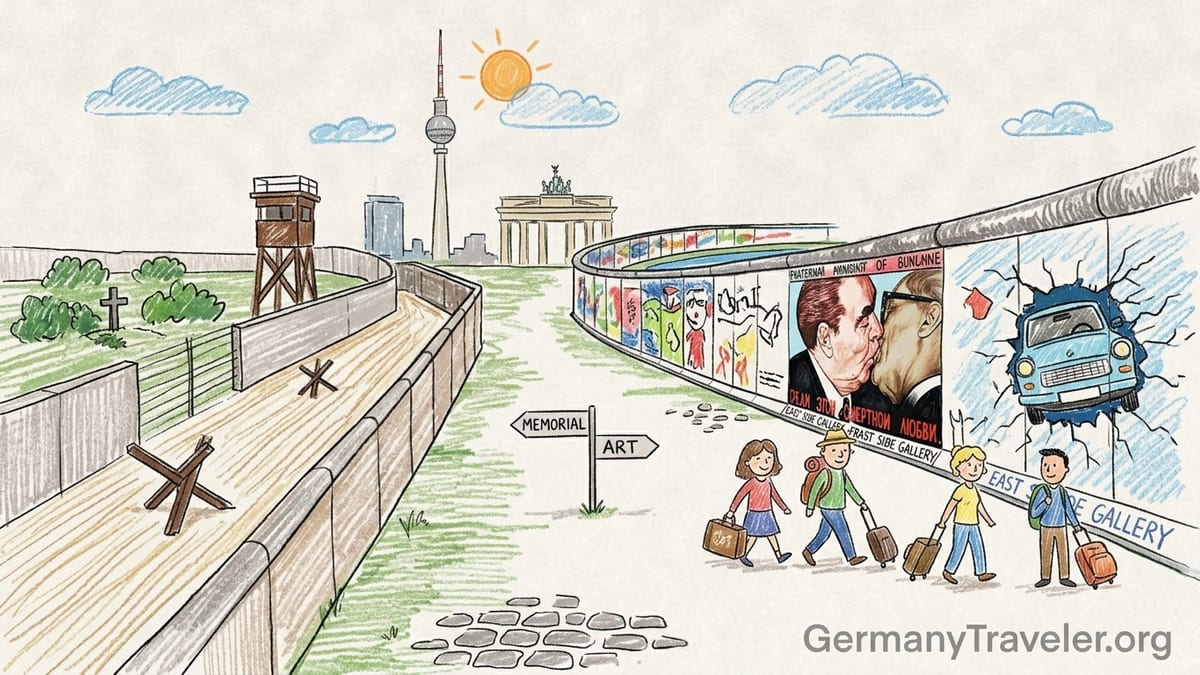
If you want to grasp how the border system actually functioned, the Berlin Wall Memorial on Bernauer Straße is the most important single site to visit. The city’s official tourism organization recommends it as the key place to understand the border strip, and it was intentionally developed as the central memorial to German division. Along several blocks you see the former border area interpreted in layers: preserved and reconstructed segments of the inner and outer walls, the patrol road, watchtower, anti-vehicle obstacles and green space where the death strip once ran.
The memorial consists of an outdoor historical site and several indoor elements. There is a visitor center at the Nordbahnhof end that introduces the history of the Wall and the events on Bernauer Straße, including tunnel escapes and fatal escape attempts. A documentation center further along the street contains a tower-like viewing platform where you look over an intact section of the border strip that has been kept much as it looked before 1989. Exhibition panels explain details that are easy to miss at street level, such as the security lighting, signal fences and raked sand strips that captured footprints.
Budget-wise, the site is straightforward. Walking the outdoor memorial is free, the visitor center and documentation center are free, and you do not need a ticket to use the observation tower. That makes Bernauer Straße an excellent choice if you want a deep experience without worrying about admission fees. Realistically you should plan 1.5 to 2 hours here, which is also the time frame VisitBerlin suggests. That allows you to watch the introductory film, walk the memorial grounds in both directions, climb the viewing platform and spend time reading panels without feeling rushed.
Logistically, Bernauer Straße combines well with central sights. You can reach the memorial via Bernauer Straße or Nordbahnhof stations on the U-Bahn or S-Bahn. From Nordbahnhof, a signed route leads through a small park that overlays the former border to the documentation center. From the memorial, it is a direct tram or bike ride down into Mitte and toward the Topography of Terror and Checkpoint Charlie, which makes it a logical starting point for a half-day or full-day history route.
Best Preserved Original Sections: Topography of Terror and Other Fragments
Several places in Berlin preserve substantial original Wall segments, but they serve different purposes. Historically minded travelers should know that the longest coherent stretch is at the East Side Gallery, although its visual impact is shaped by colorful murals. If you want to see raw, mostly unpainted concrete with the scars of time, the Wall segment at the Topography of Terror is more suitable. This roughly 80-meter length runs along the edge of what used to be the Gestapo and SS headquarters near today’s Niederkirchnerstraße.
At the Topography of Terror you walk beside the Wall at street level and can see how thin the individual panels are, how the reinforcing steel has rusted at the top, and how the structure compares to photographs from the 1970s and 1980s. Behind the wall trench-like excavations reveal the cellars of Nazi-era buildings, which underlines how layers of dictatorship overlap at this site. Inside, a free permanent exhibition traces the rise and functioning of the SS and Gestapo. Plan at least 60 to 90 minutes if you want to read a good portion of the exhibition; many visitors who only skim the panels stay about 45 minutes.
Smaller original fragments dot the city. Near Potsdamer Platz, several panels stand on a traffic island where the Wall once cut across one of Berlin’s busiest squares. Around the government district, a memorial known as the “White Crosses” remembers people who died crossing the border. Many streets mark the former course of the Wall with a double line of cobblestones that you literally walk across without noticing unless you know to look for it. These are worth keeping an eye out for, but they are not destinations on their own if you have limited time.
In practice, Topography of Terror fits well into a walk that also includes Checkpoint Charlie, Potsdamer Platz, and the Memorial to the Murdered Jews of Europe. The museum and outdoor grounds are free, and the site is located between two U-Bahn stations, making it easy to drop in even on a tight schedule. If you are already heading to Checkpoint Charlie, adding Topography of Terror gives you an original Wall fragment and a much richer historical context for roughly an extra hour on foot.
Best for Art and Atmosphere: East Side Gallery
The East Side Gallery in Friedrichshain is the Berlin Wall site that appears most often on social media feeds. Official visitor information notes that at around 1.3 kilometers in length, it is the longest continuous surviving section of the Wall, and more than 100 artworks by artists from many countries cover its river-facing side. The gallery stands where the outer wall once ran along the Spree, between Ostbahnhof and the Oberbaumbrücke bridge, and has been a listed monument for years.
This is not a place to understand the technical workings of the border. The former death strip inland from the river has largely been redeveloped with offices, event spaces and apartments. Instead, the East Side Gallery is about what happened to the Wall after 1989. Artists began painting here soon after the border opened, and the murals from the early 1990s captured both euphoria and political commentary. Famous images include the “fraternal kiss” between East German leader Erich Honecker and Soviet leader Leonid Brezhnev and a Trabant car seemingly crashing through the concrete.
A visit here normally takes 60 to 90 minutes if you walk the full length, pause for photos, and maybe sit on the riverbank. There is no admission fee or gate; it is simply a public riverside path, which makes it busiest on mild evenings and weekends. The area around Warschauer Straße is full of bars, clubs and casual restaurants, so an early-morning or late-afternoon stroll fits well with a day that continues into Friedrichshain’s nightlife. Families often combine it with a stop at nearby urban beaches or playgrounds along the river.
The East Side Gallery works especially well as a contrasting second site after Bernauer Straße or Topography of Terror. First, you absorb the sober, carefully curated history at the memorial. Later, you see how that same infrastructure turned into a giant open-air canvas and backdrop for selfies, concerts, and summer strolls. For many first-time visitors, this contrast makes the abstract idea of “memorialization” versus “commercial reuse” suddenly tangible.
Best for Context and Museums: Topography of Terror and Allied Museums
Several institutions in Berlin focus less on the Wall as a physical object and more on the political and social forces behind it. The most central of these is the Topography of Terror, already mentioned for its preserved Wall segment. Its indoor exhibition traces the machinery of terror under National Socialism and explains how the SS and Gestapo persecuted opponents and minorities. While not about the Berlin Wall itself, it gives essential background on how quickly state power can close borders and monitor citizens, which resonates with the later East German security state.
Close to Checkpoint Charlie, the privately run museum in the Haus am Checkpoint Charlie and smaller exhibitions such as the BlackBox Cold War offer detailed displays on escape attempts, espionage stories and the logic of confrontation between East and West. These charge admission, and adult ticket prices are usually in the low double-digit euro range. Visitors who enjoy dense panel text, original objects and reconstructions of escape devices tend to find this compelling, while those who prefer concise storytelling may feel overwhelmed. It is worth checking current visitor reviews or walking through the foyer before committing your time and money.
Elsewhere in the city, the Allied Museum in the Dahlem district documents the role of the Western Allies in Berlin, including the Berlin Airlift and the years when the city was a Western enclave deep in East German territory. For travelers staying several days or especially interested in Cold War aviation and intelligence work, it offers depth that the central Wall sites do not. However, it lies outside the usual first-visit walking routes, so it is better for a second or third day when you are comfortable using buses and the U-Bahn to reach residential neighborhoods.
As you choose among these, consider how much reading and museum time you actually enjoy. A concentrated 90 minutes at Topography of Terror and one additional focused museum can be more rewarding than trying to rush through several exhibitions in a single afternoon. Many travelers find that two substantial history museums in one day lead to “panel fatigue” where important details blur together.
Best Place to Feel a Checkpoint: Checkpoint Charlie and Tränenpalast
Checkpoint Charlie, at the intersection of Friedrichstraße and Zimmerstraße, was once the most famous crossing between the American and Soviet sectors. Today, little of the original border infrastructure survives on the street itself. The guard hut in the middle of the road is a replica, and uniformed figures posing for photos are hired performers. The immediate surroundings are dense with souvenir shops, quick-service restaurants and displays claiming some link to the Wall. This is the clearest example of how a site of geopolitical tension has been commercialized in the decades since.
That does not mean Checkpoint Charlie is not worth seeing. It remains a powerful geographical reference point. Old photographs of American and Soviet tanks facing each other in 1961, or of diplomatic cars crossing the border, make more sense when you are standing where they were taken. Outdoor information panels on nearby sidewalks tell the checkpoint’s story reasonably well at no cost, so a short stop of 20 to 40 minutes fits nicely into a walk between Gendarmenmarkt, Potsdamer Platz and the Topography of Terror.
For a more authentic sense of what crossing felt like, the Tränenpalast, or “Palace of Tears,” at Friedrichstraße station is much more evocative. This glass departure hall served as a border control building where East Germans said goodbye to relatives leaving for West Berlin. Today it houses a permanent exhibition about everyday life in the East German dictatorship and the emotional reality of border controls. The museum’s official information confirms that admission is free, and exhibits include original passport control booths, luggage, and personal stories recorded from people who used the crossing.
A good approach for many visitors is to briefly visit Checkpoint Charlie to understand its location and symbolic value, then invest real time at the Tränenpalast. Because both are central and linked by public transport, you can comfortably see Checkpoint Charlie, walk to the Topography of Terror, then take the U-Bahn or a short bus ride north to Friedrichstraße station for the Tränenpalast in a half-day outing.
Best for Cycling: Berlin Wall Trail and Inner-City Segments
For travelers who like to explore by bike, the Berlin Wall Trail, or Berliner Mauerweg, is one of Europe’s most distinctive urban routes. This signposted path follows the former border for roughly 160 kilometers around the old outline of West Berlin. About 50 kilometers run through the city, and the remainder pass through lakes, forests and suburbs where the border once split villages and fields. Information boards along the way explain local escape attempts, watchtowers and demolished border villages.
For most visitors, riding the entire loop is not realistic unless you devote two or three dedicated cycling days. A more accessible option is to use inner-city segments as a moving framework for your Wall visits. One popular stretch is the roughly 15-kilometer route that connects the Berlin Wall Memorial on Bernauer Straße with the government district, Potsdamer Platz, and eventually the East Side Gallery along the river. Local tourism brochures point this out as a compact “Wall route” for casual riders, and numerous bike tour companies offer guided versions of a similar itinerary.
Renting a standard city bike in Berlin is straightforward. Many rental shops and hotel desks offer day rates that are often in the 12 to 20 euro range for basic bikes, with e-bikes costing more. Online bike-sharing schemes also operate across the city, though their per-minute pricing can become more expensive over a full day. The Berlin public transport system allows bikes on S-Bahn and regional trains with a bike ticket, which makes it easy to ride one segment of the trail and then shortcut back to your hotel by rail.
If you are not used to riding in big cities, focus on the Mauerweg segments that use separate paths or quiet streets. The corridor between Bernauer Straße and the government district, for example, is mostly on dedicated routes where you share space with pedestrians and other cyclists rather than cars. It is entirely feasible for an active traveler to combine Bernauer Straße, the Brandenburg Gate, Potsdamer Platz, Topography of Terror and the East Side Gallery in one gently paced day by bike, with frequent stops and a café lunch along the way.
How Much to See in One Day: Avoiding Wall Overload
Because the Wall is tied to so many emotionally heavy stories, it is easy to over-schedule yourself. A common mistake is to try to “see all the Wall things” in a single day. On a map, Bernauer Straße, Checkpoint Charlie, Topography of Terror, Potsdamer Platz, the Tränenpalast and the East Side Gallery do not seem too far apart, but each involves dense information, personal stories and architectural details that take time to absorb. After two or three intense sites, many people feel emotionally saturated and stop taking in details.
A more realistic approach is to plan a coherent narrative for each half-day and leave room for breaks in parks or cafés. For instance, you might dedicate one morning to understanding the border’s physical structure at Bernauer Straße, then spend the afternoon on lighter experiences such as the East Side Gallery and a relaxed walk across the Oberbaumbrücke into Kreuzberg for dinner. On another day, you could start with Topography of Terror, walk to Potsdamer Platz and the Brandenburg Gate, then end with a short stop at Checkpoint Charlie and an evening visit to the Tränenpalast.
Time estimates help. For a first visit, plan approximately 1.5 to 2 hours at the Berlin Wall Memorial, 1 to 1.5 hours at the East Side Gallery, 1 to 1.5 hours at Topography of Terror, 30 minutes at Checkpoint Charlie’s outdoor displays, and 1 to 1.5 hours at the Tränenpalast. Even with optimistic walking times, that adds up to a very long and draining sightseeing day. Choosing three substantial stops and one quick look is usually more rewarding than trying to tick every box.
Geographically sensible combinations cut back on transit time. Bernauer Straße lines up neatly with the government district and Brandenburg Gate if you walk or cycle along the former border. Topography of Terror and Checkpoint Charlie are only a few minutes apart on foot. Friedrichstraße station and the Tränenpalast sit one or two S-Bahn stops from the Brandenburg Gate and Hackescher Markt. The East Side Gallery clusters naturally with Ostbahnhof and Warschauer Straße, which are both well connected by S- and U-Bahn. Thinking in terms of these clusters rather than individual spots makes your day feel like a story instead of a checklist.
Suggested Half-Day and Full-Day Berlin Wall Routes
For a flexible half-day introduction focused on understanding the Wall plus one contrasting site, start at the Berlin Wall Memorial on Bernauer Straße. Spend at least 90 minutes there, beginning at the visitor center near Nordbahnhof, watching the introductory film if it is playing, and then walking south along the memorial path. Climb the viewing tower in the documentation center to see the preserved border strip from above, then continue along the outdoor exhibits.
From Bernauer Straße, make your way by tram, bike or a 30-minute walk into central Mitte and onward to the East Side Gallery. If you are cycling, follow segments of the Mauerweg through the government district and past the Spree, then continue along the river toward Ostbahnhof. On foot, you can use the S-Bahn from Nordbahnhof to Ostbahnhof, then walk the 1.3 kilometer gallery at your own pace. Allow around 60 to 90 minutes there, depending on how many murals you want to photograph and whether you stop for a drink or snack by the water.
For a full-day history route, build a loop that connects four core experiences without feeling frantic. Begin again at Bernauer Straße in the morning while your energy and attention are high. Around midday, head toward the government district and Brandenburg Gate along the former border, either on foot or by bike. This gives you a sense of how central landmarks ended up on the front line between East and West. Continue to Potsdamer Platz and the Topography of Terror, where you can spend 60 to 90 minutes inside the exhibition and walking the outdoor grounds.
From Topography of Terror, walk to Checkpoint Charlie for a short street-level impression and to orient yourself at this emblematic crossing. After a quick look at the replica hut and outdoor panels, take public transport north to Friedrichstraße station for the Tränenpalast. Ending the day here brings the story down from high politics to individual families, with letters, luggage and recorded memories that personalize what you have seen elsewhere. If you still have energy after that, an evening stroll along Unter den Linden or a relaxed dinner in nearby side streets lets your impressions settle.
Memorialization vs Tourist Commercialization
One of the most striking aspects of visiting Berlin’s Wall sites in 2026 is how differently the city has chosen to remember and reuse its border landscape. At Bernauer Straße, the emphasis is firmly on memorialization. The grounds are largely free of commercial activity, signage is restrained, and the Berlin Wall Foundation curates exhibitions that foreground victims, escape attempts and local residents’ experiences. You will find a modest bookshop and café nearby, but the overall tone is contemplative. Information boards often highlight individuals by name, which makes the statistics of border deaths uncomfortably real.
The East Side Gallery, although protected as a monument, exists in a more ambiguous space. It is both memorial and Instagram backdrop. Efforts have been made to restore original artworks and protect them from graffiti, and plaques acknowledge the participating artists and the context of 1990. At the same time, people pose in front of famous murals with coffee cups and rental scooters, and souvenir stalls nearby sell miniatures of the Trabant car and East German traffic-light figures. The riverbank has turned from militarized border to leisure space, and the Wall functions partly as a decorative backdrop.
Checkpoint Charlie represents the far end of the commercialization spectrum. Here, commercial leaseholders and private operators dominate what visitors see first: themed cafés, fast food, large advertising boards and paid-photo opportunities. Historically serious institutions exist nearby, such as the Checkpoint Charlie Museum and other exhibitions, but at street level it can be hard to distinguish between carefully curated history and kitschy reproductions intended mainly to sell tickets and souvenirs. This does not make a visit illegitimate, but it is important to arrive with calibrated expectations and to pair the stop with at least one site where the city government and memorial foundations control the narrative.
Recognizing this spectrum helps you interpret what you are seeing. When you stand in front of a stretch of Wall covered in murals, ask whether the primary message is political memory, contemporary street art, or a mix of both. When you see actors in border-guard uniforms charging for photos, consider how that image contrasts with the sober photographs of real border guards and escapees at Bernauer Straße or the Tränenpalast. These moments of comparison are often what visitors remember most once they leave Berlin.
The Takeaway: Choosing One, Two or Three Wall Sites
Most first-time visitors do not have the time or emotional bandwidth to visit every Berlin Wall site. That is not a problem. The key is to choose a small number of places that match your interest and energy. If you only have time for a single site, the Berlin Wall Memorial on Bernauer Straße is the best all-round choice. It shows the structure of the border, honors those who died, and tells the story at street level and from above, all for free and without commercial distraction.
If you can manage two sites, pair Bernauer Straße with either the East Side Gallery or Topography of Terror. Choosing the East Side Gallery gives you the contrast between the functioning border and the wall-as-canvas in today’s city life. Choosing Topography of Terror adds deeper context about dictatorship and repression and includes a strong original wall segment alongside the exhibition. Both combinations fit into a relaxed day with a lunch break and time for reflection.
With time for three Wall-related stops, a balanced trio might be Bernauer Straße, Topography of Terror, and the Tränenpalast. This sequence lets you see the border’s physical structure, understand state repression during the Nazi period and how it set patterns for later surveillance, and then feel the human reality of separation in the departure hall at Friedrichstraße station. Alternatively, if you prefer more outdoor time and art, you could choose Bernauer Straße, the East Side Gallery and a short stop at Checkpoint Charlie, ideally by bike along segments of the Berlin Wall Trail.
Whatever you choose, remember that you are not just collecting sights. You are moving through a city that has consciously reshaped its former death strip into parks, paths and places to linger. Giving yourself enough time at each stop to read a few panels, look around, and imagine what stood there a few decades ago will leave a much stronger impression than any attempt to sprint from panel to panel in a single overloaded day.
FAQ
Q1. If I only have one afternoon in Berlin, which Berlin Wall site should I prioritize?
For a single afternoon, the Berlin Wall Memorial on Bernauer Straße is the strongest choice. It combines preserved and reconstructed wall segments, a clear explanation of the border system, and moving personal stories, all on one coherent site with free admission.
Q2. How long should I plan for the Berlin Wall Memorial at Bernauer Straße?
Most visitors should allow 1.5 to 2 hours. That gives enough time for the introductory film in the visitor center, a walk along the outdoor memorial, a visit to the documentation center and a stop at the viewing platform over the preserved border strip.
Q3. Is the East Side Gallery worth visiting if I am more interested in history than art?
Yes, but see it as a complement rather than a main history stop. Combine a detailed visit to Bernauer Straße or Topography of Terror with a shorter walk along the East Side Gallery to understand how a former border has become an open-air art monument and leisure space.
Q4. Are the main Berlin Wall sites free to visit?
Several key sites are free, including the Berlin Wall Memorial, Topography of Terror, the East Side Gallery and the Tränenpalast. Some nearby museums, especially around Checkpoint Charlie, charge admission, usually in the low double-digit euro range for adults.
Q5. Can I visit the main Berlin Wall sites in one day without feeling rushed?
You can comfortably visit two major sites and one or two shorter stops in one day, such as Bernauer Straße, Topography of Terror and a brief look at Checkpoint Charlie. Trying to add multiple additional museums often leads to information overload and fatigue.
Q6. What is the best way to get between Berlin Wall sites?
Central Wall sites are linked by U-Bahn, S-Bahn and trams, and many visitors combine short rides with walking. Confident cyclists can use inner-city sections of the Berlin Wall Trail to connect Bernauer Straße, the government district, Potsdamer Platz and the East Side Gallery in one loop.
Q7. Is Checkpoint Charlie an authentic historic site or mostly a tourist trap?
The location is authentic, but much of what you see at street level is commercialized, including the replica guard hut and souvenir-focused businesses. For deeper understanding, pair a brief street visit with time at a museum or memorial such as the Tränenpalast or the Berlin Wall Memorial.
Q8. Do I need to book tickets in advance for any Berlin Wall attractions?
For the main memorial sites mentioned here, you generally do not need advance tickets, especially when visiting individually. Some private museums and guided bike tours may offer or require online reservations, so it is wise to check details once you finalize your dates.
Q9. Is the Berlin Wall Trail suitable for casual cyclists and families?
Yes, many inner-city sections use separate paths or quiet streets and are suitable for casual riders. A popular option is to ride a short segment, for example between Bernauer Straße and the East Side Gallery, and then return by S-Bahn with bike tickets if needed.
Q10. How can I avoid the Berlin Wall sites feeling too heavy or overwhelming?
Balance intense memorial visits with lighter experiences. Limit yourself to two major history sites per day, add breaks in parks or cafés, and mix in the East Side Gallery, riverside walks or relaxed cycling so you have space to process what you are learning.