


Berlin can turn even the keenest culture lover into a museum dropout. Between Museum Island’s five grand institutions, a citywide Museum Pass that covers more than thirty collections, and a dense mix of history, art, technology and memorial sites, it is easy to overbook your days and remember little beyond sore feet. This guide focuses on what is actually worth your time, how to match museums to your interests, and how to avoid museum overload while still seeing Berlin’s highlights.
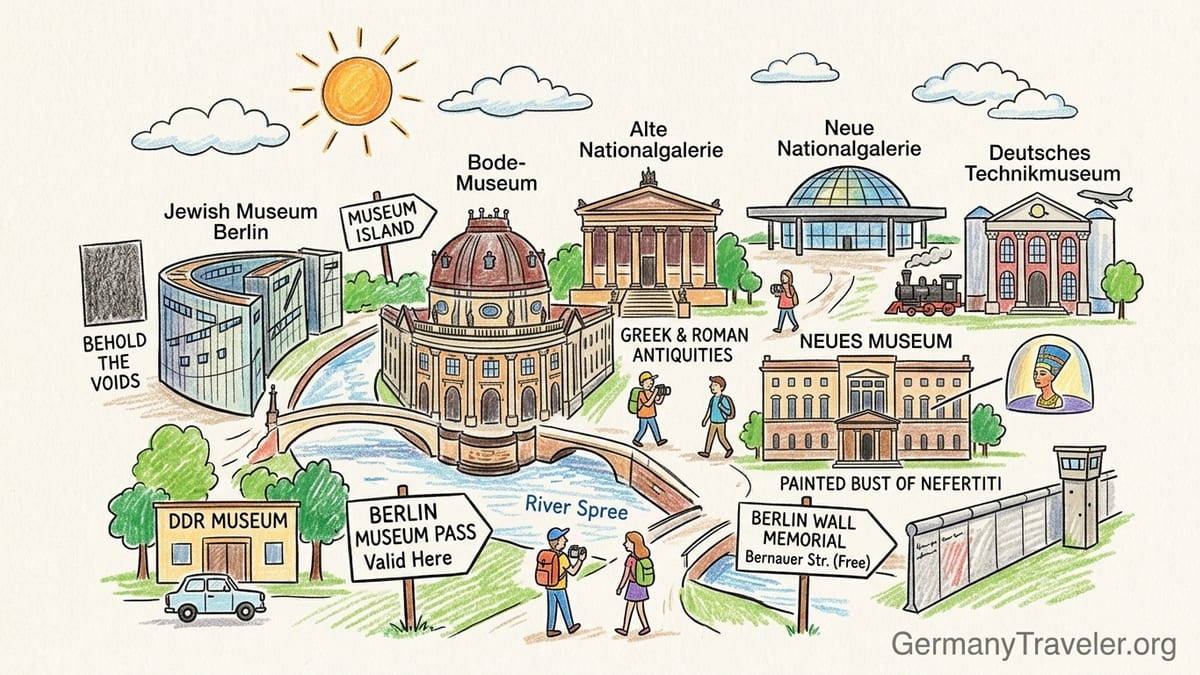
How Berlin’s Museum Landscape Works Today
Berlin’s museums fall into three broad groups that matter for planning. First are the Staatliche Museen zu Berlin, the state museums that include all of Museum Island, the Gemäldegalerie, the Neue Nationalgalerie, the Hamburger Bahnhof and several others. Second are independent or foundation museums such as the DDR Museum, Jewish Museum Berlin and Topography of Terror. Third are more specialized houses for science, technology and niche collections. The Berlin Museum Pass is valid in more than thirty institutions across all three groups, but the most popular and time consuming stops still sit within the state system.
For visitors in October 2026, the most important structural change concerns Museum Island. The Pergamonmuseum, home of the Pergamon Altar and the Ishtar Gate, is completely closed for long term renovation. It is scheduled to reopen to the public on 4 June 2027, when the Pergamon Hall, the Antikensammlung highlights and the Museum of Islamic Art will return to view. That date has been confirmed by the Prussian Cultural Heritage Foundation and the Staatliche Museen, which means any older guide suggesting you can already see the altar is outdated.
Ticketing is where planning pays off. A single major state museum such as the Neues Museum or Bode Museum currently costs about 14 euros when booked through the Staatliche Museen online shop. The Alte Nationalgalerie is slightly higher at around 16 euros. A Museum Island day ticket that covers the open museums on the island for one calendar day costs roughly 24 euros. The three day Berlin Museum Pass, sold through official partners such as VisitBerlin, costs around 32 euros and grants one free visit to each participating museum over three consecutive days. It pays off as soon as you plan three or more paid museum visits that accept it.
The other constraint is time and energy. Large museums in Berlin are genuinely large. The Neues Museum, Jewish Museum Berlin, Humboldt Forum’s historical exhibitions or the Deutsches Technikmuseum can each reward two to three hours at an unhurried pace, and some visitors comfortably spend longer. Trying to fit three such institutions into a single day means you may remember nothing from the last one. This guide therefore suggests choosing one “anchor” museum each day, possibly combined with one shorter or lighter visit rather than chaining three blockbusters together.
Ancient Worlds: Egypt, Greece and the Near East
If your main interest is ancient history, Museum Island remains your natural base even while the Pergamonmuseum is closed. For Egypt and prehistoric Europe, the Neues Museum is the essential stop. Its star object is the painted limestone bust of Nefertiti, displayed in a dedicated domed room with limited numbers allowed inside at any one time. The rest of the museum walks you from Ice Age tools and skulls through Bronze Age gold to Roman era finds in northern Europe. Realistically, you need at least two hours here, three if you like to read labels and study objects.
Greek and Roman antiquities have shifted focus to the Altes Museum, the round domed building facing the Lustgarten. Here you will find marble statues, vases, coins and smaller objects that once formed part of the Pergamonmuseum’s wider story of classical antiquity. With the altar itself closed until 2027 and full reopening of the entire Pergamon complex pushed into the 2030s, the Altes Museum is currently the best substitute if you want columns, torsos and mythological scenes in stone. A focused visit can be done in ninety minutes, but fans of antiquities can easily linger longer.
If your interest in the ancient Near East is specifically about the Ishtar Gate or the Processional Way from Babylon, manage expectations carefully. These pieces are physically present in the Pergamonmuseum and not accessible until the building’s partial reopening. There is occasionally a panoramic exhibition about Pergamon and Babylon in a temporary venue a short walk north of Museum Island, which uses projections and digital reconstructions to evoke the altar and city walls. Availability changes with construction schedules, so check locally once in Berlin rather than planning your trip around it months ahead.
For most travellers, the practical choice is simple. If you have one half day for antiquity, choose the Neues Museum, and add the Altes Museum only if you are content to walk through at museum pace for several more hours. On a short city break, there is rarely a good case for trying to see Neues Museum, Altes Museum and a third major museum in a single day.
German History and the Third Reich
Berlin’s most powerful historical sites are not all classic museums. They combine documents, open air remains and architecture. The Topography of Terror, on the former Gestapo and SS headquarters site near Potsdamer Platz, is free to enter and traces the rise and mechanics of Nazi terror through photographs, biographies and excavation trenches. A typical visit lasts 90 minutes to two hours, but it is emotionally dense and many visitors need a break afterwards. For that reason alone, it pairs better with a walk or a light art museum than with another heavy memorial.
For a structured overview of German history from the Middle Ages to the present day, the German Historical Museum has traditionally been the anchor. Its main building on Unter den Linden has been undergoing refurbishment, so check which permanent exhibitions are open by the time you visit. In recent years, the focus has shifted to well curated temporary exhibitions inside the adjacent Zeughaus. When fully open, this museum needs at least three hours to appreciate, especially if you are interested in both early modern history and the twentieth century.
Travelers often ask whether to prioritize the German Historical Museum, Topography of Terror or a concentration camp memorial such as Sachsenhausen on a day trip to Oranienburg. For most people, combining Sachsenhausen and Topography in one day makes for an extremely intense and draining experience. A more balanced schedule is to choose one heavy site, such as Sachsenhausen or Topography of Terror, and then reserve the German Historical Museum for another day when you have fresh attention for complex timelines and political context.
Queue patterns for history museums are kinder than those for Museum Island. The Topography of Terror can be entered without advance booking and even at midday in summer there is usually only a short wait to clear the entrance. The main bottlenecks happen during free Museum Sunday, held on the first Sunday of each month, when time slot tickets are required for some institutions and disappear weeks ahead. If your Berlin stay crosses a Museum Sunday, it can be attractive for budget reasons, but do not count on visiting multiple high demand sites such as the Jewish Museum or Neues Museum that day unless you secure slots well in advance.
Cold War and GDR: Where to Go Beyond Checkpoint Charlie
Cold War history in Berlin runs the risk of being reduced to souvenir stands and men in costume at Checkpoint Charlie. The famous border crossing itself now hosts two competing private museums and many ticket sellers, but neither is widely regarded as essential. If you want substance, focus on three institutions instead: the DDR Museum, the Berlin Wall Memorial on Bernauer Strasse and the Stasi Museum in Lichtenberg.
The DDR Museum, opposite Museum Island on the Spree, is an immersive look at everyday life in East Germany. You can open drawers in a recreated apartment, sit in a Trabant and listen to commentary about shopping, education and surveillance. As of its latest rate sheet, the regular adult ticket is priced at around 13.90 euros, with reductions for children, students and groups. Crowds can be intense on weekends and rainy days because it is compact and centrally located. Plan 90 minutes to two hours and be prepared for some jostling in peak seasons.
For the history of the Berlin Wall itself, prioritize the Berlin Wall Memorial on Bernauer Strasse. This site combines a preserved strip of the border fortifications, a documentation center and an observation tower. Entry is free and queues are limited to security checks and elevator access to the tower. The memorial demands at least two hours if you walk the full length of the outdoor exhibits. It pairs well with an afternoon visit to the nearby Mauerpark area for a softer landing after a difficult subject.
The Stasi Museum, housed in the former Ministry for State Security headquarters in Lichtenberg, showcases the offices of Erich Mielke and a wealth of surveillance equipment, files and propaganda. It takes effort to reach compared with central museums, but offers a deep dive into GDR power structures that many visitors find more revealing than the lighter touch at the DDR Museum. If you are a Cold War enthusiast, combining the Stasi Museum with the Wall Memorial makes a rich day; if you are a casual visitor, choose either the DDR Museum or the Wall Memorial and use remaining time for something unrelated to security services.
Jewish History, Holocaust Memory and Emotional Bandwidth
Berlin’s Jewish history and Holocaust memorial sites are among the city’s most affecting places and require deliberate pacing. The Jewish Museum Berlin in Kreuzberg is the anchor museum. It combines a powerful building by Daniel Libeskind with permanent exhibitions on Jewish life in Germany across centuries, temporary shows on art and identity, and architectural voids that deliberately disorient. A full visit can take three hours without feeling rushed. Tickets are paid individually, and the museum is not part of the state system, so it is not covered by the Museum Island ticket but is generally included in the Berlin Museum Pass for a single visit.
Close to the Brandenburg Gate sits the Memorial to the Murdered Jews of Europe, an open air field of concrete stelae. Its information center underground adds historical context, biographies and personal documents. Entry is free, but queues for the information center can stretch to 30 or 40 minutes in high season afternoons because security controls limit entry. Many visitors combine this with the Topography of Terror on the same day, which together create a very heavy program. When planning your itinerary, try to avoid stacking the Jewish Museum, Holocaust Memorial information center and Topography of Terror into one day unless you have a specific research reason to do so.
For families or sensitive travelers, the question is often when young visitors are ready for such content. The Jewish Museum has developed family friendly elements and temporary exhibitions aimed at younger audiences, but much of the material remains emotionally demanding. A practical compromise is to visit the Jewish Museum and the open air Holocaust memorial field, while leaving the underground information center for a future trip if children are not yet ready for graphic detail. That still gives a strong sense of Berlin’s Jewish heritage without overwhelming the whole family.
In all cases, leave space in your schedule after these visits for reflection. A quiet walk along the Landwehr Canal or an hour in a street side café offers exactly the decompression that back to back museum booking will otherwise deny you.
Art Lovers: From Old Masters to Contemporary Berlin
Art in Berlin divides naturally into three layers: nineteenth century painting and sculpture, classic modernism from around 1900 to the 1960s, and contemporary work, much of it by living artists based in the city. For nineteenth century art, the Alte Nationalgalerie on Museum Island is the standout. Its galleries display Romantic landscapes, portraits and sculpture under a soaring neoclassical roof. Expect to pay around 16 euros for a standard ticket if bought on its own. Two focused hours let you see the highlights without fatigue; longer visits are best reserved for cooler days.
Classic modern and post war art are anchored in two houses. The Neue Nationalgalerie near Potsdamer Platz, in Mies van der Rohe’s glass temple, houses twentieth century painting and sculpture with regular special exhibitions by major names. The Hamburger Bahnhof, north of the Hauptbahnhof, focuses on contemporary and post 1960 art in a converted railway station. Both are part of the state museums network and accept the Museum Pass. Each can absorb three hours for those who read texts and linger with installations. On a three day trip, it often makes sense to choose either Alte Nationalgalerie plus one modern museum, or to skip the nineteenth century section entirely and focus on newer work if that is your taste.
Many independent galleries spread across Mitte, Kreuzberg and Neukölln offer free access to emerging artists. They are not covered by any pass, but they also do not eat into your ticket budget. They pair well with one large museum because they allow you to experience contemporary Berlin without another full scale institutional visit. For instance, a morning in the Neue Nationalgalerie and an afternoon gallery walk in Potsdamer Strasse or around Auguststrasse gives you a rounded art day without the intensity of two blockbusters back to back.
Queue patterns for art museums depend strongly on temporary shows. When an international blockbuster exhibition opens, such as a major retrospective of a well known modern painter, weekends can see entry lines stretching around the block and timed slots selling out online. At other times, you may be able to walk into the same museum almost immediately on a weekday afternoon. If seeing a specific exhibition is important to you, book a time slot as soon as your dates are firm and plan other activities around it instead of the other way round.
Science, Technology and Natural History: Great for Curious Minds
Berlin’s best science and technology museums sit slightly away from the usual tourist triangle and repay the detour. The Deutsches Technikmuseum, near Gleisdreieck, occupies former railway yards and hangars with exhibitions on trains, aircraft, shipping, computing and industrial processes. A family can easily spend half a day here, especially when combining the main museum with the adjacent Science Center Spectrum, an interactive hands on space oriented toward children. Tickets are sold per person and are typically covered by the Museum Pass, but families should check exact combined prices at the time of visit.
For natural history, the Museum für Naturkunde north of the central station is home to Berlin’s famous mounted brachiosaurus skeleton and an impressive mineral and fossil collection. Younger visitors are drawn to the dinosaur hall and preserved animal displays. Two hours is a reasonable visit length for families, longer for enthusiasts who enjoy detailed taxonomic information. This museum is included in the Museum Pass and can be particularly rewarding on a rainy afternoon when playing in parks is less attractive.
Neither the Technikmuseum nor the Naturkunde museum have the same crowding profile as Museum Island’s highlights, but wet weekends and school holidays can still create lines at ticket counters and cloakrooms. Backpacks and larger bags often must be left in lockers for security and conservation reasons, so allow time to queue for a locker and bring a coin or token system as required. Travelling light, with only a small shoulder bag, simplifies entry to almost all Berlin museums.
These institutions are ideal second stops on days when your primary visit was emotionally heavy. For instance, after a morning at the Topography of Terror, an afternoon at the Technikmuseum shifts the mood while still offering meaningful learning. For scientifically minded travelers, they can also form the core of a day, perhaps combined with a walk through the nearby Park am Gleisdreieck or a visit to the Tempelhof Feld airfield to connect technical history with Berlin’s urban landscape.
Tickets, Passes and How to Avoid Museum Overload
The question of whether to buy individual tickets, a Museum Island ticket or the three day Museum Pass depends largely on how many paid institutions you plan to enter and on how you distribute them across days. As of autumn 2026, individual tickets for major state museums are around 14 euros, the Alte Nationalgalerie slightly more, and the Museum Island day ticket about 24 euros for all open island museums. The Museum Pass costs roughly 32 euros for three consecutive days and includes the state museums plus many independent houses such as the Jewish Museum, DDR Museum and Museum für Naturkunde.
A simple example shows how this adds up. If you plan to visit the Neues Museum, Alte Nationalgalerie and Jewish Museum on separate days, individual tickets will total roughly 14 plus 16 plus another mid teens price, comfortably exceeding the cost of the Museum Pass. With the pass, you can also add spontaneous visits to the Bode Museum, Gemäldegalerie or Technikmuseum without further expense. On the other hand, if you only want to see one Museum Island collection and perhaps an independent memorial like the Topography of Terror, it is cheaper to pay individually and skip the pass entirely.
Reservation requirements have softened since the most restrictive pandemic years, but timed entry still appears at popular museums and on special dates. The Neues Museum, Alte Nationalgalerie and some temporary exhibitions at the Neue Nationalgalerie often require or strongly recommend a time slot, especially during school holidays. Free Museum Sunday on the first Sunday of the month operates almost entirely on advance timed tickets that disappear quickly. Before you buy a Museum Pass, always check whether the specific museums you care about allow pass holders to reserve a time slot online or whether entry is managed via a separate same day queue.
To avoid overload, spread large visits across your stay and mix formats. Plan no more than one major museum that realistically needs two to three hours per day, then add one smaller, lighter experience if energy allows. For example, a day might combine the Neues Museum in the morning, a long lunch and stroll through Prenzlauer Berg in the afternoon, and a small gallery visit or short memorial stop before dinner. What you want to avoid is a schedule such as Neues Museum at 10:00, Jewish Museum at 14:00 and DDR Museum at 17:00. On paper that fits; in practice, most people will start skipping sections by mid afternoon and remember little beyond queues and cloakrooms.
Smart Itineraries: First Timers, History Fans, Rainy Days and Families
For a very first trip to Berlin, with perhaps only one full sightseeing day and limited appetite for museums, one museum stands out as a balanced introduction: the Neues Museum. It combines ancient Egypt, prehistoric Europe and striking architecture, is centrally located on Museum Island and leaves enough time for a walk along Unter den Linden, a coffee on Bebelplatz and an early evening visit to the Brandenburg Gate. If ancient history genuinely does not interest you, substitute the Jewish Museum Berlin as your single flagship. Both choices will give you a deep, memorable experience instead of a blur of half seen collections.
For history lovers with two museum slots to fill, a powerful pairing is the German Historical Museum and the Topography of Terror, spread across two days. One day, explore the structured national narrative indoors, with climate control and detailed labels. Another day, face the evidence of Nazi crimes and post war memory on the actual sites. Alternatively, combine the Topography of Terror with the Jewish Museum on separate days to focus on National Socialism and Jewish life before and after. In all these cases, leave evenings free for decompression.
The best rainy day combination depends on whether you are traveling with children. For adults, a solid pairing is the Alte Nationalgalerie in the morning followed by the DDR Museum or Jewish Museum in the afternoon, both reachable by short public transport rides and with enough variety to keep attention up. For families, the Museum für Naturkunde and the Deutsches Technikmuseum form an excellent wet weather duo, but again it is wiser to split them across two days rather than sprint through both in one epic. Rain also tends to push more visitors indoors, so book time slots and arrive early in the day where possible.
For a full museum focused family day, consider starting at the Museum für Naturkunde, taking a relaxed lunch near the central station, and then heading to the Technikmuseum and Spectrum for an afternoon of hands on experiments. This keeps content concrete and tactile, with plenty of space to move. Leave more serious history such as the Wall Memorial or Topography of Terror for another day when children are not already tired. Families using the Museum Pass can do all of this on one pass day and then switch to parks, playgrounds and boat trips for variety on others.
FAQ
Q1. Is the Pergamonmuseum open in 2026 and can I see the Pergamon Altar?
The Pergamonmuseum on Museum Island is completely closed in 2026 for renovation. It is scheduled to reopen on 4 June 2027, when the Pergamon Altar and parts of the Museum of Islamic Art will return to display. Until then, you cannot see the altar or the Ishtar Gate in Berlin.
Q2. Which one museum should I pick if I only have time for a single visit?
If you want a broad cultural overview, choose the Neues Museum on Museum Island. If your main interest is modern German history and Jewish life, choose the Jewish Museum Berlin instead. Both are substantial enough to feel like a complete experience without needing additional museums the same day.
Q3. When is the Berlin Museum Pass worth buying?
The three day Museum Pass is generally worth it if you plan to visit at least three paid museums that accept it within three consecutive days. For example, if you enter the Neues Museum, Alte Nationalgalerie and Jewish Museum Berlin on the pass, you will usually already save money compared with buying individual tickets, and any extra visits become effectively free.
Q4. Do I need to book time slot tickets for Museum Island?
Time slots are strongly recommended and sometimes required for popular Museum Island museums, especially the Neues Museum and Alte Nationalgalerie, as well as during free Museum Sunday. Booking an entry window in advance reduces waiting time and is particularly important in school holidays and on rainy weekends.
Q5. How many major museums can I realistically visit in one day?
For most travelers, one major museum that takes two to three hours, plus perhaps one smaller or lighter stop, is the realistic maximum before attention fades. Scheduling three large museums back to back usually leads to fatigue and shallow visits where you skim galleries without really taking anything in.
Q6. Are Berlin’s main history and Holocaust sites suitable for children?
It depends on age and sensitivity. The Jewish Museum and Berlin Wall Memorial offer thoughtful, age appropriate elements, but the Topography of Terror and the information center under the Holocaust memorial can be intense. Many families choose to visit one of these sites and then balance the day with a lighter activity or a science museum.
Q7. What should I know about lockers and bags in Berlin museums?
Most larger museums require backpacks and bigger bags to be stored in lockers or cloakrooms, often using a one or two euro coin as a deposit. Arriving with only a small shoulder bag speeds up entry because you can bypass cloakroom queues and security checks are easier.
Q8. How busy do Berlin museums get on free Museum Sunday?
The first Sunday of each month is very popular because many museums are free with advance time slot tickets. Prime slots for institutions such as the Neues Museum, Jewish Museum and Alte Nationalgalerie can sell out weeks in advance, and walk up options are limited. If you value calmer galleries, it may be better to visit on paid days instead.
Q9. Is the Berlin WelcomeCard a good substitute for the Museum Pass?
The Berlin WelcomeCard mainly covers public transport and offers discounts on some attractions, while the Museum Pass covers free admission to over thirty museums but does not include transport. For museum heavy trips, many visitors buy a separate regular transport ticket or Deutschlandticket and then add the Museum Pass for admissions rather than relying on WelcomeCard discounts.
Q10. What is the best museum day plan for a family with school age children?
A popular family plan is to visit the Museum für Naturkunde in the morning to see dinosaurs and animals, enjoy a relaxed lunch, then spend the afternoon at the Deutsches Technikmuseum and its Spectrum science center. This combination keeps children moving and engaged with hands on exhibits, and can usually be done on a single day of the Museum Pass.