


On paper, Berlin is the easiest place in Europe to have an unforgettable night out. The city sells itself as a 24-hour techno playground where the trains run all night, the clubs never close, and somehow everyone glides past the door staff straight into a life-changing dance floor. After several nights out that looked nothing like the myth, I learned that Berlin’s nightlife is brilliant, but it is not effortless. It asks for patience, humility and a backup plan.
The Myth of Effortless 24-Hour Club Paradise
The story most visitors hear about Berlin is simple. You land on a Friday, nap, throw on something black, then stroll into a monumental club like Berghain, Sisyphos or Tresor and dance until Monday. Guides talk about techno cathedrals in old power plants, outdoor gardens that feel like small festivals, and a nightlife scene that officially has no closing time. Some venues really do run from Friday night well into Monday morning, with rooms opening around midnight, filling at 2 am and peaking around 4 am or later.
There is some truth in this myth. Berghain in Friedrichshain still draws international DJs and is often described in music media as one of the best clubs in the world. Sisyphos in Lichtenberg turns an old factory complex into a weekend-long playground with multiple stages and a courtyard. Tresor, housed in a vault-like basement near Köpenicker Strasse, keeps the city’s early 1990s techno history alive. On a good night, these rooms can feel as intense and freeing as their reputation suggests.
What gets edited out of the story is the friction required to reach those moments. The queues outside the most famous doors are often measured in hours, not minutes. Entry prices at major clubs now tend to sit in the range of roughly 15 to just under 30 euros for a big weekend event, paid at the door, usually in cash. And crucially, there is no guarantee you will be allowed in, no matter how far you have flown or how long you have waited.
This article is a companion piece to the romantic version of Berlin nightlife. It is based on actual nights out in autumn 2025 and summer 2026, crosschecked with what locals, club regulars and recent guides describe. It does not argue that Berlin’s clubs are bad or broken. Instead, it aims to show where the reality bites, how to interpret it, and how to adjust your expectations so that a rough night at the door does not ruin your entire trip.
Queues, Rejections and the Mystery at the Door
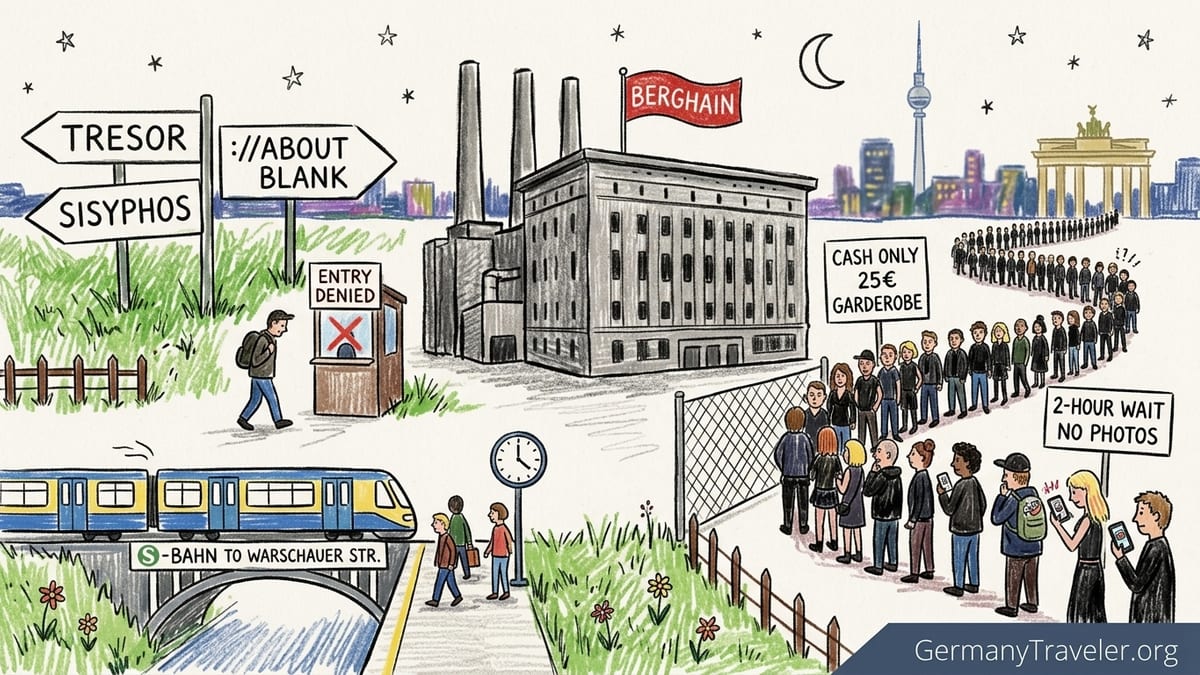
My first Saturday attempt at a “proper” Berlin night started at Berghain. I reached the site, a hulking former heating plant near Ostbahnhof, just after midnight. A chain-link fence marked the queue. From the back of the line, the building looked close. Ninety minutes later, it did not feel that way. People around me whispered theories: speak German if you can, do not speak at all if you cannot, wear black, do not smile, do not look drunk, never check your phone in the line.
These whispered rules matched what is widely reported about Berlin’s strictest doors. Berghain is known for rejecting a large share of the line without any explanation. Community forums that track queue times mention waits of two to three hours on busy nights and describe waves of rejections that can send entire groups away. Similar stories, though usually less extreme, appear around Sisyphos, ://about blank and sometimes KitKat, which has its own explicit dress rules. None of these venues publish an official checklist. The door staff look at the group in front of them for a few seconds and then either nod them in or shake their heads.
In my case, after nearly an hour and a half, the verdict was a single word in German that needed no translation. I was turned away. The group of four ahead of me and the couple behind me were also rejected. Nobody received feedback. There was no second chance or appeal. I want to state clearly that I do not know why any of us were refused. I was sober, dressed simply in dark clothes, had cash ready and was alone. It is tempting to invent a story about what went wrong, but the truth is that rejection at certain Berlin doors is opaque by design.
Over several weekends, I saw and heard variations on this theme. Friends who live in Berlin described being admitted on some nights and rejected on others while dressed almost identically. Visitors queued at Sisyphos for close to an hour, only to be told “not tonight” in two languages. Another night, a trio I met was turned away from Tresor and then told at ://about blank that the club was closing its door soon, so they would not be let in. None of this is unique to my experience. It is part of a widely discussed and sometimes resented culture around certain Berlin clubs. Whether this is good or bad depends on who you ask, but it is essential to understand before staking your whole evening on one door.
Cash-Only Reality, Transport Shocks and Lost Days
The other friction point that repeatedly caught me off guard was money and logistics. Despite Germany’s reputation for efficiency and the widespread availability of card payments in shops and restaurants, a surprising number of Berlin clubs still operate cash-only at the door and often at the cloakroom. Guides focused on the 2026 club season frequently stress this. Major venues like Berghain and several others expect you to pay entry in cash at the Abendkasse. Inside, some bars now accept cards more often than a decade ago, but you cannot rely on it, and the most painful moment is arriving at a door after a long queue and realising your card will not help.
On one Saturday, I made this mistake at a mid-sized club near Ostkreuz. The entry was listed as 15 euros, cash only. My limit for the day was nearly reached, and the nearest ATM, used by a steady stream of clubbers, charged a noticeable fee for each withdrawal. By the time I had cash in hand, the line was longer and the mood worse. It was a small problem, but at two in the morning, after one rejection already, it felt outsized. The lesson was simple: in Berlin, you still need real notes and coins in your pocket when you go out at night, especially if you plan to move between different venues and cloakrooms.
Transport added another layer. Within the city ring, Berlin’s U-Bahn and S-Bahn run through much of the night on weekends, with regular night buses filling the gaps. In theory, this makes club-hopping easy. In practice, when you are standing outside a venue in Friedrichshain at four in the morning, unexpectedly rejected and suddenly sober, the idea of mapping a new route across town can be overwhelming. One night, after striking out at a big club near Ostbahnhof, I ended up taking a taxi from Friedrichshain to Neukölln. The ride took around 15 minutes and cost just under 20 euros including a tip. Not ruinous, but enough to matter if you are travelling on a budget and already paid for a ticket you did not use earlier in the evening.
The final hidden cost was time the next day. The Berlin myth loves the idea of stumbling out of a club onto the pavement in bright midday or even Sunday afternoon, blinking in the light before drifting to a lake or brunch. In reality, my first successful run at a long Berlin night ended at around 9 am. I took the S-Bahn back towards Kreuzberg, slept in a blackout-dark hostel bunk and woke around 3 pm with a headache, almost no desire to move, and the realisation that the museum tickets I had booked for that afternoon were pointless. Berlin’s nightlife does not only consume your night. It often erases the next day.
Smoke, Crowds, No-Phone Rules and the Culture Behind Them
Even when you do get in, the reality of being inside a famous Berlin club can be more confronting than first-time visitors expect. Cigarette smoke is a major factor. Although Germany tightened indoor smoking laws years ago, Berlin’s techno institutions often fall under exemptions for certain types of venues or rely on interpretation that allows indoor smoking. In practice, that means many main rooms and adjacent bars are visibly smoky deep into the night. Clothes, hair and bags pick up the smell and keep it for days.
Cloakrooms are another pressure point. At big clubs, the Garderobe is almost always mandatory and almost always crowded between 1 am and 4 am when most people arrive or at noon on Sunday when many decide they have had enough. You may find yourself queuing once to hand over your coat and bag, paying a few euros in cash, and later queuing again to collect them. One Sunday, I spent close to half an hour just to retrieve my jacket at a club in Friedrichshain, inching forward along a corridor thick with people who were tired and impatient, but still respectful of personal space.
Then there are the no-photo or no-phone rules. Many Berlin venues do not allow photography on the dance floor. At some doors, staff place stickers over the lenses of your phone’s cameras. Others rely on signs and unspoken norms. Berghain is the best-known example, but it is not alone. Clubs like Sisyphos, ://about blank and KitKat are also widely described as enforcing phone restrictions inside. This can feel annoying if you are used to recording every night out, and some visitors are surprised to find themselves stopped by security after taking a selfie. Yet these policies are rooted in a strong local belief that people should be able to dance, dress or connect in private without appearing on strangers’ social media feeds the next day.
Important here is that none of these factors are necessarily defects. The smoke, the strict door, the no-photo rules and the careful management of cloakrooms are all parts of a particular club culture that Berlin has cultivated over decades. In 2024, Germany’s UNESCO Commission recognised Berlin’s techno culture as part of the country’s intangible cultural heritage, explicitly acknowledging the clubs and communities that grew around them. The city’s nightlife is not meant to be frictionless entertainment in the way many commercial superclubs are. It is built around ideas of subculture, privacy and continuity. Those values can sit awkwardly against the expectations of short-term visitors, but understanding them helps soften some of the frustration.
Chasing Famous Names vs Finding Smaller Wins
After a few nights structured entirely around the doors of Berghain, Sisyphos and other headline names, I changed tactics. Instead of treating “getting in” as the only possible success, I started picking an area first and then listing a mix of big and smaller venues within a few stops of each other. One evening, I set up in Friedrichshain with three options: a large, famous club on the Spree, a smaller basement venue on the same street, and a bar with a tiny dance floor near Warschauer Strasse.
Predictably, I did not clear the door at the big place. That rejection stung less than earlier ones because I walked there expecting it to be a coin flip. Within ten minutes, I was in line at the smaller basement club, where the door check focused on age, sobriety and capacity rather than vague vibe. Entry was around 12 euros, paid in cash. The room was dark, the sound system strong, and the crowd a mix of locals and foreigners who had clearly not built their identity around being inside the most famous name in town.
On another night, Neukölln delivered an even better example. I had planned to try one well-known venue further east, but a rainstorm and a very long queue turned me away. Instead, I slipped into a bar on Weserstrasse that was hosting a local label night. There was no entry fee before midnight, no grill-like door process, and no Instagram-famous aesthetics. People were gathered under low ceilings, with a small DJ booth at one end and a smoking courtyard out back. The music was as carefully selected as anything I had heard in a much bigger space, and the conversations were easier. By 5 am, I realised I had spent the entire night in a place I had not known existed twelve hours earlier.
Talking to Berliners reinforced that this pattern is common. Many locals still respect the big institutions and go there when they feel like it, but they do not hinge their whole social life on getting in. They know that on any weekend, dozens of smaller clubs, bars and cultural spaces across Kreuzberg, Neukölln, Wedding and Lichtenberg host excellent nights with less performative door drama. An event in a converted warehouse, an open-air stage by the canal or a queer party in a tiny back room can easily become the best night of your trip, precisely because you did not arrive with a myth attached.
Safety, Drinking, Solo Nights and Getting Home
From a safety perspective, Berlin remains one of the more comfortable big European cities to move around at night, especially in busy nightlife districts. The trains run late, stations are usually well lit, and there is a constant human presence around major hubs like Warschauer Strasse, Kottbusser Tor and Ostkreuz. That does not mean you can switch off completely. Pickpocketing does occur on crowded platforms and in busy clubs, especially around cloakrooms and smoking areas. On packed dance floors, small bags worn on the body and zipped pockets are sensible.
Solo nightlife is common in Berlin. Many people, including a significant number of visitors, go out alone. I did several times. In more commercial capitals, arriving solo at a club can feel strange, but Berlin’s culture often treats it as normal, sometimes even preferable to large groups that are harder to integrate. Conversations at the edge of the smoking area or near the bar are often easy to start, provided you respect physical and emotional boundaries. That said, being alone does not guarantee an easier time at the door, and it certainly does not guarantee safety if you overdo alcohol or other substances.
On that topic, Berlin’s reputation as a hedonistic city is not exaggerated, but from a visitor’s perspective, moderation is vital. Drinks inside big clubs are not cheap. A long drink or cocktail can easily reach into the low teens in euros at high-profile venues, while beer is somewhat cheaper. If you arrive already drunk, your odds at a selective door drop sharply. If you keep drinking heavily inside, the combination of loud music, late hours and occasional drug offers can become disorienting fast. Several people I spoke to who had bad experiences in Berlin clubs traced them not to the venue itself but to losing track of their own limits in an unfamiliar environment.
Getting home is the final piece. On Fridays and Saturdays, the U-Bahn and S-Bahn run through the night on core lines, and night buses fill in many routes. A standard single ticket across zones AB costs under four euros at the time of writing, and day tickets or 24-hour passes can offer better value if you are making multiple trips. However, if you end your night deep in the suburbs or at a lake outside the ring, your choices become thinner. Taxis are regulated and generally safe, but a ride from Lichtenberg or Treptow back to a central hotel can easily add 20 to 30 euros to your night. App-based services are available but may surge in price during peak hours such as Sunday afternoon when many people leave big venues at once.
Making Berlin Nightlife Work for You
After several false starts and a few expensive lessons, my relationship with Berlin nightlife changed once I stopped expecting perfection and started planning for uncertainty. Instead of booking a dinner, pre-drinks and transport around one single club with a legendary reputation, I began to treat any night out as a route with multiple possible stops. I would pick one or two ambitious doors I was curious about, then add at least two realistic fallbacks: a smaller club, a late bar, a cocktail spot or even a night bus route that passed an interesting part of town.
Carrying enough cash was a non-negotiable change. For a full night that might include two venues, one cloakroom and a taxi home, I found that having between 70 and 100 euros in notes was a comfortable range, assuming moderate drinking and typical door prices. If I spent less, that was a pleasant surprise. I also started checking event listings and unofficial guides a day or two in advance rather than assuming that every club would be open and operating every weekend. Berlin’s scene is dense but not infinite, and special events, queer nights or label takeovers often shape who is at the door and what kind of crowd they are trying to build inside.
Most importantly, I stopped taking rejections personally. Door staff in Berlin are not customer service workers in the sense many visitors are used to. They are curators tasked with protecting a space that locals consider semi-private and occasionally sacred. That perspective does not make rejection feel good, but it helps to see it as part of a system rather than an insult. Often, the same selector who turned me away at one door was perfectly polite at another club later that night. In that sense, the city itself felt less hostile once I let go of the idea that one club owed me entry.
What emerged from this shift was a different kind of satisfaction. My best memory from the summer was not finally making it past a particularly famous door. It was a Sunday afternoon spent in the garden of a medium-sized club that few non-Germans talk about, where sunlight and shade moved across a wooden deck while a DJ played long, patient records. I had ended up there after missing two earlier plans. The beer was reasonably priced, the crowd unassuming, and nobody cared where anyone had tried and failed to get in the night before.
The Takeaway
Berlin’s nightlife is not broken just because it does not match the glossy myth. It is demanding by design. The long queues, the apparently arbitrary rejections, the cash-only cloakrooms, the dense smoke and the no-phone rules are all expressions of a local culture that values privacy and continuity over turnover. Some visitors will find that frustrating or exclusionary. Others will find that, once they stop expecting the city to behave like a festival package, the friction makes the good nights feel earned.
If you are planning your first weekend in Berlin, the most useful shift you can make is mental. Do not build an entire evening or an entire trip around getting into one famous club, no matter how many articles you have read about it. Treat those doors as ambitious options, not guaranteed experiences. Have two or three backup plans in the same part of town. Carry enough cash to adapt if the first venue does not work out or if late-night transport costs more than expected. Accept that you may lose a morning of sightseeing after a particularly intense night and decide in advance whether that is a trade you are willing to make.
Most of all, treat rejection as part of the uncertainty rather than a verdict on who you are. Berlin’s nightlife can be welcoming, generous and deeply memorable, but it rarely rewards entitlement. If you arrive curious, prepared and flexible, you are far more likely to leave with a story that is richer than the brochure version, even if the most famous doors in the city stay closed.
FAQ
Q1. Is it really that hard to get into places like Berghain or Sisyphos?
It can be. These venues are known for selective doors that sometimes turn away a large share of the queue without explanation, even when people look and behave in ways that usually work elsewhere. The goal is to shape the atmosphere inside, not to reward effort at the door, so you should approach them as a risk rather than a certainty.
Q2. What should I wear for a night out in Berlin clubs?
There is no universal dress code, but dark, simple clothing is a safe baseline for most techno clubs. Loud tourist outfits, large groups in matching costumes or overtly glamorous looks can draw the wrong kind of attention at certain doors. For fetish-oriented venues such as KitKat, specific dress rules apply and regular street clothes are often refused, so always check the night’s theme before you go.
Q3. How much cash should I bring for a typical night?
If you plan to visit one or two clubs, pay for a cloakroom and have a few drinks, carrying somewhere around 70 to 100 euros in notes is a sensible range for many visitors. That covers typical door prices, basic drinks and a possible taxi home if public transport is no longer convenient. If you drink heavily or intend to visit multiple venues, you will need more.
Q4. Are Berlin clubs safe for solo travelers?
Many people go out alone in Berlin and have good experiences. Busy nightlife districts and major transport hubs usually feel active and relatively safe well into the night. You still need to watch your drink, keep an eye on your belongings and know your own limits, but being solo in itself is not unusual and often makes it easier to meet people than arriving in a large, closed group.
Q5. Do I really need to follow the no-photo rules inside clubs?
Yes. In venues that enforce a no-photo policy, ignoring it can lead to warnings or being removed. Door staff sometimes put stickers over your phone cameras, and security inside may react quickly to visible filming. The intention is to protect other guests’ privacy and encourage people to be present in the room, so it is important to respect that norm even if it feels unfamiliar.
Q6. How expensive are drinks inside Berlin clubs?
Prices vary by venue, but in high-profile clubs expect to pay mid to high single digits in euros for beer and into the low teens for long drinks or cocktails. Smaller bars and neighbourhood venues are usually cheaper. Drinking heavily before arrival to save money is not advisable, as visible intoxication at the door is a common reason for being refused entry.
Q7. What is the best way to get home after a late night out?
On weekends, many U-Bahn and S-Bahn lines run through the night, and night buses cover additional routes, so public transport is often your first option. If you leave a club during quieter hours or from a more remote industrial area, taxis are widely available and generally reliable, though a cross-city ride can easily add 20 to 30 euros to your night. Having a rough route in mind before you go out reduces stress when you are tired.
Q8. Can I still have a good night if I avoid the most famous clubs?
Absolutely. Some of the best nights reported by visitors and locals alike take place in mid-sized clubs, bars with dance floors or one-off events in basements, courtyards and cultural spaces. These spots often have more relaxed doors, shorter queues and plenty of character. If you stay open to lesser-known names, you are less likely to lose an entire evening to one rejection.
Q9. How much of the next day will I lose after a big night?
If you stay in a club until mid-morning or later, you should realistically expect to lose most of the following day to sleep and recovery, especially if you have been drinking or staying in a dark environment for many hours. Planning lighter, flexible activities for the day after a major night out, rather than fixed, expensive bookings, makes it easier to enjoy both.
Q10. What is the single most useful tip for a first-time visitor?
Go out with a plan that includes at least two or three options in the same general area and carry enough cash to move between them. Treat selective doors and long queues as part of the landscape, not as personal judgments. When you do this, rejections hurt less, you adapt faster and you give yourself more chances for Berlin to surprise you in a good way.