

I landed in Berlin with a suitcase, a club wish list and a very naïve idea of what “going out” meant. I imagined strolling into legendary techno temples at midnight, ordering card-only cocktails, snapping a few photos for friends and catching an easy taxi back around 3 a.m. Within 48 hours, Berlin had dismantled those assumptions: the real action starts closer to 2 a.m., cash is still king in surprising places, strict camera bans are taken seriously, public transport quietly hums through the night, and the city does not so much sleep as briefly pause between weekends.
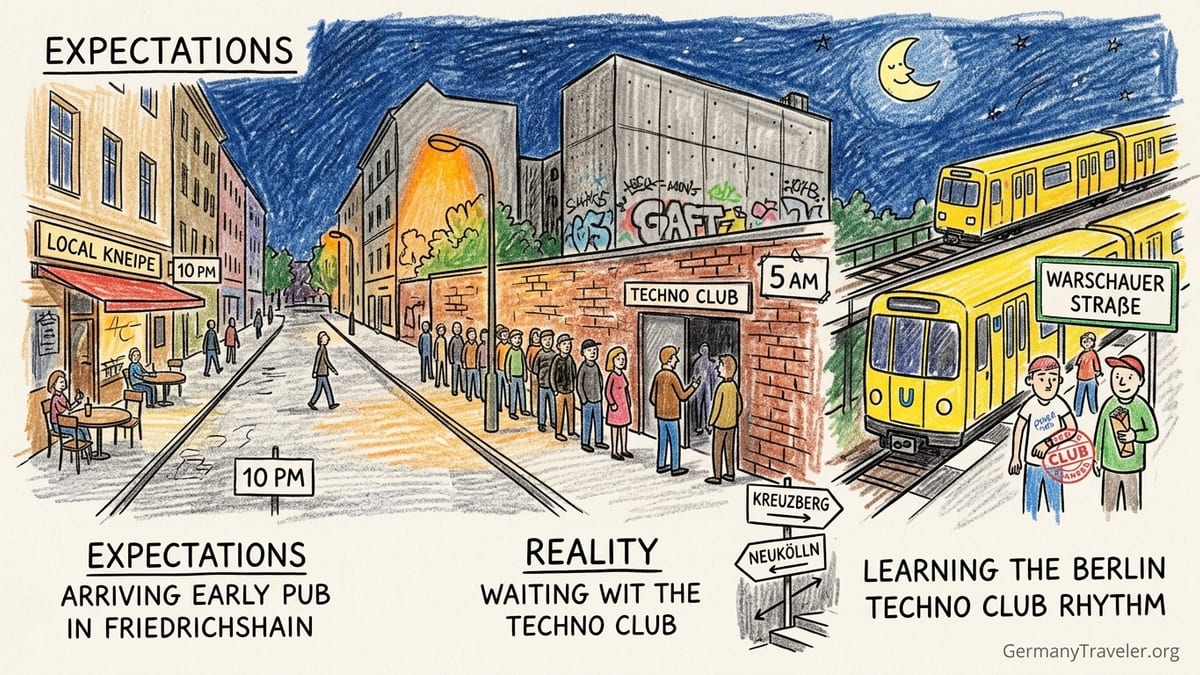
Expectations vs Reality on My First Berlin Night Out
On my first Friday in Berlin I left my Friedrichshain Airbnb at 10 p.m., proud of myself for “embracing the late start.” In most cities I visit, bars are in full swing by then and clubs already filling. In Berlin, I stepped onto streets that felt almost sleepy. Locals were lingering in Spätis with bottled beers, a few tables were occupied in corner Kneipen, but the big queues I had read about simply did not exist yet. By midnight, when I thought I had timed my arrival perfectly at a well-known techno club in Friedrichshain, I found myself in the first of many slow, silent lines that would redefine my sense of a night out.
The queue outside that club, a hulking former industrial space a short walk from Ostkreuz station, looked manageable at first: maybe 60 or 70 people. It moved in quiet, irregular bursts. Groups were turned away without explanation, people drifted off to nearby bars, and new hopefuls joined from the back. I waited around 55 minutes before reaching the front, paid a 20 euro entry fee in cash and another 3 euros for the mandatory coat check. That mix of patience, uncertainty and cash transactions turned out to be the template for most of my club experiences in the city.
The reality check extended to phones and cameras. At several techno venues, my phone camera was physically stickered at the door, and inside I saw staff politely but firmly intervene when someone tried to film. In one club in Kreuzberg, a security guard tapped a guest’s shoulder the instant a screen lit the dance floor and asked them to put it away. No shouting, but no negotiation either. Coming from cities where dance floors double as content farms, the feeling of being “offline” was jarring at first and then steadily liberating.
Transport back home was another surprise. I had assumed expensive late-night taxis, but Berlin’s public transport network quietly underpins its nightlife. On my first big weekend, I left a club near Warschauer Straße after sunrise on Sunday and walked straight onto an U-Bahn platform that was busy but calm. On Friday and Saturday nights, several U-Bahn lines, including the east-west spine that runs under Warschauer Straße and the lines through Kreuzberg, run through the night or are covered by night buses. I never paid more than around 15 euros for a taxi, and on the nights I used the trains I felt as safe as in any European capital, surrounded by sleepy ravers clutching club-stamped wrists and paper Döner wrappers.
Learning the Berlin Techno Club Rhythm
My clearest lesson about Berlin’s techno clubs came the night I arrived “on time.” A local friend had warned me that midnight was too early and 5 a.m. was completely normal, but I could not quite believe her. So I turned up at a mid-sized techno club in Kreuzberg at 12:30 a.m. and found the main floor half empty, the bar staff casually polishing glasses and only a scattering of dancers nodding to a warm-up DJ. The energy that Berlin is famous for simply was not there yet. By 2:30 a.m., though, the same room felt like a different planet: dense but not crushed, lights tightly controlled, and a crowd that knew exactly why it was there.
In the bigger techno spaces I visited around Friedrichshain, the door staff clearly expected arrivals throughout the night, not just at the beginning. One night I queued for roughly 40 minutes at 3 a.m., another night closer to an hour at 4:15 a.m. I paid between 18 and 25 euros to get in, always in cash, and 2 to 3 euros for the cloakroom where coats and bags were required to be checked. Inside, half-liter beers hovered around 4.50 to 5 euros, long drinks around 10 to 12. Bottled water from the bar was typically between 3 and 4 euros, but tap water was always available for free if I asked, something that Berlin’s club guides emphasize as part of the city’s safety culture.
The music itself helped me understand why people commit to such late hours. In one cavernous Friedrichshain club, the main room kicked into a relentless, high-BPM techno set that barely dipped for three hours. Smoke machines and strobes flattened the space into a kind of monochrome tunnel, and cigarette smoke added yet another layer to the haze. There was no VIP platform, no visible branding, almost no conversation on the dance floor. People were there to move, often for many hours, and many around me stayed sober or sipped Club-Mate and water, clearly pacing themselves across a long night rather than sprinting through a short one.
The strict door policies made more sense once I had been inside. At every serious techno club I tried, the focus was on atmosphere and mutual respect rather than pure profit. Dress codes were not about labels or looking expensive but about blending in. Dark, simple clothes, practical shoes and a low-key attitude helped. Loud groups, stag parties in costumes, or anyone treating the line as a spectacle were usually the ones I saw turned away. I was rejected once at a smaller but much-hyped industrial club near Ostbahnhof after a 40-minute wait. The bouncer looked at my group, asked curtly how many of us there were, and simply shook his head. It stung, but after a few nights I realized this was part of the ecosystem, not an attack on me personally.
Smaller Electronic Venues vs The Big Rooms
After two marathon nights in the larger temples, I started seeking out smaller electronic venues around Neukölln and Kreuzberg. These spots, often tucked behind unmarked doors or down graffiti-lined courtyards, offered a very different experience. Entry fees were lower, usually between 10 and 15 euros, and in one Neukölln basement club on a Thursday I paid just 8 euros before midnight. The queue there took less than 10 minutes, and the bouncer simply checked my ID, gave a friendly nod and waved me in.
Inside these smaller venues, the DJ booth felt more like a corner of the room than a distant stage. In one Kreuzberg bar-club hybrid, the DJ stood at eye level behind a narrow counter, adjusting vinyl on two turntables while people leaned over to order drinks. The music leaned more toward house and breakbeat than heavy techno, and the volume, while still club-loud, allowed for pockets of conversation. A beer cost 4 euros, a basic mixed drink 7 or 8. There was often no strict camera-sticker ritual, but a shared understanding that people were there to be present, not to film.
Smoking policies varied more in these spaces. A couple of venues had semi-open courtyards where most smokers naturally gravitated, which kept the air inside relatively breathable. Others were more relaxed about people smoking anywhere, which meant my clothes absorbed that familiar Berlin mix of cigarettes and fog fluid the moment I walked in. If you are sensitive to smoke, smaller venues can be a gamble, but they also felt more flexible: it was easy to step outside for air without losing the thread of the night.
These modest-size clubs also felt more forgiving socially. On one night out in Neukölln, I arrived alone shortly after midnight, ordered a beer and leaned against a pillar near the dance floor. Within half an hour, a group of regulars had pulled me into a conversation about the DJ and the label hosting the night. There was no sense that I was intruding. People drifted in and out of conversations organically. Compared with the anonymity of the huge techno bunkers, where the crowd can feel like a single pulsing organism, these venues allowed me to have a night that was both musical and social without pressure to push through until midday.
Cocktail Bars, Kneipen and Queer Nights: Very Different Worlds
Not every night I spent in Berlin revolved around a Berghain-adjacent fantasy. Some of my most revealing experiences came in far more modest spaces. On my second evening, still slightly jet-lagged, I met a friend at a cocktail bar in Mitte that would not look out of place in London or New York. The interior was dim but polished, with backlit shelves of spirits and bartenders in aprons stirring drinks over perfectly clear ice. A classic cocktail started around 12 euros and signature creations pushed closer to 15. Payment here was no problem by card, service was attentive, and the door policy consisted of a quick “Do you have a reservation?” before guiding us to bar stools. It felt cosmopolitan and familiar, a reminder that Berlin contains plenty of upscale nightlife for those who seek it.
At the other end of the spectrum were the Kneipen, Berlin’s traditional neighborhood pubs. One evening in Friedrichshain, after a club rejection, I ended up in a smoky corner bar that looked unchanged since the 1980s. Yellowed walls, lace curtains, a TV quietly showing football, and an older bartender who switched comfortably between German and dry humor. Here a large beer cost about 3.50 euros, the menu was a handwritten list of schnapps, and payment was cash only. People chatted across tables, a couple played cards, and nobody seemed in a hurry to leave. It was the perfect place to recalibrate after the intensity of techno doors and to be reminded that nightlife in Berlin is as much about slow local rituals as it is about world-famous clubs.
Queer nightlife added yet another layer. In Schöneberg and parts of Neukölln, I visited queer bars that felt explicitly welcoming. One Schöneberg bar, reached via a rainbow-flagged doorway off a quiet side street, had a relaxed check at the door, a small 5 euro entry that mostly went toward supporting regular drag shows, and drink prices similar to other bars: 4 euros for beer, 9 to 11 for simple cocktails. The crowd was mixed in age and style, with both locals and visitors, and the energy felt protective rather than exclusive. Staff were quick to step in if someone behaved disrespectfully, and clear signage about consent and respect appeared in the bathrooms and near the bar.
Later, in Neukölln, I tried a queer techno night hosted in a medium-size club space. The door line here moved slowly because security took its time with each group, but there was a clear emphasis on creating a safe environment inside. Entry was 18 euros, coat check 2.50, and the music ranged from trippy techno to harder industrial sounds. The smoking was heavy, but I left feeling energized rather than overwhelmed. Among all the spaces I tried, these queer nights were some of the most memorable, combining Berlin’s musical intensity with a strong sense of community.
Late-Night Friedrichshain and Kreuzberg Streets
Walking through Friedrichshain and Kreuzberg after midnight taught me as much about Berlin nightlife as any queue. Around Warschauer Straße and the edges of the RAW-Gelände, the sidewalks felt like an extension of the clubs. People spilled out of warehouse doors for smoke breaks, food trucks and Döner stands did brisk business, and the air carried a blend of frying onions, cigarette smoke and distant bass. I rarely saw aggressive behavior. Groups were animated but mostly focused on their own nights. The most common street soundtrack was a mix of laughter in multiple languages and the hiss of beer cans opening.
In Kreuzberg, especially around Görlitzer Bahnhof and along the canal, the atmosphere was slightly scruffier but still largely relaxed. One Friday at 3 a.m., I walked between a bar in Reuterkiez and a small club near Kottbusser Tor. There were pockets of open drinking, clusters of people perched on bridges, and the occasional loud argument, but I never felt directly threatened. I kept my bag zipped and avoided quiet parks and alleys, the same basic precautions I would take in any big city. Police were present but not omnipresent, and most of the visible activity seemed centered on people trying to keep their own party going rather than seeking trouble.
Street food became an essential part of my nights. Outside one Friedrichshain club, a small stand sold vegan burgers and fries until well after sunrise, with lines nearly as long as the club’s. In Kreuzberg, several late-night Döner and falafel counters near Kottbusser Tor stayed open into the early hours. A hearty wrap or plate rarely cost more than 7 or 8 euros and often felt like the difference between stumbling home exhausted and making it to the first U-Bahn of the morning in relatively good shape.
Public transport glued all this together. On weekends, trains along the key east-west and north-south lines kept running through the night, sometimes every 10 or 15 minutes, sometimes a bit more spread out. On weeknights, night buses covered routes after the last trains, and I used them a couple of times coming back from Neukölln. Stops were well-lit and usually occupied by a handful of other night owls, from kitchen staff finishing shifts to club-goers comparing wrist stamps. When I did take taxis, especially after clubs that were farther from my accommodation, drivers were used to late-night revelers and the rides were short in the central neighborhoods where most nightlife clusters.
Places I Would Not Return To (And Why)
Not every Berlin night was a revelation. A few places I tried once and quietly crossed off my list. One was a commercial club near Warschauer Brücke that aggressively advertised itself to tourists with neon signs, promoters on the street and bundled “VIP” wristband deals. The queue moved fast, entry was around 15 euros and paid by card, and there was no particular door scrutiny beyond checking IDs. Inside, multiple floors pumped out chart remixes and generic EDM, packed with bachelor parties and big tour groups.
Drink prices there were noticeably higher than in the more local-oriented clubs and bars I visited: around 6 euros for a beer and 13 to 15 euros for sugary cocktails in plastic cups. Staff were working hard but clearly overwhelmed at times, and I witnessed two separate arguments near the bar that escalated until security stepped in. Compared with the respectful, almost understated vibe inside the techno clubs and queer venues, this spot felt transactional and slightly chaotic. I left after an hour and would not recommend it to anyone hoping to understand what makes Berlin nightlife special.
Another disappointment was a supposedly “authentic” Kneipe in a highly touristed part of Mitte. The décor was convincingly old-fashioned, but the atmosphere was curt to the point of hostile. When I asked in simple German about one of the draft beers, the bartender rolled his eyes and switched to abrupt English. Prices were tourist-level, with small beers close to 4 euros and shots aggressively pushed. The regulars at the bar were left alone, but anyone who looked like a visitor seemed to be tolerated rather than welcomed. With so many genuinely warm neighborhood bars in Friedrichshain, Neukölln and Prenzlauer Berg, I saw no reason to spend another evening there.
Even among the more respected clubs, I had one night that did not quite click. At a warehouse-style venue in a former industrial zone, the sound system in the second room felt oddly flat and harsh, making it hard to stay in the space for long. The DJ played a string of tracks that never quite locked into a groove, and the crowd seemed more interested in standing and talking than dancing. Entry had cost 22 euros, coat check another 3, and drinks were on the higher end of what I encountered in Berlin. While nothing was objectively terrible, the combination of so-so sound, unfocused music and a detached crowd left me feeling that my time and money would be better spent elsewhere on future trips.
The Takeaway
By the time I left Berlin, my idea of a “night out” had stretched from a tidy 4-hour window into something closer to a full shift. For most travelers, I would suggest planning two to four serious nightlife nights within a week-long stay, with quieter evenings in between for bars, Kneipen and late dinners. It is entirely possible to go harder, of course, but I watched enough wide-eyed visitors on Sunday mornings to know that trying to experience every club in a single weekend usually ends in exhaustion rather than enlightenment.
If you want to explore the techno side of Berlin, arriving at clubs between 1:30 and 3:30 a.m. worked best for me. Before that, some places feel half-empty. Much later than that and queues can still be long while your own energy dips. Bring enough cash for entry, coat check, drinks and food afterward: for a full night in a larger club I routinely spent between 50 and 80 euros including everything. Keep your clothes simple and comfortable, put your phone away inside, and accept that rejection at some doors is not a personal verdict but part of how the city’s nightlife protects certain spaces.
Crucially, the bigger my wish list got, the more I realized the danger of fixating on a single famous club. If your entire trip revolves around getting into one venue, a rejected lineup can ruin your mood and derail your night. Instead, I learned to treat each plan as a suggestion rather than a guarantee. On the night I was turned away from a hyped industrial club, I ended up dancing at a much smaller Neukölln venue where the DJ played a joyful, left-field set to a crowd of 200. It turned out to be one of my favorite nights in the city.
Berlin’s official tourism board speaks of club culture as part of the city’s identity, on par with its art and history, and after my own nights out I understand why. The seriousness about music, the attention to safety and consent, the reliance on public transport and corner bars, the coexistence of sweaty dance floors and quiet Kneipen all contribute to a nightlife ecosystem that feels specific to this place. If you arrive with curiosity, a willingness to adapt to the city’s rhythm, and a plan that does not crumble if one door stays closed, Berlin’s nights can be some of the richest travel experiences you will have.
FAQ
Q1. How many nights should I dedicate to Berlin nightlife on a short trip?
For a one-week visit, two to four dedicated nightlife nights is realistic. That gives you time to experience big clubs, smaller venues and bar nights without burning out or spending every daylight hour recovering.
Q2. What time should I arrive at a Berlin techno club to avoid the worst queues?
In my experience, arriving between 1:30 and 3:30 a.m. balanced atmosphere and waiting time. Earlier than that, rooms can feel half-empty; later and queues often remain long while your own energy fades.
Q3. How much cash should I bring for a full club night?
For a larger techno club, I usually needed between 50 and 80 euros to cover entry, coat check, a few drinks, water and late-night food. Smaller electronic venues and bar-led nights were cheaper, often landing closer to 30 to 50 euros.
Q4. Is it normal to be rejected at the door, even if I am dressed appropriately?
Yes. I was turned away once despite wearing simple, dark clothes. Door staff consider group size, behavior in the queue and overall vibe. Rejection is common enough that locals treat it as part of the process rather than a personal insult.
Q5. Do I really need to worry about phone and camera bans inside clubs?
In serious techno clubs, yes. Staff often place stickers over phone cameras and can intervene if someone films on the dance floor. In smaller bars and mixed-music venues, rules are looser, but it is still good etiquette to keep your phone in your pocket.
Q6. How expensive are drinks inside Berlin clubs compared with bars?
In clubs I visited, beers were usually around 4.50 to 5 euros and mixed drinks about 10 to 12. In neighborhood bars and Kneipen, beers were more often between 3 and 4 euros and simple long drinks 7 to 9, so a full night out in bars was noticeably cheaper.
Q7. Is smoking allowed inside Berlin nightlife venues?
Smoking is common in many clubs, especially in techno spaces, and some allow it almost everywhere indoors. A few venues rely on outdoor courtyards for smoking, which keeps the main rooms less smoky, but if you are sensitive, expect your clothes to smell of cigarettes after a night out.
Q8. How safe did you feel getting home late at night?
Overall I felt as safe as in other major European cities. I used night U-Bahn and buses on weekends and occasional taxis from more remote clubs. Sticking to main streets, keeping valuables secure and avoiding dark parks helped me feel comfortable even at 4 or 5 a.m.
Q9. Are cocktail bars and Kneipen worth prioritizing if I am mainly interested in clubs?
Yes. Cocktail bars showed me a more polished, international side of Berlin, while Kneipen and corner bars revealed its local rhythms. Both provided easier, lower-pressure evenings that balanced the intensity of long techno nights.
Q10. How can I enjoy Berlin nightlife without fixating on one famous club?
I found it helpful to create a shortlist of several options for each night, mixing big-name clubs with smaller venues and bars in the same area. That way, if one door did not work out, I could pivot quickly and still have a memorable night rather than letting a single rejection define my trip.